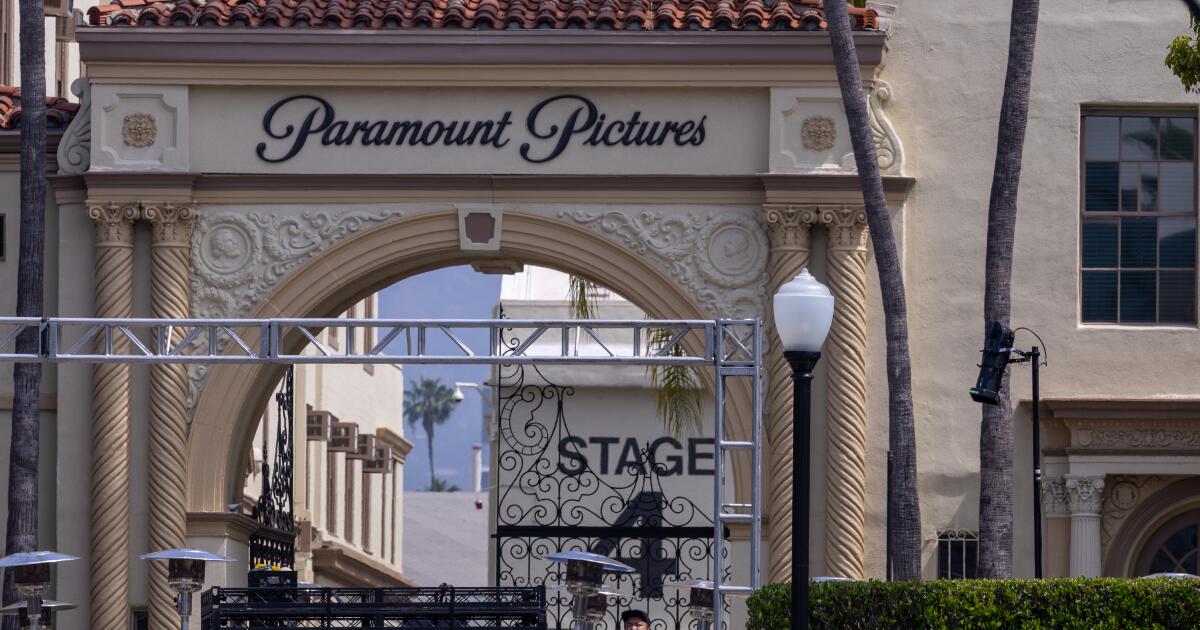
British authorities approve Paramount’s Warner Bros. deal
British regulators on Thursday cleared tech scion David Ellison’s $111-billion deal to buy Warner Bros. Discovery — the latest international agency to find the blockbuster combination of TV channels and historic film studios wouldn’t dampen competition.
Britain’s Competition and Markets Authority and the government’s culture minister separately reviewed Paramount Skydance’s proposed Warner acquisition, which is facing significant turbulence in the U.S. as California Atty. Gen. Rob Bonta leads a coalition of state attorneys general who are battling to try to unravel the mammoth deal.
“The evidence shows that, after the merger, Paramount will continue to face sufficient competition in the various areas it operates in, including the production and distribution of films and TV content, the supply of children’s channels to pay-TV providers and the supply of streaming services,” the authority said in a statement.
Earlier this summer, Secretary of State for Digital, Culture, Media and Sport Lisa Nandy said she was weighing whether to intervene by launching an in-depth investigation into potential harms that could result from the proposed Paramount-Warner Bros. combination.
Nandy opted not to issue an “intervention notice” after striking an agreement with Paramount that provides “assurances and legally-binding commitments” that the company would not abuse its market clout.
The authority’s approval was significant because Paramount owns CBS News, children’s channel Nickelodeon and Channel 5, one of the largest over-the-air television broadcasters in the United Kingdom.
Warner Bros. Discovery owns HBO, CNN, Cartoon Network and TNT Sports, which broadcasts the Olympics, Champions League and Premier League soccer matches.
Ellison and his team now have won clearances from 66 antitrust regulators, including the U.S. Department of Justice, and regulators in Australia, Germany, France, Italy, China and Canada, among others. The European Commission also approved the deal last month.
“These clearances recognize that the combination of Paramount and WBD will enhance consumer choice and enable a creative-first company to invest in more projects and bring stories to audiences worldwide,” Paramount said in a statement.
Still, the deal is stalled in the U.S.
Bonta and his fellow Democrat state attorneys general have won early victories in their court battle, and a federal judge this week scheduled a March trial — months later than Paramount had hoped — to determine whether the merger would violate the century-old U.S. Clayton Antitrust Act.
Paramount is facing a June 4 deadline to finalize the deal or pay Warner a $7-billion break-up fee.
Bonta and the 11 other state attorneys general, including from New York, Colorado and Oregon, have alleged the merger of two major film studios would give Paramount-Warner Bros. more than 25% of the wide-release theatrical film market. Their lawsuit contends the combined company would own too many cable TV channels — more than 50, including CNN, TBS, HGTV and Comedy Central.
The Writers Guild of America has separately sued to block the transaction, claiming the combination of two historic studios would reduce opportunities and pay for writers.
Ellison, in a guest essay this week, blamed politics for the U.S. friction. “The issue is whether I can be trusted as a steward of Warner’s CNN,” Ellison wrote in his op-ed in the New York Times.
Bonta, in a recent interview with The Times, denied his lawsuit was motivated by politics, saying it was a “meat-and-potatoes” antitrust case.
More than 5,000 entertainment industry workers, including such high-profile stars as Jane Fonda, Ben Stiller, Bryan Cranston and Mark Ruffalo, signed an open letter early this year, calling on Bonta to thwart the merger. The group alleged the transaction would weaken Hollywood with “fewer opportunities for creators, fewer jobs across the production ecosystem, higher costs, and less choice for audiences.”
Britain’s competition authority found the combined company would still encounter competition from Universal Pictures, Disney and Sony Pictures Entertainment and “a range of other smaller studios.”
In addition, the CMA factored in the competition brought by streaming services to traditional forms of movie and TV distribution — one of Paramount’s key arguments.
“Paramount is grateful to the CMA for its constructive engagement and its review of the transaction,” Paramount said in its statement. “These conclusions further demonstrate the misguided and gerrymandered market definitions relied upon by the US state AGs in their antitrust complaint in California.”