Brilliant

‘Every Brilliant Thing’ review: The interactive Daniel Radcliffe

What makes life worth living? For hard-core “Harry Potter” fans with money to burn, it might be getting Broadway tickets to interact fleetingly with Daniel Radcliffe in “Every Brilliant Thing,” an ingenious and touching solo performance piece written by Duncan Macmillan with Jonny Donahoe on the subject of suicide — or more precisely, on the ordinary joys that militate against such a drastic step.

Radcliffe was breathlessly scampering up and down the aisles of the Hudson Theatre before the show began, enlisting audience members to be participants in the play. Having seen “Every Brilliant Thing” twice before, once at the Edye (the black box at Santa Monica’s BroadStage) starring Donahoe in 2017 and once at the Geffen Playhouse’s intimate Audrey Skirball Kenis Theater starring Daniel K. Isaac in 2023, I knew exactly what he was up to.

The play revolves around a list that the narrator began at the tender age of 7 after his mother first attempted suicide. While she was still in the hospital, he started compiling, as much for her benefit as for his own, sources of everyday happiness.

Ice cream, water fights, kind people who aren’t weird and don’t smell unusual. These items are given a number, and audience members assigned a particular “brilliant thing” are expected to shout out their entry when their number is called.

The list gradually grows in complexity as the narrator gets older. Miss Piggy, spaghetti bolognese and wearing a cape give way to more sophisticated pleasures, such as the way Ray Charles sings the word “You” in the song “Drown in My Own Tears” or the satisfaction in writing about yourself in the second person.

Music plays a prominent role in “Every Brilliant Thing,” which was adapted from a monologue/short story Macmillan wrote called “Sleeve Notes.” The narrator’s terribly British father takes refuge from the emotional storms of his household by listening to jazz records in his office. John Coltrane, Cab Calloway, Bill Evans, Nina Simone are favorite artists, and the narrator can tell his father’s mood simply by the record he’s decided to play.

The production, directed by Jeremy Herrin and Macmillan, involves every level of the Hudson Theatre. I assumed I would be safe, occupying an aisle seat in the murderously expensive prime orchestra during a press performance attended by critics. But I wasn’t flashing a pad as my colleague across the aisle from me was doing to ward off any intrusions. And just before the show was about to start, Radcliffe was suddenly kneeling beside my seat asking if the person I was sitting with was my partner.

I told him that we weren’t a couple, just friends, and that I would be the worst person he could possibly ask to perform anything. But Radcliffe wasn’t so easily put off. “Let’s just say that you’re an older couple who have been together for some time,” he whispered. “And all you have to do is hand me this box of juice and candy bar when I refer to the older couple.”

OK, what harm could there be? Little did I know that “older couple” was to become “old couple,” a term that seemed to be repeated incessantly, at least to my Gen X ears not yet accustomed to scurrilous millennial attacks! I composed myself by pretending that we were in the world of anti-realism. But in truth, I would like to be the kind of person who would offer an anxious kid in a hospital waiting room a juice box and a candy bar, so maybe the casting wasn’t so far-fetched after all.

Daniel Radcliffe in the Broadway production of "Every Brilliant Thing."

Daniel Radcliffe in the Broadway production of “Every Brilliant Thing.”

(Matthew Murphy)

A theatergoer was called upon to play the vet who euthanized the narrator’s childhood pet, a dog named Indiana Bones that was symbolized by a coat someone volunteered from the audience. It was the boy’s first experience of death, a difficult concept for a young mind but an important precursor for a boy not given the luxury of existential innocence.

Other audience members, particularly those seated on the stage, played much more elaborate roles. One man, first invited to serve as a stand-in for the narrator’s father, was asked instead to play the boy. He was given one word to say in reply — “Why?” — as his father tries to explain the reason his mother is in the hospital. This same enlisted actor was later called upon to play the dad giving a toast at his son’s wedding, one of the rare occasions when he was able to summon language for the kind of deep feeling he would normally only be able to express through his records.

One kind and patient spectator conscripted to play the school counselor had to remove her shoe to improvise a sock puppet, one of the tools of her empathetic practice. Another audience member sensitively played Sam, the narrator’s love of his life, a relationship that reveals the long-term toll of being raised by a parent suffering from suicidal depression.

Radcliffe’s audience wrangling was as intuitively sharp as his deeply felt performance. He has the comfort of a good retail politician, who’s not afraid of making direct contact with crowds. Two-time Tony winner Donna Murphy, in the house at the reviewed performance, gamely went along when Radcliffe briefly enlisted her luminous services.

Obviously, Radcliffe is the main reason “Every Brilliant Thing” is on Broadway. The show, which began at Britain’s Ludlow Fringe Festival in 2013, is a gossamer piece, a 70-minute curio best experienced in close quarters without the high expectations and ludicrous prices of New York’s turbo-charged commercial theater. The Hudson Theatre lends a mega-church vibe to the proceedings, but the spirits of theatergoers are nonetheless moved.

A scruffy-faced Radcliffe, twinkling accessible geniality in jeans and a sweatshirt, zips up and down the cavernous theater as though waging a one-man campaign against the isolation epidemic. There’s no denying that Harry Potter has matured into an assured stage actor. His Tony-winning performance in “Merrily We Roll Along” should have put to rest any doubts, but the glare of his fame can still obscure his serious chops.

Sincere yet never smarmy, ironic without ever being cynical, well-groomed though far from swank, he’s a more glamorous version of the character than the one originated by Donahoe, the British comedian with an everyman demeanor whose portrayal seemed so genuine at the Edye that I mistakenly thought that the play was his personal story.

Donahoe’s performance was filmed for HBO, but “Every Brilliant Thing” is meant to be experienced in a theater. The whole point of the show is to transform the audience into an impromptu ensemble, a group of strangers emotionally united through the story of one young man’s intimate knowledge of suicide, a subject that Albert Camus called the “one truly serious philosophical problem.”

I’m of two minds about “Every Brilliant Thing.” I was moved once again by the piece, but I’m grateful I didn’t have to wreak havoc on my credit card to pay for my seats. I love the interactive, gentle humanity of the play, but I was also acutely aware of how the work has been commodified. I applaud Radcliffe’s willingness to carve an independent path as an actor, but I might have been more impressed by his adventurousness had he decided to perform in a pocket venue that didn’t have the tiers of pricing I associate with airlines.

Yet launching a conversation around mental health with an audience magnet as powerful as Radcliffe is on balance an excellent thing. And Radcliffe’s compassionate portrayal of a survivor recognizing that he’s not out of the woods just because he made it into adulthood is one of those things that makes a theater lover just a little more appreciative of the humanity at the center of this art form.

Source link

Holidaymakers say ‘really handy’ under £15 Amazon travel gadget is ‘brilliant for packing’

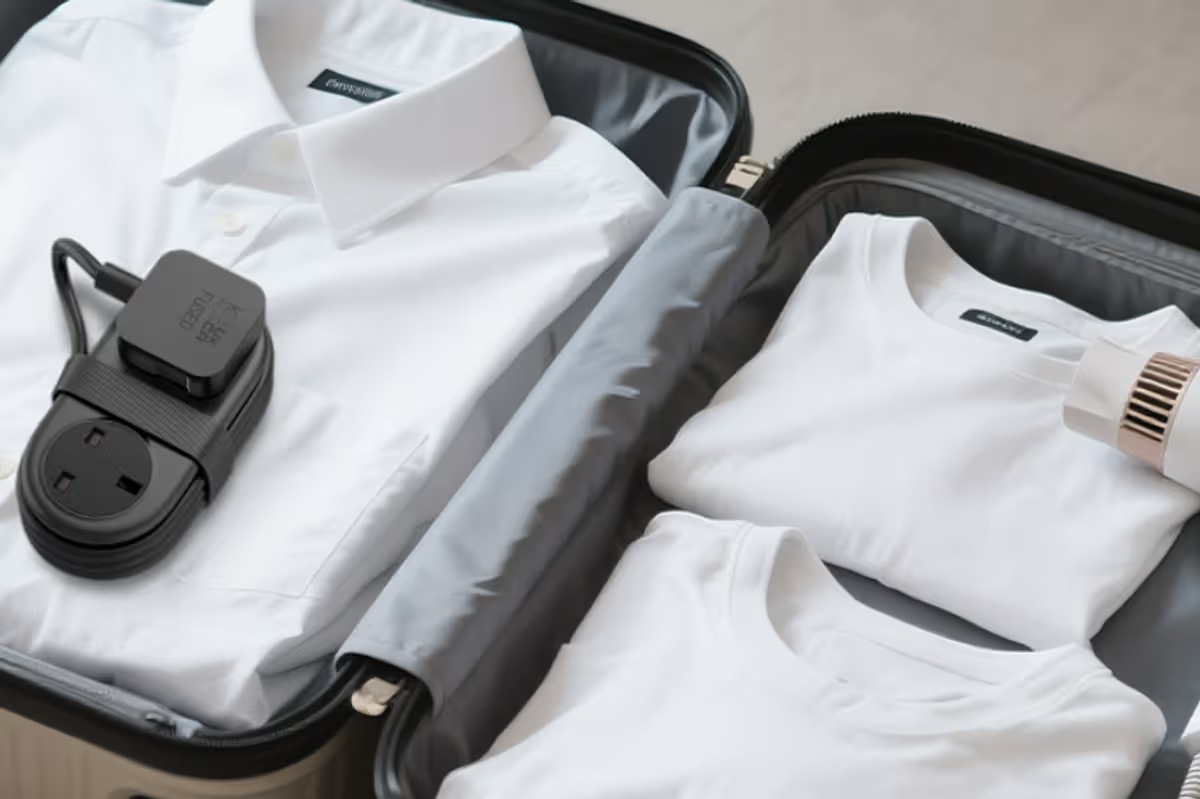
The ORICO small power strip is smaller than a mobile phone and features a wrap-around design that can fit into any package suitcase

For anyone who regularly travels, be it for work or pleasure, they’ll know the familiar frustration of arriving at a hotel room to discover there are barely any plug sockets – and the ones that do exist are often hidden behind beds, miles away from a mirror or in awkward corners. With most people now travelling with multiple devices, from phones and smartwatches to tablets, cameras and laptops, an extension cable has become a travel essential, and we’ve found one on offer for under £15.

For a limited time, the ORICO Travel Extension Lead has been reduced from £21.99 to £14.99 in the Amazon spring sale. Designed specifically with travel in mind, the small power strip is roughly the size of a smartphone and features a wrap-around cable so it packs neatly into a suitcase or hand luggage without taking up valuable space.

Despite its compact design, it still manages to offer plenty of charging options. The device includes two traditional plug sockets alongside two USB-A ports and a USB-C port, allowing travellers to power up to five gadgets at once. That means you can charge your phone, laptop, camera and other devices from a single wall socket without needing multiple adapters, especially if travelling abroad.

READ MORE:

One feature shoppers have praised is how flat it is, meaning it can fit into tighter spaces than traditional plugs. The staggered socket layout also prevents one plug from blocking another, making it easier to use every available port.

Safety features have also been built into the design, including protection against overheating, overcharging and short circuits, while the extension cord itself uses thick copper wiring designed to handle higher currents. The casing is also flame-retardant, adding an extra layer of reassurance when charging multiple devices overnight.

Orico Travel Extension Lead

Content Image

£21.99

£14.99

Amazon

Buy here

ORICO small power strip is smaller than a mobile phone and features a wrap-around design that can fit into any package suitcase.

For travellers looking for alternatives, there are a few other compact charging solutions worth considering. The Anker Tower Extension Lead is another popular option, offering a similar combination of standard plug and USB ports. However, this is more expensive at £29.99.

Meanwhile, the Belkin 8-Outlet Surge Protector Power Strip is £39.99 down from £44.99, with room for 12 plugs plus 2 USB-C ports – though no USB-A ports on this particular design.

Shoppers who have already bought the ORICO extension lead say it’s become a go-to travel accessory thanks to its size and practicality. One reviewer said: “Great travel pack! Comes with a really handy tie to keep the wires nice and neat. Two USB ports and two plugs, really good to charge all your devices on the move.”

Another wrote: “Very convenient and compact! I love how this wraps up perfectly for travel or for my work bag. I have had no issues with it, and all the ports work well. I use this to charge my MacBook Pro.”

Of course, not every experience has been perfect. One reviewer said their extension lead stopped working after several trips, though they added that the company rectified the issue. They said: “Bought it in July for travel use but stopped working in November after about four trips. Update: After posting my review, the company reached out and offered a refund or replacement.”

One said it was ‘brilliant for packing for holiday’, adding: “Took up little space. Had USB ports for all devices.”

Another shopper commented: “ It’s the best for travelling. My kids travel and I bought one for each of them. It also makes a good gift. Something people don’t think about but need. Most people have multiple devices to plug in and having one power strip is awesome! It is also the perfect size.”

Whether it’s the train station, airport, holiday home or busy cafe, this nifty extension cable has become essential for many who need plenty of power on the go, without needing to sit right next to a socket. Shoppers can find the deal here.

Source link

‘Scrubs’ revival review: A return to form with brilliant additions

Suddenly it feels like the 2000s again, with a revived “Scrubs” premiering Wednesday on ABC and Tracy Morgan reincarnating the spirit of “30 Rock” in NBC’s “The Fall and Rise of Reggie Dinkins” — network television shows, too, as in the days when streaming was just something tears and traffic did.

Beginning as a tale of new doctors at work and in love, “Scrubs” may also be seen as a looking-glass “Grey’s Anatomy,” although as “Scrubs” premiered first, it’s fairer to say that “Grey’s” is a straight-faced “Scrubs,” probably not a thought that ever crossed Shonda Rhimes’ mind. The show, then and now, combines a sentimental, satirical, soapy, sometimes surreal comedy with a straightforward medical show. Stars Zach Braff, Donald Faison and Sarah Chalke are back full-time, not quite in their old places, but arranged in close quarters, with Judy Reyes and John C. McGinley listed as recurring and other old faces slated to peek in.

The show left the air in 2010, after its ninth season, a virtual spin-off that has been declared noncanonical. The Season 8 finale saw protagonist, narrator and inveterate daydreamer J.D. (Braff), a person who really needs people — “I can’t do this all on my own” runs the show’s title song — looking into a happy future, married with a child to surgeon Elliot (Chalke). But that was just a dream, just a dream. The new season finds them at odds, and while a child is mentioned, it remains unseen, at least for the four episodes (of nine) out for review.

As we begin again, J.D. is working as a concierge doctor, tending to the minor ailments of the rich — cut toe, long-lasting chemically induced erection — when he’s drawn back to Sacred Heart Hospital to check on a patient. By the end of the first episode, his former mentor, the acerbic yet strangely sympathetic Dr. Cox (McGinley), will give him a job, of which is officially a spoiler to describe — even though it’s the premise of the show — noting his gift for teaching and reuniting J.D. with bromantic best friend Turk (Faison), the chief of surgery. (“Two chiefs!” is their chanted motto, followed by a special handshake. They are men who will be boys.) Turk is still married to head nurse Carla (Judy Reyes); they have four daughters, whom we do see, briefly. (J.D.’s appointment rankles Dr. Park, played by Joel Kim Booster, the series’ designated mean person.)

Moving into the space Turk, J.D. and Elliot occupied 25 years earlier are a new crop of interns, bringing youth appeal and naivete (the better to instruct them). Blake (David Gridley) is a cocky know-it-all, who will become a less cocky know-it-not-all; Asher (Jacob Dudman) is British, insecure and attracted to Amara (Layla Mohammadi), who is homeschooled (“I almost won prom queen twice but my brothers voted for my mom”) and a fan of Sam (Ava Bunn), a social media star who hangs her hands like Alexis Rose. Dashana (Amanda Morrow), the serious one, who sees Turk as an ally: “You’re, like, the only Black surgeon in this place; the rest of them just got, like, Coldplay on loop in the ER and say things like, ‘You’re so articulate.’” (“This brother likes Coldplay, too,” says Turk, pressing play on “Clocks.” Another lesson learned.)

As before, the show is fast-paced, packed with asides and ironic cutaways, with jokes riding on the back of jokes and some unexpected slapstick (the best kind), though it will shift into a lower gear when something capital-I important needs to be said. The world has changed in 16 years (“I am now supposed to watch every word that comes out of my mouth because apparently they are all fragile little Christmas ornaments,” grumbles Dr. Cox) and so the risqué material is left to the older characters, though the sex jokes now mostly amount to lack-of-sex jokes. (“She used to get worked up by ‘Bridgerton,’” Turk says of Carla, “but the new season doesn’t come out for another year.” “Spring 2027,” nods J.D.) Monitoring behavior is Vanessa Bayer as Sibby, a tightly wound administrator with an effortful smile, whom Turk calls “the feelings police.” (A longtime favorite of this department, Bayer is a brilliant addition. Told that Tarzan is a fictional character, Sibby replies, “I wouldn’t be so sure. They did make a movie about his life.”)

They say you can’t go home again, but with a good map and a good crew you can get pretty close. Not every bucket drawn up from the well of old IP will prove potable, but it often has: “Arrested Development,” “Veronica Mars,” “Party Down,” “Roseanne/The Conners,” “Frasier,” even “Dallas.” “Twin Peaks: The Return” is, of course, a work of art. Under the watchful eye of creator Bill Lawrence — later to co-create “Ted Lasso,” which is coming back for a fourth season even though it really ended after the third — with Aseem Batra, who wrote for the original series, as showrunner, it is very much the sitcom of old, older. (But everyone still looks good.)

There will undoubtedly be some who find nits to pick, but it’s hard to imagine any less-than-obsessed fans unhappy with this lagniappe, apart from its comparative brevity. And references to the original run notwithstanding — appletinis, “Star Wars,” a certain closet — it’s intelligible and funny on its own terms , and as full of love as ever. “When this work makes you fall apart,” says J.D., narrating, “someone is there to patch you up.”

New viewers will not be shut out.

Source link