“The Bride!” is a maniacal assemblage of ’30s musicals, ’40s noirs, 19th century literature and 21st century ideology. Every wacky second, you’re well aware how perilously close it is to falling apart at the seams. This spiritual sequel to “Frankenstein” is a romantic tale of obsession, possession and fantasy — adjectives that also apply to its filmmaker, Maggie Gyllenhaal, who expends massive quantities of energy jolting it to life. She succeeds by the skin of her teeth.
The monster’s missus comes with as much narrative anticipation as Godot. Mary Shelley’s 1818 novel has Dr. Frankenstein bicker with his creature about her potential existence before deciding against it in fear that “she might become ten thousand times more malignant than her mate.” Over a hundred years later, the debate continued, raging through nearly all of 1935’s “Bride of Frankenstein” which finally introduces Elsa Lanchester and her sky-high bouffant five minutes before the end credits, just enough time for her to make an iconic impression before her arranged husband blows them both to smithereens. Boris Karloff laments, “She hate me.” Lanchester’s Bride never speaks and quite possibly never knows what is happening to her at all.
Gyllenhaal’s empowerment story, meanwhile, feels like an unhinged scream. Jessie Buckley (who starred in Gyllenhaal’s debut, “The Lost Daughter”) tackles the dual roles of the Bride and Shelley, a hat tip to Lanchester, who did the same thing. The action starts in Shelley’s grave where she’s spent centuries seething about the sequel she never dared to write, then cuts to an American nightclub, where her spirit suddenly possesses a drunken strumpet named Ida (Buckley) — not smoothly but herky-jerky, with the angry author causing this gangster’s moll to go on the fritz. Her accent alternates mid-sentence from city gal to snidely British, Ida loudly accusing a mob boss of murdering women. She’s right and she’s next.
Our setting is 1936 Chicago, but this is an exaggerated, fictional world, not ours or even Karloff’s. Elsewhere in town, the original creature, played by Christian Bale, has lurched here from Austria still on his lonely quest for companionship. (For simplicity’s sake, he goes by Frank.) He begs the ethically gray Dr. Euphronius (Annette Bening) to help him finally experience what he chivalrously calls, “a garden of pleasure.” The blunter and crasser Euphronius asks if Frank has a specific shape of mammaries in mind. (Her maid, played by Jeannie Berlin, is a riot.)
This Bride comes alive roughly and rudely not having given her consent either. Regardless, now that she’s here, she still has to figure out her next move, with or without Frank, and often without key pieces of information. Frank has convinced her she’s an amnesiac. Also, somehow, she doesn’t even know that she’s dead.
The theme is, of course, a woman’s right to choose. But what’s interesting about Gyllenhaal’s approach is that she expands Ida’s options beyond an enthusiastic yes and a priggish no into a dim sum menu that includes a dubious yes, an asterisked yes and a no that rejects even having to answer the question. She also overuses Bartleby the Scrivener’s line, “I would prefer not to.” I would prefer not to hear that quote a dozen times in two hours, but neither I nor the Bride get exactly what we want.
A perversity in the script is that Frank is a manipulator and a gaslighter but overall a pretty good dude. Their bond is messy and thrilling, with one of the most delightful romantic montages in ages. There’s a great scene where Frank exposes his unbeating heart to her and gets rejected, yet he laughs with delight because the Bride’s stubborn spirit is exactly what he likes about her.
The Bride also looks dynamite in her bias-cut coral dress and peekaboo black lace bra. Her zapping turns her entire head of hair — not just a streak — shocking white à la Jean Harlow, and leaves an oddly-appealing black blotch on her cheek. It’s a fabulous look, at once sexy and frightful, with an element of cartoonishness as the movie sends her speeding around the country pursued by gangsters and the police, changing stolen cars but never her clothes.
The movie makes no secret of its phony mechanics. In one scene, the Bride is the most famous outlaw in America; in the next, a cop doesn’t recognize her at all. There are several moments that force you to accept that the characters can become psychic at will, including one where Frank somehow mind-controls a party to dance the jitterbug — heck, we almost believe that he invented it — and the smart move is just to give in and enjoy the number.
Whatever Gyllenhaal wants to do, she does, which becomes its own act of captivation and reckless empowerment. It helps that Buckley and Bale are terrific, as is the ensemble at large. The full force of Lawrence Sher’s cinematography, Karen Murphy’s production design and Hildur Guðnadóttir’s orchestral score is fabulous, combining to make something seedy, moody and extravagant.
Gyllenhaal’s love for other variations of this story is right up there onscreen with brash callbacks to Mel Brooks’ 1974 “Young Frankenstein” and the underrated “Frankenhooker.” Yet “The Bride!” isn’t just assembled from her passion for those movies. It seems to be made of every movie: a wild and playful and overbearing ambulation of references.
Almost every role is a Frankencharacter of the director’s cinematic obsessions, like Penelope Cruz’s lady detective who is named for “The Thin Man’s” Myrna Loy, acts like “His Girl Friday’s” Rosalind Russell, and dresses like Barbara Stanwyck in “Double Indemnity.” I suspect that Gyllenhaal’s favorite movie might be the same as my own, the bitterly nostalgic ’80s-does-’30s Steve Martin musical “Pennies From Heaven.” Watch it and tell me if you agree and even if you don’t, at least you’ll have seen one of the greatest films of all time.
There’s a scene in which Frank meets his own idol, an alt-world version of Fred Astaire (played by Gyllenhaal’s brother Jake, who is good at mugging and singing), and vomits his fandom at him until the actor recoils. The intensity of devotion can feel a bit like that. It also exposes that our culture is ready for its own shock of invention. Shelley spawned the entire genre of modern science fiction; today’s talents often feel like remix artists.
Like the mad scientists she’s sending up, Gyllenhaal goes too far. She triply underlines her feminist themes and nearly sabotages her own clever creation. Ironically, she doesn’t trust the audience to think for itself either. The overkill hits its nadir when the Bride repeatedly wails the survivors’ hashtag, “Me too!” But grab a scalpel and cut 10 minutes out of it and “The Bride!” would be a rip-roaring dazzler. This monster is more than alive, it’s allliiiiiive.
‘The Bride!’
Rated: R, for strong/bloody violent content, sexual content/nudity and language
It starts with the exclamation point, right there in the title. “The Bride!” is a wild, willfully over-the-top double-barreled reinvigoration of 1935’s “Bride of Frankenstein” that is always doing something a little extra in telling its unpredictable story of identity and the reclamation of the self.
“I probably can’t definitively explain it,” says writer-director Maggie Gyllenhaal about that punctuation. “I think I first just put it there and wondered when someone was going to tell me to take it away. And nobody ever did.”
Set in a dreamscape 1930s — imagine a steampunk-meets-art-deco version of “Bonnie and Clyde” — the film features a title performance by Jessie Buckley in three roles, sometimes in conversation with each other. First, there’s Ida, a Chicago party girl who is killed when she becomes an inconvenience to powerful men. Then there’s “Frankenstein” author Mary Shelley, taking possession of another person’s body and voice.
Finally, there’s the Bride herself, the rebellious, reanimated corpse of Ida brought back to life as a companion to a creature here known as Frank (Christian Bale). The duo sets off on a lovers-on-the-run-style crime spree that captures national attention.
On a February Los Angeles morning, Gyllenhaal moves briskly across the lobby of a low-key-chic hotel, barely breaking stride to ask that, instead of a discreet celeb-friendly indoor corner table, perhaps our interview could take place on an outdoor patio. She would like to take in a bit more California sunshine before returning home to wintry Brooklyn.
Dressed in a baggy suit that is both sharp and casual, Gyllenhaal doesn’t come across as particularly fussy but, rather, as someone certain of what she wants, even if what she wants is to explore the messiness of uncertainty, pushing the edges for herself and her collaborators.
Jessie Buckley in the movie “The Bride!”
(Warner Bros. Pictures)
Take, for example, that exclamation point. What might at first seem a bit of preciousness, and which even Gyllenhaal initially makes seem a bit of a throwaway, reveals itself to have a much deeper meaning.
“It wasn’t that it was careless,” Gyllenhaal says with a calm focus. “If you are Ida or Mary Shelley or many women in the world and you’ve been sort of tamped down and silenced and not able to express everything it is that you wanted or needed to express, it’s like if you’ve had your hand on a geyser. When the geyser finally breaks, it’s going to break with a whole lot of extra energy. And maybe that’s where the exclamation point comes from.”
“The Bride!” is the second feature film as writer and director for Gyllenhaal, 48, following 2021’s “The Lost Daughter.” That movie, a bracing examination of the psychological toll of motherhood, would go on to wide acclaim and awards recognition, including Oscar nominations for actors Buckley and Olivia Colman, as well as for Gyllenhaal’s screenplay (an adaptation of the 2006 novel by Elena Ferrante). Prior to that, Gyllenhaal had been known for emotionally fearless performances in films such as “Secretary,” “The Dark Knight” and “Crazy Heart,” for which she received a supporting actress Oscar nomination.
Deciding how to follow up “The Lost Daughter” wasn’t easy. Gyllenhaal says she went to a party and saw someone with a tattoo on their forearm of Elsa Lancaster‘s intense gaze from “Bride of Frankenstein.” Taken with the image, Gyllenhaal checked out the movie and was surprised to discover Lancaster’s iconic character was only in it for a few minutes. After reading the original novel of “Frankenstein,” she started to wonder whether Mary Shelley had other things on her mind at the time of her debut novel.
“I just had this fantasy,” she says with a slightly conspiratorial air. “I’m not speaking for Mary Shelley, but there must have been some other, naughtier, wilder, more dangerous things that Mary Shelley wanted to say that weren’t said in ‘Frankenstein.’ What else might she have wanted to express?”
Christian Bale and Jessie Buckley in the movie “The Bride!”
(Warner Bros. Pictures)
And so Gyllenhaal set about writing, with her “Lost Daughter” star in mind for the lead, though she initially didn’t tell Buckley. One of Gyllenhaal’s biggest learning curves in directing “The Lost Daughter” was figuring out how to speak to each actor individually to get the most out of them.
“With Jessie, I just spoke to her like I speak to myself,” Gyllenhaal said. “No translation needed.”
Reached via email, the “Hamnet” star evokes a Frida Kahlo painting to convey their closeness.
“We share two beating hearts,” Buckley says. “Maggie has absolutely been instrumental to waking me up to a part of myself I needed to know — and I think vice versa. We share a similar language and curiosity.”
Moving from the intimate scale of “The Lost Daughter” to the expanded scope of “The Bride!” was exciting for them both.
“I loved seeing her in a bigger sandpit,” Buckley says. “From ‘The Lost Daughter’ it was clear that Maggie had something to say as an artist. But where do we grow? What’s the scarier place? What are the questions we might whisper to ourselves? And what happens if we put those whispers into the ether?”
Gyllenhaal’s new film is unafraid to risk being too much. One extravagant party turns into a musical sequence that finds Bale’s creature singing and dancing to “Puttin’ on the Ritz” — a wink to a whole other self-aware frame of reference and Mel Brooks’ satirical 1974 “Young Frankenstein.”
“Sometimes it was too much too much — that’s the line I was trying to walk,” Gyllenhaal says. “I think so many women are told that we’re too much, over and over again, from the moment we get here. And so I’m used to that.
“But I think that scene is sort of about that. It’s about a kind of explosion of life and humanity. So much of the movie is about these people who cannot fit into their box. This is where they celebrate their bigness, their too-muchness, their monstrousness. That’s the monster mash: ‘I am who I am.’”
“Sometimes it was too much too much — that’s the line I was trying to walk,” Gyllenhaal says. “I think so many women are told that we’re too much, over and over again, from the moment we get here. And so I’m used to that.”
(David Urbanke / For The Times)
Making a purposefully idiosyncratic retelling of a classic tale came with its own challenges. “The Bride!” was originally scheduled to be released by Warner Bros. last fall, on the date that would eventually go to “One Battle After Another.” When a rescheduled March 2026 opening was announced, there were reports — “Beware ‘reports,’ ” Gyllenhaal tells me, wryly — of behind-the-scenes clashes between the director and the studio.
Gyllenhaal doesn’t deny that, to find the final version of the movie, she worked closely with Pam Abdy, who, along with Mike De Luca, is co-chair and co-chief executive of Warner Bros. Motion Picture Group. This time the stakes were higher, the filmmaker says, and being left to her own devices, as she had been on “The Lost Daughter,” wasn’t always the best solution.
“If I make a big, hot roller coaster of a movie and remain totally honest in what I’m trying to explore and think about inside it, will people respond? That was my question,” she says. “And then I cut it in a way that was entirely my expression. And I have to say in particular, Pam, who was my point person on this and also has become a friend, she really took me to task on that and said, ‘You want many people to respond and understand this. You have to clarify here and here.’ ”
Though Gyllenhaal admits there were moments of “friction” and that Abdy “has a slightly different agenda than I do,” she now sees the merit in the process. “Something really alive was born, and I think the movie is better for the work that she and I did together,” Gyllenhaal says. “I know that’s an unusual thing to say. I know that you have lots of people saying like, ‘Ah, the studio f— my movie up.’ That is not my experience. It’s really not.”
In a phone interview, Abdy says, “Listen, she tasks me with challenging her, and I task her with challenging us. We’re all in the service of making the best movie we can possibly make for the audience. And we, privately, all of us — studios, directors, filmmakers — we go through a process. It’s unfortunate that certain people choose to assume they know what’s happening in those rooms. But they don’t.”
Abdy describes their collaboration as a healthy and normal one. “You test the movie, you get information, you make adjustments,” she says. “And we needed the time and space to do that.”
Maggie Gyllenhaal, right, on set with Jessie Buckley and Christian Bale while making “The Bride!”
(Warner Bros. Pictures)
The courage Gyllenhaal once exhibited as a performer now seems to be serving her as a filmmaker. The last feature Gyllenhaal appeared in as an actor was 2018’s “The Kindergarten Teacher,” playing an overzealous mentor to a young poetry prodigy. She also appeared in three seasons of the HBO series “The Deuce” from 2017 to 2019, in which she played an adult film performer struggling to move behind the camera into directing.
As to whether she will return to acting, Gyllenhaal says, “I don’t know. I really prefer directing. This is a better job for me.”
Better how? “I felt as an actress, to be honest, like I always would hit up against a wall of how much I was able to participate or express,” she says. “And I thought for a long time, OK, this is the gig, and what I have to do is learn how to protect self-expression, even if that means I just need a tiny bit of space around me where I have the real estate to do what I need to do as an actress.
“And then when I moved into writing and directing, I didn’t have to play that game anymore,” she says. “And also I could create an environment where nobody had to play that game. Anyone could explore and express the things that were interesting to them. It was ultimately up to me to decide if I wanted to use them or not. So why not let people explore and surprise me?”
Gyllenhaal’s “The Bride!” may catch the same current wave of pop-inflected Gothic-style romances as Emerald Fennell’s “Wuthering Heights” and Guillermo del Toro’s “Frankenstein.” A catchphrase that emerges in the film is “brain attack,” the Bride becoming a folk hero to women around the country who emulate her distinctive look: Jean Harlow by way of Courtney Love with an inky smear of makeup across the face.
There is something intuitively catchy about brain attack, even if it’s also a little bewildering.
Gyllenhaal remembers an “aspect of terror” about stepping into a bigger studio release. “So do most things that require that you really grow and learn in order to do them. But I’m interested in terror and so I guess I was playing around with the idea of heart attack, panic attack. And I think in order to really do that, some brain attacks are required.”
Gyllenhaal tells me how a few days earlier she had been wearing a hat with the phrase on it while reading by the hotel pool and three 20-something women, maybe a little day drunk, began asking her about it. Two of them seemed puzzled by the phrase, struggling to parse out its meaning, while the third instinctively got it. She just knew. So Gyllenhaal gave her the hat.
“I guess ‘brain attack’ is a phrase you might have to feel,” Gyllenhaal offers, her mouth widening into a smile.
So too, perhaps, with Gyllenhaal’s telling of “The Bride!” with its visions of reckless abandon and personal reclamation — exclamation point and all. It will become a movie waiting for those who need it.
Despite Linda Carter and Max Branning sharing a kiss and his claims that he loves her – to his daughter’s disbelief – another woman seems set to become his new love interest
08:52, 19 Feb 2026Updated 08:52, 19 Feb 2026
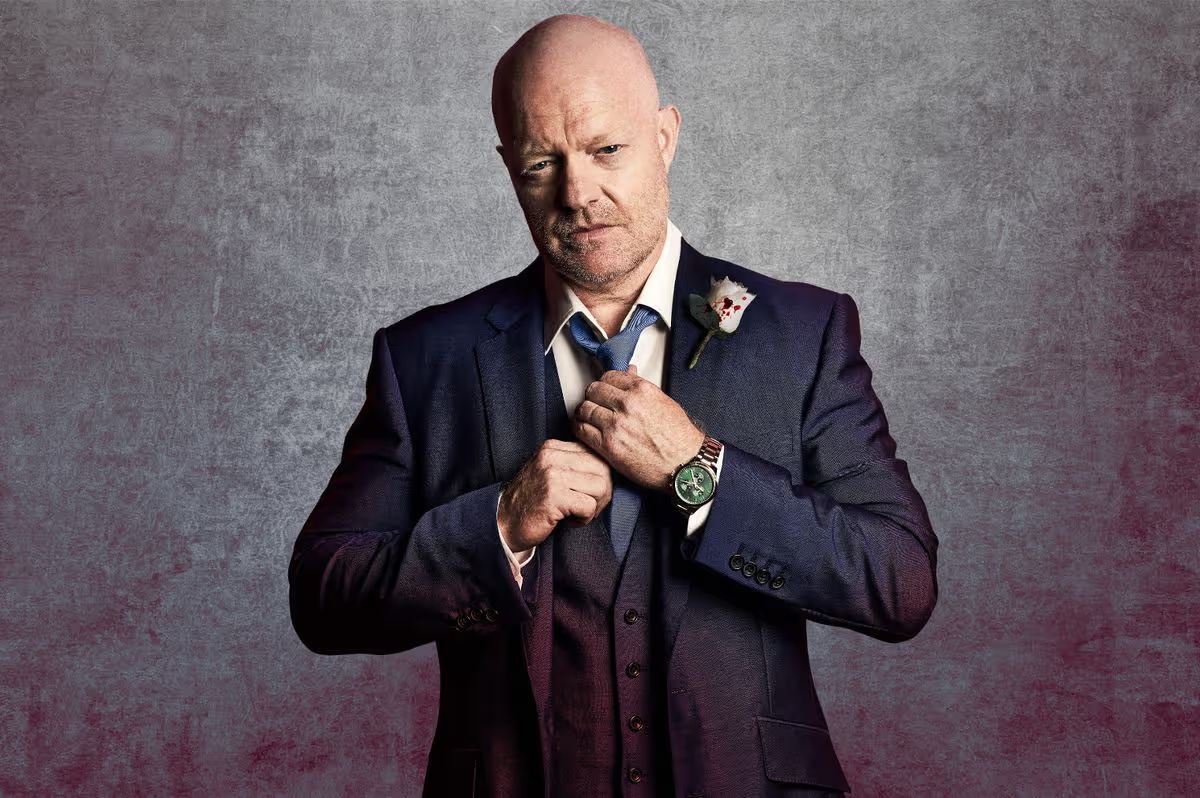
EastEnders fans ‘work out’ who Max’s bride is – and it’s not Linda(Image: CREDIT LINE:BBC/Kieron McCarron)
The Walford Womaniser has struck again! While Max Branning seems convinced he’s in love with his ex Linda Carter, he’s found himself in another flirty interaction with a different woman has led EastEnders fans to say they know who his next love interest is.
Since he returned, many have thought Max (Jake Wood) might eventually marry his former flame Linda (Kellie Bright) in 2027. In the flashforward to next year, he was about to walk down the aisle to a mystery woman, and Linda was teased to be one of them.
But, during Tuesday’s episode (17 February), Max had a date with Linda that couldn’t be described as anything other than a disaster. For starters, Linda didn’t even know it was a date. When Max turned up with flowers and tried to kiss her, she firmly rejected him, leaving the worst philanderer in Walford to dejectedly lick his wounds.
The devastated Max then gave the flowers to Gina Knight (Francesca Henry), wishing her a happy birthday. The brief interaction had many thinking Gina would be the next woman added to Max’s long list of lovers.
“They’re gonna do max and gina as a couple,” said one fan. Another added: “I do think there’s something in Max giving Gina the flowers.” Others, though convinced that the show was hinting and a Max and Gina romance, were clear that they did not want it to happen.
Ensure our latest headlines always appear at the top of your Google Search by making us a Preferred Source. Click here to activate or add us as your Preferred Source in your Google search settings.
“I refuse to be in a reality where Gina and Max have a baby,” a fan said, referring to the pregnant woman seen in Max’s bed during the flashforward.
Another said: “Please for the love of god do not put Gina and Max together – he’s got form for younger women and Gina is already in a complex relationship with Harry after George and Nicola’s baby news. Gina can do better then him and he’s too much baggage for her.”
A third posted a TikTok where they pointed out that Max had previously had a relationship with Gina’s half sister Lucy Beale (Hetti Bywater) just before she died. At the time, Lucy was 21 and Max was not only 45, but her best friend’s father. The TikTok poster said: “Ewww were these scenes foreshadowing Max trying it on with Gina or something?
“Is that why Peter [Beale, Gina and Lucy’s brother] is p***ed off at him in the flashforward and why Cindy [Beale, their mother] didn’t look happy with him? As if getting with Lucy wasn’t bad enough…”
Max has been romantically linked to many women over the years and has a tendency to go for younger women. One of his major storylines in the late 2000s involved an affair with Stacey Slater (Lacey Turner), who was his own son’s wife.
Jake Wood, who plays Max, has previously said that he thinks Stacey is the love of Max’s life. When asked at a press event who Max’s true love is, Jake mentioned Tanya (Jo Joyner), the mother of three of his children, but settled on Stacey.
The actor said: “Obviously, Tanya is very high, but I think probably Stacey as well. I think we saw that when Max came back a couple of months ago. The connection is still really strong between the pair of them; they really understand each other. I think wherever they are in different parts or wherever they are in their lives, they’d always have that connection. So, if you asked Max, he would probably say Stacey.”