Love Story: Narciso Rodriguez talks about Carolyn Bessette-Kennedy’s wedding dress
As a child in Newark, N.J., Narciso Rodriguez was often transported back to Cuba by the stories from his family and their friends. He walked the halls of El Encanto, a Havana department store and fashion mecca on the island — one that drew in celebrity clientele and featured haute-couture designs and fragrances from the far-flung fashion capitals of Paris and Milan.
“I don’t know that they could have afforded any of those things when they were in Cuba,” he tells De Los. “But they certainly filled my imagination with beautiful stories and laid the foundation for my work.”
It was the women in his life — the “amazing, powerful, loud, colorful dynamos,” as he describes them — who inspired him to pursue a career in fashion.
“Their stories, their lives, their power, their curves, it all influenced me,” he says. “They’re the reason I wanted to create things.”
Over the last three decades, the renowned designer has earned a reputation for sleek, flattering lines and effortless shapes, most famously seen on the career-launching dress he designed for his friend Carolyn Bessette-Kennedy to wear on her wedding day. The bias-cut silk slip has remained a source of inspiration for generations of brides since, and has been making waves again thanks to the FX series “Love Story: John F. Kennedy Jr. and Carolyn Bessette.”

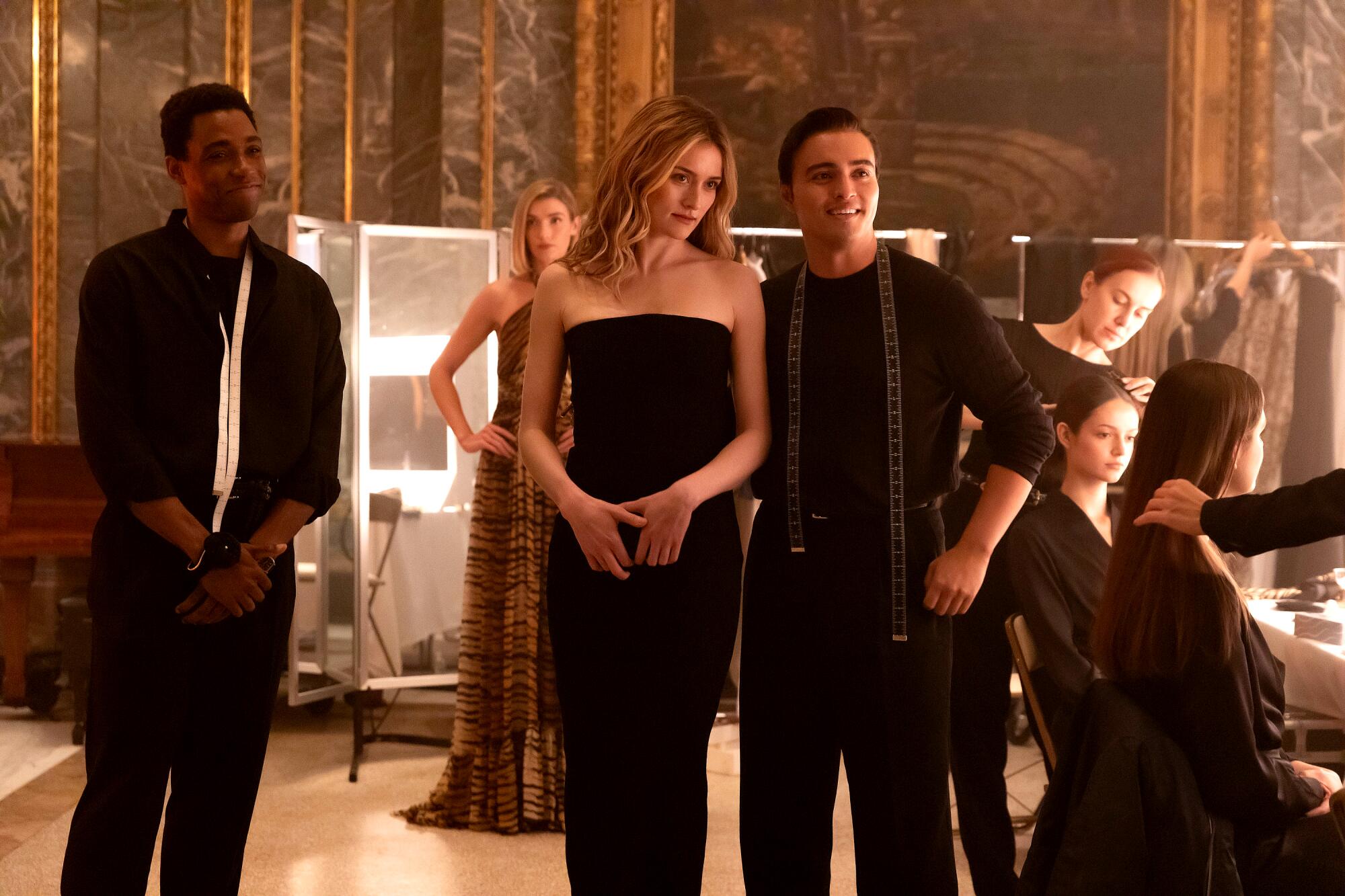
Omari K. Chancellor as Gordon Henderson, from left, Sarah Pidgeon as Carolyn Bessette, Tonatiuh as Narciso Rodriguez in FX’s “Love Story: John F. Kennedy Jr. & Carolyn Bessette”
(Eric Liebowitz / FX)
“Love Story” will follow the couple’s wedding in the latest episode, out March 5. (Rodriguez is portrayed by Tonatiuh on the show.)
After designing Bessette-Kennedy’s dress, Rodriguez launched his own label and a fragrance line, and has continued to create designs that are woven into the fabric of American history — Michelle Obama wore his dress on election night in 2008.
De Los spoke with Rodriguez about his career, upbringing and memories of designing Bessette-Kennedy’s dress.
You’ve spoken about how inspired you were by the women in your life growing up. Are there any “fashion icons” from your family or neighborhood that you could point to from your childhood?
You know, I’m so lucky because I was raised in a very Cuban household in a very culturally rich community in Newark. I mean, it was Italian, Spanish, Cuban, Puerto Rican, Black. It was everything. But I always think back to when I was very, very young, there was a kind of matriarch here in the neighborhood. Her name was Concha and she was kind of this lightning rod. My dad’s sister was married to her son, so when my parents came to the U.S., she gave them a place to stay. She would teach all of the young women how to cook and gave everyone a place to stay until they got on their feet. She was larger than life, she was like “Auntie Mame.” She had these great ‘60s beehive wigs in amazing wig boxes, she made these beautiful Chanel suits for herself, and had all these gold bangles, great lipstick and stilettos. When she came into the room, she just radiated power, joy and style. I always think of her as being my first signpost on the road.
They were all beautiful, you know? My aunts and my mom were the most beautiful, glamorous women. None of them were wearing designer clothes, but they took great pride and great care in how they looked, and that really made an impression on me.
How did that impression translate into a concrete passion? How did you go about actually pursuing a career in fashion?
I loved architecture. I loved building things, so I was always drawing, sketching and sculpting. Then I would see my mom take a piece of fabric and the way she could take something flat and shapeless and turn it into a garment was fascinating. By the time I was 13, I was doing fashion illustration, and I got a job in a tailor shop. Later, I enrolled myself in Saturday courses at Parsons [School of Design], and I kind of had to hide it from my parents at first. I felt like I couldn’t be a fashion designer, you know, because of the whole “macho” idea, but I just kept going. I was lucky that I was someone who always knew what they wanted to do, and that Parsons recognized I had talent for it at a young age.
I was exposed to really great people there, too. Donna Karan was a critic, Calvin Klein was a critic, Oscar de la Renta too. I got to do projects with all of them, and then I was hired after school by Donna Karan while she was still at Anne Klein. It was an amazing experience, and then I got poached by Calvin Klein, which was a very different experience.
How so?
It was incredible, but just very different. Whereas Anne Klein was this melting pot of creativity, Calvin was much more image-driven and precision-driven. He brought in great talents to collaborate with, so on any given day, you’d be working with the most amazing photographers, stylists and art directors. It was a really great finishing school as a young person.
You arrived at Calvin Klein during a period of reinvention for the brand. This was in the era of Kate Moss, and the famous “Marky Mark” print ads. We see a version of it in “Love Story,” but what was it like to actually be there?
When I got there, I think around 1989, it hadn’t really started to change yet. And I thought, “Wow, I made a really big mistake. This is not my aesthetic, not my thing.” But it changed very quickly, and it was very exciting. [Calvin] worked very hard. He was very focused, and he appreciated that I could keep up. Like everybody, there was a rough initiation period, but afterward, he gave me the opportunity to work on some tailored pieces that sold really well at retail, so I was rewarded with more opportunities.
But it was the ‘90s, and it was New York, and it was brilliant. It felt like the whole city was reinventing itself, and Calvin was a leader in that. All the best photographers, the most brilliant artists were there. Jacky Marshall, Zack Carr, Carolyn — the talent was endless. I was really fortunate to experience it and build friendships that were lifelong.
I’m curious if you remember your first impressions of Carolyn. How did you two connect?
We were quite friendly immediately, and then we became the best of friends. We lived in the same building, so the rest was history. You know, she’s an incredible person, and she had great style. She was bigger than life.
Carolyn has been regarded as a fashion icon, and especially now, everyone is trying to re–create her look. There was something more subtle and interesting going on than just “minimalist” fashion, so how would you describe what made her style so special?
Carolyn was so authentic in so many ways, and I think that she was very pragmatic about her choices. She had a great eye. She knew what worked for her, and she knew how to present herself. She never wanted to be uncomfortable. She was very connected to herself. I think so many people have this relationship to fashion and what they think they should look like based on the ideas they see in a magazine or being sold to you by the industry, and Carolyn never fell into that trap.
I have this conversation often with young designers, with people, with journalists. Today, everything that we see is inauthentic. Celebrities are paid to wear designer clothes. They’re styled by a stylist, and nothing is innate. That is the opposite of Carolyn. She was 100% real.

Narciso Rodriguez in 1997.
(Paolo Roversi)
We have to talk about her wedding dress. If you’re a bride, it’s impossible to look for inspiration without coming across her dress. What was it like to have a friend ask you to create something for such a special, important moment?
You know, until my children were born, Carolyn was the love of my life. We were very close, and she asked me, as you said, to make the dress that she would marry the love of her life in. It was very personal for me. It wasn’t a press event, it was a conversation between two people who were very close. I knew what looked good on her, she knew what looked good on her. I knew that she would never want to be bogged down with trains and lace. It wouldn’t be her.
What was the actual design process like?
It was an effortless collaboration. She came to fittings in Paris, we pulled the neckline down a bit lower, and the dress was born. I added the gloves, the veil and the shoe. It was just magical, and exactly the way it should be. It really made her the focus. You know, she was the one who pointed that out to me about my work. She always said, “You create a frame for a woman’s beauty and personality to shine through.” I’ve always thought that was a really beautiful thing that she gave me, because it’s true. I never want my work to be what you see first. I think the success of that dress is that you see her and her happiness and the purity of it all.
Everything about the wedding, including the dress, had to be kept a secret. Was it a challenge to make sure that no one knew what you were working on?
I was working in Paris, and I got approval from the owner of [Cerruti]. He was discreet about it. I worked with one pattern maker. I had a fit model who was lovely. Nobody knew who it was for. They always asked. But because I was working in Paris, they didn’t really connect me to her. I was also quite cautious when the dress was in work, I remember I had become quite friendly with Azzedine Alaïa. I asked, “Can I take this dress over to you and have you check it out to see what I’m doing?” I went over and he looked at the prototype, and said, “Why don’t you move this seam over the bum by a centimeter. I think it’ll be more flattering.” And I did, because he was the master, and he tortured me to know who it was for, but I never told him. Later, when it was all over the press, he would call and pretend he was a fancy lady looking for a wedding dress for her daughter. [Laughs] He tricked me a few times into believing some of his gags, but he was an amazing person.
It was just a magical time in all of our lives. And then I flew to America with the dress and went to the wedding, and it was that simple. You know, I’ve heard all these amazing stories about how the dress didn’t fit, and I had to sew her into it, and that she was hours late because of it, and none of this is true. But I love that people have made up all these stories.
Maybe the dress on her seems so effortless that people want to invent a way to complicate it.
[Laughs] I really have heard so many crazy stories, but when you look at the pictures, it certainly doesn’t look like it didn’t fit. That’s for sure.
As you mentioned, the dress was all over the press later. How did that moment impact your career?
Well, I went from Paris to my best friend’s wedding, and then I flew home to New York to do a pit stop at my apartment. When I arrived, there was a huge crowd outside the building with news trucks. I kind of walked through the crowd and into the building, and I said to the doorman, “What’s all that about?” And he looked at me, and he said, “They’re here to see you.”
Oh, wow.
It was a very big, kind of scary, unexpected change in my life. I remember going up to my apartment and trying to navigate that when Anna Wintour’s office called and said, “Anna would like for you to come to the Princess [Diana] benefit in Washington.” And I said I couldn’t go, I needed to be back in Paris, I didn’t even have a white shirt. And they said, “It’s Princess Di and Anna Wintour. You’re going. We’ll send you a shirt.” So I went, and I met Princess Diana, and it was really strange to be at such a big event and have so many eyes on me, because I didn’t expect that, and everyone was curious. I remember they were shady journalists trying to sit next to me and get information about where [John and Carolyn] went on their honeymoon. Life changed dramatically, but it brought great attention to the work that I was doing in Paris, and I was able to then go off and start my own business and do my own thing.
I’m sure you had an understanding through Carolyn about what it felt like to be hounded or followed by photographers and press, but did that firsthand experience in New York give you another layer of understanding for what she was going through?
It’s so funny because society today will do anything for that. But it was a very different time, and she was a very private person. I was a very private person. It’s very invasive, and I was kind of stuck in the middle, because while I needed to promote my work and my shows, and sort of be in the press, it wasn’t something that I was very comfortable with. I mean, I love doing the work more than I like the things attached to it. It can be debilitating, and it was difficult for me, but I adjusted, because I could hide behind my work, but as a private citizen, it was more difficult for her.

Narciso Rodriguez.
(Sølve Sundsbø)
You’ve been a part of fashion history on numerous occasions. Michelle Obama frequently wore your designs, but most famously, on election night in 2008, and then during her final appearance as first lady. How does it feel to have been a part of those moments?
It’s hard to put into words. You know, you spend so much time in it, and you have these amazing moments, like designing a dress that became legendary for brides, or getting to dress the first lady, and it wasn’t until COVID that I took a step back. I think about my mother and father coming here to give their son a chance to live out his dreams. And to have been able to sit with my friends on election night and watch her appear in my dress on such a historic moment — the first African American elected president of the United States — words fail. [Michelle Obama] is such an incredible human being who I admire so much, and to have been a part of that night, I feel so lucky.
I don’t talk about my work with my children, but the other day, when they were on the bus headed to school, they told one of their friends, “My dad went to the Obama White House.” They were proud of me. My parents’ dreams came true, and now I get to share that with my children. It’s very special.
It’s really powerful to hear you frame it that way — that these moments mean so much because of your experience being the child of immigrants. How does it feel to be in the midst of a revival right now?
It makes me want to create more. It means a lot to me that people remember these pieces, and that they’re still part of the conversation. But it also means a really great deal to me because I think it’s an important story to tell today. I think it’s important that young people hear that this kind of thing can happen to the children of immigrants, especially as I’m watching all of the horrible things happening to immigrants now.
I could never do what my parents did. When I think about it now, my parents were so much more successful than I could ever be, because they left behind their home for a cold climate, in a place where they couldn’t speak the language, and they really struggled for a long time before I was born. And now, the idea that we’re trying to take that opportunity away from people? It just blows my mind.
My parents faced so many hardships, their life wasn’t easy, but I can’t imagine if they had been put through what immigrants are put through today. I am the “American Dream,” right? I got the chance I got to do the work that I love and succeed because of them. I want that for everyone. I want that to be the world we live in.