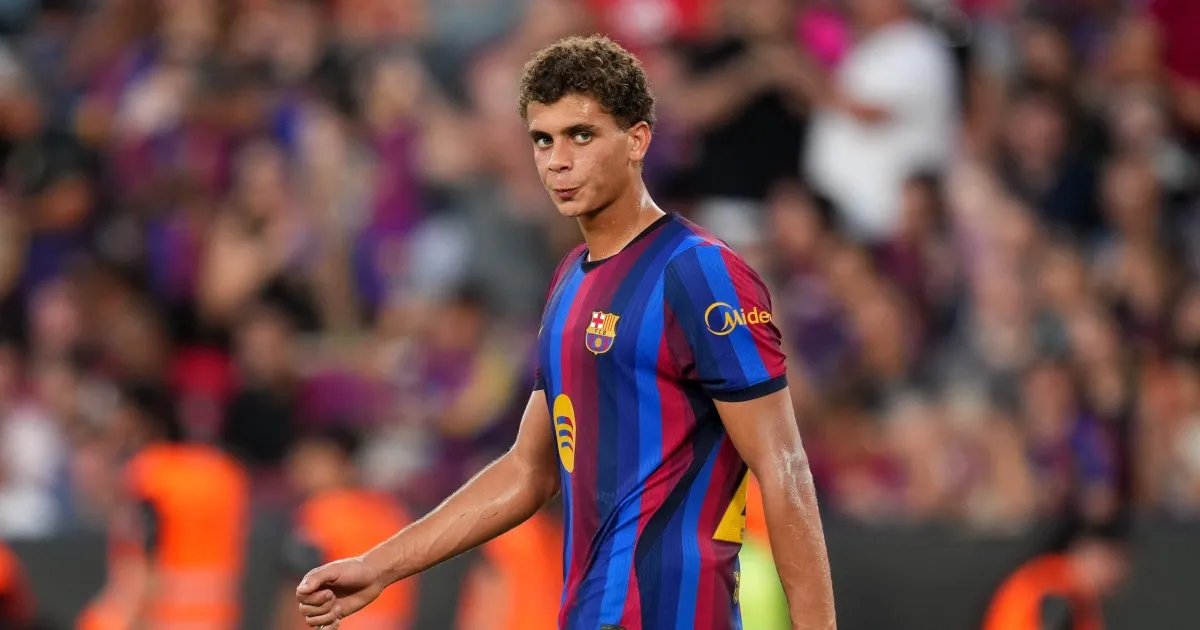
LAS VEGAS — The door opened for Arthur Kaluma to show his worth for the Lakers in the NBA Summer League on Saturday night.
He did so in a big way.
Kaluma had 34 points and five rebounds during the Lakers’ 91-70 win over the Dallas Mavericks at the Thomas & Mack Center.
He was 11 for 16 from the field and six for 10 from three-point range.
With Lakers rookie guard Cameron Carr unable to play because of a right thumb contusion, Kaluma took over the scoring role. Carr, the 24th pick in the NBA draft, is averaging 17 points per game.
“Cam doesn’t play tonight, so he gets a little bit more minutes, gets a couple more touches,” said Lakers Summer League coach Ty Abbott about Kaluma. “But he’s done a really good job of making the most of it when he doesn’t have actions run for him. So the way that he’s been able to stay ready, find windows for himself has kept him in a rhythm. So, on a night like tonight, when we can run some actions for him, he knocks them down and just plays out of his mind. It was great.”
Kaluma said he was “a little nervous” but his three-point shooting said otherwise.
“When [teammate] Jon Elmore came down and he pitched it back to me for a three … I just knew when it came off my hand it was cash,” Kaluma said. “So I said, ‘Yeah, I’m hot.’ It went on from there.”
Late in the fourth quarter, Kaluma lined up a three-pointer, setting his feet and scoring from 29 feet out. He flashed three fingers and smiled. His teammates on the bench stood and cheered, as did the fans.
“We have such a great group of guys this year at Summer League and going through this it’s hard to get that camaraderie with a group,” Kaluma said. “But I feel like everybody wants to see everybody succeed and I felt that tonight. I’m not going to lie to you. They tell me to shoot the ball. I passed up a couple of shots and they were mad at me the other day.”
Kaluma played for the South Bay Lakers in the G League last season. He averaged 14.6 points per game, 4.9 rebounds and shot 55% from the field, 37% from three-point range.
“The G can get grimey, you know what I’m saying? It’s a time where everybody is trying to fight for a position and there is a certain hunger that you have to have in order to be successful in the G,” Kaluma said. “And I feel like that drive that I had my first year in it pushed me into this summer to really get better and work on my game and come here and have the opportunity to perform.”
Kaluma wasn’t alone in helping the Lakers improve to 2-0 in Summer League play.
Adou Thiero ran the court, took a lob pass from Chris Mañon and threw down a two-handed dunk. He had another solid outing with 15 points and four rebounds. He shot just four for 12 from the field, but was a plus-15.
But the night belonged to Kaluma.
“I pride myself on the defensive end,” he said. “I know I got hot offensively, but the shot was just falling today, you know what I’m saying? My game is three-and-D. I lock-up on defense and I know I can hit open shots. I just got hot today and I’m not going to try to let it get to my head.”
At this year’s Sundance Film Festival, filmmaker William D. Caballero won the NEXT Special Jury Award for Creative Expression for his intensely personal, multimedia feature debut, “TheyDream.” During his acceptance speech, he made a powerful statement.
“In case ICE were ever to harm me or kill me, this film will serve as the truth of who I am, and who my family is, before Fox News or this administration ever makes us out to be the villain[s],” he recalls paraphrasing during a recent interview.
Blending live action footage with different animation techniques — as well as the 3-D-printed miniatures that have been a fixture of Caballero’s work for more than a decade — “TheyDream” honors the filmmaker’s Puerto Rican loved ones, particularly his mother, Milly.
She collaborated with him in the making of this one-of-a-kind portrait of loss, resilience and shared healing. Their heartfelt exchanges throughout this process are also shared on-screen.
“Seeing her light up and become transformed throughout was just invigorating, because it allowed us to talk about heavy things and bond throughout the process of creating a story that’s personal [for us] both,” Caballero says. “It’s like, ‘Let’s guide each other and instead of me taking your stories and making magic with them, let’s make this magic together.’”
The brilliantly unconventional piece of autobiographical storytelling will screen as the closing night film of the Los Angeles Latino International Film Festival (LALIFF) on Sunday. Recently, John Leguizamo and Ben DeJesus joined the film as executive producers.
Starting with his 2013 short film “How You Doin,’ Boy? Voicemails From Gran’pa,” Caballero has used miniatures to immortalize his loved ones. That bite-sized introduction to his Boricua grandfather’s humorous wisdom evolved into the HBO Latino show, “Gran’pa Knows Best.”
“When I started working on ‘Gran’pa Knows Best,’ I knew that 3-D printing was this new technique,” he says. “But I’d never seen anyone that looked or sounded like my grandfather in it. I realized that it could be a really creative method to preserve his voice and his story. “
Then came the 2017 short “Victor & Isolina” about his grandparents’ relationship, and more recently in 2022, he debuted “Chilly and Milly,” which focused on his parents. Some of the sets from these shorts, tiny replicas of places familiar to Caballero, and a few of the miniature characters were reused in “TheyDream.”
“Being able to create these things in miniature is almost like getting back in touch with the idea of play,” Caballero explains. “As a child, you invent lots of stories all the time. But now as an artist, I’m able to tell stories that touch upon reality and painful memories, but also hopes and dreams in a way that hearkens back to the innocence of childhood.”
Filmmaker William D. Caballero will screen “TheyDream” on Sunday at the Los Angeles Latino International Film Festival (LALIFF).
(William D. Caballero)
“TheyDream” is a culmination of the eclectic and nimble artistic practice that Caballero has developed since he studied digital art at the Pratt Institute in Brooklyn.
“I’d always just been attracted to new ways of expressing myself and expressing stories. And I say this both in a way that brings me pride, but also brings me a bit of a headache, because I don’t think I’ll ever be a conventional filmmaker,” he says, laughing.
Still, working outside the margins of traditional moviemaking requires great adaptability.
When Caballero received funding for “TheyDream” in 2021, the money wasn’t enough to conceive it as he had originally envisioned it: entirely told with 3-D-printed figures in physical sets. The lack of resources forced him to rethink his approach, and he opted for hiring two Puerto Rican animators, Julisse Tinoco and Frank Martinez, each of whom animate in distinct styles, to help him create some of the sequences needed.
“This all goes back to the resourcefulness that I learned when I was young,” Caballero says. “When you’re born Latino and low-income in this society, you can’t let yourself be written off or you’re already defeated before you even begin.”
Caballero grew up in housing projects in New York City, and later in a trailer in his grandmother’s backyard in Fayetteville, N.C. Both of his parents were disabled.
Filmmaker William D. Caballero poses as his father for a reference shot in the making of his 2026 film “TheyDream.”
For Caballero, he says the arts have provided an escape that he “needed in order to survive and not feel weighed down by American consumerism, by poverty and by feeling trapped.” Whenever grief has perturbed him, Caballero has processed it through creativity.
With “TheyDream,” he wished to extend that vehicle for self-reflection to his mother. The film addresses complicated familial bonds and his mother’s experience caring for others.
“Throughout the years, we’ve lost several of my family members that we were both close to, but my mother especially,” he says. “She feels their absence much stronger than I do. I live in Los Angeles, my mother still lives in North Carolina. Knowing that she was alone in the mobile home, it just made me feel like, ‘That can’t be good for her.’”
His mother, he says, deals with self-esteem issues because her identity has for so long been reduced to being a caretaker for elderly relatives, who, inevitably, pass away — leaving her feeling like a failure. In reality, it was thanks to her devotion that they added years of life.
Caballero’s mother was at the Sundance premiere of “TheyDream,” where she witnessed how others saw her through the film she helped her son craft.
“I wanted her to feel like, ‘Mom, look at all these people that are clapping for you. They’re clapping for you because you are a hero. You deserve to hold yourself high and be strong and know that there’s something incredible in your story that’s indicative of the stories of many low-income Americans, regardless of race,’” Caballero says, visibly moved.
A prolific and highly regarded artist (he is a 2018 Guggenheim Fellow), Caballero has several other projects in the works that he’s trying to shop around. One of them is an episodic series titled “Second Fiddle,” about a 15-year-old Latino boy who gets accepted to a prestigious summer youth orchestra camp — and whose overbearing mother decides she’s going to stay in the camp with him.
Caballero’s mother, Milly, got the animated treatment in “TheyDream.”
“I never saw a Latino playing violin on TV or the big screen. I didn’t see any quirky, nerdy, artsy Latino kids like I was,” he says. “And I felt in my core that [it] was just wrong and something that I could change.”
Another project, “Raúl Playing Game,” is “an adult version of Pixar’s ‘Inside Out,’ ” that takes place in the mind of a closeted bisexual man. Caballero himself is bisexual. In 2022, “Raúl Playing Game” was selected for the LALIFF Inclusion Fellowship, which provided support for a short film version that serves as proof of concept for a potential TV show.
“I always wanted to make sure that I was telling authentic stories even if not necessarily always positive stories,” he says. “I’m very happy that I never lost track of that. Because I do believe that we need to tell our own stories, in our own unique voices, before someone else does it for us.”