break

Alcaraz beats Zverev to break slam record in reaching Australian Open final | Tennis News

Carlos Alcaraz becomes the youngest man to reach all four slam finals and can now become youngest to win all four.

Carlos Alcaraz overcame cramps and injury to fend off Alexander Zverev in an epic, momentum-swinging five-setter to become the youngest man in the Open era to reach the finals of all four Grand Slam events.

At 22, he’s aiming to be the youngest man to complete a career Grand Slam.

Recommended Stories

list of 4 itemsend of list

He reached his first Australian Open final the hard way, winning 6-4, 7-6 (5), 6-7 (3), 6-7 (4), 7-5 in 5 hours, 27 minutes on Friday.

That’s despite being two points away in the third set from a semifinal victory in a tournament where he hadn’t dropped a set through five rounds.

He was behind in the fifth set after dropping the first game and didn’t break back until Zverev was serving for the match in the 10th.

Alcaraz will next face either two-time defending champion Jannik Sinner or 10-time Australian Open titlist Novak Djokovic, who is bidding for an unprecedented 25th Grand Slam singles title. The long afternoon match delayed the start of the night’s semifinal.

The top-ranked Alcaraz was leading by two sets and appeared to be in the kind of form that won him the US Open last year and has helped him evenly split the last eight majors with Sinner.

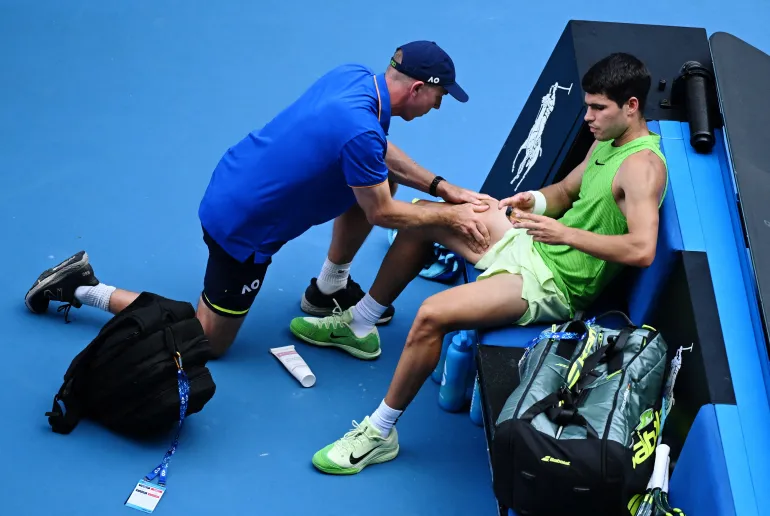
But in the ninth game of the third, he started limping and appeared to be struggling with an upper right leg problem. After holding for 5-4, he took a medical timeout in the changeover. It may have been cramp, but he rubbed the inside of his right thigh and called for the trainer, who also massaged the same area.

Zverev was demonstrably upset, talking with a tournament official, when his rival was given the three-minute break for treatment.

Spain's Carlos Alcaraz receives medical attention during his semi final match against Germany's Alexander Zverev
Spain’s Carlos Alcaraz receives medical attention during his semifinal match against Germany’s Alexander Zverev [Jaimi Joy/Reuters]

Even with his limited footwork, Alcaraz was able to hit winners and get to 6-5 before the trainer returned in the changeover to massage the area again.

When he went back out, the crowd gave him rousing support. Zverev served a double-fault to open the next game, and Alcaraz lobbed and then slapped a forehand winner down the line to get to 0-30. But Zverev won four straight points to force the tiebreaker and then win it.

No 3 Zverev, the 2025 runner-up, retained his composure despite Alcaraz’s obvious discomfort on the other side of the net, and the crowd on Rod Laver Arena firmly behind the Spaniard.

He was in front for the entire fourth set, but Alcaraz stayed with him, until Zverev again took charge in the tiebreaker. More than four hours had elapsed when the match went to a fifth set, the first five-setter on the centre court in the 2026 tournament.

Alcaraz dropped serve in the opening game of the fifth set but hung with Zverev, getting five breakpoint chances without being able to convert.

The drama lifted in the sixth game, when Alcaraz sprinted across court to track down a drop shot and slid at full pace for an angled forehand winner. The crowd went crazy.

Alcaraz finally converted the break when Zverev was serving for the match at 5-4 in the fifth set.

He held for 6-5 and converted his first match point when Zverev was serving to stay in the match.
Source link

What’s the deal with the Dodgers’ TV deal? Is MLB giving them a break?

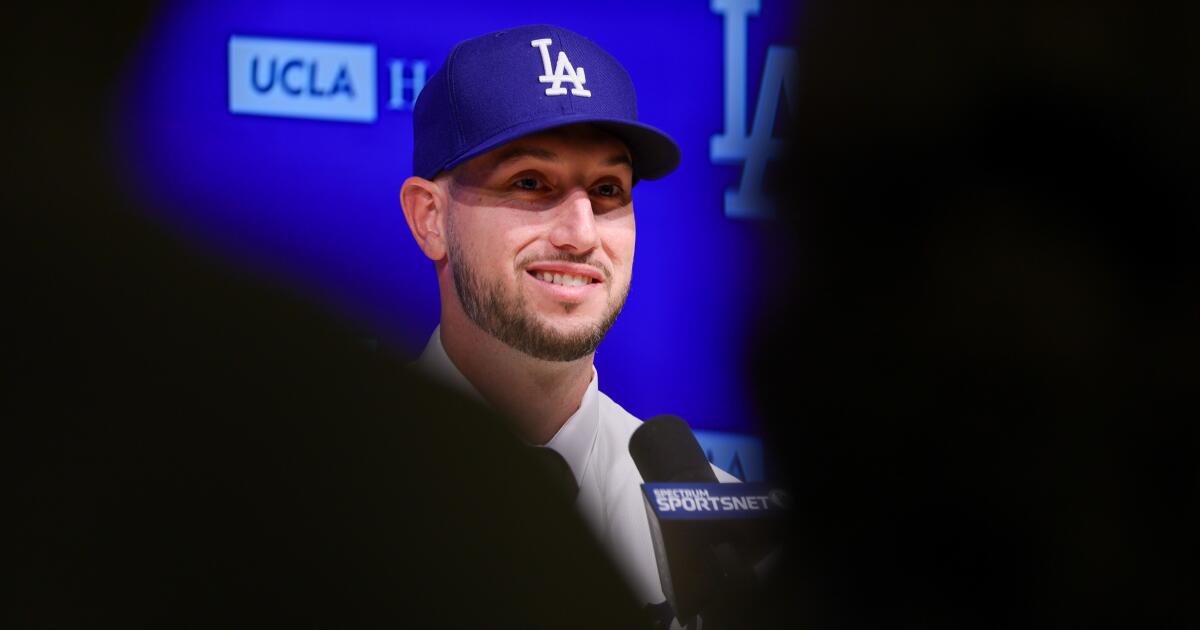
The Dodgers’ $240-million signing of Kyle Tucker revived anguished cries that the team is ruining baseball. It also revived a strange chapter in team history, with frenzied online commentary that the signing of Tucker was made possible in large part because Major League Baseball long ago rewarded the Dodgers’ owners with preferential financial treatment that continues to this day.

Is that true?

Yes and no.

Uh, thanks. Go on.

Remember Frank McCourt, the Dodgers’ former owner?

In 2011, after then-commissioner Bud Selig rejected a proposed $3-billion local television deal between the Dodgers and Fox Sports, McCourt took the team into bankruptcy court before agreeing to sell. That meant Selig and the MLB owners would not pick the new Dodgers owner. McCourt would, in a process controlled by the court.

With the Dodgers’ local TV rights soon to expire, McCourt realized bidders for the team might offer more — and he might make more — if the bidders knew in advance how much the league would take from the sale of those rights.

In a settlement with McCourt — and to avoid the risk of the judge imposing a deal less favorable to the league — MLB agreed the fair-market value of a Dodgers TV deal would be based on the very Fox deal that Selig had rejected.

Why did that matter?

That value was $84 million for the first year and would increase thereafter, with the league taking its standard 34% cut and sharing that among all its teams.

However, with a bidding war looming between Fox Sports and Time Warner Cable, Selig knew the rights would be worth more than Fox had offered in its extension with McCourt, who needed immediate cash.

In bankruptcy court, an attorney for Guggenheim, the winning bidder and still the Dodgers’ owner, said the settlement represented a “substantial component of the value proposition of the transaction” — that is, a primary justification for the then-record $2.15-billion purchase price.

In 2013, one year after buying the team, Guggenheim sold those local TV rights. Were they indeed worth more?

You might as well ask if Shohei Ohtani is good. The rights that McCourt wanted to sell for $3 billion were bought by Time Warner Cable for a record $8.35 billion.

Because of the settlement, the league would take its cut based on a deal worth $3 billion rather than based on a deal worth $8.35 billion.

And the league was fine with this, because it wanted to help a marquee franchise return to glory?

LOL, no. In 2012, an MLB attorney had warned the court that the settlement could result in a league of “the Dodgers and the other 29 teams.” Under its terms, the Dodgers could keep tens of millions of dollars each year that otherwise would be shared with the league.

In the wake of the massive Time Warner deal, Selig’s office told other owners it planned to treat television revenue for the Dodgers like television revenue from any other team.

However, thanks to McCourt, the bankruptcy court was in charge, not the league. MLB did not have the power to redo the court-approved settlement, because Guggenheim could have asked the court to uphold the deal and order the league to abide by it.

After negotiations, MLB and Guggenheim made a modest adjustment, setting the “fair-market value” of the Time Warner deal at about $130 million for the first year rather than $84 million. That figure is used to determine the league’s cut, which for all local TV deals has since increased from 34% to 48%.

Just about every report on the Dodgers’ TV deal says the team is guaranteed $334 million each year. Is that accurate?

That $334 million is the annual average. The deal started at a lower value and increases every year.

By the time the deal ends in 2038, the Dodgers will be getting more than $500 million per year.

How is that possible? Aren’t local sports channels dying?

The parent company of the FanDuel Sports channels — including the one that carries the Angels — emerged from bankruptcy last year but now is fighting to remain in business. If your company spends millions upon millions on sports rights, and if your financial success depends on cable and satellite customers paying for a programming bundle that includes sports channels most viewers do not watch, you’re doomed.

The Angels’ local television revenue took a big hit last year and probably will do so again this year. The Milwaukee Brewers, the team that plays in the smallest market in the majors, reportedly got $35 million in its FanDuel deal last year.

The Dodgers own SportsNet LA through a related entity, American Media Productions (AMP), and the television revenue comes via a marketing and distribution agreement with Charter Communications, which inherited the deal when it acquired Time Warner Cable in 2016.

Charter’s revenue in 2024: $55 billion. The giant television, telephone and broadband company is not going out of business anytime soon, even as it is stuck with a money-losing Dodgers deal.

What did Dodgers chairman Mark Walter say upon the establishment of SportsNet LA?

“The creation of AMP will provide substantial financial resources over the coming years for the Dodgers to build on their storied legacy and bring a world championship home to Los Angeles.”

Nailed it. So why would Walter consider forsaking some of those substantial financial resources?

In 2028, when MLB national TV contracts expire, Commissioner Rob Manfred would like to offer traditional networks and streaming services the chance to bid not just on national broadcasts but on an all-baseball, all-the-time outlet where fans could watch any team, wherever they lived, and with no blackouts. With that, the league believes, it could strike gold — and then share the wealth among all 30 teams.

That would require teams to turn over their local broadcast rights to the league. The Dodgers’ local television revenues provide a massive competitive advantage. It’s hard to imagine Walter (and owners of other big-city teams with similar TV riches) surrendering those riches without the league offering him something significant in return.

Like what?

Perhaps a chance to exempt the Dodgers from sharing ticket revenue, or to secure the Japanese television rights now controlled by MLB. Maybe the league would buy SportsNet LA. Could be anything. But that is a 2028 issue. First up is collective bargaining, and the possibility of owners shutting down the sport next winter in pursuit of a salary cap.

Source link