bracket

USC enjoys breakthrough super regional appearance, eager for more

As USC baseball coach Andy Stankiewicz noted the next additions that will be made to USC’s refurbished baseball stadium, he paused Monday night as a train rumbled loudly behind Blue Bell Park.

Stankiewicz, 61, smirked at the fitting metaphor after the Trojans clinched their first NCAA super regional berth in 21 years. He, after all, has rebuilt the USC program over his four seasons as head coach.

“Now we have a beautiful stadium,” he said of Dedeaux Field. “We’re going to have a beautiful clubhouse next year, batting cages and all that.”

As Stankiewicz attempted to utter another sentence, the train’s ear-piercing horn sounded.

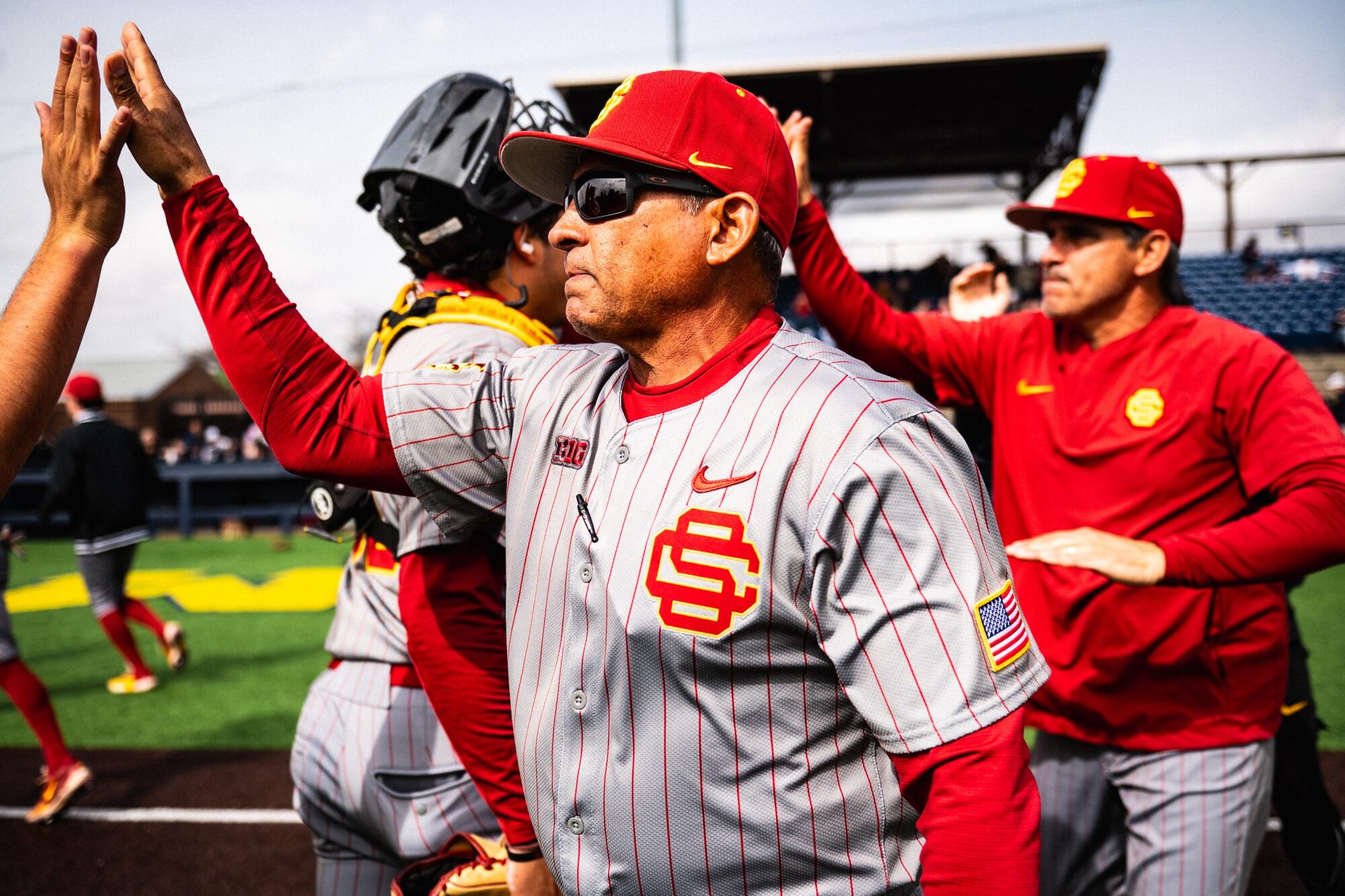
USC baseball coach Andy Stankiewicz exchanges a high five on a basebal field.

USC baseball coach Andy Stankiewicz has guided the Trojans to the NCAA super regionals for the first time in 21 years.

(USC Athletics)

“That’s appropriate because we tell people the train’s moving,” Stankiewicz said. “Now we have a train honking its whistle. The train’s moving. We’re certainly excited to see where we’re going.”

The Trojans are definitely going places these days thanks to many players who believed in Stankiewicz’s vision despite knowing their on-campus stadium would be under construction for at least two seasons.

The Trojans had six players on the College Station Regional’s All-Tournament Team. Three of them — Abbrie Covarrubias, Kevin Takeuchi and Andrew Lamb — are upperclassmen who could have been tempted to transfer after they learned that they would be without a home field for two years. Junior shortstop Dean Carpentier is another upperclassman who believed in Stankiewicz.

“You talk about just kind of cornerstones,” Stankiewicz said. “Abbrie and Takeuchi … and Dean Carpentier and Andrew Lamb, these guys, they could have left. … They got here when we had a field, and they chose to stay.

“That’s something that I’m grateful for. It just tells you the quality of young men that they are. They’re here. They got two feet in and said, ‘I’m not going anywhere. I want to help build this program. Then to see the success that, not just Abbrie, but all of them have had, they’re great leaders. They lead by example.”

While Dedeaux Field was under construction, the Trojans played most of their home games in 2024 and 2025 at Irvine’s Great Park, 47 miles and another county away. They practiced at East L.A. College.

Yet, they still reached a regional final in 2025. They have gone a step further this year by climbing out of the losers’ bracket in the regional to eliminate Texas A&M and reach a super regional for the first time since 2005.

The Trojans didn’t just climb out of the losers’ bracket. They rumbled through like a runaway train, dominating with 55 runs over four losers’-bracket wins. They scored 21 of those runs over two victories against SEC power Texas A&M in the regional final.

The Trojans made themselves at home while playing in one of the SEC’s most hostile environments. It was as though the Trojans have grown accustomed to making themselves at home on the road in recent years.

Although parts of Dedeaux Field are still under construction, the Trojans were 32-1 there for the best home record in school history. USC (47-17) eclipsed the 40-win mark for the first time since 2005.

“Obviously being able to play at home this year has been a blessing,” designated hitter Augie Lopez said after he was named the Most Outstanding Player of the College Station Regional. “But the last couple of years we’ve just kinda showed up every day — whether that was in Irvine or East L.A. Community College for practice — just with the same mentality of we’re going to show up and put our work in and dominate no matter where we are.

“Just showing up every day and punching that time card and going to work and just putting your head down and knowing that no matter where you are (or) what home field you have or you don’t have a home field, we’re going to get it done and play quality baseball.”

USC pitcher Grant Govel throws to home against Texas State during an NCAA regional on May 29.

USC pitcher Grant Govel throws to home against Texas State during an NCAA regional on May 29.

(Sam Craft / Ap Photo/sam Craft)

The 12-time national champions will face North Carolina at the Chapel Hill Super Regional in hopes of reaching their first College World Series since 2001. No player on the current roster was alive when the Trojans won their last national title in 1998.

Only a few were even born when USC made its last super regional appearance in 2005 at Oregon State.

“With the history that this program has, it’s been an honor to wear the Trojan brand on the front of my chest,” Lopez said. “Honestly just knowing that this team is the team to bring USC back to the super regional it’s incredible.

“Honestly, it hasn’t hit me until right now, but we’re just feeling absolutely grateful. I’m super blessed.”

You don’t need to hear the horn to realize USC’s train is moving in the right direction in Stankiewicz’s fourth season at the helm.

Source link

USC baseball dominates Texas A&M to advance to regional final

On a night when the crowd at Blue Bell Park saw some of the most majestic home runs you’ll see in college baseball, USC’s Andrew Johnson showed why pitching is still paramount.

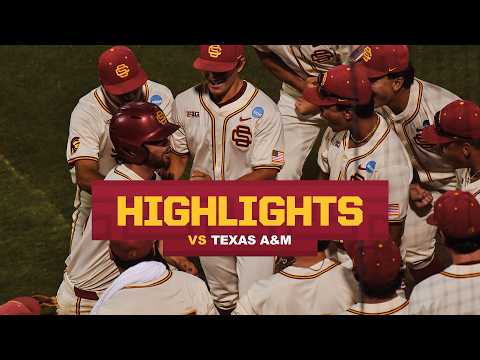
The sophomore right-hander delivered arguably the most important pitching performance of the season for USC on Sunday night, beating Texas A&M 14-3 to propel the Trojans to a winner-take-all College Station Regional Final on Monday.

After needing five pitchers in a rout over Texas State earlier in the day just to reach the regional final out of the losers’ bracket, USC coach Andy Stankiewicz rode Johnson.

Two nights after throwing 21 pitches over 1⅔ innings, Johnson threw 124 pitches over 7⅓ strong innings to beat the host Aggies (41-14) before a crowd of 6,934.

“I’ll say this, I’ve been here [as USC’s head coach] four years,” Stankiewicz said. “That’s the best pitching performance I’ve seen in four years, hands down.

“In a big moment when we needed somebody to step up to take the ball, there hasn’t been a guy that’s done that as well as [he] did … this evening.”

Leading 11-2, Johnson retired the first batter in the top of the eighth inning before Nico Partida singled to right. Jake Duer followed with an RBI triple to right field, prompting a call to right-hander Rohan Kasanagottu.

Johnson (8-2) held the Aggies to three runs on nine hits and two home runs with one walk and four strikeouts. Kasanagottu added 1⅔ perfect innings of relief with two strikeouts.

“It was just basically [Stankiewicz] coming up to me and looking at me, and me just nodding at him,” Johnson said. “And he’s like, ‘All right, let’s go.’

“I don’t know if I’ve thrown 120-whatever before, but I honestly feel pretty good. I’ll pitch tomorrow if it [means] we’re going to win some more.”

USC junior Kevin Takeuchi bats against Texas A&M in the NCAA regionals.

USC junior Kevin Takeuchi bats against Texas A&M in the NCAA regionals on Sunday.

(Chris Mora / USC Athletics)

The Trojans (46-16) have scored 48 runs over three wins since falling into the losers’ bracket. They beat Lamar 19-6 on Saturday, and then they beat Texas State 15-4 on Sunday afternoon before pummeling the Aggies (41-15).

Chris Hacopian gave the Aggies a 1-0 lead with a home run in the first. The Trojans countered with four runs in the bottom of the inning with Kevin Takeuchi’s two-run single and Andrew Lamb’s two-run double.

“Yeah, we never want to lose,” Texas A&M coach Michael Earley said. “We never want to get our [butt] kicked. That always sucks, but it is what it is. It’s baseball.

“They beat us, period, from the freaking first pitch. But we got a game tomorrow, and we’re excited to get out there.”

Lamb greeted reliever Cooper Powell with a three-run home run over the right-field bleachers in the third inning. Augie Lopez gave USC a 9-1 lead with a two-run home run in the fourth.

Gavin Grahovac tagged Johnson for a monstrous solo home run to cut USC’s lead to 9-2 in the fifth. Lamb, who singled in the fifth, added another two-run double in the ninth.

“I’m going to flush this thing here in about five minutes,” Earley said. “We’re going to move forward and we’re going to come out tomorrow and get to play in front of our home crowd.

“What more could you want, man? What more could you want?”

That’s the same mentality USC has taken since losing their opener.

“I think we’re seeing the ball really well,” Takeuchi said. “We’re sticking to the middle of the field and kinda just letting the park do its thing. Just trying to put [the] barrel on the ball.

“But when you have pitching like these guys have been, they’ve been lights out. They keep us in every ballgame, so it’s really good for us to just be able to compete for them and kinda just to rack up the hits. I think we’re just seeing the ball really well, and we’re going to continue to do that tomorrow.”

Source link

NCAA to expand March Madness fields to 76 teams

The NCAA announced Thursday that it will expand its two March Madness tournaments by eight teams each next season, a long-expected move that will drop more games into the first week of the highly popular and lucrative showcase without substantially changing its overall form.

The new, 76-team brackets will jam eight extra games — for a total of 12 involving 24 teams — into the front half of the first week of the men’s and the women’s tournaments. It will turn what’s now known as the First Four into a bigger affair that will now be called the “March Madness Opening Round.”

The 12 winners will move into the main 64-team bracket that will begin, as usual, on Thursday for the men and Friday for the women.

It is the first expansion of the tournaments in 15 years, when they were bumped to 68 teams each.

The NCAA said it will distribute more than $131 million in new revenue to schools that make the tournament. That money will come via expanded TV advertising opportunities for alcohol, the likes of which were previously restricted. It said the value of the rights agreement will increase $50 million each year on average over the course of the six years.

Most of the eight new slots are expected to go to teams from the power conferences that were already commanding the lion’s share of entries in the bracket. Two years ago, the Southeastern Conference placed a record 14 teams in the men’s bracket. Last season, the Big Ten had nine.

Keith Gill, the chairman of the Division I men’s basketball committee, called the expansion “a nice way to create some access but make sure we have the bracket we all love when we start Thursday at noon.”

The move is a product of the times, which includes massive expansion — the Atlantic Coast Conference, for instance, has grown from nine to 17 teams since 1996 — and the reality that mid-major schools with top-notch players will often see them plucked away by programs with bigger budgets and the ability to pay them through revenue sharing.

Cinderella? There will still be room for those stirring runs in the tournaments, though not a single mid-major advanced past the first weekend of either tournament the last two seasons.

This is hardly a concern of the decision-makers anymore, who will point to TV ratings that traditionally spell out fans’ preference for the likes of Duke and North Carolina over St. Peter’s and San Diego State, especially once the Sweet 16 starts.

What matters more to the biggest schools is that their teams have a chance to compete in what remains the best postseason in college sports and that they aren’t iced out by lower conference champions who earn automatic bids.

“You’ve got some really, really good teams who are going to end up in that 9, 10, 11 [seed] category that I think should be moved into the” 64-team bracket, SEC commissioner Greg Sankey said last year in discussing how he favored expansion.

Also, the money. The new beer and wine money will add to what the NCAA can distribute in “units” that are earned for placing teams in the bracket and then for every round those teams advance. Last year, that amounted to about $350,000 per unit for the men’s tournament. The Big Ten made nearly $70 million from both tournaments, won by conference members Michigan [men] and UCLA [women].

Leaders in the SEC, Big Ten, Big 12 and ACC have all acknowledged that smaller programs help make March Madness what it is, all the while steadily expanding their own power in NCAA decision-making. That brings with it the tacit threat of fracturing the single thing the NCAA does best — the basketball tournament.

This move might forestall that. What it isn’t expected to do is drastically change the TV deal beyond the advertising.

The current deal for the men’s tournament is worth $8.8 billion and runs through 2032. Adding a few extra games between mid-level Power Four teams on Tuesday and Wednesday won’t change that much.

One reason this took as long as it did was the NCAA negotiations with CBS and TNT, which themselves have been in negotiations over their own ownership.

The more drastic option of expanding the tournament to 96 teams or beyond would involve adding an extra week to a tournament that has thrived in part because of the symmetry of a six-round bracket that gets whittled down over three weeks.

That basic shell began in 1985, with only slight tweaks, the latest of which came in 2011 when it was upped to 68.

Source link