Trump Kidnapped Venezuela’s President. Now Britain Looks to Profit
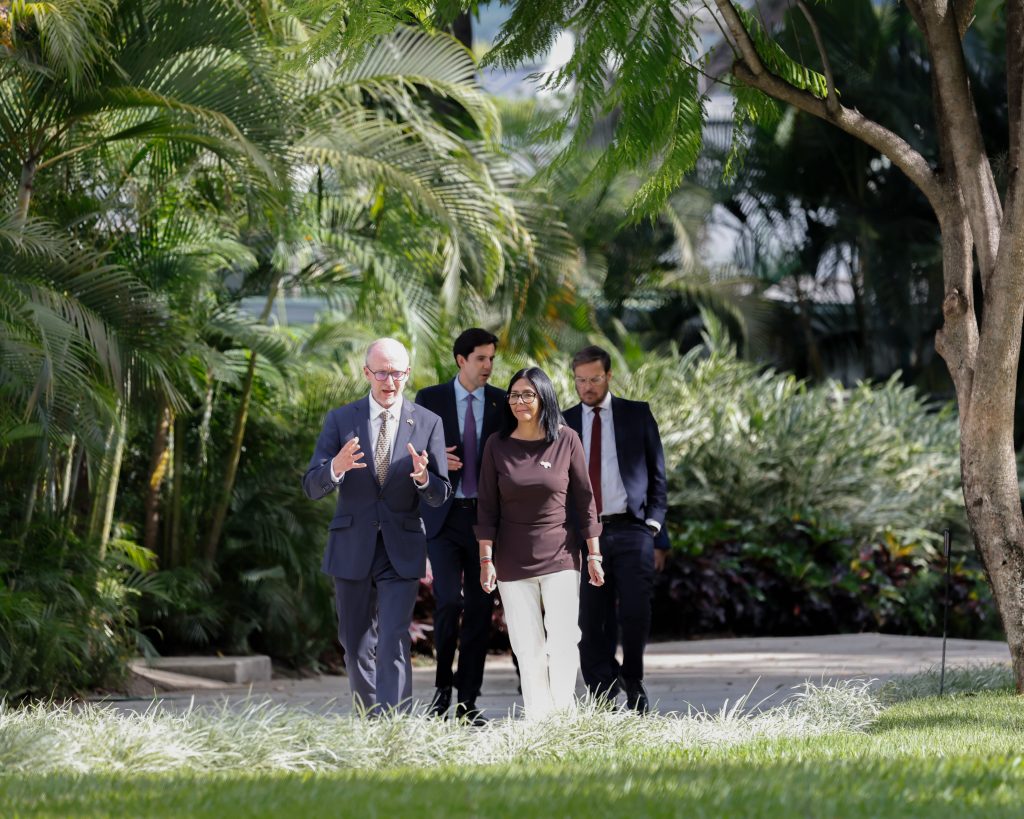
Rodríguez hosted UK Chargé d’Affaires Colin Dick on September 18 in Caracas. (Presidential Press)
Britain’s energy giants stand to make huge profits in Venezuela amid a major diplomatic rapprochement between London and Caracas, it can be revealed.
It comes in the wake of the kidnapping of Nicolás Maduro earlier this year in a move described by UN experts as a “deliberate violation of the most fundamental principles of international law”.
Donald Trump has repeatedly emphasised how the US intervention was motivated by oil interests, even telling the UN General Assembly last week: “To the victor belong the spoils”.
Hours after Maduro’s seizure, Keir Starmer said Britain was “not involved”, but refused to be drawn on whether it was unlawful. “We shed no tears about the end of the regime,” he declared.
The kidnapping is already resulting in a boon for Britain’s energy giants, with interim president Delcy Rodríguez welcoming foreign companies back to Venezuela and softening the country’s hydrocarbon legislation.
Since January 2026, BP and Shell have signed major agreements with the Venezuelan government as it appears to be operating under duress from the Trump administration.
Documents obtained by Declassified indicate how Britain’s Foreign Office has helped facilitate their return, with an influx of high-level meetings between executives and officials taking place in the weeks and months after Maduro’s removal.
The opening of Venezuela’s economy has also paved the way for the normalisation of relations between London and Caracas. Plans were made earlier this month to upgrade diplomatic representation to ambassadorial level.
But serious questions surround benefitting from the kidnapping of a head of state amid a broader assault on Venezuela’s sovereignty.
“US coercive control over Venezuela’s oil revenues may have involved violations of Venezuela’s sovereignty”, said UN special rapporteur Ben Saul.
That includes breaches of “the duty of non-intervention, the right of economic self-determination, and the principle of permanent sovereignty over natural resources”.
Professor Francisco Rodríguez, a leading Venezuelan economist who has advised its national assembly, told Declassified that “deals of this type are much more likely to survive when there is a broad consensus not only on their legal validity but on their desirability for the nation.
“At present, I see many more sectors of Venezuelan society that do not consider these agreements either legal or convenient for the nation, and some of them see them as outright exploitative”.
Rodríguez added: “It is hard to see any truly autonomous Venezuelan leaders signing these deals were a gun not pointed at their head”.
Firesale
Venezuela’s economy has been restructured under Delcy Rodríguez, who assumed power in January and was pictured with Trump earlier this month in New York, just miles from Maduro’s prison cell.
The country’s hydrocarbon legislation has been modified to make the terms more favourable for foreign firms, and its energy revenues are now being diverted through the US Treasury, with Washington taking a major cut.
By July, the US government had collected more than $13 billion in revenues from Venezuelan oil sales, according to the Financial Times.
In August, Trump also announced a “historic oil agreement” with Venezuela which would give the US control of more than 65 billion barrels of oil reserves for 100 years.
The deal would secure “our energy dominance for the next century”, Trump declared, “all at zero cost to the United States”.
Remarkably, the company at the forefront of that agreement, North American Blue Energy Partners (NABEP), hired three lawyers who had previously worked for the UK’s Serious Fraud Office.
It is within this context that Shell and BP have returned to Venezuela.
Shell has been granted concessions to develop and operate two offshore gas fields, named Loran and Dragon, which are projected to contain vast amounts of recoverable gas.
The company also signed a preliminary deal to develop two onshore oil fields known as Carito and Pirital in Monagas State, one of the country’s most oil-rich regions.
After signing a memorandum of understanding (MoU) in Caracas in March, Shell’s regional manager Adam Lowmass recalled the company’s “long history in Venezuela, dating from 1912”. He declared: “I could not be prouder of our team”.
BP signed its own MoU with the Venezuelan government in April to develop the Cocuina-Manakin gas field which sits on the maritime border with Trinidad and Tobago.
The company was also granted a licence for the second phase of operations on the Loran field in partnership with Emirati XRG and Qatari UCC Oil and Gas, and has started trading oil in the US.
Shell and BP plan to process Venezuela’s natural gas using the Atlantic LNG plant and export terminal in Trinidad and Tobago, in which they are both major shareholders.
This cross-border presence will give the firms significant control over the supply chain of natural gas in the Caribbean, a large portion of which will be destined for Europe.
Meetings and lobbying
Data obtained by Declassified through the Freedom of Information Act indicates how the Foreign Office has facilitated Shell and BP’s return to Venezuela.
Executives from the companies met with Colin Dick, Britain’s chargé d’affaires in Caracas, eight times in the two months following Maduro’s kidnapping, compared with eight meetings for all of 2025.
While the Foreign Office has refused to disclose what was discussed beyond a few heavily redacted emails, the frequency of the meetings might be seen as implicit endorsement for the energy giants’ new ventures in Venezuela.
Oil has been guiding British foreign policy in Venezuela for over a century. Former foreign minister for the Americas Alan Duncan declared in 2018: “The revival of the oil industry will be an essential element in any recovery, and I can imagine that British companies like Shell and BP will want to be part of it”.
Britain’s current director for the Americas Harriet Thompson was in Caracas in early March 2026 as Shell was gearing up to sign major new energy deals.
Thompson “conducted a productive visit that included meetings at the Venezuelan Foreign Ministry and engagements with representatives of British companies to explore growth opportunities for both countries”, the embassy said.
When asked in parliament whether those talks involved British natural resource companies, the Foreign Office said the question had already been answered in January – two months before the meetings had even taken place.
In its own write-up, the Venezuelan government said the delegation was the first of its kind for years, and opened new routes for “trade exchange” within a broader goal of “strengthening cooperation in strategic sectors”.
Earlier this month, Venezuela’s foreign minister and former ambassador to the UK Félix Plasencia and National Assembly president Jorge Rodríguez, Delcy’s brother, were in London for another high-level diplomatic exchange.
Standing outside the Foreign Office, Rodríguez noted how the meetings with British diplomats had covered “oil and gas investments” and the “rapid economic growth of Venezuela”.
The views expressed in this article are the authors’ own and do not necessarily reflect those of the Venezuelanalysis editorial staff.
Source: Declassified UK