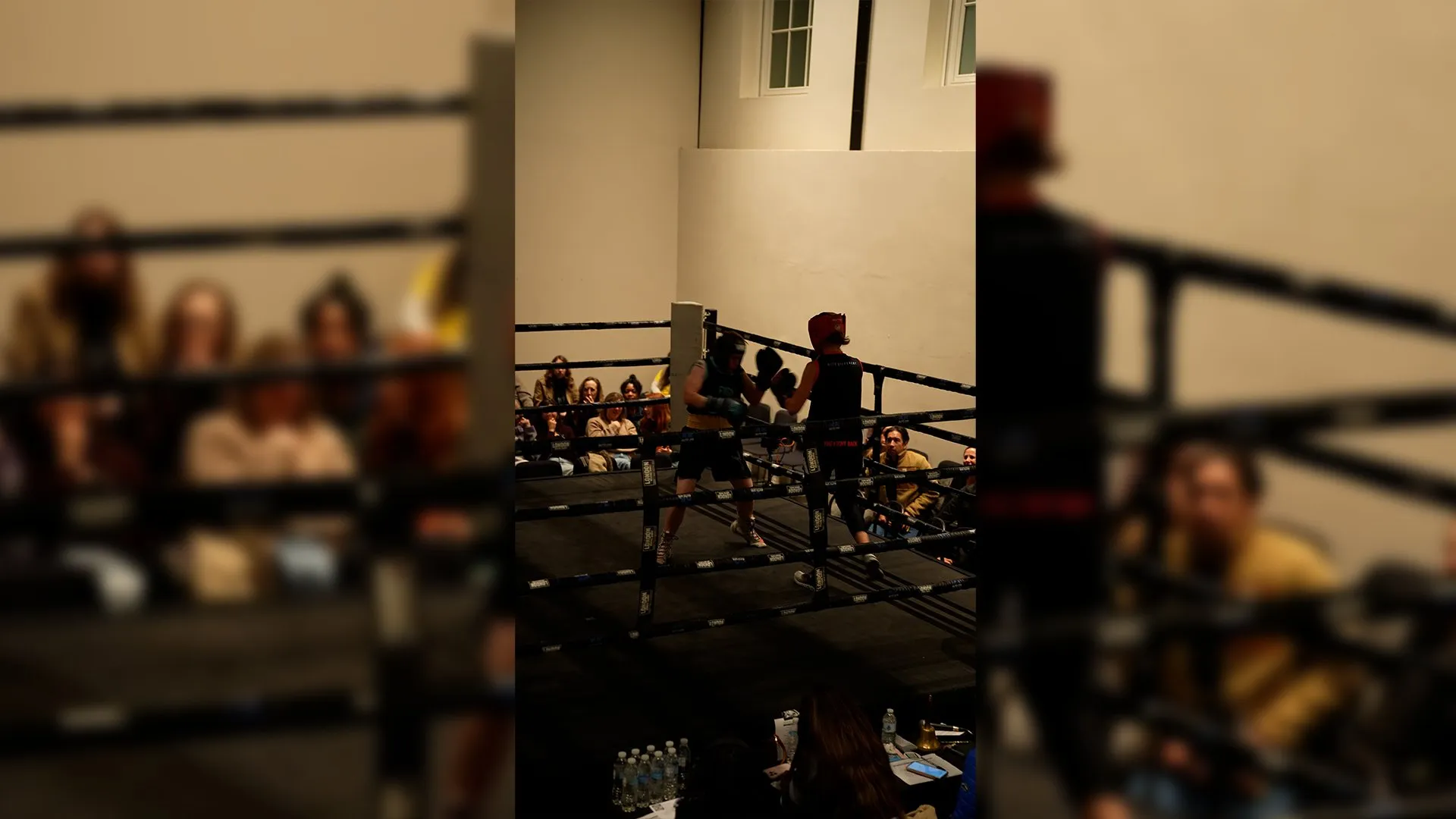
Some of the women taking part in this boxing match are survivors of domestic abuse. They have completed an intensive training programme run by nonprofit Fight Forward, which uses boxing to help survivors heal from trauma and rebuild the confidence they lost.
In late 2015, Tyson Fury had everything he had every wanted. He was happily married, starting a family and was the unified world heavyweight champion.
But everything unraveled quickly for the boxer from Manchester, England. He started abusing alcohol and drugs. His weight skyrocketed to nearly 400 pounds. He was declared medically unfit to box.
And he didn’t care.
“I didn’t care about myself, my health, my family, my wife, my kids, nothing,” Fury said in the Netflix documentary “Tyson Fury,” which premieres Friday. “Belts, boxing, money, nothing mattered. … Only self-destruct. That’s what mattered.”
After a severe anxiety attack in 2016, Fury said, he visited a psychiatrist, who said he “ticked all the boxes” for a number of disorders, including depression, anxiety and bipolar disorder.
His wife, Paris Fury, said in the documentary that the psychiatrist also told them that Fury is “a mild schizophrenic.”
“It was like, don’t be silly. What’s she on about, schizophrenic?” Paris Fury said. “Maniacs are schizophrenic. You’re not schizophrenic. I had never heard of bipolar. What’s bipolar? When somebody actually explained it to me … I was like, wow, that’s him to a T.”
Tyson Fury keeps his demons at bay while readying for a rematch with fellow unbeaten heavyweight Deontay Wilder, who battled him to a draw in their first bout.
As an undefeated young boxer, Fury had his sights set on claiming the unified heavyweight title from Wladimir Klitschko, who had held the belts since 2008. In November 2015, he did just that, upsetting the Ukranian boxer by unanimous decision — almost immediately afterward, Fury’s inner struggles started to surface.
“I achieved all my childhood dreams,” Fury said. “Focused on this one man throughout my full career, the man no one could beat. And then when I finally beat this man, it was like my whole point of existence had been taken away.”
Fury said he started hearing constant voices in his head, often telling him to harm himself.
“Words can’t explain the darkness I was in,” Fury said. “I came from the living version of the pits of hellfire. And I 100% thought at times I’d end up in a padded room with the door locked, and that scared me so much.”
He added: “I would think, ‘If only I could get back to not hearing voices.’ I just wanted to be what I thought was normal again, what I could get back to before. I tried so many times and failed and failed and failed and failed and just couldn’t do it.”
Ali, who fled Somalia’s civil war and settled in London, won the controversial split-decision fight against American Kreps to claim IBO and WBF junior featherweight belts.
Ramla Ali, a British Somali boxer whose life story is the subject of a new film, has realised a long-held dream and won her first world title to claim two vacant junior featherweight belts in the United States.
The 36-year-old landed the biggest titles of her career by winning the IBO and WBF belts in a controversial split-decision victory over American fighter Mikiah Kreps in Arlington, Texas, on Sunday.
The nail-biting nature of the 10-round contest should not have come as too much of a surprise as the duo are former sparring partners and ended the night with an expression of mutual respect.
“Mikiah, I want to share this victory with you because you pushed me for 10 rounds,” an emotional Ali said while addressing her opponent, whom she stopped from exiting the ring after being declared winner.
“I kept saying I’m so tired because your work rate was next level. I don’t know how I kept up, so thank you for being such a great boxer.”
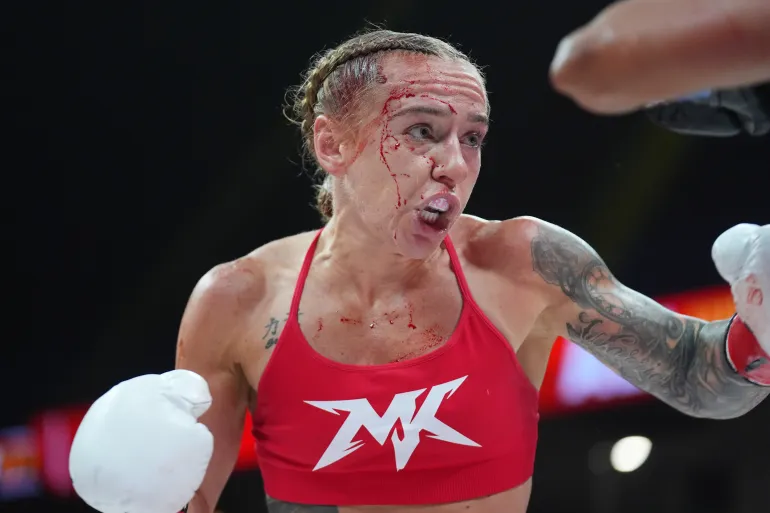
Mikiah Kreps was covered in blood as she fought Ramla Ali [Julio Cortez/AP]
The 30-year-old Niagara Falls native reciprocated the emotion. “I respect you,” Kreps said as both fighters wrapped an arm around each other.
During the fight, Ali had Kreps on the canvas in round three, but she was behind her younger opponent in the overall punch count at the end of the fight.
The outcome of the fight caused controversy from the moment the referee lifted Ali’s arm when the decision was announced.
According to the official punch statistics from the fight, Kreps outlanded Ali by 115 blows to 78 and the American was also way ahead in the power shot count.
One judge scored the bout 98-91 for Kreps but the other judges saw the fight differently and gave Ali the decision win with scores of 97-92 and 96-93.
Veteran promoter Lou Di Bella wrote on social media, “Mikiah Kreps won that fight and it wasn’t even close. Stevie Wonder could see that.”
Kreps lands a punch on Ali during the ninth round [Julio Cortez/AP]
From Somalia’s civil war to world champion
The external noise would have mattered little to Ali who dropped to her knees when the scores were announced.
Ali and her family are no strangers to adversity, having settled in London in 1992 after fleeing Somalia during its civil war.
Years after picking up the sport as a teenager in East London, Ali became the first Somali boxer to compete at the Olympic Games when she represented the country of her birth at Tokyo 2020. She later became the first Muslim woman to win an English amateur boxing title.
Ali’s journey has provided the inspiration for the movie ‘In the Shadows’ starring Top Boy actor Jasmine Jobson.
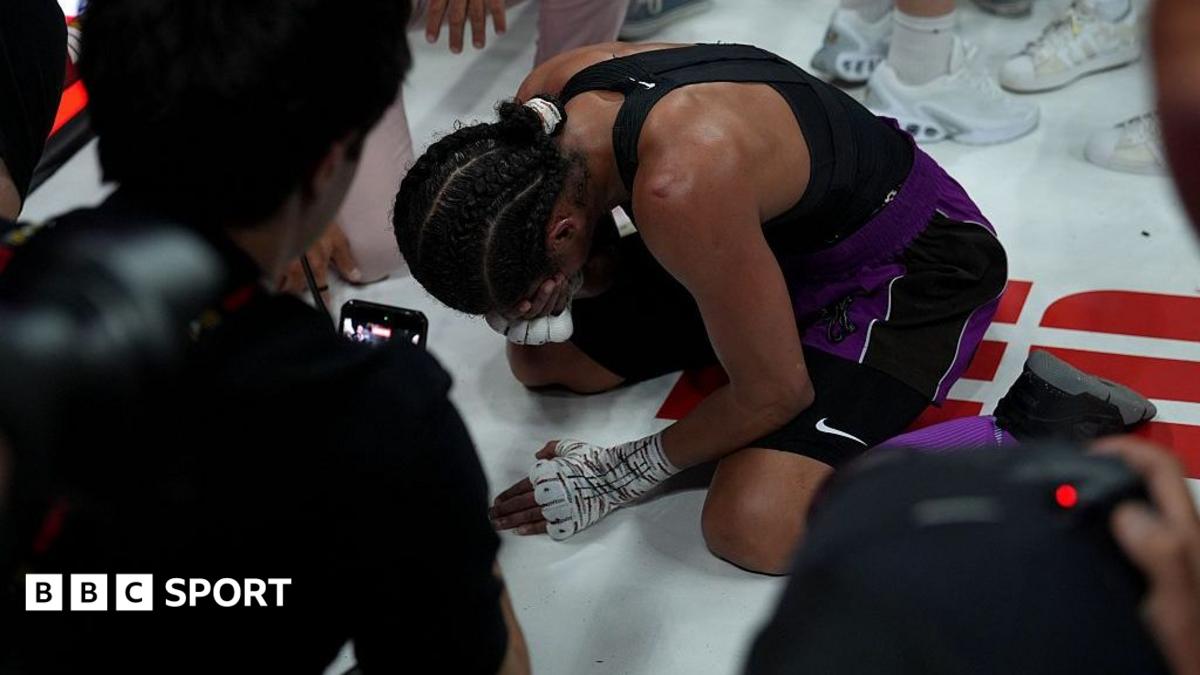
Ali wept as she dropped to the mat after winning her first world title [Julio Cortez/AP]
The fighter lost her father earlier this year and said she stayed up all night prior to the fight, wishing he would have been around to see her in the ring.
“My father passed away in May so I was really emotional,” she said in a post-fight interview with All The Smoke Boxing.
“Every round, I kept going to my corner to tell my coach I couldn’t do it anymore because I was physically exhausted. I boxed through my skin and I’m glad I got the victory.”
Ali’s career has always been multi-dimensional. As a model and Unicef ambassador, she has projected her voice beyond sporting arenas.
“I can’t put into words what this means to me and what this means to all of Somalia,” she said, fighting back tears, while standing inside the ring.
“I’ve hopefully inspired so many young girls and boys out there to dream big and that’s all I’ve ever wanted to do.”
In this photo from September 11, 2025, Ali poses with Somali students during her visit to the Dadaab refugee camp in Garissa county, Kenya, in her capacity as a UNICEF UK ambassador at a time when humanitarian agencies had warned of the severe impact of global aid reductions on vulnerable populations [File: Thomas Mukoya/Reuters]
Ramla Ali secured her first world title at the age of 36 after defeating Mikiah Kreps in a split-decision victory in Arlington, Texas.
The win is a crowning moment for the Briton, who fled a war-torn Somalia as a child before going on to become an Olympian, activist, author and now the WBO and IBF super-bantamweight champion.
With her biopic about her remarkable life just released, Ali fulfilled a dream long in the making and that seemed far away when she was swept aside by Yamileth Mercado in her first attempt two years ago.
An emotional Ali fell to her knees in tears as she was confirmed the winner with scorecards that read 97-92, 96-93 and 98-91 in her favour, dedicating the victory to her late father.
“When we were in the changing room, my coach said, because my dad passed away in May, ‘Do this for him’,” Ali said.
“That’s where those emotions came out at the end, because I did it for my dad.”
“I can’t put into words what this means to me and what this means to all of Somalia,” she added.
“I’ve hopefully inspired so many young girls and boys out there to dream big and that’s all I’ve ever wanted to do.”
As Ali wept, there was devastation for Kreps who was convinced she had done enough to win the contest.