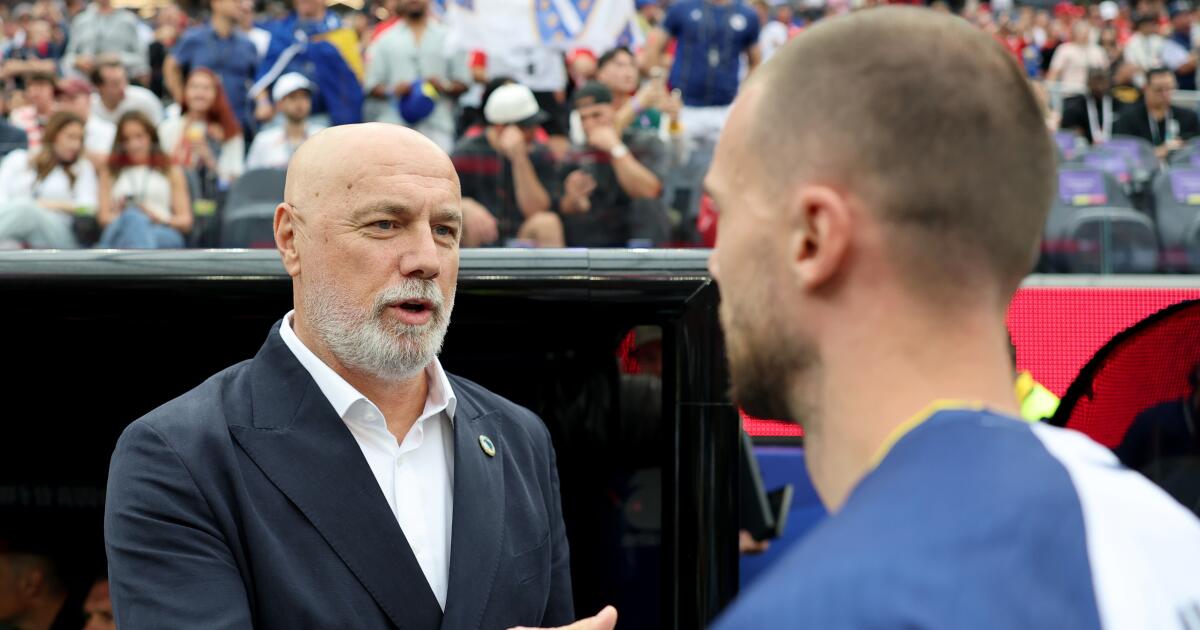
Sergej Barbarez all in with Bosnia-Herzegovina at 2026 World Cup
Imagine it. A neophyte coach, leading a team for the first time at any competitive level, and it being a high-profile assignment on the biggest of big stages.
A self-assured broadcaster, critical and competitive, having his bluff called, being invited to not just talk about it, but to be about it: Walk the walk, why don’t you?
A former player — scorer, shooter — being challenged to step up and right a listing ship while navigating politics and the push and pull of history and high hopes.
Imagine that guy going: “Bet.”
As in, you betcha. As in, I’d bet on me.
Lakers fans, you’ve seen JJ Redick run this play in the NBA.
Bosnia and Herzegovina’s faithful — who comprised the vocal majority amidst the full house for Thursday’s 4-1 Group B loss to Switzerland at SoFi Stadium — are seeing manager Sergej Barbarez pull the same improbable stunt.
The 54-year-old Barbarez is Bosnia’s national soccer team’s fifth manager since 2022. He’s also a former national team captain turned professional poker player turned broadcaster whose turn coaching this team came as a complete shock.
He might be the most interesting man amidst a mass of most interesting men at the World Cup, and he has Bosnia back on two feet.
And he had them on equal footing Thursday until Switzerland scored the match’s first goal in the 74th minute.
“Maybe our start wasn’t that good,” Barbarez said through an interpreter. “But from the first cooling break until the goal, we were the better players, the better team.
“I don’t like self-pity,” he added. “I entered the dressing room and told them all that they have one hour to cheer up to lift their heads up.”
The loss to the 19th-ranked Swiss was the first in six matches for 64th-ranked Bosnia, following six consecutive 1-1 or 0-0 draws, including their 1-1 World Cup opener against host Canada.
They know they’ll have to win their next match Wednesday against Qatar for an opportunity to reach the knockout stage: “It seemed,” Barbarez said, “from the very beginning that the last game would be the most important one, and it turns out it is.”
And they’ll be ready, he said.
“It’s hurtful; it’s quite painful,” he said. “But this is my job, and trust me, I’ll make sure they will be fine ahead of the next game. We will try to remedy what happened.”
We’d expect to hear something similar from Redick — whose poker face isn’t as good as Barbarez’s, whose small sigh and slight smile betrayed his only emotions during his postgame news conference Thursday.
(As for who wore it better: Barbarez pumping up Bosnian fans in all-black business attire beats Redick’s all-black athleisure.)
Ahead of schedule and happy to be here, Bosnia is playing in the World Cup for the first time in 12 years. Playing hard with house money.
Barbarez spent most of his 14-year professional playing career in the Bundesliga, scoring 105 goals for Borussia Dortmund, Hamburg and Bayer Leverkusen. When he retired, he got his coaching license but didn’t use it until 2024, taking a gamble on a different competitive calling.
He played poker professionally in Europe for a decade, made at least $143,000, according to Cardplayer.com, and reached two final tables in the World Series of Poker.
He also became an unabashed critic of the Football Assn. of Bosnia, which was churning through managers; three of them were hired and fired within months. Beyond failing to qualify for the 2024 Euros, Barbarez admonished the association’s leadership for its 2022 decision to schedule friendlies with Russia soon after it was banned by FIFA and UEFA for invading Ukraine.
And then, in April 2024, he was introduced as the national team manager.
“His energy and authority can be crucial factors in getting the national team back on track for success,” the president of the Football Federation Vico Zeljkovic told reporters.
Also key: “Personality,” Zeljkovic said.
Barbarez maintained from the outset that his goal was to qualify for the Euros in 2028 — and for his players to feel proud wearing Bosnia’s blue, yellow and white.
On Thursday, his players felt it and so did thousands of fans who showed up at SoFi Stadium wearing those colors for a World Cup match. All of them, all in.
“They support us all over the world,” said Ermin Mahmić, who scored his side’s only goal in the 93rd minute. “It’s not normal to be honest, and we’re very thankful for them.”
And surely for Barbarez, who took a path rarely traveled, willing to bet big on Bosnian football.