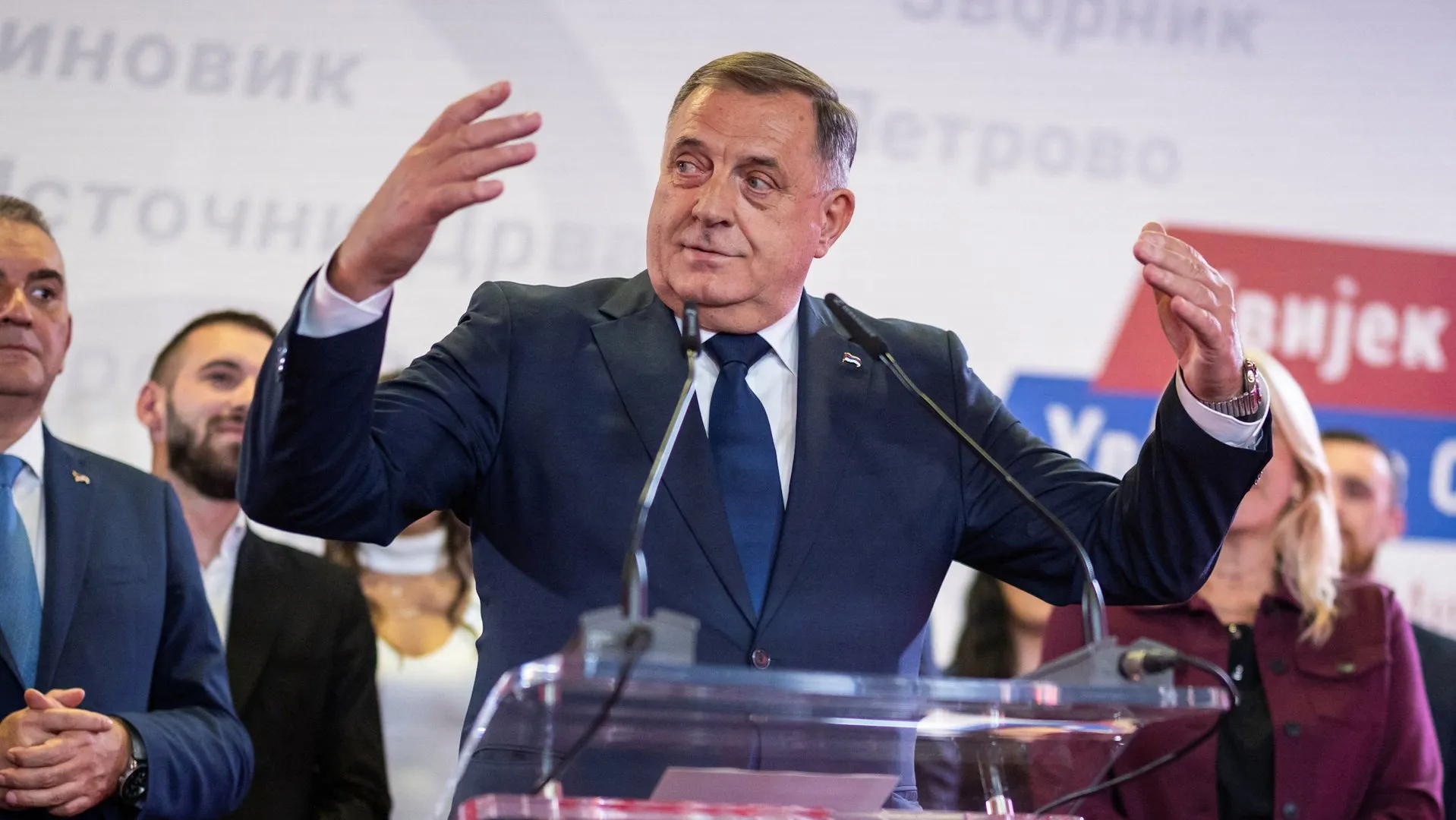
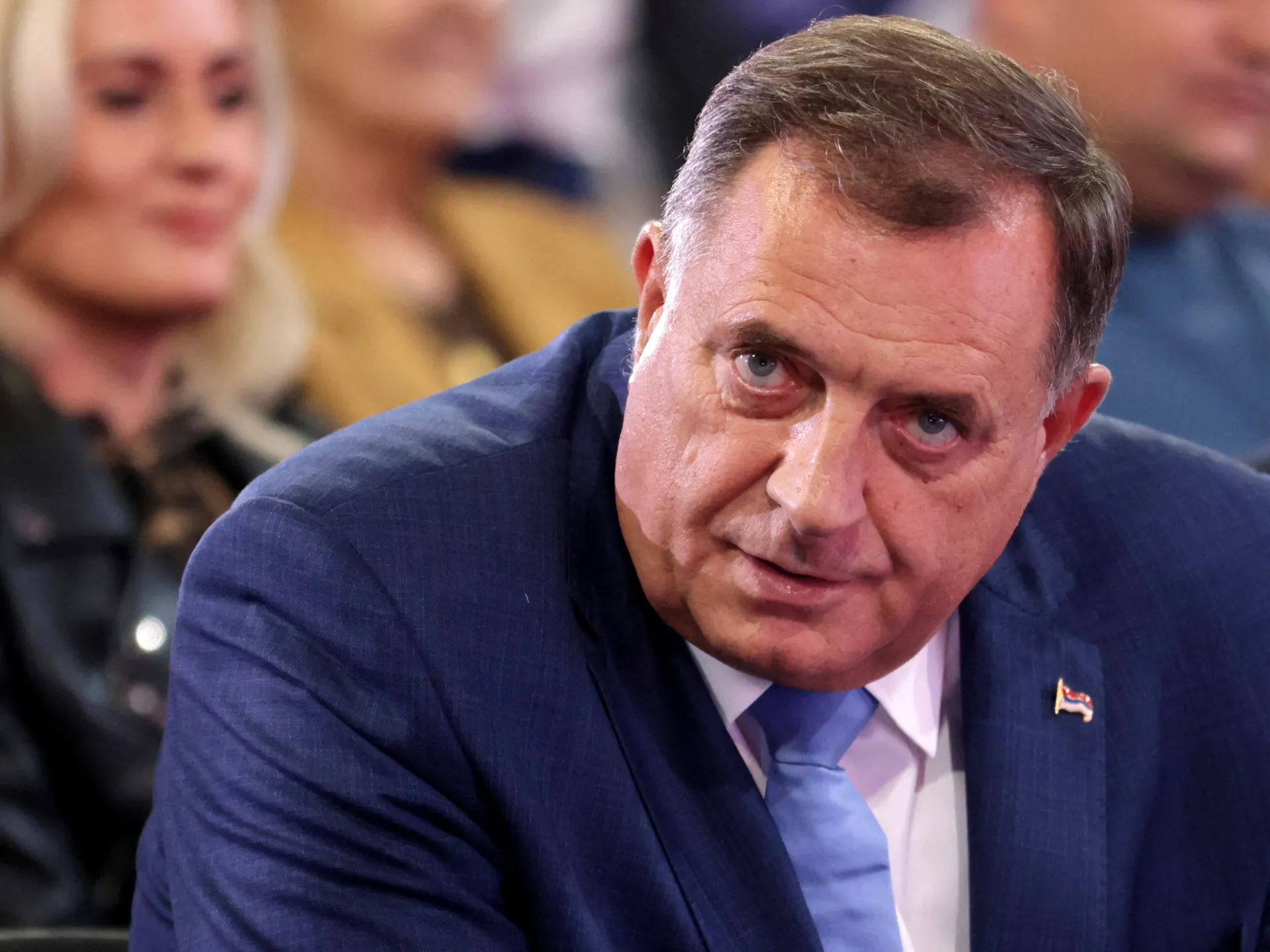
Bosnian Serb nationalist Milorad Dodik claimed victory for his party as Bosnia’s presidential elections reinforced its deep political and ethnic divisions. The presidency is made up of three members who rotate the leadership every eight months.
Speaking at the final rally of his right-wing alliance ahead of Bosnia’s October 4 election, Bosnian Serb leader Milorad Dodik delivered a predictably controversial statement.
“Bosnia-Herzegovina is dead. It is an impossible country, it makes no sense,” Dodik told supporters of the Alliance of Independent Social Democrats (SNSD) party in Banja Luka on Friday.
Recommended Stories
list of 3 itemsend of list
“It is now nothing more than an empty shell … for those who are trying to keep it alive, so they can prove themselves right about something,” said the former president of Republika Srpska, who is known for frequent separatist threats and for challenging the country’s constitution.
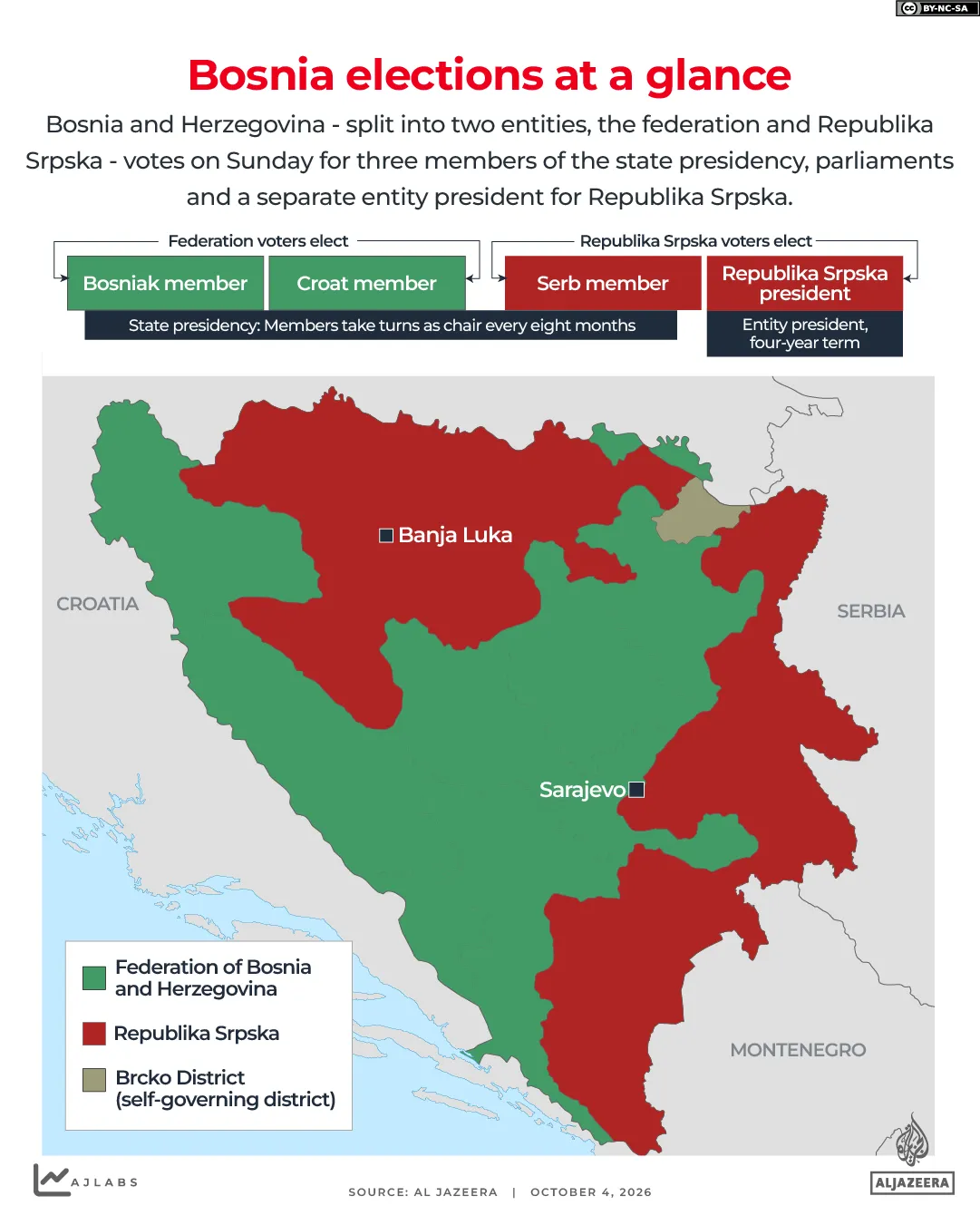
Dodik’s comments came as Bosnia remains deeply divided over its political future more than three decades since the 1995 Dayton peace agreement. It split the country into two semi-autonomous parts – the Serb-majority Republika Srpska entity and the Federation entity, where most Bosniaks and Croats live.
The agreement ended the 1992–95 Bosnian War and established a political framework for power-sharing among Muslim Bosniaks, Orthodox Serbs and Catholic Croats.
On Sunday, voters across the country cast ballots to elect the three members of Bosnia and Herzegovina’s multiethnic presidency, representatives to the national parliament and leaders of institutions in the country’s two entities.
Dodik himself is not on the ballot after being stripped of his post last year, following his conviction for refusing to carry out decisions issued by Christian Schmidt, the international peace envoy who oversees the implementation of the Dayton peace agreement.
‘No political relevance’
Elvis Fejzic, a professor at the Faculty of Political Science in Sarajevo, said attempts by figures such as Dodik to dismantle Bosnia and Herzegovina amount to “populist rhetoric”.
“Politicians and political parties that act unconstitutionally do not determine the fate of Bosnia and Herzegovina,” Fejzic told Al Jazeera, arguing that Bosnia and Herzegovina’s status as a UN member and internationally recognised state is secure.
“Bosnia and Herzegovina … will outlive all those who, through inflammatory statements, seek to obstruct its path towards integration and development,” he said. “Their statements have no political relevance whatsoever.”
Political analyst Tanja Topic said that while Dodik was not officially a candidate, he remained a central figure in the campaign and sought to present himself as a “senior official in international relations”.
Topic told Al Jazeera that the election result could produce several political scenarios in Bosnia and Herzegovina, from “cohabitation in Republika Srpska”, through the formation of a grand coalition, to a “blockage at the state level and the Council of Ministers continuing to operate in a caretaker capacity”.
Dodik’s rhetoric marks ‘long escalation’
Expert Adnan Cerimagic said Dodik’s rhetoric should be taken “seriously” and viewed as part of a “long escalation” rather than a reflection of the country’s current reality.
“For the past four years, his moves against the Dayton order and against Bosnia’s EU and NATO path have reached a new and dangerous level: in March 2025 the country came close to an armed standoff between Republika Srpska and state police,” Cerimagic, a senior analyst at the European Stability Initiative, told Al Jazeera.
“Casting Bosnia as a front-line in a supposed war between Christianity and Islam, and himself as a defender of Christian Europe, is aimed at the one people in Europe against whom a genocide has been committed since the Second World War and recognised as such by two international courts,” he added.
Cerimagic added that Dodik’s rhetoric may reflect uncertainty over the electoral prospects of his preferred candidate, as well as a belief that the European Union has less leverage over Bosnia than it once did.
Initial results are customarily released by the Central Election Commission late on election night and then refreshed every few hours.
In the days that follow, the commission progressively inputs votes from polling stations that remain outstanding, mobile voting teams, as well as ballots sent by mail and those cast at diplomatic and consular missions.
The final, official results must be published by November 20 at the latest.
Voters cast their ballots for a dizzying number of officials across multiple tiers of government.
Published On 4 Oct 20264 Oct 2026
Polls have opened in Bosnia and Herzegovina for a general election to choose new leaders at the national and regional levels, in a vote that could affect the country’s European Union membership bid.
On Saturday, about 3.4 million voters are choosing the three members of the country’s multiethnic presidency, lawmakers for the national Parliament and heads of institutions for the country’s two entities: the Federation of Bosnia and Herzegovina (FBiH) and Republika Srpska, which is dominated by ethnic Serbs.
Recommended Stories
list of 3 itemsend of list
Bosnia’s complex web of governing institutions was created by a United States-brokered peace agreement in 1995 in an effort to manage the ethnic divisions between Muslim Bosniaks, Orthodox Serbs and Catholic Croats that gave rise to the 1992-95 war.
A voter identifies himself using an optical scanner at a polling station during the general election in Sarajevo, Bosnia and Herzegovina, October 4 2026 [Hazim Aljovic/EPA]
The major parties’ repeated focus on war-era rhetoric and division was frustrating for some voters, activist Adi Selman of the Karton Revolucija protest group told the AFP news agency.
“I don’t think these new elections in Bosnia will change anything,” the 34-year-old said in the northern Bosnian town of Tuzla, ahead of the vote.
“The choice is limited to political parties that have already been around for 30 years and basically pick up votes by harping on about war, tensions, divisions and the past.”
“Bosnia and Herzegovina is dead; it is an impossible country,” Republika Srpska’s former president, Milorad Dodik, told the final rally of his right-wing Alliance of Independent Social Democrats (SNSD) in the entity’s capital Banja Luka late on Friday.
EU membership bid
In the FBiH, Bosniak parties are pushing for a stronger central state, with incumbent Bosniak presidency member Denis Becirovic pledging a renewed path to the EU and NATO.
The EU granted Bosnia candidate status in December 2022, but accession negotiations scheduled for 2024 were delayed as Brussels demanded the country pass stronger anticorruption laws and reform its judicial system.
A voter feeds a paper ballot into an optical scanner at a polling station during the general election in Sarajevo, Bosnia and Herzegovina, October 4 2026 [Hazim Aljovic/EPA]
Croat nationalist parties are also pushing for electoral reform, demanding a greater say in choosing the Croat member of the presidency in the entity they share with the more numerous Bosniaks.
Meanwhile, Russia is accused of slowing down the country’s path towards joining the EU, while also holding close ties with the SNSD, which favours secession for Republika Srpska.
This general election is the first in the country in which new electronic tools are being used to scan ballot papers and carry out biometric fingerprint verification in a move to reduce fraud during the election.
Polls close at 7pm (17:00 GMT) and first results are expected later on Sunday.
Bosnians are heading to the polls to choose the next government at all three of the state, entity and canton levels. It may seem complicated, but for a country divided into two entities – the Federation of Bosnia and Herzegovina and Republika Srpska, along with Brcko District – this is nothing new.
When do Bosnia’s elections take place?
The general elections are scheduled for Sunday, October 4. More than 3.4 million people are eligible to vote.
[Al Jazeera]
What’s different about this election?
This year, new election technology will be used. Voters will be identified using biometric devices, while ballot papers will be scanned rather than simply placed in ballot boxes.
The use of scanners, however, does not mean voting will be fully electronic. Votes will still be cast and recorded on paper, but verification and counting should be faster and more transparent, while voter identification should be more accurate.
Who is running for the Presidency?
Candidates for the Bosniak representative include current Presidency member Denis Becirovic of the Social Democratic Party (SDP), Bakir Izetbegovic of the Party of Democratic Action (SDA), Semir Efendic of the Party for Bosnia and Herzegovina (Stranka za BiH), and Fahrudin Radoncic of the Union for a Better Future of BiH (SBB).
Izetbegovic, the president of the centre-right SDA, the biggest Bosniak party in the country, is running for his third term after being defeated by Becirovic in 2022.
Three candidates will run for the Croat seat in the Presidency: Darijana Filipovic of the Croatian Democratic Union of Bosnia and Herzegovina (HDZ BiH), Slaven Kovacevic of the Democratic Front (DF), and Zdenko Lucic, a candidate supported by a coalition of five Croat parties.
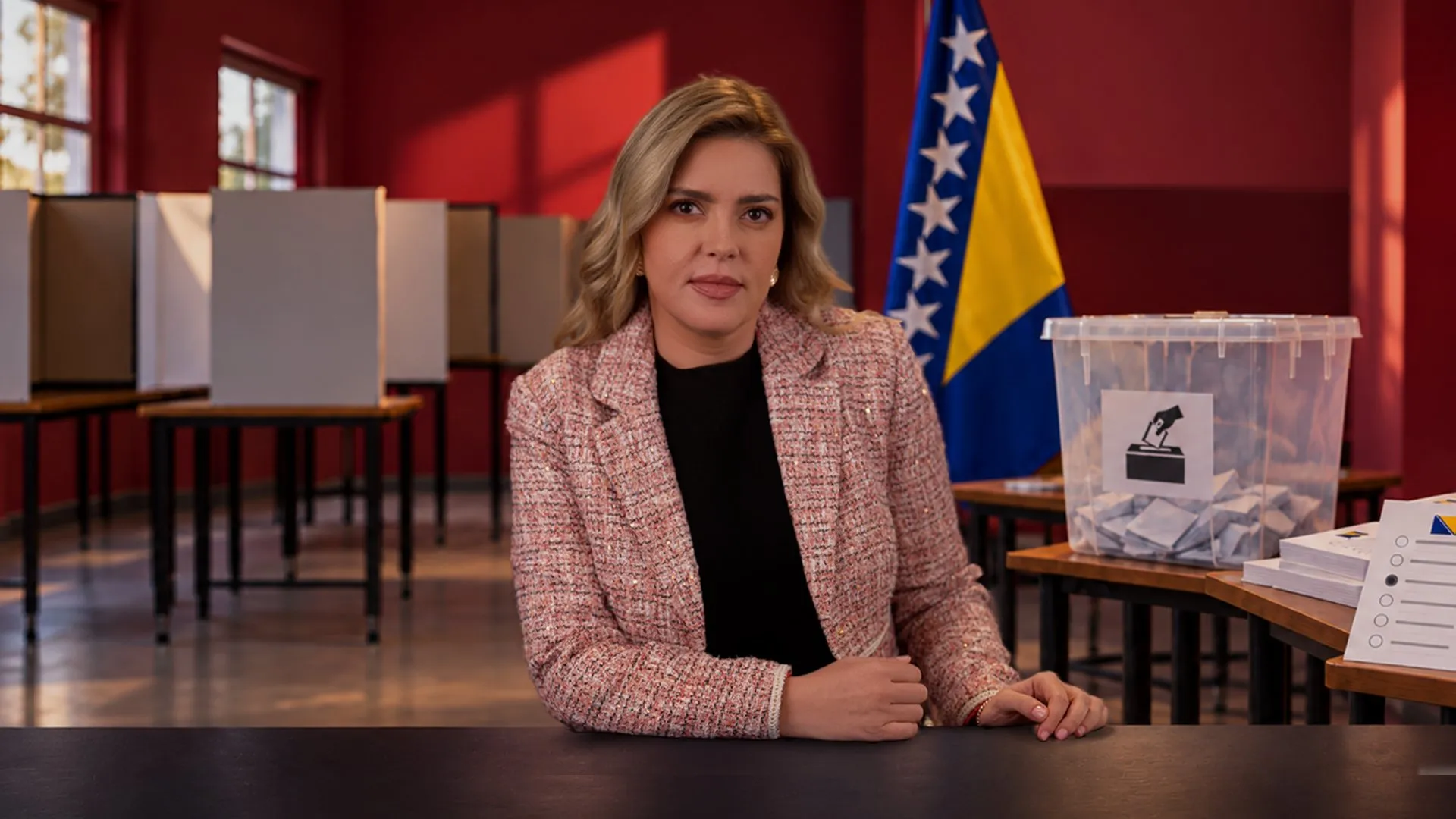
The current Serb member of the Presidency, Zeljka Cvijanovic from the right-wing Alliance of Independent Social Democrats (SNSD), is running for a second term. During her term on the country’s top state body, which began in November 2022, just a few months after Russia’s war in Ukraine started, she maintained close and continuous cooperation with Russia and its president, Vladimir Putin.
SNSD is led by Milorad Dodik, the former president of Republika Srpska, best known for his separatist moves and for challenging the Constitution of Bosnia and Herzegovina and the decisions of former High Representative Christian Schmidt.
Cvijanovic will face Marinko Bozovic of the Serb Democratic Party (SDS) and Nebojsa Vukanovic of the List for Justice and Order.
[Al Jazeera]
Who else is on the ballot?
Voters will be choosing representatives for 14 governments, as well as members of the country’s three-member Presidency.
Each entity has its own president, assembly, prime minister and ministers. The Federation of Bosnia and Herzegovina is further divided into 10 cantons, each with its own government.
For all this to happen, the Central Election Commission (CIK), the main body responsible for overseeing the voting process, earlier said that 75 political parties and four independent candidates were registered and eligible to participate.
How are Presidency members chosen?
When registered voters go to the polls, they do not elect one president, but choose one of three members of the country’s collective head of state. They are the representatives of the three constituent peoples – Bosniaks, Croats and Serbs.
The Bosniak and Croat members are elected from the Federation of Bosnia and Herzegovina, while the Serb member is elected from Republika Srpska.
This is because the majority of Bosniaks and Croats live in the Federation, while most Serbs live in Republika Srpska.
The election of the Croat member has weighed on Bosniak-Croat relations for years and has often been used as a reason for political blockades.
Parties gathered around the centre-right Croatian Democratic Union of Bosnia and Herzegovina (HDZ BiH) are demanding changes to the Election Law, saying they want to prevent Bosniak voters from influencing the election of the Croat member of the Presidency.
But that would also require changes to the Constitution, which allows all citizens in the Federation to choose whether they want to vote for the Bosniak or the Croat member.
[Al Jazeera]
What about citizens who live outside their constituent group’s voting area?
A Serb living in the Federation, or a Bosniak or Croat living in Republika Srpska, who wants to run would not be able to do so, nor can they vote for those they consider to be their own representatives.
That is one of the many paradoxes of Bosnia and Herzegovina’s electoral system.
How is the state-level government chosen?
Citizens elect representatives to the Parliamentary Assembly, which consists of two houses.
Forty-two representatives will be elected to the House of Representatives.
Two-thirds are directly elected from the Federation of Bosnia and Herzegovina, and one-third from Republika Srpska.
A quorum consists of a majority of all members elected to the House of Representatives.
The second chamber – the House of Peoples – has 15 delegates and is elected indirectly through the institutions. It consists of Bosniaks, Croats and Serbs – five from each group.
What happens with the entities?
The election of entity-level authorities works somewhat differently.
In Republika Srpska, citizens directly elect the National Assembly, as well as the entity president and vice presidents.
They do not directly elect the government – it is confirmed by the National Assembly.
In the Federation of Bosnia and Herzegovina, citizens directly elect the House of Representatives of the Federation Parliament and the cantonal assemblies.
Those cantonal assemblies then elect delegates to the Federation’s House of Peoples.
The president of the Federation, the entity government and the cantonal governments are formed after the elections, through parliamentary majorities and political agreements.
Why is it a challenge to form the government?
It is difficult not only because the electoral system is complex, but also because of the lack of agreement among representatives of the three different ethnic communities.
Frequent blockades and obstruction make decision-making difficult at all levels, even though many politicians invoke the politics of compromise.
Elections in Bosnia and Herzegovina, therefore, are not only about who wins, but about whether a system designed to represent everyone can serve its citizens.
Why are the elections important?
New election technologies might reduce potential fraud, but much more will be needed for the country’s path towards the European Union.
The outcome of the election could unblock, or further slow down, the adoption of key laws needed for the country’s progress towards EU membership.
The EU granted Bosnia and Herzegovina candidate status in December 2022 and opened accession negotiations in 2024.
However, the country’s progress has since been assessed as very limited and slowed by political blockades.
These elections will also be a test for the ruling coalition, which promised to focus on social and economic issues amid the rising cost of living.
When are the results?
The first preliminary results are traditionally published by CIK late on election night, on October 4, and are updated every few hours.
In the days after the elections, CIK gradually enters votes from the remaining polling stations, mobile voting teams, as well as ballots received by mail and from diplomatic and consular missions.
The official results will be known no later than November 20.
Bosnia and Herzegovina votes on October 4 in an election that may determine whether the country breaks its political deadlock, strengthens its path towards the European Union or faces fresh divisions that could reverberate across the Balkans.