There’s a mysterious new character that fans are wondering about their true identity
Content cannot be displayed without consent
The latest season of hit Marvel sequel series Daredevil Born Again has introduced a mysterious new villain.
While the show debuted last year, it quickly became a hit with fans and critics alike and succeeded in picking up where the Netflix version of the comic book character left off. It also meant that the character was now officially a part of the Marvel Cinematic Universe.
Its first season managed to score an impressive 87% on website Rotten Tomatoes and the premiere episode of the second season is streaming now on Disney+.
As episodes are released on a weekly basis, fans will see Mayor Wilson Fisk crush New York City underfoot as he hunts down public enemy number one, the Hell’s Kitchen vigilante known as Daredevil. But, beneath the horned mask, Matt Murdock will try to fight back from the shadows to tear down the Kingpin’s corrupt empire and redeem his home. Resist. Rebel. Rebuild.
The show sees most of the original cast return including Charlie Cox and Vincent D’Onofrio reprising their roles as Matt Murdock and Wilson Fisk respectively. Also returning are Wilson Bethel as Bullseye and Deborah Ann Woll as Karen.
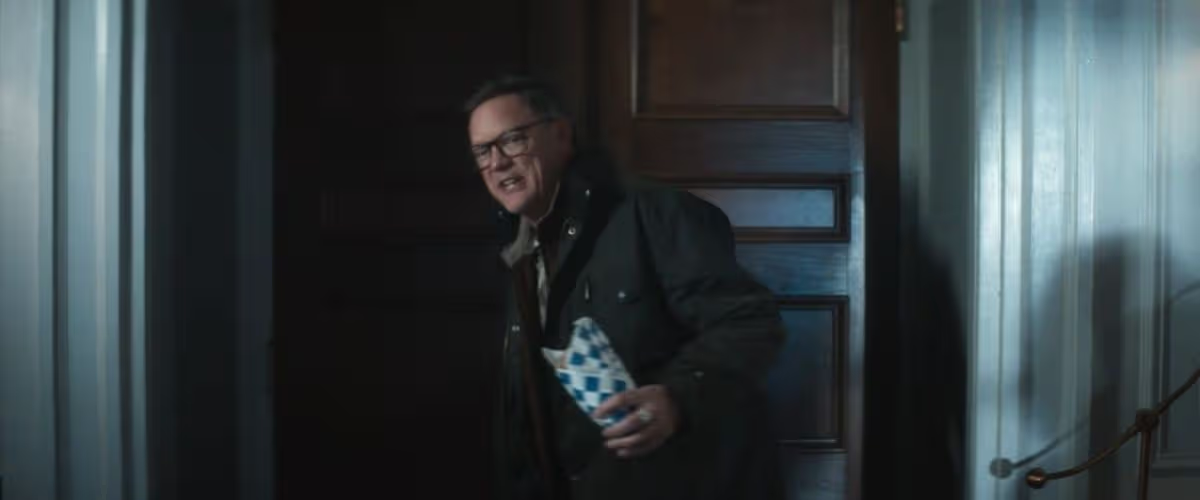
One newcomer to the show though has already made an impact just one episode in. That is the currently mysterious Mr Charles, played by Matthew Lillard. Lillard is famed for his previous roles in the Scream franchise as well as Five Nights At Freddy’s, the Scooby Doo live-action films and Prime Video series Cross.
But who is his character Mr Charles? Is he in the original Marvel comics? Here’s all you need to know. Beware some mild spoilers for Daredevil Born Again season 2, episode 1.
Who is Mr Charles?
In the show, we meet Mr Charles as he watches developments in New York on the TV from Washington. Daredevil has just sunk the North Star ship which was secretly smuggling weapons for Wilson Fisk and his associates. Turns out, Mr Charles is a middle man for these associates.
As a result, he gets a phone call and agrees he needs to address the matter personally. He arrives at Fisk’s office on his own terms, seemingly one of the very few people unafraid of the Kingpin. In a reference that may have missed the average viewer, the name Miss de Fontaine is mentioned and confirmed to be Mr Charles’ boss.
This means he works for Contessa Valentina Allegra de Fontaine, played by Julia Louis-Dreyfus and seen in The Falcon and the Winter Soldier , Black Widow , Black Panther: Wakanda Forever , and Thunderbolts. So this Mr Charles works for the CIA but is assisting de Fontaine with illicit operations.
However, some fans believe that this name could be a cover for who the character really is. According to Screen Rant there is a character called Mr Charles in Marvel lore but he only appeared in one issue, outside any main storyline or continuity. The issue was published in 2013 and he was a Roxxon Corporation employee who was in charge if illegal oil drillings in the ocean.
Fans will just have to wait as the series continues to see who Mr Charles really is and what he is truly up to. There is always the chance that he is an original character created for the show.
It starts with the exclamation point, right there in the title. “The Bride!” is a wild, willfully over-the-top double-barreled reinvigoration of 1935’s “Bride of Frankenstein” that is always doing something a little extra in telling its unpredictable story of identity and the reclamation of the self.
“I probably can’t definitively explain it,” says writer-director Maggie Gyllenhaal about that punctuation. “I think I first just put it there and wondered when someone was going to tell me to take it away. And nobody ever did.”
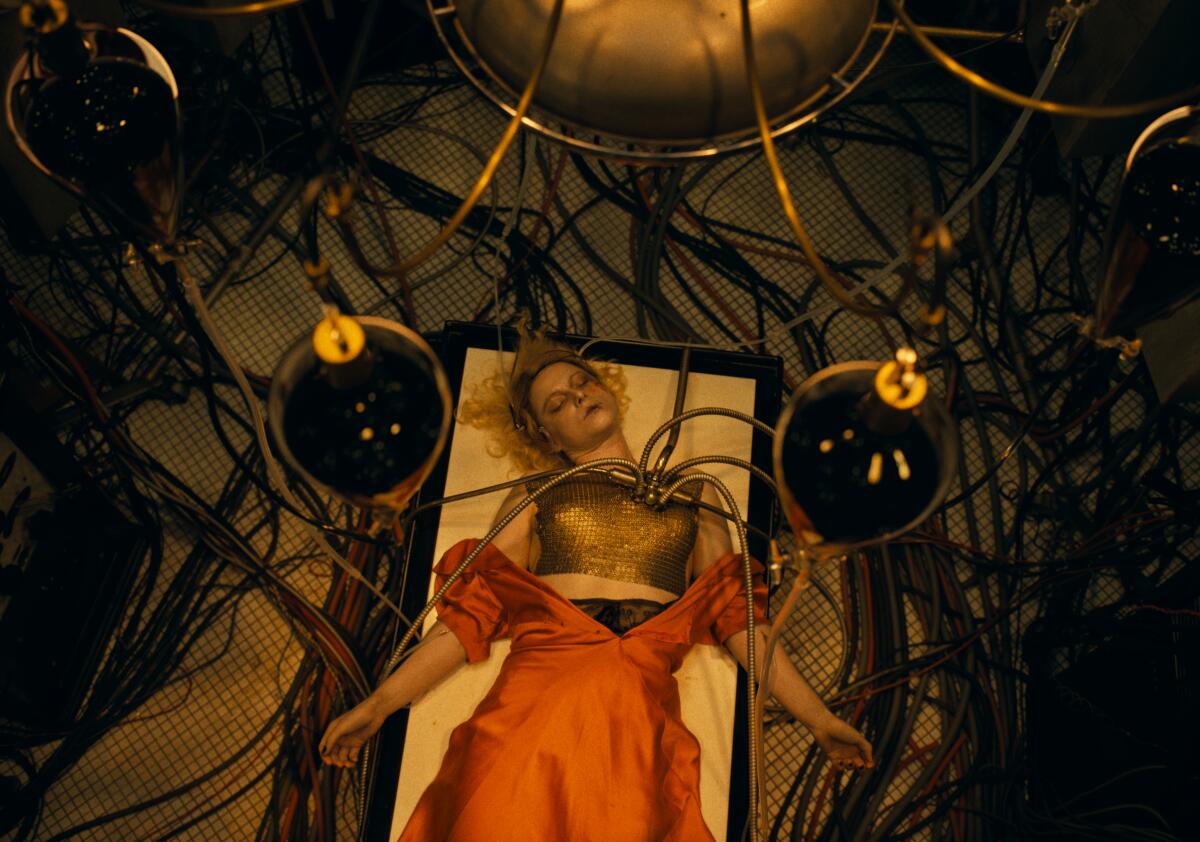
Set in a dreamscape 1930s — imagine a steampunk-meets-art-deco version of “Bonnie and Clyde” — the film features a title performance by Jessie Buckley in three roles, sometimes in conversation with each other. First, there’s Ida, a Chicago party girl who is killed when she becomes an inconvenience to powerful men. Then there’s “Frankenstein” author Mary Shelley, taking possession of another person’s body and voice.
Finally, there’s the Bride herself, the rebellious, reanimated corpse of Ida brought back to life as a companion to a creature here known as Frank (Christian Bale). The duo sets off on a lovers-on-the-run-style crime spree that captures national attention.
On a February Los Angeles morning, Gyllenhaal moves briskly across the lobby of a low-key-chic hotel, barely breaking stride to ask that, instead of a discreet celeb-friendly indoor corner table, perhaps our interview could take place on an outdoor patio. She would like to take in a bit more California sunshine before returning home to wintry Brooklyn.
Dressed in a baggy suit that is both sharp and casual, Gyllenhaal doesn’t come across as particularly fussy but, rather, as someone certain of what she wants, even if what she wants is to explore the messiness of uncertainty, pushing the edges for herself and her collaborators.
Jessie Buckley in the movie “The Bride!”
(Warner Bros. Pictures)
Take, for example, that exclamation point. What might at first seem a bit of preciousness, and which even Gyllenhaal initially makes seem a bit of a throwaway, reveals itself to have a much deeper meaning.
“It wasn’t that it was careless,” Gyllenhaal says with a calm focus. “If you are Ida or Mary Shelley or many women in the world and you’ve been sort of tamped down and silenced and not able to express everything it is that you wanted or needed to express, it’s like if you’ve had your hand on a geyser. When the geyser finally breaks, it’s going to break with a whole lot of extra energy. And maybe that’s where the exclamation point comes from.”
“The Bride!” is the second feature film as writer and director for Gyllenhaal, 48, following 2021’s “The Lost Daughter.” That movie, a bracing examination of the psychological toll of motherhood, would go on to wide acclaim and awards recognition, including Oscar nominations for actors Buckley and Olivia Colman, as well as for Gyllenhaal’s screenplay (an adaptation of the 2006 novel by Elena Ferrante). Prior to that, Gyllenhaal had been known for emotionally fearless performances in films such as “Secretary,” “The Dark Knight” and “Crazy Heart,” for which she received a supporting actress Oscar nomination.
Deciding how to follow up “The Lost Daughter” wasn’t easy. Gyllenhaal says she went to a party and saw someone with a tattoo on their forearm of Elsa Lancaster‘s intense gaze from “Bride of Frankenstein.” Taken with the image, Gyllenhaal checked out the movie and was surprised to discover Lancaster’s iconic character was only in it for a few minutes. After reading the original novel of “Frankenstein,” she started to wonder whether Mary Shelley had other things on her mind at the time of her debut novel.
“I just had this fantasy,” she says with a slightly conspiratorial air. “I’m not speaking for Mary Shelley, but there must have been some other, naughtier, wilder, more dangerous things that Mary Shelley wanted to say that weren’t said in ‘Frankenstein.’ What else might she have wanted to express?”
Christian Bale and Jessie Buckley in the movie “The Bride!”
(Warner Bros. Pictures)
And so Gyllenhaal set about writing, with her “Lost Daughter” star in mind for the lead, though she initially didn’t tell Buckley. One of Gyllenhaal’s biggest learning curves in directing “The Lost Daughter” was figuring out how to speak to each actor individually to get the most out of them.
“With Jessie, I just spoke to her like I speak to myself,” Gyllenhaal said. “No translation needed.”
Reached via email, the “Hamnet” star evokes a Frida Kahlo painting to convey their closeness.
“We share two beating hearts,” Buckley says. “Maggie has absolutely been instrumental to waking me up to a part of myself I needed to know — and I think vice versa. We share a similar language and curiosity.”
Moving from the intimate scale of “The Lost Daughter” to the expanded scope of “The Bride!” was exciting for them both.
“I loved seeing her in a bigger sandpit,” Buckley says. “From ‘The Lost Daughter’ it was clear that Maggie had something to say as an artist. But where do we grow? What’s the scarier place? What are the questions we might whisper to ourselves? And what happens if we put those whispers into the ether?”
Gyllenhaal’s new film is unafraid to risk being too much. One extravagant party turns into a musical sequence that finds Bale’s creature singing and dancing to “Puttin’ on the Ritz” — a wink to a whole other self-aware frame of reference and Mel Brooks’ satirical 1974 “Young Frankenstein.”
“Sometimes it was too much too much — that’s the line I was trying to walk,” Gyllenhaal says. “I think so many women are told that we’re too much, over and over again, from the moment we get here. And so I’m used to that.
“But I think that scene is sort of about that. It’s about a kind of explosion of life and humanity. So much of the movie is about these people who cannot fit into their box. This is where they celebrate their bigness, their too-muchness, their monstrousness. That’s the monster mash: ‘I am who I am.’”
“Sometimes it was too much too much — that’s the line I was trying to walk,” Gyllenhaal says. “I think so many women are told that we’re too much, over and over again, from the moment we get here. And so I’m used to that.”
(David Urbanke / For The Times)
Making a purposefully idiosyncratic retelling of a classic tale came with its own challenges. “The Bride!” was originally scheduled to be released by Warner Bros. last fall, on the date that would eventually go to “One Battle After Another.” When a rescheduled March 2026 opening was announced, there were reports — “Beware ‘reports,’ ” Gyllenhaal tells me, wryly — of behind-the-scenes clashes between the director and the studio.
Gyllenhaal doesn’t deny that, to find the final version of the movie, she worked closely with Pam Abdy, who, along with Mike De Luca, is co-chair and co-chief executive of Warner Bros. Motion Picture Group. This time the stakes were higher, the filmmaker says, and being left to her own devices, as she had been on “The Lost Daughter,” wasn’t always the best solution.
“If I make a big, hot roller coaster of a movie and remain totally honest in what I’m trying to explore and think about inside it, will people respond? That was my question,” she says. “And then I cut it in a way that was entirely my expression. And I have to say in particular, Pam, who was my point person on this and also has become a friend, she really took me to task on that and said, ‘You want many people to respond and understand this. You have to clarify here and here.’ ”
Though Gyllenhaal admits there were moments of “friction” and that Abdy “has a slightly different agenda than I do,” she now sees the merit in the process. “Something really alive was born, and I think the movie is better for the work that she and I did together,” Gyllenhaal says. “I know that’s an unusual thing to say. I know that you have lots of people saying like, ‘Ah, the studio f— my movie up.’ That is not my experience. It’s really not.”
In a phone interview, Abdy says, “Listen, she tasks me with challenging her, and I task her with challenging us. We’re all in the service of making the best movie we can possibly make for the audience. And we, privately, all of us — studios, directors, filmmakers — we go through a process. It’s unfortunate that certain people choose to assume they know what’s happening in those rooms. But they don’t.”
Abdy describes their collaboration as a healthy and normal one. “You test the movie, you get information, you make adjustments,” she says. “And we needed the time and space to do that.”
Maggie Gyllenhaal, right, on set with Jessie Buckley and Christian Bale while making “The Bride!”
(Warner Bros. Pictures)
The courage Gyllenhaal once exhibited as a performer now seems to be serving her as a filmmaker. The last feature Gyllenhaal appeared in as an actor was 2018’s “The Kindergarten Teacher,” playing an overzealous mentor to a young poetry prodigy. She also appeared in three seasons of the HBO series “The Deuce” from 2017 to 2019, in which she played an adult film performer struggling to move behind the camera into directing.
As to whether she will return to acting, Gyllenhaal says, “I don’t know. I really prefer directing. This is a better job for me.”
Better how? “I felt as an actress, to be honest, like I always would hit up against a wall of how much I was able to participate or express,” she says. “And I thought for a long time, OK, this is the gig, and what I have to do is learn how to protect self-expression, even if that means I just need a tiny bit of space around me where I have the real estate to do what I need to do as an actress.
“And then when I moved into writing and directing, I didn’t have to play that game anymore,” she says. “And also I could create an environment where nobody had to play that game. Anyone could explore and express the things that were interesting to them. It was ultimately up to me to decide if I wanted to use them or not. So why not let people explore and surprise me?”
Gyllenhaal’s “The Bride!” may catch the same current wave of pop-inflected Gothic-style romances as Emerald Fennell’s “Wuthering Heights” and Guillermo del Toro’s “Frankenstein.” A catchphrase that emerges in the film is “brain attack,” the Bride becoming a folk hero to women around the country who emulate her distinctive look: Jean Harlow by way of Courtney Love with an inky smear of makeup across the face.
There is something intuitively catchy about brain attack, even if it’s also a little bewildering.
Gyllenhaal remembers an “aspect of terror” about stepping into a bigger studio release. “So do most things that require that you really grow and learn in order to do them. But I’m interested in terror and so I guess I was playing around with the idea of heart attack, panic attack. And I think in order to really do that, some brain attacks are required.”
Gyllenhaal tells me how a few days earlier she had been wearing a hat with the phrase on it while reading by the hotel pool and three 20-something women, maybe a little day drunk, began asking her about it. Two of them seemed puzzled by the phrase, struggling to parse out its meaning, while the third instinctively got it. She just knew. So Gyllenhaal gave her the hat.
“I guess ‘brain attack’ is a phrase you might have to feel,” Gyllenhaal offers, her mouth widening into a smile.
So too, perhaps, with Gyllenhaal’s telling of “The Bride!” with its visions of reckless abandon and personal reclamation — exclamation point and all. It will become a movie waiting for those who need it.
Lauren Chapin, the former child actor best known for portraying Kathleen Anderson in the 1950s series “Father Knows Best,” has died. She was 80.
The actor’s son, Matthew Chapin, announced on Facebook that his mother succumbed to her “long hard fought battle” with cancer after five years. He did not disclose additional details about her death or her condition. He said in his post he is “at a complete loss for words right now.”
“Please keep my sister and family in your thoughts and prayers as we go through this incredibly tough time,” Matthew Chapin added.
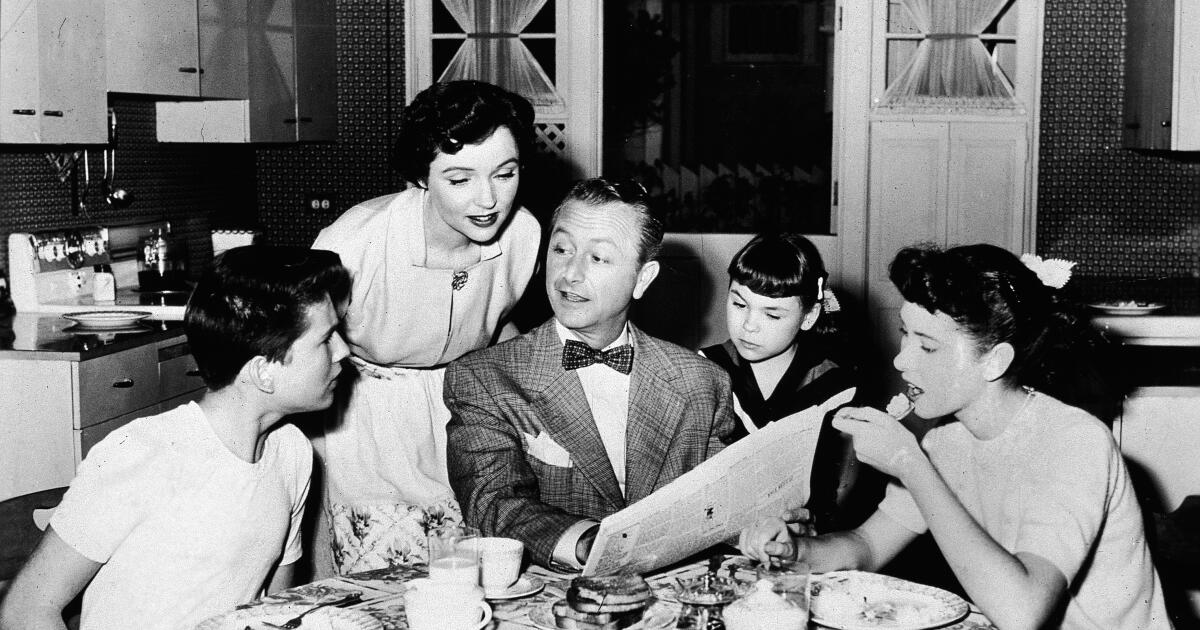
Lauren Chapin, a Los Angeles native born on May 23, 1945, began her screen career in the 1950s with a minor role in 1954’s “A Star Is Born” starring Judy Garland and James Mason, appearances in TV including the anthology series “Lux Video Theatre” and the family sitcom “Father Knows Best.”
“Father Knows Best” aired from 1954 to 1960 — bouncing between networks CBS and NBC — and starred Robert Young as the patriarch of the middle-class Anderson family. Chapin’s Kathleen, also “Kathy” and nicknamed “Kitten,” was the youngest of Jim Anderson Sr. (Young) and Margaret Anderson‘s (Jane Wyatt) three children. Her screen siblings were played by Elinor Donahue and Billy Gray.
The Emmy-winning sitcom, which ran for more than 200 episodes over six seasons, comprised the bulk of Chapin’s screen career. Chapin followed up her time on “Father Knows Best” with a single appearance on “General Electric Theater,” and nearly two decades later a role in 1976’s “The Amorous Adventures of Don Quixote and Sancho Panza” and two “Father Knows Best” reunion specials. In 1980, she appeared alongside Gary Coleman in the film “Scout’s Honor.”
She would not return to the screen until the late 2010s, starring as an elderly school bus driver in the YouTube series “School Bus Diaries” from 2016 to 2017, according to IMDb.
Off-screen, Chapin was an evangelist who shared her faith through public speaking, ministry and outreach, according to her website. She also concerned herself with various charitable efforts and work as a talent agent, channeling her experience to guide rising stars, including a young Jennifer Love Hewitt. Chapin’s website notes her accolades, including five Junior Emmy awards for child actress and “Honorable Mayor” titles from Oklahoma, Texas and Florida for her charity work.
In 1989, she penned “Father Knows Best: The Lauren Chapin Story,” which chronicled her time on the beloved sitcom but also illuminated the emotional and sexual abuse she allegedly endured from several family members off-screen. The memoir also concerned itself with Chapin’s post-”Father Know Best” life, including struggles with drug addiction, suicide attempts, troubled marriages and legal trouble.
“Lauren Chapin’s story reminds us that while fame may introduce a person to the world, it is perseverance, honesty, and compassion that define a life well lived,” says the description on Chapin’s website.
She is survived by her son, her daughter Summer and her brother Michael Chapin, according to the Hollywood Reporter.
Suicide prevention and crisis counseling resources
If you or someone you know is struggling with suicidal thoughts, seek help from a professional and call 9-8-8. The United States’ first nationwide three-digit mental health crisis hotline 988 will connect callers with trained mental health counselors. Text “HOME” to 741741 in the U.S. and Canada to reach the Crisis Text Line.