Israeli PM says money he facilitated Qatar in sending to Gaza was recommended by Israeli security agencies for humanitarian purposes.
Israeli Prime Minister Benjamin Netanyahu has boasted about bombing Qatar, while dismissing domestic accusations that funds sent to Gaza were used for anything other than aid.
In an interview with Israel’s i24NEWS that he shared on social media on Saturday, Netanyahu said Qatar was a “hostile” state that did not dictate Israeli policy during its genocidal war on Gaza.
Recommended Stories
list of 3 itemsend of list
“I attacked Qatar, I also bombed it and attacked them during the war, and they attacked me,” Netanyahu boasted.
The interview comes just days before the one-year anniversary of Israel’s September 9, 2025, strike on Doha. The bombing killed five Hamas members and a Qatari security officer during a meeting to discuss the United States-backed Gaza ceasefire proposal.
Qatar, which has long served as a mediator in Middle East conflicts and beyond, has hosted Hamas’s political office since 2012, after what it says were requests from the US.
Doha condemned the strike as a “blatant violation of all international laws and norms”, with Qatari Ministry of Foreign Affairs spokesperson Majed al-Ansari calling it a “cowardly” assault.
Several countries in the region, including Iran and Pakistan, also condemned the attack, with leaders from Jordan, the United Arab Emirates and Saudi Arabia visiting Qatar shortly afterwards in a show of solidarity.
United Nations Secretary-General Antonio Guterres called the strikes a “flagrant violation” of Qatar’s sovereignty and territorial integrity.
During a meeting later that month at the White House, Netanyahu and US President Donald Trump called Qatar’s Prime Minister and Minister of Foreign Affairs Sheikh Mohammed bin Abdulrahman bin Jassim Al Thani to apologise for the strike.
During the i24NEWS interview, Netanyahu also defended the transfer of millions of dollars in Qatari funds to Gaza that Israel had facilitated, saying the funds were intended for humanitarian purposes and had been transferred on the recommendation of Israeli security agencies Mossad and Shin Bet.
“All this money is worth 2 percent – 2 percent of all the money that entered the Strip,” the prime minister said.
Some of Netanyahu’s detractors have alleged that the funds were used to help Hamas prepare its October 7, 2023, attack on Israel, which precipitated its genocidal war on Gaza.
Qatar denies such allegations, saying any claims that it funds Hamas are unfounded and pointing to the strict oversight governing its aid transfers.
“Today, when they [Israel] are claiming that this is the financing of Qatar to Hamas, it has no basis,” Sheikh Mohammed said during last year’s Doha Forum.
“All our aid … went to Gaza, went to the people, and was under a very transparent process that the United States is fully aware about.”
Netanyahu made the remarks weeks before Israelis head to the polls on October 27, in the country’s first general election since its war on Gaza began in 2023.
With the October vote approaching, Netanyahu faces mounting pressure at home over his government’s handling of the Gaza war, the economy and the war with Iran — all shaping up as central issues in the campaign.
Critics and analysts have long accused Netanyahu of stoking tensions with foreign states ahead of elections to rally nationalist support.
Weekly insights and analysis on the latest developments in military technology, strategy, and foreign policy.
“I want to talk a little bit about forward [forces] and air base defense. Let’s be clear, we got our rear-end handed to us from drones and other vehicles, aerospace vehicles, if you will, including three F-5s that took off in Iran and flew low level and dropped bombs on an airbase,” retired U.S. Air Force Gen. Glen VanHerck just declared during a panel discussion today centered on counter-drone defenses at the annual Space & Missile Defense (SMD) Symposium in Huntsville, Alabama, at which TWZ is in attendance. Before his retirement in 2024, VanHerck served as head of U.S. Northern Command (NORTHCOM) and the U.S.-Canadian North American Aerospace Defense Command (NORAD).
“That’s embarrassing as an airman to me to say that happened,” VanHerck added, noting that this was the first time in decades U.S. forces had been subjected to an aerial attack of this kind.
A series of reports, as well as unconfirmed claims from Tehran, state that Iranian F-5s targeted Camp Buehring in Kuwait on an extremely dangerous low-level bombing mission. The attack reportedly came on or around March 1, just three days after U.S. and Israeli forces began launching combined strikes on Iran.
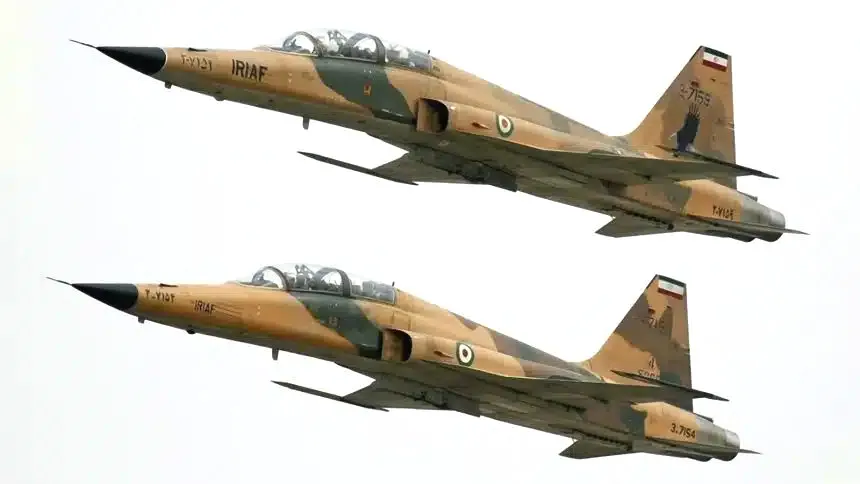
A stock picture of a pair of Iranian F-5s. Iranian quasi-state media
At the time of writing, the U.S. government still does not appear to have officially confirmed the Iranian F-5 strikes on Camp Buehring. TWZ has reached out to U.S. Central Command (CENTCOM) in light of VanHerck’s remarks today, and the command declined to comment.
NBC News was first to report on this attack in a story in April, citing anonymous U.S. officials. At that time, the outlet also said only that a single Iranian F-5 had struck Camp Buehring. American forces have been present at this base continuously since the lead-up to the invasion of Iraq in 2003.
In June, Iranian state media outlet PressTV aired a segment with additional claimed details about the operation, as well as interviews with what were said to be the pilots who took part. That report said that a trio of heavily refurbished Iranian F-5s, known locally as Kowsars, had been sent on the mission. Iran acquired a fleet of 166 F-5E/Fs from the United States in the 1970s under the regime of the Shah. How many of those jets were still operational to any degree when the latest conflict broke out on February 28 is unclear. The Iranian Air Force was heavily targeted by U.S. and Israeli forces from the start.
According to PressTV, the F-5s flew to Kuwait from Iran at extremely low altitudes, at times below 50 feet, and at high speed to evade detection, including by E-3 Sentry Airborne Warning and Control System (AWACS) jets flying above. The pilots maintained radio silence the entire time.
Iranian Pilots Shocking Revelation:
– During recent Iran-US war, Iranian Pilots used decads old F-5 aircraft to bomb US Base in Kuwait.
– F-5 flew about 15m above the surface to avoid detection and the pilots already had done homework regarding the engagement envelope of US… pic.twitter.com/EYsqxz9iHA
The PressTV report also claimed that pilots followed a route specifically designed to avoid Patriot surface-to-air missile batteries and other air defenses at Camp Buehring. Though this remains unconfirmed, it is worth noting that Patriot has known limitations when it comes to its engagement envelope. New capabilities are being developed for the system now to expand its flexibility to address targets approaching from different vectors, as well as ones that have already passed overhead. Without the aid of some type of look-down sensor capability, ground-based air defense systems more broadly cannot see through the horizon or topography, either.
Many questions remain about how Iranian F-5s would have been able to ingress and egress from Kuwait unscathed, and successfully drop unguided bombs on Camp Buehring in the process. It’s unclear where the jets launched from, and it is very possible they needed to carry significant extra fuel in external tanks just to have made the trip to and from Iran in the first place. This would also have impacted their top speed and capacity to carry ordnance.
As an aside, a pair of Iranian Su-24 Fencer swing-wing combat jets also attempted to strike targets in Qatar on March 2, but that would have been a much shorter trip across the Persian Gulf. Those jets were also shot down by Qatari F-15s before they could reach their destination.
Qatari MoD released statement noting that the QEAF downed two Iranian Su-24MK strike aircraft. Would be interesting to know which asset(s) shot them down.
In addition to the sensors associated with Patriot and other air defense systems on the ground, as well as E-3s in the air, the U.S. military has spent years developing a more integrated air and missile defense network with allies and partners across the Middle East. It is also worth noting here that Iran very actively targeted air and missile defense radars in the region early in the conflict, something we noted was its own separate wake-up call, as you can read more about here. This raises a question of what else Iran may have brought to bear in support of this operation. Iranian forces could have launched additional missile and/or drone strikes against sensors, command-and-control nodes, and other sites to help clear the way. Electronic warfare, cyber attacks, and/or deception of various kinds could have been employed, as well.
During the panel today, VanHerck said he did not believe any of this should have come as a surprise, and that it speaks to larger issues surrounding base defense facing the U.S. military today.
“People are like, ‘How come that happened? We got surprised.’ No, we didn’t get surprised,” he said. “What happened was we had two services pointing fingers at each other, and nobody made a decision on whose mission and role responsibility that was, candidly.”
Whether VanHerck’s comments here reflect his specific understanding of what happened during the attack on Camp Buehring in March, or if he was speaking more generally, is unclear. The two services he refers to here are the U.S. Air Force and the U.S. Army. As part of the delineation of official roles and responsibilities after the Air Force was split from the Army in 1947, the latter service was given the lead role in defending both services’ bases against aerial attacks. Today, the Army has a broader responsibility for ground-based air and missile defense across the joint force, abroad and at home, as well.
“The department needed to say it is this service or that service’s responsibility moving forward,” VanHerck continued today. “I’m not taking sides in that. The bottom line is, we didn’t make the decision, we accepted risk, and now we’re paying the price of that risk that we accepted, candidly.”
Now, “the Air Force chief has stood up and said, ‘Okay, I’m going to take that mission on,’” VanHerck also noted. “What we can’t have happen in the next year is a bifurcated solution where you have Patriots and THAADs [Terminal High Altitude Area Defense systems] operating up here, and you have counter-drone … down here, and they’re not fusing data and sharing C2 [command and control] and collaboration. That can’t happen, and we’ve got to make sure we get together and don’t allow that to happen.”
When it comes to Iran’s reported F-5 attacks on Kuwait earlier this year, much remains unknown and unconfirmed. However, it is certainly the opinion of retired Gen. VanHerck that it should be taken seriously and speaks to the urgency with which much bigger problems with the U.S. air and missile ecosystem need to be addressed.