Iran Ceasefire Hangs In Balance As Israel Bombards Lebanon
Traffic through the strategically vital Strait of Hormuz remains largely stalled, according to multiple reports, despite Iran and the United States agreeing to a two-week ceasefire. Earlier this week, U.S. President Donald Trump had given Tehran a deadline to agree to his ceasefire demands, including reopening the strait, or he threatened to turn Iran into a “living hell.”
Only one oil products tanker and five dry bulk carriers have passed through the Strait of Hormuz in the last 24 hours, according to ship-tracking data analysis, Reuters reports. Since the U.S.-Israeli war with Iran began on February 28, vessel traffic has averaged only a few ships per day, based on data from Kpler, Lloyd’s List Intelligence, and Signal Ocean. Prior to the conflict, an average of 140 vessels transited daily through the strait.
According to data from Windward, a maritime intelligence firm that tracks international shipping, 11 vessels have been allowed transit through the strait in the 24 hours since the ceasefire. Four of these ships are Iranian, four are Greek, and one is Chinese.
Intelligence firm AXSMarine reports that two eastbound ships, the Oman-owned Lucia and Greek-owned Iolcas Destiny, were given passage from the Gulf in the early hours of Thursday morning despite the Iranian declaration that the strait was closed.
Windward said all vessels transiting the strait must still coordinate safe passage with Iranian authorities, who are requiring shippers to pay substantial tolls, reportedly as much as $1 per barrel for outbound oil, settled in cryptocurrency. For context, the largest supertankers can carry up to three million barrels of crude.
According to an unconfirmed report from Russia’s TASS news agency, quoting an unnamed senior Iranian source, Iran will allow no more than 15 vessels a day to pass through the strait under the ceasefire agreement.
Meanwhile, Iran’s deputy foreign minister, Saeed Khatibzadeh, claims that the strait has been mined, forcing all ships to use channels that are controlled by Iran.
There are still around 1,400 ships waiting at anchorages on both sides of the narrow passage.
Although the strait has remained effectively closed since the war began, Iran has granted limited exemptions to allies, including China, Russia, India, Iraq, and Pakistan, while some Malaysian and Thai vessels have also been permitted to transit following diplomatic negotiations in recent weeks.
Now, the Israeli campaign in Lebanon is being identified as a major sticking point in fully reopening the strait.
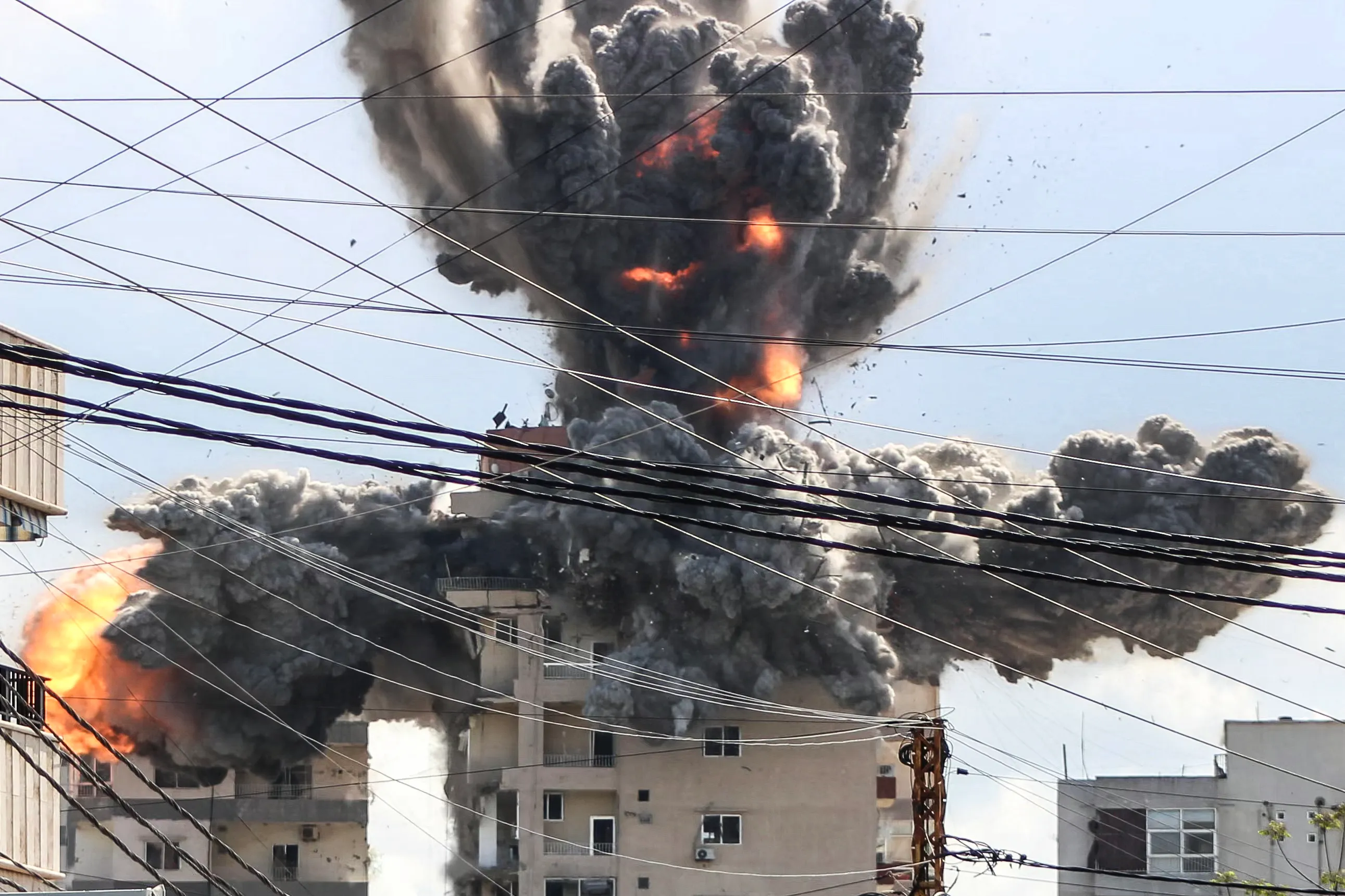
The United States and Israel maintain that the two-week ceasefire now in place does not apply to Lebanon, where the Israeli military carried out one of its heaviest waves of airstrikes yesterday.

Iran and Pakistan, which helped broker the ceasefire, insist that Lebanon is included in the agreement.
Iranian President Masoud Pezeshkian described Israel’s latest strikes on Lebanon as a “blatant violation” of the ceasefire agreement, and their continuation would “render negotiations meaningless.”
In a statement on X, Pezeshkian wrote, as per machine translation:
“Israel’s renewed incursion into Lebanon is a blatant violation of the initial ceasefire agreement. This is a dangerous sign of deception and lack of commitment to potential agreements. The continuation of these actions will render negotiations meaningless. Our fingers remain on the trigger. Iran will never abandon its Lebanese sisters and brothers.”
Deputy foreign minister Khatibzadeh accused Israel of carrying out a “surprise attack” on Lebanon, calling it a “serious violation” of the ceasefire agreement.
“It was a sort of genocide, you know, by the regime of Israel in Lebanon, just immediately after the ceasefire was accepted,” Khatibzadeh told the BBC. “It is a type of practice that the Israeli regime has always done: accepting ceasefire, then surprise attack, massacring.”
He added that the United States “must choose between war and ceasefire”, saying: “They cannot have both at the same time.”
Khatibzadeh continued: “If President Trump … is interested in peace for the whole Middle East, and since Iran is committed to that, we ask everybody in the Middle East to be abided by this agreement and this ceasefire that we reached with Americans, and we expect Americans do the same with its ally, the Israeli regime.”
The speaker of the Iranian parliament, Mohammad Bagher Ghalibaf, reiterated that Lebanon forms “an inseparable part of the ceasefire” deal. In a post on X, he said, “There is no room for denial and backtracking”. Ghalibaf added: “Ceasefire violations carry explicit costs and STRONG responses. Extinguish the fire immediately.”
Ahead of expected U.S.-Iran talks in Islamabad tomorrow, Pakistani Prime Minister Shehbaz Sharif also condemned Israel’s “ongoing aggression against Lebanon.” Sharif’s office said in a statement: “The prime minister said that Pakistan was engaged in sincere efforts for regional peace, and it was in this spirit that the peace talks between Iran and the United States were being convened.”
Reports suggest that Trump has asked Prime Minister Benjamin Netanyahu to scale back Israeli strikes on Lebanon, in an effort to keep the ceasefire on track.
According to NBC News, which cites a senior Trump official, the request came during a phone call yesterday, shortly after Netanyahu publicly vowed to continue striking Lebanon.
Nevertheless, in an interview with PBS News Hour yesterday, Trump had said Lebanon was not included in the ceasefire deal because of Hezbollah, the Iranian-backed militant group that operates in Lebanon.
“They were not included in the deal. That’ll get taken care of, too,” the president told the outlet.
When asked by PBS if he was happy with Israel continuing to hit Lebanon, Trump said, “It’s part of the deal.”
“Everyone knows that,” he said. “That’s a separate skirmish.”
Today, in a possible breakthrough, Israeli Prime Minister Benjamin Netanyahu agreed to conduct direct talks with Lebanon, with a focus on disarming Hezbollah and establishing peaceful relations between the two countries.
UPDATES:
UPDATE: 2:10 PM EDT –
Israeli Prime Minister Benjamin Netanyahu’s long-running corruption trial is set to resume Sunday, according to a court spokesperson, just hours after Israel lifted the state of emergency imposed during its war with Iran.
“With the lifting of the state of emergency and the return of the judicial system to work, hearings will resume as usual,” a statement from the courts says, according to a report from The Times of Israel.
The Pentagon has lost eight MQ-9 Reaper drones in the Middle East since April 1, bringing the total number of such aircraft lost in the Iran war up to 24, according to two U.S. officials who spoke to CBS News under condition of anonymity because they were not authorized to speak publicly.
Publicly available flight-tracking data indicates that U.S. transport aircraft are still shuttling between bases in Europe and the Middle East. Open-source accounts on X today reported at least nine Air Force cargo aircraft (eight C-17s and one C-5) all flying between U.S. bases in these regions earlier today.
There are also signs of a ramp-up in military aircraft activity over Pakistan today, thought to be a development connected with the arrival of the delegations for the scheduled U.S.-Iran talks tomorrow in Islamabad.
UPDATE: 2:00 PM EDT –
Journalist Neria Kraus says she spoke to Trump today, who told her that “Netanyahu is on board with the agreement.”
“We’re going to have a very successful agreement. It’s gonna be very good, everything’s gonna work out very good,” Trump reportedly added.
On the topic of Lebanon, Trump told Kraus, “Netanyahu is gonna be fine. He’s gonna low-key a little bit. He’s got a problem with Hezbollah. He’s gonna low-key a little bit, but he’s gonna be absolutely fine.”
The head of NATO, Mark Rutte, acknowledged that a number of allies were “a bit slow” to back the United States in its military actions against Iran, as the alliance faces growing criticism from Donald Trump. Speaking in Washington, Rutte commended Trump for his “bold leadership and vision” and said he could see why the president was frustrated with the transatlantic alliance.
Rutte also noted:
“What I see when I look across Europe today is allies providing a massive amount of support — basing, logistics, and other measures — to ensure the powerful U.S. military succeeds in denying Iran a nuclear weapon and degrading its capacity to export chaos.”
Meanwhile, there are unconfirmed reports that Trump is pushing NATO to commit to sending warships or other military capabilities to the Strait of Hormuz in the coming days. Rutte reportedly told this to German outlet Spiegel, after meeting with Trump.
With the ceasefire looking increasingly fragile, President Trump said U.S. ships, aircraft, and troops would remain positioned around Iran, warning that Washington would resume military action unless Tehran fully complies with the agreement reached with the United States.
“If for any reason it is not, which is highly unlikely, then the ‘Shootin’ Starts,’ bigger, and better, and stronger than anyone has ever seen before,” Trump wrote in a late-night Truth Social post.
There is also pushback from Iran on another key point that the ceasefire agreement should have cleared up, namely, U.S. and Israeli demands that Iran cease uranium enrichment.
Iran’s atomic energy chief, Mohammad Eslami, has said the United States will “not succeed in restricting Iran’s enrichment program.”
“The claims and demands of our enemies to restrict Iran’s enrichment program are merely wishes that will be buried,” Eslami was quoted as saying by Iran’s ISNA news agency.
Trump has demanded a total halt on enrichment and called for the removal of buried nuclear “dust” from Iran in exchange for sanctions relief.
The foreign ministers of Iran and Saudi Arabia spoke by phone today in what AFP reported was the first official contact between the two countries since the war began.
Saudi Arabia’s foreign ministry said in a statement on X that Foreign Minister Prince Faisal bin Farhan received a call from his Iranian counterpart, Abbas Araghchi.
The statement said: “During the call, they reviewed the latest developments and discussed ways to reduce tensions to restore security and stability in the region.”
Saudi Arabia, the United Arab Emirates, Kuwait, Qatar, and Oman have not reported any hostile aerial attacks today, marking the first prolonged halt in such strikes from Iran since the war began on February 28.
In a statement, the UAE’s Defence Ministry said its airspace remained free of any aerial threats today.
In a post on X, the ministry said: “UAE air defense systems did not detect any ballistic missiles, cruise missiles, or UAVs launched from Iran.”
Israeli Prime Minister Benjamin Netanyahu confirmed that Israeli strikes in Lebanon killed the nephew and secretary of Hezbollah leader Naim Qassem.
In a statement on X, Netanyahu said Ali Yusuf Harshi was “one of the closest people” to the militant group’s leader. He added that the Israeli military will continue to strike Hezbollah “wherever necessary.”
The Israel Defense Forces (IDF) said it has killed “dozens” of Hezbollah fighters during its expanded ground operation in southern Lebanon over the past week.
In a series of posts on X, the military said its forces have established operational control over the area and will continue targeting what it described as Hezbollah infrastructure.
There is no sign of any let-up in the Israeli operations directed against Hezbollah.
Today, the IDF ordered people to flee their homes in Beirut as it warned of further strikes. “Urgent warning to residents of the southern suburbs of Beirut … The Israeli Army is continuing its operations and striking Hezbollah military infrastructure throughout the southern suburbs,” said Avichay Adraee, an Arabic-language spokesperson of the IDF.
Hezbollah said it fired rockets at northern Israel in its first attack on Israel since the ceasefire agreement with Iran. The group said the strike was in response to what it described as Israeli violations of the ceasefire.
Hezbollah has also released what it says is footage showing C-802/Noor-type anti-ship cruise missiles being prepared for an attempted attack on an Israeli Navy warship earlier this week.
In his latest situation report today, Adm. Brad Cooper, the commander of U.S. Central Command, described the U.S. military as having inflicted “a generational military defeat” on Iran.
CBS News reports that survivors of a deadly attack on a major U.S. base south of Kuwait City earlier on March 1 have disputed the Pentagon’s description of events. According to CBS News, members of the targeted unit felt their unit in Kuwait was left dangerously exposed in the face of the Iranian attack, which killed six service members and wounded more than 20.
“Painting a picture that ‘one squeaked through’ [as JD Vance had described the attack] is a falsehood,” one of the injured soldiers told CBS News. “I want people to know the unit … was unprepared to provide any defense for itself. It was not a fortified position.”
The report states that, although troops took cover only hours before the attack, when missile alarms signaled there was a ballistic missile overhead, an all-clear alert subsequently sounded. “Officers removed their helmets and returned to their desks in the wood and tin workspace,” after which the Iranian drone struck.
Citing people familiar with the talks, the Financial Times reports that the White House pushed the idea of a temporary ceasefire with Iran even as Trump escalated threats against the Islamic Republic. The article states:
For weeks, the Trump administration was leaning on Islamabad to convince the Iranians to agree to a pause in fighting where it would reopen the Strait of Hormuz, the people said. Pakistan’s crucial role, as a Muslim-majority neighbour and intermediary, was to sell it to Tehran.
Contact the author: thomas@thewarzone.com