Bolivian

Bolivian president to reshuffle cabinet amid antigovernment protests | Protests News

Rodrigo Paz is under pressure from weeks of demonstrations and poor economic conditions.

Bolivia’s right-wing President Rodrigo Paz has said he will reorganise his cabinet as he faces calls to resign amid weeks of widespread protests.

During a news conference on Wednesday, Paz said he would reshuffle his ministers in a bid to ease tensions with antigovernment protesters.

Recommended Stories

list of 3 itemsend of list

“We need to reorganise a cabinet that must be able to listen,” Paz told reporters.

Since taking office in November, Paz and his government have faced backlash to economic restructuring measures, including controversial cuts to fuel subsidies. The country is in one of its worst economic crises in decades.

Protesters have taken to the streets to express frustration with Paz’s free-market reforms. His inauguration ushered in a period of right-wing leadership after nearly two decades of governance by the Movement for Socialism (MAS).

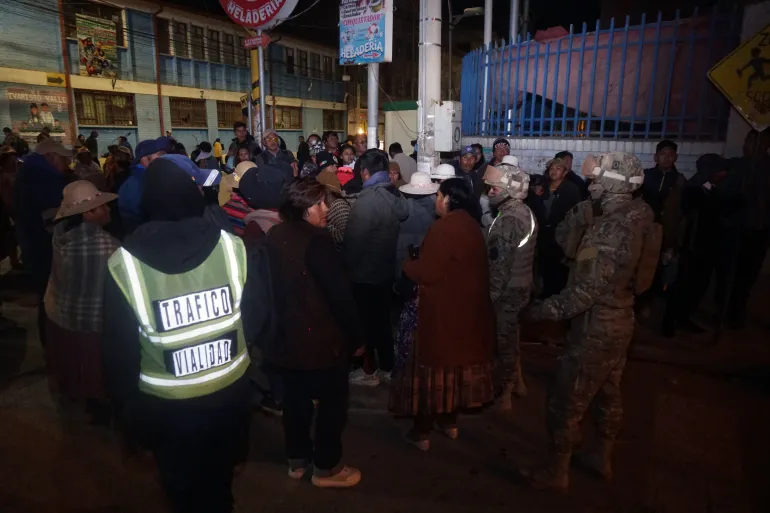
Thousands of farmers, labourers, miners and teachers have denounced Paz’s reforms. Riot police clashed with protesters again in the capital, La Paz, earlier this week.

While Paz acknowledged frustrations in his remarks on Wednesday, his government has depicted the protests as dangerous and anti-democratic.

Minister of Foreign Affairs Fernando Aramayo said earlier in the day that the mass protests and roadblocks were aimed at destabilising the country and “disrupting the democratic order”.

Former leftist President Evo Morales, who continues to exert influence over the country’s politics, has expressed support for the demonstrations.

The Paz government, meanwhile, has accused Morales of fomenting unrest. The former socialist president faces charges of statutory rape and has an arrest warrant out against him. His allies, however, say the charges are part of an effort to remove him from political life.

The administration of US President Donald Trump has expressed support for Paz, whose election is seen as part of a regional shift to the right.

“Let there be no mistake: the United States stands squarely in support of Bolivia’s legitimate constitutional government,” Secretary of State Marco Rubio said in a social media post on Wednesday. “We will not allow criminals and drug traffickers to overthrow democratically elected leaders in our hemisphere.”

Paz also slammed Colombian President Gustavo Petro, who has frequently feuded with right-wing governments in the region, for recent comments describing the protests as a “popular insurrection”.

The Bolivian Ministry of Foreign Affairs announced on Wednesday that it would ask the Colombian ambassador to leave the country, citing interference in domestic political affairs.

“If they expel the ambassador simply for proposing dialogue and mediation, it means we’re sliding towards extremism that could lead to a very difficult situation for the Bolivian people,” Petro said in an interview with the local radio station Caracol.

Source link

Bolivian army attempts to clear roads after 11 days of protests | News

NewsFeed

Military police in Bolivia arrested demonstrators, and used tear gas to try and disrupt road blockades after 11 days of protests. Rallies over fuel shortages, due to the effective closure of the Strait of Hormuz, blocked roads, even after a deal was signed on Friday between protesters and the government.

Source link

Bolivian court: Arrest Evo Morales for skipping human trafficking trial

Former Bolivian President Evo Morales attends a public event in Chimore, Bolivia, in Feburary. Morales reappeared at the event in his political stronghold in the center of the country a little more than a month of not being seen publicly and amid differing reports about his health and whereabouts. File Photo by A/Jorge Abrego/EPA

May 11 (UPI) — A criminal court in the Bolivian city of Tarija declared former President Evo Morales in contempt after he failed to appear for trial on charges related to the alleged trafficking of a minor.

The hearing, scheduled for Monday, was expected to begin the final stage of a case investigating Morales’ alleged relationship with a 15-year-old girl in 2015, from which a child was allegedly born.

The contempt ruling triggered measures intended to ensure the appearance of the former leader of the ruling Movement for Socialism, or MAS.

Authorities issued an arrest warrant authorizing security forces to detain Morales anywhere in the country and prevent him from leaving Bolivia. The court also ordered freezing his bank accounts and precautionary registration of his assets.

Prosecutors said they gathered more than 170 pieces of evidence in the case, which were expected to be presented during the trial.

After Morales and his legal team failed to appear in court, the judge applied Bolivian law that prohibits criminal trials in absentia.

“Because the accused failed to appear and did not legally justify his absence, this court issues a contempt ruling,” the judge said, according to Bolivian newspaper El Deber.

The trial will remain suspended until Morales is arrested or voluntarily appears before the court.

Morales’ defense team argued the case already had been addressed and resolved in 2020, adding the former president should not face prosecution again. His lawyers also claimed “there is no victim” and describe the charges as politically motivated, according to Chilean news outlet Emol.

Attorney Nelson Cox, a member of Morales’ legal team, said insufficient security guarantees existed to transport the former president from the Chapare region of Cochabamba. He also described the case as a “political fabrication” intended to block Morales from running for office again, according to Bolivian broadcaster Unitel.

Prosecutors and lawyers representing the alleged victim criticized interruption of the trial.

“It is a mockery of the victims and the judicial system. The evidence is overwhelming and the accused must answer for his actions before the law,” the regional prosecutor’s office said.

Since October 2024, Morales has remained in the Chapare region, his main political stronghold, where he is protected by thousands of supporters and self-defense groups.

At that time, police were unable to execute an earlier arrest order after Morales supporters blocked roads for 24 days to prevent officers from entering the area where he remains sheltered.

The government of President Rodrigo Paz announced Tuesday it would seek information from U.S. judicial authorities to investigate Morales’ alleged links to drug trafficking networks. Bolivian authorities are seeking to participate as a “victim” in ongoing U.S. legal proceedings to gain access to evidence.

One of the most significant cases involves former anti-drug chief Maximiliano Dávila, who was extradited to the United States in December 2024 and sentenced in March to 25 years in prison for conspiracy to import cocaine.

Morales has argued that Dávila’s extradition is part of an effort to pressure him into testifying against the former president in exchange for legal benefits.

Source link