bold

‘The Diplomat’ creator on Kate Wyler’s bold choice in Season 4

In case it wasn’t already clear: Debora Cahn, the creator of “The Diplomat,” likes to leave viewers in suspense.

The Netflix political thriller has followed Kate Wyler (Keri Russell), the highly competent, intensely impulsive, deeply flawed and incredibly relatable career diplomat, as she’s cleaned up backroom deals, navigated volatile international crises and unstable government leadership — all while managing a topsy-turvy marriage tangled up in it. And the stakes escalate with each season’s finale, forcing Kate to test her limits. But the fourth season has brought her breaking point.

Alarmed by the questionable decision-making by President Grace Penn (Allison Janney) — as the bullying tactics used against the U.K. to ensure their cooperation against Russia become untenable — Kate resigns in unplanned, but grand fashion at the G7 summit in front of world leaders. She’s eventually joined by other members of Penn’s administration: chief of staff Billie Appiah (Nana Mensah), Secretary of State Miguel Ganon (Miguel Sandoval) and, most notably, her husband, Vice President Hal Wyler (Rufus Sewell).

“We like a good cliffhanger,” Cahn says during a recent video call.

Cahn’s thought about how “The Diplomat” will ultimately conclude. But like the show’s savvy titular character, she perfectly executes the art of the charming evasion when pressed for answers — namely, how close are we to getting there?

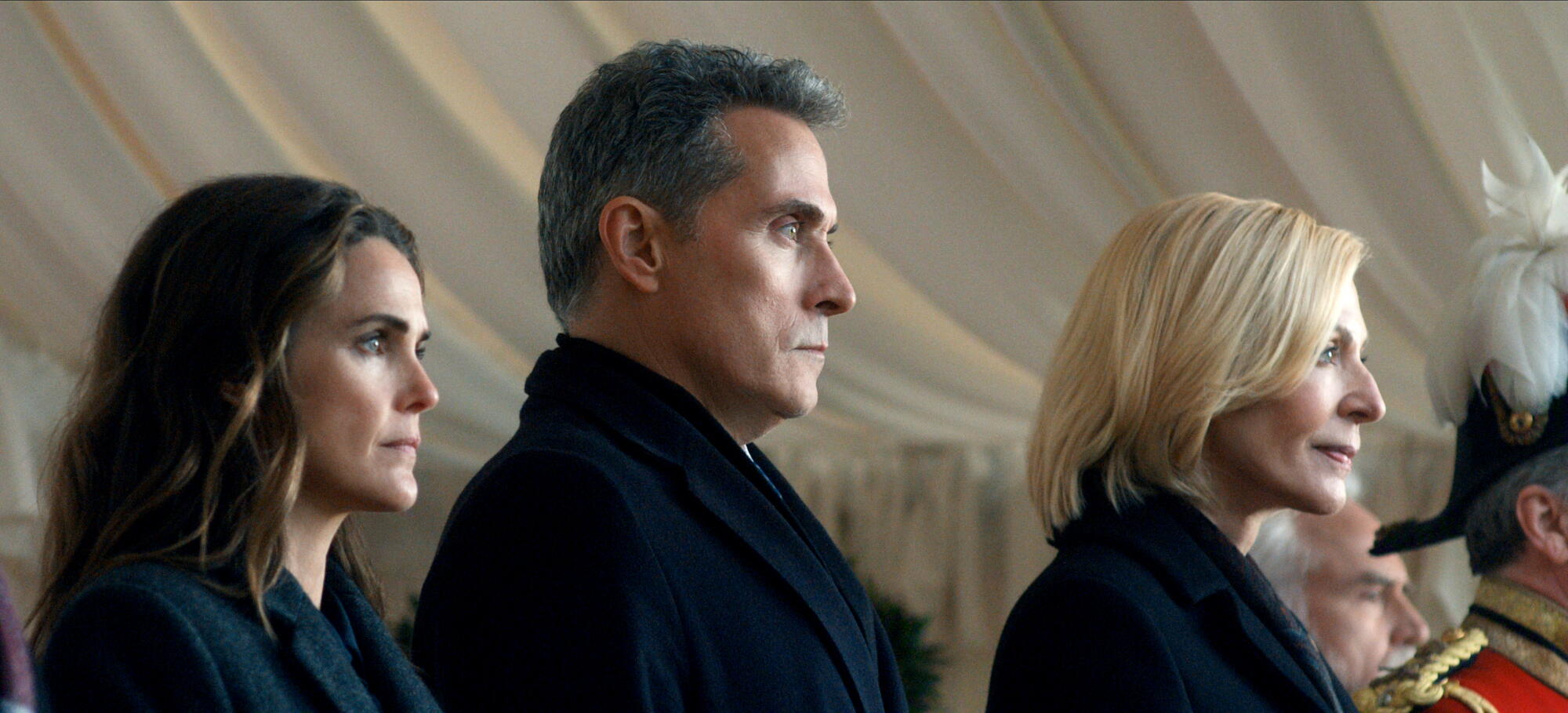
The side profiles of a brunette woman, a man and a blond woman, standing beside each other under a white tent.

Keri Russell as Kate Wyler, left, Rufus Sewell as Hal Wyler, Allison Janney as Grace Penn in Season 4 of “The Diplomat.”

(Netflix)

“I don’t know — maybe it just did,” she teases. Cahn then turns more serious: “I’ve always had an idea of what the end is. As with everything on the show, I’m always delighted to have that idea blown out of the water by a better idea, but so far it hasn’t happened.”

Cahn began her television writing career on Aaron Sorkin’s acclaimed political drama, “The West Wing,” spanning seasons 4 through 7. After working on shows such as “Grey’s Anatomy,” “Vinyl” and “Homeland,” she took the helm as creator and showrunner for the first time with “The Diplomat.” And writing a political drama today meant grappling with a creative responsibility she hadn’t faced before.

“I didn’t have to figure out what ‘The West Wing’s’ political position was going to be or what ‘The West Wing’ thought about the world,” she says. “I want to make a show that is compelling for a lot of different people. And there are certain things that are happening in the world that, as much as I try or would like to be even-handed, … [are] really difficult to ignore when you’re living at a time when you feel like democracy is crumbling.”

On a recent afternoon from her home in New York, Cahn spoke more about the new season of “The Diplomat.” These are edited excerpts from the conversation, which includes spoilers.

A woman and a man sit in the backseat of a car, each staring out their respective window

The marriage between Kate (Keri Russell) and Hal (Rufus Sewell) is tangled with their work.

(Netflix)

So much of the show, but particularly this season, is about lines that are drawn and the crossing of them. How did you and the writers decide what would be the line for Kate?

It took months and months and months to decide because we wanted to treat the question as realistically as possible. A lot of good people don’t quit. And so, why? What’s the reasoning? The whole season is examining that question for Kate and, in a way, for all of them. I didn’t want to be like, “Well, she doesn’t like the president, so she walked on out.”

What did you want out of that final moment of the season?

The moment when she stands up, she has come to a clarifying realization that her line has just been crossed. It happens in that room. And we argued about that a lot. We ended up feeling really strongly that it be what was happening right there. That this was a question she had wrestled with, but when you see that you are off the cliff, it will become clear what you have to do. So for her, Grace’s speech was that moment. She then walks out of the room and thinks: “What the mother f— did I just do? I’ve just ended my career. Have I ended my husband’s career?” That’s how she feels until she hears the door open and sees Billie walk out, and both of them go through a similar moment when they hear the door open, and Ganon walks out; then obviously the last one [is Hal] that really nobody was expecting. But for Kate, there is a big difference between having realized that you can’t go forward because your own line has been crossed, to realizing that you have started a movement, and that there is a contagion in that action.

How much did the real world, particularly international relations, inform or shape the season?

I don’t ever like to do a ripped-from-the-headlines show, particularly because we write it and then a year or two passes before it gets on air. But it did feel like, at a time when this administration was coming back into power again, and their first move was to fire people and really obliterate the institution that we were writing about, it didn’t seem like a story that we could walk around and ignore.

A man in a tuxedo and a woman in a shimmering white gown sit beside each other while applauding

Bradley Whitford as Todd Penn and Allison Janney as Grace Penn in Season 4 of “The Diplomat.”

(Nick Wall/Netflix)

We haven’t had a woman president. We know the sexism around this topic: Women are too weak, women can’t make tough decisions. What was the lay of the conversation in the writers’ room about who Grace Penn would be as president?

The situation that we wanted to sustain throughout the season was she’s not doing these things because she got shot, her stomach hurts and she’s mad. She’s doing things because she became president, and she thinks this is how the country needs to be run. Is there an overcompensation around her making sure that people don’t think that she’s too weak and afraid to be a foreign policy hawk? I think in plenty of circumstances, women in positions like that are more likely to take a strong decisive military action because there is this looming concern of, “Well is she tough enough? Is she gonna try and have everybody hold hands and make up?” There is an instinct to make sure that people realize that that isn’t your plan. Every one of the decisions that she made, we made sure that there was a smart, strategic, security mandated argument for doing what she was doing.

What Grace says at the top of that summit regarding the U.K. and Russia, if you didn’t know what was going on behind the scenes, it would seem reasonable and strategic.

I’m happy to hear you say that because that was very deliberate. We went round and round with different versions of what she said in that speech because some people would listen to it and say, “Oh, my God, she can’t say that. It’s just overwhelmingly reprehensible.” Then we would show our Washington people, and they were like, “It’s not so bad.” Democrats who were like, “This isn’t crazy. This is kind of middle of the road these days.” We realized that we couldn’t have her saying things that have become accepted in Washington because the public would view it as monstrous, and we didn’t want to be portraying a villain.

Is that the most difficult thing for you as the showrunner of a political show today — a president as a villain?

It’s trickier than I hoped it would be. I’m not really interested in the presidency as much as I’m interested in the thousands of people who interact with the president and perhaps don’t, as individuals, wield as much power in their hands as that office holder does. But real power, particularly in numbers, can make things happen or stop really disastrous things from happening. Whether or not we think that there’s a villain in the White House, what does everybody else do to try to manage it?

A bald man sits in front of a desk with U.K. flags positioned on either side of him

Rory Kinnear, who plays Prime Minister Nicol Trowbridge, sings opera in a scene where his character is having a hallucination.

(Clifton Prescod / Netflix)

There’s a surreal interlude with Prime Minister Nicol Trowbridge (Rory Kinnear) and his hallucinations — he’s singing opera, at one point. How did you arrive at that turn for him?

I would be lying if I didn’t say one of the big reasons I wanted to do that was because I found out Rory Kinnear sings opera. When we knew we were going to have this situation where he was going to through something even more stressful than everything that he’s been through up until now, it felt like it would be really great to see what’s going on in there [his mind]. I called him up and I said, “I’d like to have you singing ‘Pagliacci’ — is that OK?” And he was like, “Well, let’s start warming up now.”

For a brief moment, with Grace shot, Hal is acting president. I’m curious how you arrived at the length of time he’d fill in for Grace. It’s a few hours. And it reveals so much.

There’s a gravitational pull that we’ve been resisting ever since we made the president a big role, and then placed one of our leads in the role of vice president. There’s this pull toward the White House. But I’ve never wanted to be like, “Oh, well, then Hal’s president. Then, Hal dies, and Kate’s president! Everybody gets a chance.” Once he was VP, it started to seem equally absurd to not have a taste of that because it is, in fact, the reality in that job.

Making Hal a president for a long period of time wasn’t all that interesting to me, but I did want a little bit of a window into it. We think we really know what Hal Wyler is going to do in that role — and by we, I mean Kate, really —and it just isn’t true at all. It also turns out she really had no idea who he was as a vice president, and he’s a much different person than she thought. She thought he was going to continue to be a bull in a china shop, big swings and big ideas and asking for forgiveness, not permission. That’s not who he’s been in that job.

A group of people line up on a stage

Billie (Nana Mensah), left, Kate (Russell), Hal (Sewell), Grace (Janney), Fitzwilliam (Neil Pearson) and Todd (Whitford) in “The Diplomat.”

(Nick Wall/Netflix)

Both couples faced questions like: Who is this person I married or how am I responding to who they are at this moment? What were you interested in exploring in both these dynamics?

The conversation that we were just having is in a way relevant for all four of them. Not only is Hal different than Kate thought he would be, Hal’s different than Hal thought he would be. I haven’t run a show before. This is this is my first time in that position, and I am absolutely different than I thought I would be. I was 100% sure I knew exactly how I would handle things, and it didn’t happen. That’s an idea that we wanted to keep alive for Hal and definitely for Grace. You can prepare for it all you want and still not know.

You can’t help but feel for Todd as he tries to figure out Grace. But then he nearly dismantles NATO and you’re like, Todd!

Todd goes through two phases. He has this terrible feeling of helplessness that is eventually supplanted by this terrible feeling of power that he’s unable to manage. In a lot of ways, the Todd story is the most realistic one we’re telling because a lot of people who’ve never done this before are making the most consequential decisions, literally in the world. And Todd’s not a dumb guy, and I don’t think the people that we’re watching do this are dumb people, but, boy, are they in over their head really fast.

I want to talk about Grace and Todd and the use of “babe.” There’s something so intriguing to me about what they’ve done with that pet name across the season.

You’re thinking about all my favorite things. I don’t know what to say other than I’m glad it’s reading. You take a term of affection, and, at a certain point, it just becomes a name. The affection that it carries with it is just a horrible memory of a moment that is clearly gone.

Source link

Lincoln Riley’s bold decisions help lift USC to win over Penn State

USC coach Lincoln Riley kept his offense on the field on fourth and four at the USC 13.

The decision was so confounding, Penn State coach Matt Campbell burned the Nittany Lions’ final timeout with 4:15 remaining. Riley grinned with his team protecting a 31-23 lead in front of a rowdy crowd of more than 106,000 fans decked in all white at Beaver Stadium Saturday night.

USC punted after the timeout and Riley watched his maligned defense recover Penn State receiver Brett Eskildsen’s fumble on the Nittany Lions’ first snap of the ensuing drive.

With no timeouts remaining, Penn State had no room for error while trying to stop USC. The Trojans burned as much clock as they could and were again prepared to snap the ball on fourth down when the Penn State defense jumped offside, effectively sealing the Trojans’ win.

Riley has long been scrutinized for clock management and late-game decision making, but in one of the most hostile environments in the country, he helped the No. 19 Trojans work their way to a 31-23 win.

USC (6-1, 3-1 Big Ten) had the better record and national ranking, but Penn State (3-3, 0-3) was favored to win by 1½ points in a sign of the plunging confidence in Riley and his Trojans.

“We came in here against the odds,” Riley said during his postgame on-field interview with NBC. “Everybody in the country counted us out and said we weren’t going to win a tough road game.

“Trojans came [to] play. Great environment here. Tonight the white-out game went cardinal and gold.”

Quarterback Jayden Maiava, who had struggled at times the past few weeks, completed 21 of 33 passes for 301 yards, three touchdowns and no interceptions. He was sacked once.

Trent Mosley, who returned after missing the past two games with an injury, and Tanook Hines delivered a series of highlight catches to support Maiava. Mosley hauled in nine passes for 111 yards and a touchdown, while Hines added four catches for 82 yards and another touchdown.

King Miller ran for 102 yards in 19 carries and scored off a Maiava option pitch.

USC wide receiver Kayden Dixon-Wyatt catches a touchdown pass ahead of Penn State linebacker Tony Rojas.

USC wide receiver Kayden Dixon-Wyatt catches a touchdown pass ahead of Penn State linebacker Tony Rojas during the second half of the Trojans’ 31-23 win Saturday.

(Barry Reeger / Associated Press)

The teams traded touchdowns and field goals early, entering halftime tied 17-17.

Riley made the curious decision to open the third quarter with an onside kick, but his defense limited Penn State to a field goal.

Miller ran for a 13-yard touchdown on USC’s next drive.

Penn State mounted a long drive that the Trojans’ defense again limited to a field goal, giving USC a 24-23 lead with 14:52 left in the fourth quarter.

Maiava then led a 10-play, 71-yard scoring drive. On the final snap of the drive, Maiava had time to sit in the pocket, scan the field and connect with Kayden Dixon-Wyatt for a 10-yard touchdown. USC hit the extra point and led 31-23 with 11:11 left in the fourth quarter.

USC’s defense forced a Penn State punt and Riley worked the clock to protect the win.

Desman Stephens II returned from his one-game suspension for his hit on Oregon quarterback Dante Moore and led the Trojans with nine tackles.

Freshman Luke Wafle delivered five tackles and one massively important sack of Penn State quarterback Rocco Becht for a loss of 10 yards with six minutes left in regulation.

It was raining in State College late in the fourth quarter. The Trojans’ defense danced on the sideline as the song “Umbrella” played in the stadium and the Trojans lingered on the field to soak up a big road victory.

Source link

Family behind ‘The Bold and the Beautiful’ is trying out microdramas

On the set of CBS’ legacy soap opera “The Bold and the Beautiful” at the Sunset Las Palmas Studios in Hollywood, two actors were caught in a fiery exchange.

“Do you want to know where Jack was last night?” actor Skyla Lynne asked with a sly grin. “He was with me.”

From behind a monitor displaying a vertically oriented feed, the director interjected: “Could you pause a bit more in between those lines? We might want to do an episode break there.”

The scene wasn’t for an episode of the famous soap opera. It was part of the 40-episode second season of “Hollywood Starlet,” a new microdrama series from “The Bold and the Beautiful” head writer Bradley Bell and his son Oliver.

“I’ve been doing soap operas my whole life, and it felt like there’s been a buzz about microdramas, and it really felt like a natural extension to the stories that we do,” Bradley Bell said. “[On soap operas] we build two cliffhangers usually on Fridays to keep the viewers over the weekend. Here, you do it every couple of minutes. It’s like speeding up the dance routine, but it’s really right in our lane of soap operas.”

Microdramas are the scrollable, cliffhanger-heavy stories built for phone screens. They are giving audiences a new way into the kind of stories that once belonged to traditional soap operas and telenovelas. The so-called vertical format originated in China a few years ago and has drawn a growing global audience thanks to its short, addictive nature. Hollywood names, including Issa Rae and Kevin Hart, are joining in.

Now, Bell is moving into the space. The 16-time Emmy winner and his son Oliver recently launched a production company called Red Flair Entertainment to capitalize on the format.

“Hollywood Starlet,” their first production, premiered Sept. 3 on aTwist, a new vertical series app founded by industry veterans Jana Winograde, former president of Showtime; Susan Rovner, former president of Warner Bros. Television; and Lloyd Braun, former chairman of WME.

Oliver Bell, founder of Red Flair Entertainment, is producing the micro series, "Hollywood Starlet."

Oliver Bell, founder of Red Flair Entertainment, is producing the micro series, “Hollywood Starlet,” being filmed at Sunset Las Palmas Studios in Los Angeles.

(Genaro Molina/Los Angeles Times)

Bradley Bell says it was Oliver who hatched the idea.

“I saw this unique format and was fascinated by it,” Oliver Bell said. “I noticed some areas that we could quite easily improve on.”

Microdramas first came across Oliver’s social media feed around a year and a half ago when he was still in college. The 24-year-old said he quickly “fell down a rabbit hole” and became so obsessed with the format that he wrote his dissertation at the University of St Andrews in Scotland on soap operas and microdramas.

After he graduated in December, he and his father founded Red Flair Entertainment and started to develop “Hollywood Starlet,” with Oliver serving as an executive producer and his father as a producer.

The series — which costs about $175,000 to $220,000 a season to produce — is being financed by aTwist. Red Flair has a backend deal, allowing it to share in subscription revenue the show generates for the platform.

After filming two seasons of “Hollywood Starlet,” Red Flair plans several more vertical series across many different genres, like horror and romance, the Bells said.

Oliver grew up visiting sets and eavesdropping on writing meetings from under his father’s desk. The family’s storytelling line runs back to his grandparents, William Bell and Lee Phillip Bell, who created “The Young and the Restless” and “The Bold and the Beautiful.” Oliver says he’s carrying on that legacy in a very Gen Z way.

“In a way, microdramas are just the natural evolution of the soap opera,” Oliver Bell said. “You could kind of trace the legacy through that and the modernization of serialized TV.”

His father, who was working on episode 9,911 of “The Bold and the Beautiful” while speaking with The Times, said the short-form stories can reach younger viewers who might be daunted by the soap’s decades of history.

“It’s like cracking open a book, and it’s hard for people to get into it to learn the history,” he said. “So having smaller, bite-sized pieces is appealing to us.”

“The Bold and the Beautiful” has aired continuously for 39 years, but it’s now one of American TV’s last soap operas. Until the 1980s, 10 to 12 soaps typically aired at once, said Elana Levine, a media professor at the University of Wisconsin-Milwaukee who studies the genre. Today, five remain: four on broadcast TV and one, “Days of Our Lives,” is on streaming only.

“It makes sense to take this storytelling form that has been super popular and enduring in the U.S. and find a way to translate that into the mobile devices that we carry around us all of the time,” Levine said.

While soap operas historically targeted a mostly female audience, microdramas reach a much broader audience, said Michael Berry, director of UCLA’s Center for Chinese Studies, who has studied the rise of vertical series.

“It gives us essentially the main beats that we would get from a soap opera format, but it’s happening in a much more compact and addictive way,” he added.

Cameramen prepare for a scene on the set of the micro series, "Hollywood Starlet," being filmed.

Cameramen prepare for a scene on the set of the micro series, “Hollywood Starlet,” being filmed at Sunset Las Palmas Studios in Los Angeles.

(Genaro Molina/Los Angeles Times)

Lou Trabbie, the soap’s production designer, had never heard of a microdrama before working on “Hollywood Starlet.”

“It’s all going in a different direction. You just adapt and move forward, and that’s what we see here,” Trabbie, who’s worked in the industry for 38 years, explained. “It’s really great to see how these are done with smaller crews. I feel like this is where the business is going.”

“Hollywood Starlet” shoots on the same Sunset Las Palmas soundstage as “The Bold and the Beautiful,” filming during the soap’s monthly dark week.

The first season, 45 short episodes, was shot in six days at the start of summer with a non-union cast and crew of 45. Less than a week after its release, much of the same crew was back to start working on season two.

Oliver Bell said the series used non-union crew due to “budgetary restrictions.”

At a time when major film and TV shoots are leaving the state, microdramas are one of the few areas of production that are growing locally.

Excluding China, vertical video is expected to generate $150 billion globally in revenue this year, according to consulting firm Owl & Co. Most of that comes from TikTok, YouTube Shorts and Instagram Reels.

Sunset Las Palmas Studios, where “La La Land” and the first two seasons of “I Love Lucy” were filmed, dedicated an entire sound stage in June to standing sets for vertical series. The sets include a courtroom, a bar/restaurant, an apartment, an office and a hospital.

Paxton Fuller and Sean Griffin walk through the soundstages.

Paxton Fuller, left, executive producer of “Hollywood Starlet,” walks with Sean Griffin, Vice President of Sales and Business Development, for Las Palmas Studios, through a courtroom set on the stage meant specifically for microdramas.

(Genaro Molina/Los Angeles Times)

Still, the Bells don’t think microdramas will replace soap operas. The two formats, they argue, can “coexist.”

“Coming into someone’s living room or bedroom, soap operas were almost like an extension of their family that they can count on for years and decades with the same actors. The same families that have watched since day one,” Bradley Bell said. “It’s a different type of viewer for microdramas.”

Oliver Bell added: “We’re trying to grab the scroller’s attention, not necessarily ‘The Bold and the Beautiful’ viewer … Microdramas are unavoidable through social media. [It’s] conditioning our brains and how we process media.”

Source link