body camera

Standoff over masked agents fuels the latest partial government shutdown

A dispute over whether federal immigration agents should be allowed to wear masks during enforcement operations has become one of the biggest obstacles to keeping the Department of Homeland Security funded, pushing the government toward a partial shutdown early Saturday.

Democrats have described the practice as corrosive to public trust, arguing that masked agents create the appearance of a “secret police” force. Republican lawmakers, President Trump and his top advisors, meanwhile, have drawn a hard line against requiring officers to remove their face coverings, insisting that doing so would expose them to harassment, threats and online doxxing.

“They want our law enforcement to be totally vulnerable and put them in a lot of danger,” Trump said at a White House event Thursday. He added that it would be “very, very hard to approve” Democrats’ demands, such as unmasking federal officers.

The standoff over masking stalled negotiations as lawmakers raced to meet a funding deadline for the Department of Homeland Security at midnight Friday. Without a deal, key agency functions — from airport security to disaster relief coordination — could be affected if the shutdown drags on.

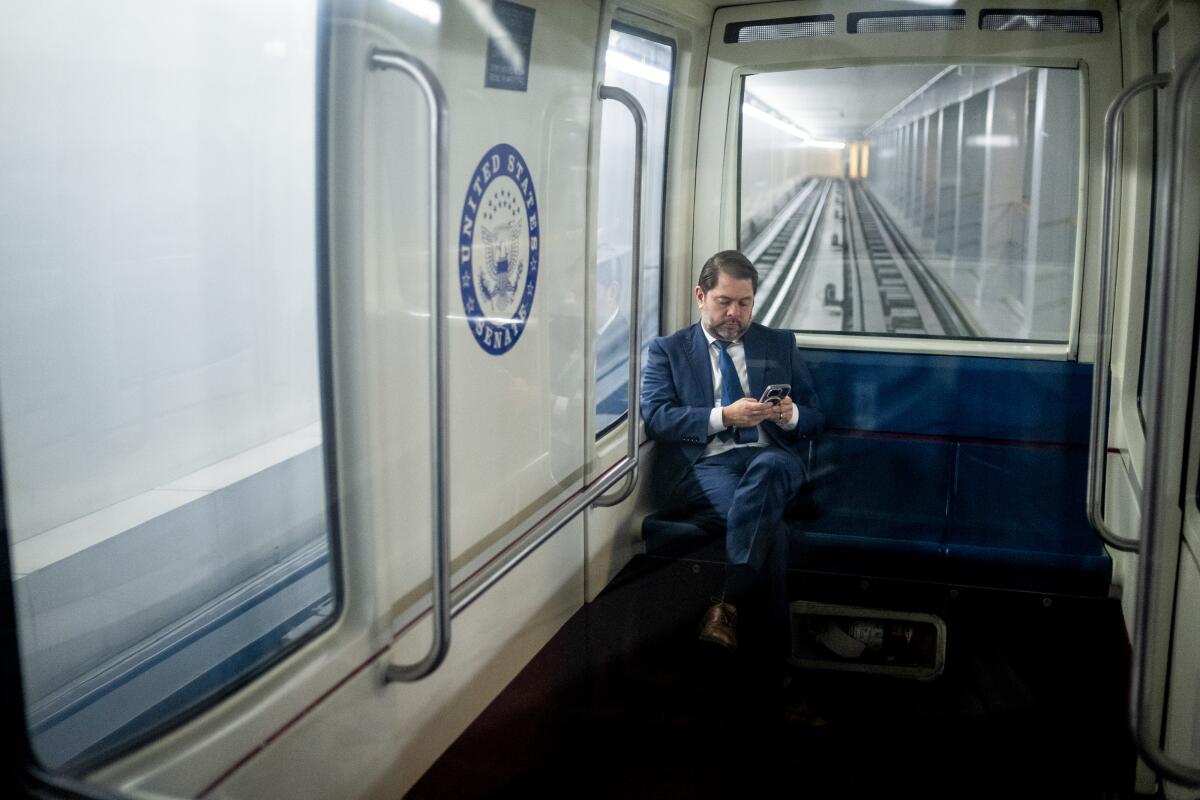
a man in a suit looks at a phone while riding the Senate subway

Sen. Ruben Gallego (D-Ariz.) rides the Senate subway Thursday ahead of the latest partial government shutdown.

(Graeme Sloan / Bloomberg via Getty Images)

As with every shutdown, the agency’s essential functions will continue to operate, Tricia McLaughlin, assistant Homeland Security secretary for public affairs, said in a statement. But employees performing those functions at agencies such as the Federal Emergency Management Agency, the Coast Guard, and the Transportation Security Administration could go without pay if the shutdown stretches for weeks.

The heads of those agencies told the House Homeland Security Appropriations Subcommittee on Wednesday that the shutdown is expected to create severe and lasting challenges.

Vice Adm. Thomas Allan, the acting vice commandant of the Coast Guard, said a shutdown would delay maintenance for boats and aircraft, and halt pay for 56,000 active-duty reserve and civilian personnel. Ha Nguyen McNeill, acting administrator of TSA, recounted how the last government shutdown affected her workers and spiked wait times at airports.

“We heard reports of officers sleeping in their cars at airports to save money on gas, selling their blood and plasma and taking on second jobs to make ends meet,” she said, adding that some are still recovering from the financial impact.

Operations within U.S. Immigration and Customs Enforcement and Customs and Border Protection — the agencies that are central to the budget impasse — are likely to be the least affected. That’s because both agencies still have access to $75 billion in funding approved last year as part of Trump’s “big, beautiful bill.”

By midday Friday, it remained unclear when the partial shutdown would end, as lawmakers left Washington for a security conference in Munich and progress between Democratic and White House negotiators remained nebulous.

“We’ll see what happens,” Trump told reporters on Friday when asked about cutting a deal. “We always have to protect our law enforcement.”

The partial government shutdown comes at a moment of acute public anger at the agency’s approach to immigration enforcement, which has included the fatal shootings of two U.S. citizens, Renee Good and Alex Pretti, in Minneapolis.

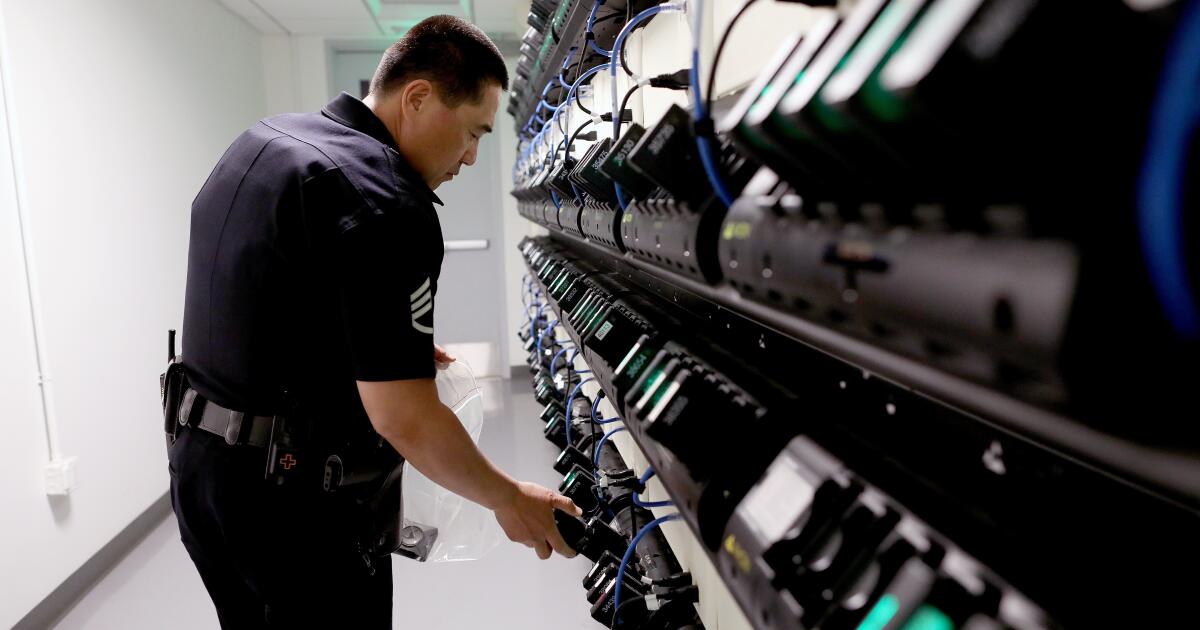
Since the shootings, the Trump administration has tried to quell tensions. Border policy advisor Tom Homan said Thursday that the administration was ending its immigration crackdown in Minneapolis. Homeland Security Secretary Kristi Noem announced earlier this month that the agency would be acquiring and issuing body cameras to federal agents. Trump also said he wants to employ a “softer touch” to immigration enforcement after the killings of Good and Pretti.

But Democrats maintain that they need reforms written into law. Among their demands is requiring officers to wear and turn on body cameras, banning them from wearing masks, and ending the practice of “roving patrols” and instead requiring that they carry out only targeted operations.

“We will not support an extension of the status quo, a status quo that permits masked secret police to barge into people’s homes without warrants, no guardrails and zero oversight from independent authorities,” Senate Minority Leader Chuck Schumer said on the Senate floor Thursday.

Todd M. Lyons, the acting director of ICE, told a Senate panel Thursday that he does not want to see federal agents masked either, but said he is hesitant to bar face coverings because the threats to agents are too severe.

“I would work with this committee and any committee to work with holding individuals accountable that doxx ICE agents, because ICE agents don’t want to be masked,” Lyons said. “They’re honorable men and women, but the threats against their family are real.”

Federal immigration officials are more supportive of body cameras.

U.S. Customs and Border Protection Commissioner Rodney Scott told a House committee on Tuesday that he supports expanding the use of body cameras, but said more funding is needed to hire personnel to oversee the rollout.

“Fund the entire program so that we can be transparent and that we can make sure America knows what we’re doing, because that trust is critically important,” he said.

Ben Johnson, executive director of the American Immigration Lawyers Assn., said that while the White House has made some “tweaks around oversight,” its actions continue to fall short.

The association, which represents 18,000 immigration attorneys, has urged Congress to refuse more funding for ICE and CBP before implementing reforms.

“The American public wants and deserves real, meaningful guardrails that are written into law that ensure this administration — and, quite frankly, any administration — will abide by the Constitution and respect fundamental principles of due process,” Johnson said Wednesday on a call with reporters.

“Congress has a critical opportunity right now to meet that demand,” he added.

three men talk during the Senate Homeland Security and Governmental Affairs Committee hearing

Republican Sens. James Lankford of Oklahoma, Ron Johnson of Wisconsin and Rand Paul of Kentucky talk during a hearing Thursday on oversight of federal immigration agencies.

(Tom Williams / CQ-Roll Call via Getty Images)

So far, Democrats maintain they will continue to bock funding bills without accountability measures in place.

California’s two Democratic U.S. senators, Adam Schiff and Alex Padilla, were among the Senate Democrats who helped block passage of funding bills Thursday that would have averted a shutdown because they lacked accountability measures.

“I will not support more funding for ICE until there are new guardrails to rein in its lawless conduct,” Schiff wrote on X. “I’m a no on anything but real reform.”

Padilla said he would be a “firm no” until lawmakers agree that federal immigration officers need to be held accountable.

“Donald Trump and Republicans want Americans to forget about their lawless immigration roundup, but we won’t,” Padilla said.
Source link

LAPD to train their body cameras on immigration agents, under mayor’s directive

Los Angeles police officers must turn on their body cameras at the scene of federal immigration enforcement operations and preserve the footage, according to an executive directive issued by Mayor Karen Bass on Tuesday.

Since June, federal immigration raids have disrupted neighborhoods and communities across Los Angeles and around the nation, including at work sites, along neighborhood streets and in commercial areas.

Often, police officers have responded to the scene to try to keep order amid tensions between immigration agents and community members.

“The point that we’re trying to make here is that ICE enforcement is not welcome here,” Bass said at a news conference Tuesday morning. “We have resisted against it since this terror started, and we will continue to do that.”

In addition to recording the federal immigration agents’ actions, LAPD officers must document the name and badge number of the agents’ on-scene supervisor, summon emergency personnel if someone at a scene is injured and take reports from the public about federal agents’ alleged misconduct, Bass’ five-page directive states.

The directive also prohibits federal immigration agents from using city property and imposes a fee on owners who allow federal agents to use private property.

The effort builds on a previous Bass directive that aimed to restrict the city from assisting federal immigration agents. The LAPD has a long-standing policy that its officers should not be involved in immigration enforcement.

The Department of Homeland Security did not immediately respond to a request for comment.

Bass noted that officers are supposed to turn on their body cameras anyway, including when they’re responding to a call from the public or when another law enforcement agency asks for assistance.

“We’re saying we really want you to do that, even if you are there and there’s not a disturbance that breaks out, if you’re there on the scene,” Bass said.

The LAPD did not immediately provide comment. The Los Angeles Police Protective League, which represents rank-and-file LAPD officers, did not respond to a request for comment.

In Chicago, the mayor issued a similar directive in January, instructing the Police Department to “investigate and document” alleged illegal activity by federal agents, said Tania Unzueta, political director of Mijente, a national group that organizes within Latino and Chicano communities.

“ICE’s power must be challenged at every level, and local governments have a critical role to play in holding the line against federal enforcement,” Unzueta said.

But in Los Angeles, immigrant rights advocates expressed concerns about requiring the LAPD to police another agency.

Maegan Ortiz, executive director of the Institute of Popular Education of Southern California, or IDEPSCA, cited the LAPD’s history of using excessive force against civilians and said that in the recent immigration raids, officers have sometimes inflamed instead of defused tensions.

“Are they really the best people to determine what is excessive use of force, given the literal millions of dollars that we’re seeing paid out in settlement because of use of force by LAPD?” Ortiz said. “Can we trust this police department to police others when they can’t police themselves?”

James “Jim” Willis, a former LAPD detective who later worked for the L.A. Police Commission’s inspector general’s office, said he agreed with the directive’s intent: to bring greater accountability to Immigration and Customs Enforcement operations. But he has questions about how it would work in practice.

For one thing, he said, it’s unclear whether LAPD officers are supposed to respond whenever an ICE operation is underway. Doing so would put further strain on a department that is down hundreds of officers from a few years ago, he said.

It’s also unclear what will happen with the recorded footage.

“Who’s going to audit this?” he asked. “Do you now create a new group, a new division and new section?”

Since rolling out the tiny recording devices in 2015, the city has spent millions of dollars, both on the body cameras themselves and data storage for the digital files. LAPD officials have conceded that the vast majority of the footage gathered by officers goes unwatched, since there isn’t enough manpower to review it.

At Tuesday’s news conference, Jocelyn Duarte, executive director of the Salvadoran American Leadership and Educational Fund, praised Bass’ directive and called on the Los Angeles Board of Commissioners, which provides civilian oversight of the LAPD, to ensure that officers “protect Angelenos from lawless federal conduct.”

“Local law enforcement must not be complicit through silence or inaction when federal agents overstep legal and ethical boundaries,” Duarte said. “Now it is imperative that our commission and LAPD fully implement this directive and make it clear that our city will not allow for fear-based enforcement to define life in our neighborhoods.”

Ortiz said she is excited that the directive imposes fees on private property owners who allow federal immigration agents to use their property. The Institute of Popular Education of Southern California has been a leader in calling for a boycott against Home Depot, which has not taken a public stance against repeated raids at the day labor centers that the organization runs at the stores.

“I do think that something does need to be done with these huge billion-dollar corporations who are allowing this and are choosing to stay silent while their customers are being dragged away and disappeared,” Ortiz said.

Source link

Immigration officials grilled over U.S. citizen deaths during oversight hearing

The leaders of the agencies enforcing President Trump’s immigration crackdown faced tough questioning on Capitol Hill on Tuesday, with one Democratic lawmaker asking the head of ICE if he would apologize to the families of two U.S. citizens killed by federal agents and called domestic terrorists by Homeland Security Secretary Kristi Noem.

Todd Lyons, acting head of Immigration and Customs Enforcement, declined to apologize to the families of Renee Good and Alex Pretti during the hearing but said he welcomed the opportunity to speak to Good’s family in private.

“I’m not going to speak to any ongoing investigation,” Lyons said.

For the first time since the federal operation in Minneapolis led to the deaths of Good and Pretti, the heads of three immigration agencies testified before the House Homeland Security Committee.

Along with Lyons, the other witnesses were Joseph Edlow, director of U.S. Citizenship and Immigration Services, and Rodney Scott, commissioner of Customs and Border Protection. Their agencies fall under the Department of Homeland Security.

Democrats and some Republicans have called for increased oversight of the Trump administration’s immigration operations since the shootings last month of Good and Pretti, both 37, by federal agents.

In the aftermath of the shootings, the administration replaced Gregory Bovino, a Border Patrol official who led the charge in Minneapolis, with border policy advisor Tom Homan, a former ICE official. Officials also withdrew some agents and began requiring those in Minneapolis to wear body cameras.

“We must take the temperature down and look at the record of enforcement actions through rational eyes,” said the committee’s chair, Rep. Andrew Garbarino (R-N.Y.).

Garbarino asked for commitment from the ICE and CBP leaders to give the committee the full reports and findings of the investigations into the shootings of Good and Pretti once those conclude. Scott and Lyons agreed.

Scott, the CBP commissioner, told the committee members that officers face an unprecedented increase in attacks by people who interfere with law enforcement action. He said these actions are “coordinated and well-funded.”

“This is not peaceful protest,” he said.

Lyons, the ICE leader, told lawmakers that his agency has removed more than 475,000 people from the U.S. and conducted nearly 379,000 arrests since President Trump returned to the White House. He said the agency has hired more than 12,000 officers and agents.

He condemned so-called sanctuary jurisdictions, which limit the collaboration between local law enforcement and ICE, as well as the rhetoric from public officials against ICE.

Lyons testified that 3,000 out of 13,000 ICE agents wear body cameras. Scott estimated that about 10,000 of 20,000 Border Patrol agents wear cameras, adding that “we’re building that program out.”

The agency heads faced intense questioning from Democrats on the committee, including those from California.

Rep. Eric Swalwell (D-Dublin) asked Lyons about his comment last year that the deportation process should work “like Amazon Prime, but with human beings.”

Lyons said the comment had been taken out of context.

“I did say that we need to be more efficient when it comes to removing individuals from the United States, because ICE doesn’t detain people punitively — we detain to remove,” he said. “I don’t want to see people in custody.”

“Well, speaking of human beings, how many times has Amazon Prime shot a nurse 10 times in the back?” Swalwell responded.

Swalwell asked how many agents have been fired for their conduct under Lyons’ leadership. Lyons said he would get that data.

“Can you tell us if, at least — God, I hope at least one person has been fired for their conduct since these operations have begun,” Swalwell said.

Lyons said he wouldn’t talk about personnel.

Swalwell was the one who asked Lyons if he would apologize to the families of Good and Pretti. He also asked if Lyons would resign from ICE. Lyons declined.

Rep. Lou Correa (D-Santa Ana) questioned Lyons about whether carrying a U.S. passport is enough for people to avoid being detained or deported. An October report by ProPublica identified more than 170 instances of U.S. citizens who were detained at raids or protests.

Lyons said U.S. citizens shouldn’t feel the need to carry their passports.

“No American citizen will be arrested for being an American citizen,” Lyons said.

Correa said a number of U.S. citizens in his district, which is majority Latino, have been detained, some for several days.

Lyons said he wasn’t aware of any cases of detained American citizens.

“Are you surveilling U.S. citizens today?” Correa asked.

Lyons said there is no database for protesters.

“I can assure you there is no database that’s tracking down citizens,” he said.

This is a developing story and will be updated.

Source link