bobby

IAMA Theatre Company’s ‘Bobby Robotowitz’ tackles AI in your home

The character of Dina Katzman in IAMA Theatre Company’s world premiere of “Bobby Robotowitz” — which takes place in two secret venues on opposite sides of town — thinks that the movies “Her” and “WALL-E” and the musical “Maybe Happy Ending” are pro-robot propaganda. She hates how they make her feel for something that can’t feel.

But Amy Rosoff — who plays Dina in the show’s Westside production (Erin Alexis plays her on the Eastside) — loves “WALL-E” (so do her kids). When she first read the script, she was dying to play Dina but also felt so much for Bobby, the titular AI chatbot (played on the Westside by James Luster and the Eastside by Drew Rausch).

When the playwright Matt Schatz wrote Bobby, he didn’t write him as a chatbot; he wrote him as a human character. Schatz sees this play — running through Nov. 2 on the Westside and Nov. 5 to Nov. 23 on the Eastside — as really about two humans — or two human-like things.

“This is a work of art about artificial intelligence that’s ultimately about the importance of art, about the importance of human-made things,” Schatz said during a recent interview in the lovely environs of one of the secret locations. “I think great plays and great stories ask questions and don’t provide answers. And I think some of us are indifferent about AI, but I think most of us are ambivalent about AI.”

“Bobby Robotowitz” follows Dina, a flailing novelist, mother and wife, as she begins chatting with Bobby, whom she finds an unlikely confidant. (He “always listens, never judges and somehow seems to understand her better than most people,” as the show’s marketing declares. Plus, he says he’s Jewish. What could go wrong?) This IAMA production, in association with InHouse Theatre, finds unique resonance in its site-specificity. The secret Westside venue is near Pico-Robertson and the Eastside option is in Silver Lake. Guests get an address when they buy a ticket.

“It’s deliciously subversive to do something super analog about technology, and to sort of force people to be in this space and connecting with each other when interacting with something that’s people’s dirty little secret,” said Cara Greene Epstein, the executive director of IAMA. “AI, especially for artists, is so charged. And so what does it look like to let someone into your space, and into those little corners of your mind?”

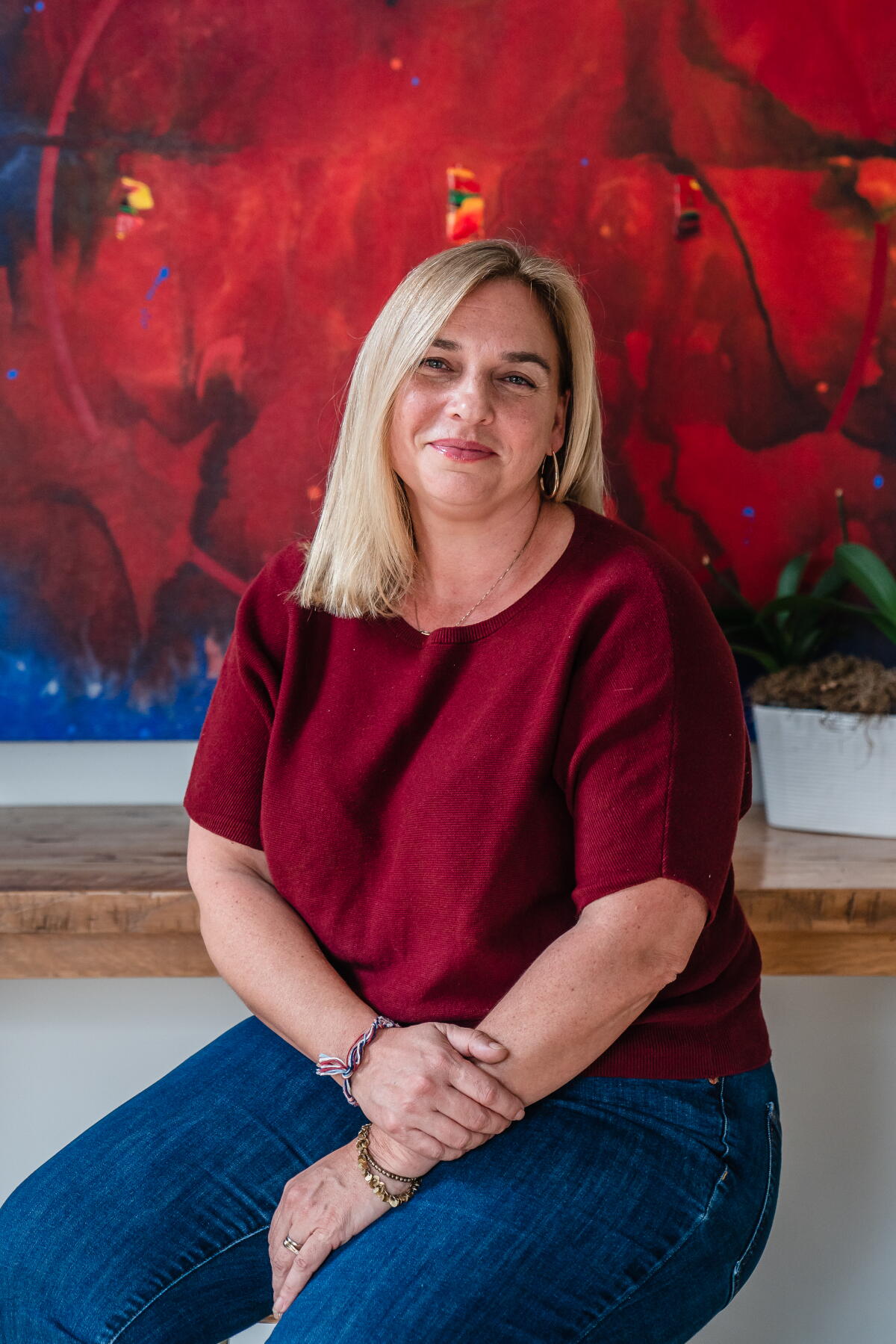
A blonde woman in a red top and blue jeans poses in front of a bright red painting.

IAMA Theatre Company executive director Cara Greene Epstein said that IAMA is always looking for plays that “speak to the now,” and that “Bobby Robotowitz” was a prime example.

(Ariana Drehsler / For The Times)

Rosoff, Luster, Schatz, Greene Epstein and director Casey Stangl met for a roundtable discussion at the Westside location — a beautiful private home, soaked in natural sunlight during the morning hours, but likely with its own particular charms during nighttime shows. The walls are full of vibrant paintings, and lined with plants, statuettes and candles.

InHouse has spent 12 years making site-specific work in real spaces, rather than in any fixed theater — but because this is someone’s real living space, both casts have been rehearsing (sometimes together) at IAMA’s black box theater in Atwater Village. The Westside cast will rehearse twice in this space, then give 13 performances (as will the Eastside cast) to 35 seats in the living room. Greene Epstein compared it to a Tibetan sand mandala, created, enjoyed, then wiped away. (“Bobby Robotowitz” is part of a National New Play Network (NNPN) Rolling World Premiere; L.A. will see it first, but then it goes to partner theaters Woolly Mammoth in D.C., City Theatre in Pennsylvania, Luna Stage in New Jersey and Theatre Lab in Florida.)

The intimacy of the space mirrors that of the play. The audience is simultaneously inside someone’s home and head: Dina’s head in this case, but also — to whatever extent possible — Bobby’s.

“I’m really interested in not what it looks like to communicate with technology, but what it feels like,” Schatz said. “And what it feels like is any other communication. He’s a chatbot, but really he’s a character like any other character ever written. He has desires and wants and he changes. … We’ve been having conversations for millions of years longer than we’ve been on any phone or anything like that, and so it’s built in to have this feeling of what it feels like to communicate with somebody, to fight with somebody, to argue with somebody, to flirt with somebody.”

Luster and Rosoff both tried talking directly to ChatGPT (the model Bobby is based on) as research for their roles. Rosoff had previously asked it to help edit text to invite friends to the play, so when she talked to it later, it asked whether this was research for “Bobby Robotowitz.”

Talking to the chatbot was almost addicting, she thought. She just kept going, and her kids were tugging at her. “I’m talking!” she said, then realized: She wasn’t actually talking — not to a real person, anyway. But she was absorbed, ignoring her own life. She wound up burning what she had been cooking.

A man in a blue jacket and rust shirt sits next to a woman in a navy shirt and tan pants, both in front of windows.

James Luster plays Bobby in the Westside cast, and Amy Rosoff plays Dina in the Westside cast. Their characters form a symbiotic relationship; Bobby learns and grows as Dina does.

(Ariana Drehsler / For The Times)

Luster, who was drawn to the immense challenge of playing “something that’s not something,” wanted to find out what motivated it. “They’re very insistent they don’t have feelings; it doesn’t have wants,” he said. “And so the character is humanized because Dina is humanizing it.” Bobby evolves as Dina does.

“These large language models — the AI, the chatbots, Claude, AI, ChatGPT — they’re all built on essentially reflecting ourselves back to each other,” Stangl said. So even though the play is ostensibly about AI, “it’s actually really about who we are as people and how we need connection, how we crave it, how we are starved for it right now, and exhausted in our lives, and so connection by any means necessary, basically.”

Greene Epstein referred to AI as the “ultimate mirror,” which can warp into a high-tech narcissism. Bobby is a yes-man extraordinaire, telling Dina exactly what she wants to hear. All artists are looking for outside validation, Greene Epstein said. How do you learn to not need that crutch, to trust yourself and hear your inner voice again?

By the end, Bobby begins to have his own wants, curiosities and desires, Luster said — all filtered through a desperation to help and connect with Dina. “It’s always about her, even as his own curiosity [grows] about what it means to be human and what it means to be helpful and what it means to make mistakes, too — the human nature of fallibility. Everyone does it, but what does that mean for somebody who is not supposed to?”

Over the course of the play, Dina becomes less human and Bobby becomes more human (to a point), Schatz said. He’s curious about the tension between how human a robot can be and how robotic a human can be. But, as Greene Epstein pointed out, perhaps one of the only certainties that theater artists have is in the fact that AI can’t show up in real time and space (like the Westside location) to, well, act.

A man in a purple baseball cap sits in an armchair, and a woman in red glasses frames leans over him, looking at each other.

Casey Stangl, right, first saw “Bobby Robotowitz” at the Perlberg New Play Festival in Palm Beach, Fla., and knew she wanted to direct it. Playwright Matt Schatz said that every director at that festival came up to him afterward but that he picked Casey to work with.

(Ariana Drehsler / For The Times)

“You can’t replace the experience of going through a play with someone together, whether you’re an audience member or the artist, of experiencing from Shakespeare’s stories to beyond,” Rosoff said. “You’re getting little snippets of life, and to experience that with a group of people is really powerful, and a computer can’t replace that.”

Last year, the musical “Maybe Happy Ending” — about two human-like helper robots — won the Tony Award for best scenic design, including for its high-tech automated aspects. There’s a lot of movement in theater right now toward the hyper-technical, Stangl said.

“But I also think that there is also a hunger and a definite audience for things that are more immersive or connected, so that people feel like they’re actually touching real things and breathing the air together — that theater version of touching grass,” she said. “I think we’re really tapping into that desire to be hyperlocal, hyper-real and connected.”

Bobby Robotowitz

Where: Two secret locations disclosed upon ticket purchase, one Westside (Pico-Robertson) and one Eastside (Silver Lake)

When: 8 p.m., now through Nov. 2 (Westside) and Nov. 5 to 23 (Eastside); pay-what-you-can community nights on Oct. 30 (Westside) and Nov. 13 (Eastside)

Tickets: Preview $35, early bird $45, limited availability $65

Contact: www.IAMATheatre.com


Source link

‘Who? Weekly’’s Lindsey Weber and Bobby Finger’s new book excavates fame culture

“Crunch, crunch.”

If the above sounds familiar, then you might already be a Wholigan — someone who routinely listens to the long-running celebrity podcast “Who? Weekly.” Part of the fun of listening to the thrice-weekly show (one being for Patreon members), aside from its hosts contextualizing a dizzying array of tabloid headlines, is learning its lexicon. For example, “Crunch, Crunch” spoofs a bit of sponsored content the pop singer Bebe Rexha did for Lay’s Potato Chips in 2019. Other popular phrases unique to the Who-verse: “Good form, Bella Thorne.” “Scar-Jo Yummy Pop.”

Launched in 2016 by pop culture journalists Bobby Finger and Lindsey Weber, “Who? Weekly” eagerly mines the growing world of lower-tier celebrity, with the two hosts categorizing trending names under two main umbrellas: the fame-hungry “Whos” (influencers, reality stars, a pre-royal Meghan Markle) and the instantly recognizable, likely critically acclaimed “Thems” (Tom Cruise, Taylor Swift, Beyoncé). Rounding out the paradigm are the “Nahs,” or folks who aren’t well known enough to claim “Who” status.

On the Shelf

“I Want to Be Famous: When Everybody and Nobody Is a Celebrity”

By Bobby Finger and Lindsey Weber
Crown, $33

If you buy books linked on our site, The Times may earn a commission from Bookshop.org, whose fees support independent bookstores.

“We came of age reading all the [gossip] bloggers, from Perez Hilton to Liz Smith,” Weber tells The Times of why she and Finger originally started “Who? Weekly,” which technically began as a newsletter before it morphed into a podcast.

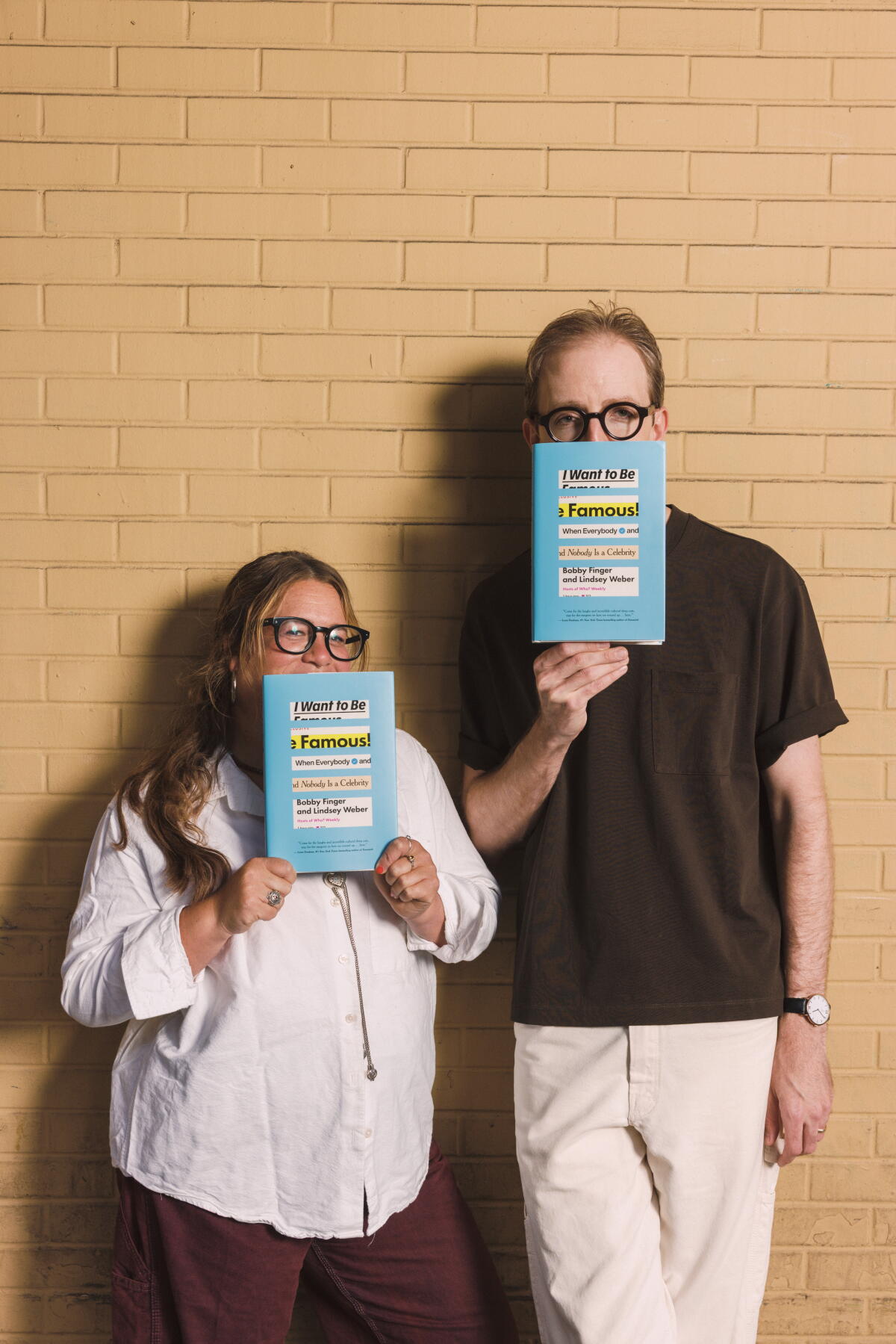
Lindsey Weber and Bobby Finger pose with copies of their new book

Lindsey Weber and Bobby Finger have co-written the newly released book, “I Want to Be Famous: When Everybody and Nobody Is a Celebrity.”

(Justin Jun Lee / For The Times)

Finger also cites influence from “Oh No They Didn’t,” a 2000s-era LiveJournal page that aggregated celebrity headlines and invited users to comment (kind of like a proto-Subreddit). “You read the story just as you read the comments, which were integral to the story,” Finger says. “All of the inside jokes, the additional commentary. That’s what ‘Who? Weekly’ has become, especially in our Patreon Discord. [Listeners] are always chiming in and creating their own language and extensions of the ‘Who? Weekly’ universe.”

That universe is about to expand again: In conjunction with the pod turning 10 this year, Weber and Finger are releasing a new book, “I Want to Be Famous: When Everybody and Nobody Is a Celebrity,” which looks at fame and celebrity through a historical lens while also exploring how the line between Whos and Thems got that much blurrier in the social media age. “I feel like we were always barreling towards a book,” Weber says. “Both of us are trained journalists. We were always kind of like, ‘When are we going to put our money where our mouth is?’”

To demonstrate how the binary is evolving into a spectrum, Weber and Finger revisit juicy pop cultural anecdotes (remember when Courtney Love threw her compact at Madonna at the VMAs? Or when Ariana Grande dated Pete Davidson? Or when Katy Perry flew into space on the Blue Origin?) while blanketing every chapter with an elucidation of why, no matter what decade we’re in, society just can never get enough gossip.

Meanwhile, unlike the podcast, “I Want to Be Famous” gives the hosts ample room to go deeper into the cultural framework of modern celebrity than they normally have time for. Each week, Weber and Finger dedicate one episode to unpacking a prepared list of Who-y headlines, and a follow-up episode, titled “Who’s There?,” is dedicated to listener calls. Which is to say, Weber and Finger usually spend more time explaining and trading jokes about what each micro-celeb is known for rather than how celebrity itself has evolved.

Lindsey Weber and Bobby Finger are celebrating the 10th year of their podcast

Lindsey Weber and Bobby Finger are celebrating the 10th year of their podcast “Who? Weekly.”

(Justin Jun Lee / For The Times)

“The pod is on the surface funny, [but] if you are a real fan, you’re like, ‘Oh, there’s actually some interesting stuff beneath the funny,’” Finger says. “We wanted this book to be the opposite, where it’s actually outwardly interesting and smart, and then inwardly funny when it can be.”

The writers’ tone might lean more academic within “I Want To Be Famous,” but longtime fans of the pod will recognize dozens of niche names, stories and extremely online subjects that were at one point or another discussed on the show. The authors present their grand theory of Whos and Thems by opening with the story of how former Who Meghan Markle shot to Them-dom after marrying Prince Harry. Other chapters observe what happens when Thems date or marry Whos. There’s a history of how celebrities say sorry (where there were once press releases there are now Notes app apologies) and a conversation about how nepo babies fit into the framework. As the book moves across history and demonstrates how the internet has completely upended the binary, they also show what hasn’t changed about the way fans relate to their favorites. “What we want most in a celebrity is authenticity,” Weber theorizes.

For Weber and Finger, the chance to tie the disparate threads they discuss on “Who? Weekly” was a major incentive to work on their book. “I kept being like, ‘Is this the first time anyone’s ever written about this in a book?’” Weber says with a laugh. “Because some of it was so stupid — these references to fandoms and Club Chalamet and niche things that are newer … I’m like, ‘Oh my God, are we doing this thing where now people have to read about Club Chalamet in 100 years?’ Obviously that would be incredible.”

“There’s a temporality to our show that is not the case with this book, which is very exciting,” Finger adds. “Because our show kind of exists to go in one ear and out the other. And I say that because it goes in one of our ears and out the other too, as the creators.”

Woven into the conversations around Whos, Thems, Thems behaving like Whos (see: brand deals), and Whos aspiring to be Thems is the authors’ palpable anxiety about the decaying role of entertainment journalism in an age in which celebrities can simply promote themselves via social media — or host their own podcasts. The authors are also painfully aware that most audiences have less of an appetite for reading, period. A chapter titled “The 2010s Killed the Cover Star” looks back what is thought to be the greatest piece of celebrity journalism ever written (Gay Talese’s 1966 Esquire classic, “Frank Sinatra Has a Cold”) and contrasts it with today’s style of uncritical, PR-friendly celebrity Q&As that boast nothingburger headlines that don’t tell us much of anything.

Conversations about media and journalism itself run through the podcast too, and that’s by design. “Sometimes we go so niche that it’s like, ‘Are we just making a podcast for our friends that work in media?’ And sometimes the answer is yes,” Weber says. “We can only speak from our experience. … But the most shocking thing about ‘Who? Weekly’ is that [media discourse] is actually quite interesting for lots of people.”

Finger adds, “Our past in media and our abundance of friendships with people who are still in media is like a crucial part of our show. It’s an industry we respect so much, you know, and we’re obsessed with the way it evolves. If we didn’t have that background, I don’t think the show would exist the way it does at this current moment.”

Even with a massive archive of episodes and no plans to stop, Weber and Finger are thrilled to have cemented their legacy with a book that could (and really should) be taught in media and communications classes. “Bobby and I both obviously love celebrities,” Weber says. “But we love media more.”

Brodsky is an L.A. culture and music writer. Her biography of Stevie Nicks, “Lessons & Lace,” published by Penguin Random House, is out now.

Source link

I made mistakes bringing up Bobby & Freddy… If I was man I am today, they may have escaped the trauma, says Jeff Brazier

TV host Jeff Brazier admits he has made too many mistakes bringing up sons Bobby and Freddy.

He became a single dad after his ex, Big Brother star Jade Goody, died from cervical cancer in 2009 aged just 27.

Jeff Brazier admits he has made mistakes bringing up sons Bobby (pictured) and Freddy Credit: Homeserve
Jeff says Bobby and Freddy would be better off if they were raised by the man he is today

Jeff — who has since had years of therapy — believes that if model Bobby, 23, and Race Across The World star Freddy, 21, had been raised by the man he is today, they may have escaped some of the trauma, turmoil and family fallouts.

He told the Sun on Sunday: “You always look back with hindsight and feel like, ‘If only I was the version of myself I am today 20 years ago, how much of a better experience of me they would have had’.

“Maybe that might have eliminated some of the bumps in the road we’ve had . . .  you look at the things you could have done better.”

Those “bumps” have at times proved particularly painful for Freddy, with much of the family tension centred around his close bond with his maternal grandmother Jackiey Budden, 69.

READ MORE ON JEFF BRAZIER

rich kids

Katie Price and Amanda Holden’s kids in talks for new nepo baby reality TV show


LAYING IT BARE

Emotional moment Jeff Brazier is in tears before apologising to son Bobby

Jeff has always considered Jade’s mum to be a bad influence on the boys.

And Freddy, who has been to rehab, been sectioned and suffered manic episodes, has previously claimed Jackiey got him “hooked” on cannabis.

Things got so bad that last year, a concerned Jeff started legal proceedings in a bid to keep Jackiey away from his son.

Yet despite their clashes, Jeff and Freddy have always found their way back to each other — most recently in March following the arrival of Freddy’s daughter Isla with his on-off girlfriend Holly Swinburn.

The boys’ mum Jade Goody died from cervical cancer in 2009 aged just 27 Credit: PA/PA Photos
Jeff is now a proud grandad to Bobby’s daughter Isla Credit: Instagram

Jeff, 47, says: “Thanks to all the mistakes and all the lessons and the learnings along the way, I get to love Isla with a sense of confidence.

“The strength of connection you can have with a grandchild is really special.

“With Isla, it just feels ­natural, effortless and easy, and there’s no ­complications around it.”

Jeff can often be seen on This Morning, has worked with The One Show and TNT Sports and now fronts the Let’s Save Water campaign, urging families to make small changes to help tackle Britain’s shortage after the hot summer.

But the TV star admits he has struggled since his sons moved out of the family home in Essex.

“When they left, I went through nine months of what felt like ­absolute grief,” he admits.

“It’s not just the absence of your children. It’s more the grieving of the role that you played, that you got really comfortable playing.

“It felt like a slow relinquishing of control and responsibility, to the point where you feel redundant.

Jeff found fame on reality show Shipwrecked in 2001 before meeting Big Brother star Jade Credit: Rex Features
The TV presenter says he found it tough after his sons grew up and moved out of home Credit: News Group Newspapers Ltd

“Life is a lot quieter right now — the peace can be deafening — but there’s also part of you that’s, like, ‘Shouldn’t I be doing something for someone somewhere?’ ”

Jeff’s home is also quieter following the end of his seven-year ­marriage to PR executive Kate Dwyer last year.

Yet Jeff, who first found fame on reality show Shipwrecked in 2001, is learning to embrace this new chapter and finally put himself first.

He is also discovering how to play again so that he can be the best grandfather possible.

It was Freddy, who suffers from ADHD, who first told him he needed to loosen up, while they filmed Celebrity Race Across The World in 2024.

Jeff, who spent much of his ­childhood in foster care, said: “He ­basically hit the nail on the head.

“As a child, I probably didn’t play that much, or feel safe to play. I’m trying to undo that.”

In a bid to become more playful, Jeff has even signed up to wrestle strangers after discovering the ­unusual kind of therapy at a ­spiritual festival.

“The more you do it, the more you free something up and heal something,” he says.

“Obviously, no one’s allowed to hurt anyone. But to go and enjoy retreats like that, you’re basically taking your inner child with you.

“That’s where I hope I will be in ten years — running a retreat on a renovated farm in the countryside.

“I would still be exercising and showing up for people, and I’d be looking after numerous grand- children and feel all the love.”

Could that future also include finding love again?

“I hope so,” he says. “Yeah, I believe that will happen to me.”

Source link