Weekly insights and analysis on the latest developments in military technology, strategy, and foreign policy.
Venerable A-10 Warthog attack jets are helping dismantle Iran’s Navy. Though the A-10 is most commonly associated with missions over land, the jets have a long-standing, if often obscure, maritime role. Moreover, Warthog pilots have been training for decades for the specific scenario of hunting Iran’s fleets of fast boats in and around the highly strategic Strait of Hormuz. All of this comes as the U.S. military works to find ways to reopen the critical waterway to normal maritime commerce, which has ground to a virtual halt in the face of Iranian attacks on shipping and its declaration that the strait is closed.
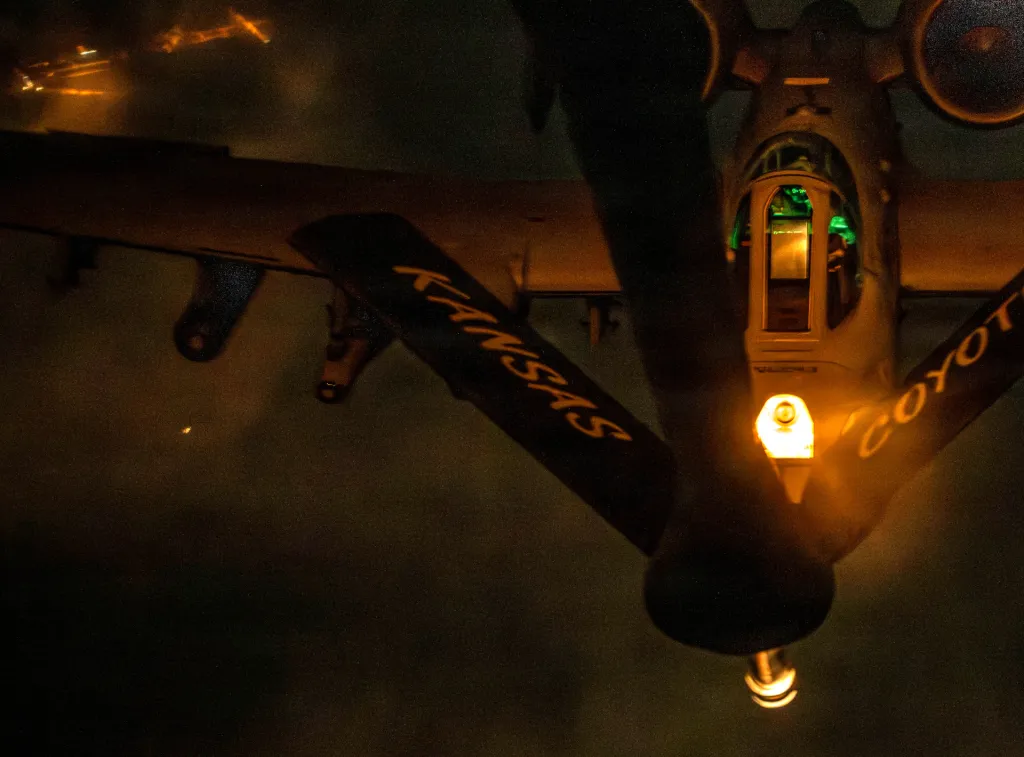
Chairman of the Joint Chiefs of Staff U.S. Air Force Gen. Dan “Razin” Caine discussed the A-10’s contribution to the current conflict with Iran at a Pentagon press conference this morning. The U.S. military has previously disclosed the basic fact that Warthogs have been supporting what is dubbed Operation Epic Fury. A-10s have previously been seen attacking Iranian-backed militias in Iraq. The A-10 is very much in the twilight of its career, with the Air Force hoping to have the type retired for good by the end of the decade, if not sooner.
An A-10 seen linking up with a tanker while flying a mission in support of Operation Epic Fury. CENTCOM
“The A-10 Warthog is now in the fight across the southern flank [of Iran] and is hunting and killing fast attack watercraft in the Strait of Hormuz,” Caine said.
Caine also said that AH-64 Apache attack helicopters are now operating in a similar manner as the A-10, but did not say specifically that they were being used against maritime targets. He did note that U.S. allies in the region have been using their own AH-64s to help shoot down incoming Iranian drones, something that has been observed already in the course of the current conflict. Israel has long used Apaches in the counter-drone role, and TWZ has been closely tracking work to expand the helicopter’s capabilities in this regard, including by the U.S. Army.
“We continue to hunt and kill [Iranian] afloat assets, including more than 120 vessels and 44 mine layers,” the Chairman also said, speaking more broadly. The total destruction of Iran’s naval forces is one of the core stated goals of Operation Epic Fury.
When it comes to the A-10, as noted, despite years of the aircraft being referred to as a ‘single mission’ platform geared solely to close air support missions in support of ground forces, it has long had a maritime role. Just weeks before the current conflict erupted, the U.S. military underscored this reality by releasing pictures showing Warthogs training together with the USS Santa Barbara, a U.S. Navy Independence class Littoral Combat Ship (LCS) in the Persian Gulf.
“The irony here is that the A-10’s continued use in the Middle East goes against a prevailing narrative that the Warthog needs to go because its utility is limited on the modern battlefield. This argument is not without merit, but it assumes that every tactical air asset in the inventory needs to be able to fight on the front lines on day one of a conflict with a peer-adversary, and that there are not many other tasks needing to be done beyond firing the shots at the ‘tip of the spear’ during such a conflict. It’s also worth noting that the A-10 remains the least expensive tactical jet to operate in the USAF’s stable.”
“Regardless of the A-10’s impending fate, its ability to deliver rapid, highly precise attacks on small, fast-moving targets, and its ability to loiter for extended periods while soaking up small arms fire, means that its talents can be applied directly to the maritime domain. This is especially true when it comes to countering small boats that can pose a big danger to much larger ships. Such asymmetric dangers are only amplified for ships operating in tight, complex littoral environments, where threats can emerge quickly and attack in large packs, leaving even the most powerful warship’s defenses overwhelmed.”
An A-10 flies past the Independence class LCS USS Santa Barbara during an exercise in the Persian Gulf in early February 2026. USN
This particular exercise also underscored the danger posed by Iranian naval mines, and how A-10s could help protect ships tasked to clear them. The Santa Barbara is one of three Independence class LCSs configured for minesweeping duties that had been forward deployed in the Middle East last year to fill gaps left by the decommissioning of a quartet of Avenger class mine hunters. Those ships have become a separate topic of discussion after two of them, the USS Tulsa and USS Santa Barbara, emerged thousands of miles away to the east, first in Malaysia and now in Singapore. Why the Navy sent those ships not just out of harm’s way in the Middle East in the run-up to the current conflict, but then to an entirely different theater remains largely unexplained.
In general, threats posed by small boats, especially operating in swarms, are not new. This is also an area where Iran’s Islamic Revolutionary Guard Corps has invested heavily for decades, as TWZ has explored in the past. U.S. officials have previously declared the Iranian Navy to have been rendered combat ineffective, but many of the more than 120 ships it has targeted so far have been larger vessels. Iran has hundreds of fast boats, some of which are armed with short-range anti-ship missiles, as well as artillery rockets and other weapons. They can also be used to lay naval mines. These fleets are inherently harder to find and fix, and do not need large ports to operate from. The A-10’s attributes, including its long loiter time, make it a key tool for interdicting these threats.
All of this is now further magnified by the expanding use of explosive-laden drone boats. Though kamikaze uncrewed surface vessels are now firmly in the public consciousness as a result of their use in the conflict in Ukraine, Iran and its regional proxies pioneered their use in Middle Eastern waterways years beforehand. This is a capability that Iran has now brought to bear in its efforts to keep the Strait of Hormuz closed to regular maritime traffic.
In terms of air defense threats around the Strait of Hormuz, this likely comes mainly from shoulder-fired surface-to-air missiles, or man-portable air defense systems (MANPADS), at this point in the conflict. Despite concerns voiced about their survivability over the years, A-10s are capable of fighting in that kind of threat ecosystem.
U.S. Central Command has previously released pictures showing Warthogs flying in support of Epic Fury carrying loadouts that include 70mm APKWS II laser-guided rockets and AGM-65 Maverick air-to-surface missiles, as well as AIM-9M Sidewinder air-to-air missiles. The A-10s also have their iconic built-in 30mm GAU-8/A Avenger cannons. APKWS IIs, AGM-65s, and the GAU-8/A are all weapons that can be effectively employed against targets at sea, including small boats, along with various threats on land.
An A-10 carrying a mixture of APKWS II rockets, AGM-65 Maverick missiles, and AIM-9M Sidewinders seen during a sortie in support of Operation Epic Fury. CENTCOM
These are also just the A-10 loadouts that have been shared publicly. The Warthogs can carry a wide array of other precision-guided munitions that could be employed against Iranian boats sitting in port or on the move in and around the Strait of Hormuz, as well as other targets.
As an aside, when A-10s carry AIM-9Ms, it is typically for self-defense, but the Warthogs could also possibly use those missiles to engage Iranian one-way attack drones if the opportunity were to arise. A-10s are also capable of employing air-to-air optimized versions of the APKWS II rocket against drones, as you can read more about here.
Chairman Caine’s confirmation this morning that A-10s are flying missions over and around the Strait of Hormuz also comes amid a clear uptick in overall U.S. operations in this particular area.
“As reported by U.S. Central Command yesterday, the U.S. military dropped 5,000-pound penetrator weapons into underground storage facilities storing coastal defense cruise missiles and other support equipment,” Caine also said. “These [bunker-buster] weapons are bespokely designed to get through concrete and or rocks and function after penetrating those barriers.”
The Chairman did not name the bombs in question, which have previously been reported to have been new GBU-72/B types, as you can learn more about here.
“We continue to hunt and kill mine storage facilities and naval ammunition depots,” Caine added.
It is possible that the A-10’s role in the littorals along Iran’s southern coast could expand in the coming weeks. Reuters reported yesterday that the U.S. military is considering a range of new options for trying to reopen the Strait of Hormuz, including a possible ground incursion to temporarily occupy parts of the Iranian shoreline. A potential mission to seize control of Iran’s highly strategic Kharg Island in the Persian Gulf has also been raised. A group of Navy amphibious warfare ships laden with Marines is already reportedly on its way to the Middle East. U.S. Navy warships escorting convoys of commercial vessels through the strait is another possibility, but American officials have downplayed the prospect of that starting any time soon. Any of these courses of action entails significant risks.
U.S. President Donald Trump has notably gone back and forth in recent days about a desire for a broader international mission to help get commercial ships flowing again through the strait. After being publicly rebuffed by several allies and partners, Trump said the United States no longer required any help.
“I wonder what would happen if we ‘finished off’ what’s left of the Iranian Terror State, and let the Countries that use it, we don’t, be responsible for the so called ‘Straight?’ [sic],” Trump then wrote yesterday in a post on his Truth Social site. “That would get some of our non-responsive ‘Allies’ in gear, and fast!!!”
Trump: “I wonder what would happen if we ‘finished off’ what’s left of the Iranian Terror State, and let the Countries that use it, we don’t, be responsible for the so called ‘Straight?’ That would get some of our non-responsive ‘Allies’ in gear, and fast!!! President DJT” pic.twitter.com/pwbF1lYELS
In the meantime, we know that A-10s are now actively on the hunt for Iranian maritime threats around the Strait of Hormuz as part of what could be one of the Warthog’s last major combat deployments ever.
It was so big it couldn’t use the English Channel, Suez Canal or Panama Canal.
The biggest ship in the world was taller than iconic buildings(Image: Cheunghyo/Getty)
The biggest ship in the world was longer than both the Eiffel Tower and the Empire State Building. It was known as the Seawise Giant and became one of the longest self-propelled ships in history.
The boat, later called Happy Giant, Knock Nevis and Mont, was built in Japan between 1974 and 1979. It had the greatest deadweight tonnage of a ship ever recorded.
Fully laden, it was 657,019 tonnes and was the heaviest in the world. Seawise Giant had a draft of 24.6 meters (81ft) and a length of 458.45 meters (1,504.1 ft).
Due to its size, it was incapable of navigating the English Channel, the Suez Canal or the Panama Canal.
The ship has a long history, and was created by Sumitomo Heavy Industries, Ltd in Yokosuka, Kanagawa, Japan, as an Ultra Large Crude Carrier.
It remained unnamed for a long time and was identified as its hull number, 1016. The ship suffered severe vibration problems during sea trials, and an unknown Greek owner refused to take delivery of it.
Eventually, the Japanese shipyard sold the ship thanks to a deal with Hong Kong Orient Overseas Container Line. Yet, they wanted to lengthen the ship by several meters and add 146,152 tonnes of cargo capacity.
Two years later, the ship relaunched as the Seawise Giant. In 1988, it was damaged during the Iran-Iraq war after fires erupted aboard the ship, and oil spread into the water.
The ship was still intact but was so damaged it was not deemed economical to repair.
However, a Norwegian investment firm bought the damaged ship. Over the next few years, it was repaired and renamed Happy Giant.
Up until 2004, the ship was owned by various Norwegian investment firms. It was then purchased by First Olsen Tankers and renamed Knock Nevis.
The ship was converted into a primarily moored storage tanker in the Persian Gulf.
However, it was then taken on by new owners Amber Development and named Mont. It had one final voyage to India where the ship was scrapped.
The ship was beached in December 2009 and due to its size, it took until the end of 2010 for it to be scrapped. The Seawise Giant’s anchor was saved and is on public display in Hong Kong.
It goes down in history as the longest ship ever constructed at 458.45 meters and is taller than many of the world’s tallest buildings. The Eiffel Tower stands at 330 meters and the Empire State Building at 443 meters.
Iranian explosive-laden boats appear to have attacked two fuel tankers in Iraqi waters, setting them ablaze and killing one crew member, after projectiles struck three vessels in Gulf waters, according to reports.
The ships targeted in late-night attacks on Wednesday in the Gulf near Iraq were the Marshall Islands-flagged Safesea Vishnu and the Zefyros, which had loaded fuel cargoes in Iraq, two Iraqi port officials told the Reuters news agency.
Recommended Stories
list of 4 itemsend of list
“We recovered the body of a foreign crew member from the water,” one port security official said, as Iraqi rescue teams continued searching for other missing seafarers. It was not immediately clear which ship that person was linked to.
One Iraqi port security source said Zefyros is flagged in Malta and provided Reuters with a list of crew names.
Al Jazeera’s correspondent in Baghdad, Iraq, Mahmoud Abdelwahed, said the tankers were loaded with crude oil from the Umm Qasr port in southern Iraq in the Basra province, and were attacked soon after their voyage got under way.
“Iraqi officials say this is a flagrant violation of Iraq’s sovereignty given the fact this act, they say, of sabotage has happened in Iraq’s territorial waters,” Abdelwahed said.
Reuters said that reports of the use of explosive-laden unmanned surface vessels, which Ukraine has used with great effect in its war with Russia, come as Iran has blocked oil shipments from transiting the key Strait of Hormuz, through which one-fifth of the world’s oil transits but has been blocked amid the United States-Israeli war on Iran.
Reuters, citing two unnamed sources, also reported on Wednesday that Iran has deployed about a dozen mines in the strait, while US President Donald Trump said US forces had struck 28 Iranian mine-laying vessels, amid warnings by Trump of severe repercussions should Iran lay mines in the key waterway for global shipping.
Strait of Hormuz sealed
Iran’s Islamic Revolutionary Guard Corps (IRGC) have warned that any ship passing through the Strait of Hormuz will be targeted.
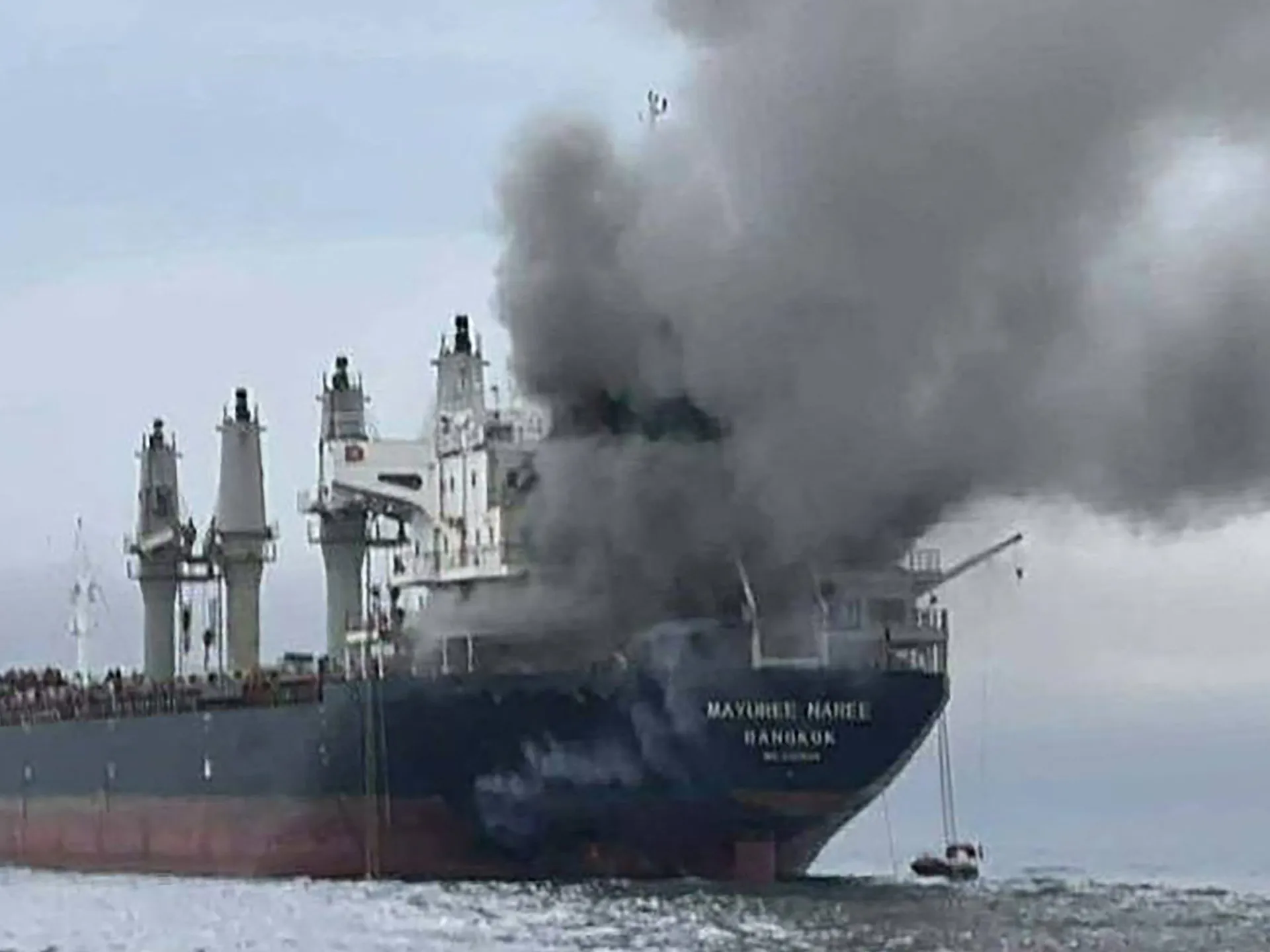
The Thai-flagged Mayuree Naree dry bulk vessel was struck by “two projectiles of unknown origin” while sailing through the strait earlier on Wednesday, causing a fire and damaging the engine room, the ship’s Thai-listed operator Precious Shipping said in a statement.
“Three crew members are reported missing and believed to be trapped in the engine room,” Precious Shipping said.
“The company is working with the relevant authorities to rescue these three missing crew members,” it said, adding that the remaining 20 crew members had been safely evacuated and were ashore in Oman.
Images shared by Thai news outlet Khaosod English showed what were reported to be crew members of the ship after their rescue by Oman’s navy.
The IRGC said in a statement carried by the semi-official Tasnim news agency that the ship was “fired upon by Iranian fighters”, suggesting the first direct engagement by the IRGC, who have previously fired missiles or drones.
The Japan-flagged container ship ONE Majesty also sustained minor damage on Wednesday from an unknown projectile 25 nautical miles (about 46 kilometres) northwest of Ras al-Khaimah in the United Arab Emirates, two maritime security firms said. Its Japanese owner Mitsui OSK Lines and a spokesperson for Ocean Network Express, its charterer, said the vessel was struck while at anchor in the Gulf, and an inspection of the hull revealed minor damage above the waterline.
All crew are safe, they said, adding that the vessel remains fully operational and seaworthy. The owner said the cause of the incident remained unclear and was under investigation.
A third vessel, a bulk carrier, was also hit by an unknown projectile approximately 50 nautical miles (about 93km) northwest of Dubai, maritime security firms said.
The projectile had damaged the hull of the Marshall Islands-flagged Star Gwyneth, maritime risk management company Vanguard said, adding that the vessel’s crew were safe. Owner Star Bulk Carriers said the ship was hit in the hold area while it was anchored. There were no crew injuries and no listing.
The US Navy has refused near-daily requests from the shipping industry for military escorts through the Strait of Hormuz since the start of the war on Iran, saying the risk of attacks is too high for now, sources familiar with the matter told Reuters.
This hidden gem off the Cumbrian coast boasts a medieval castle, The Ship Inn pub, and a landlord crowned in a centuries-old tradition
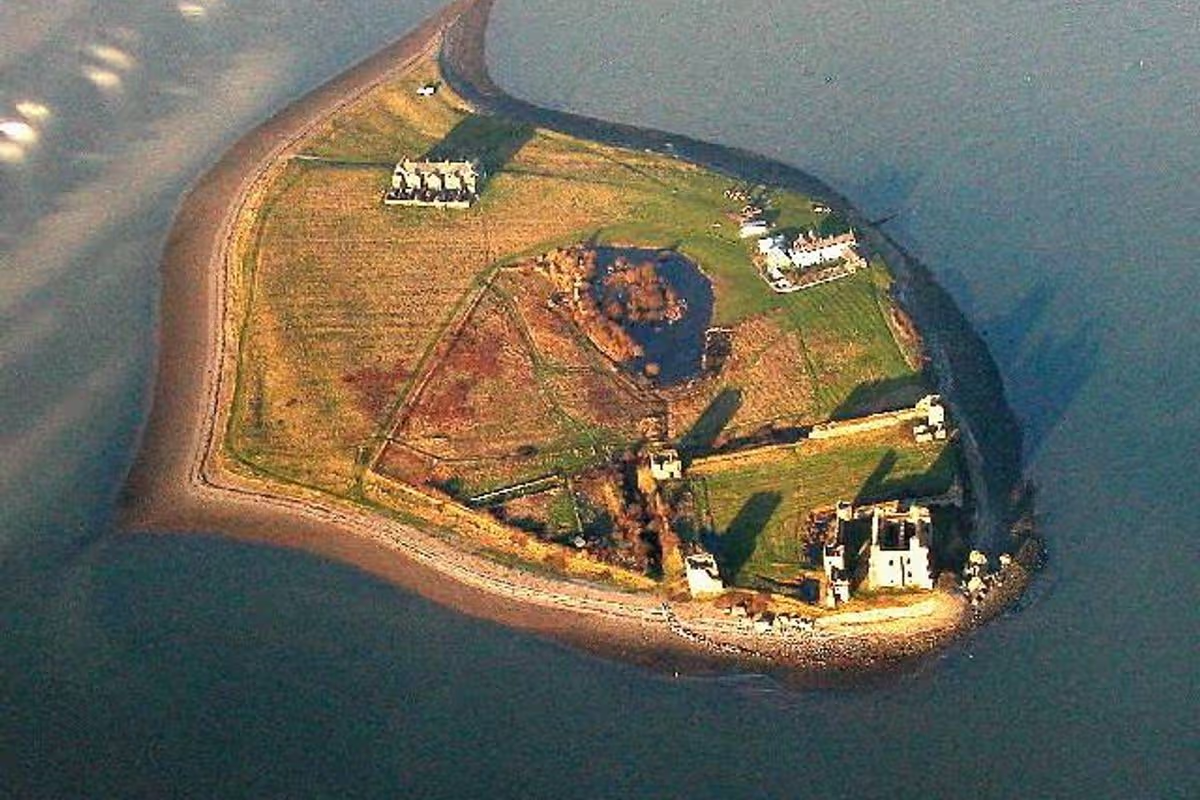
The tiny island is protected by English Heritage(Image: Simon Ledingham / geograph.org.uk)
Charming and eccentric, this tiny island off the Cumbrian coastline attracts visitors eager to experience its remarkable setting and rich historical heritage.
Resembling something from a storybook, Piel Island boasts a crumbling castle and its own monarch – though not in the traditional sense.
As far as hidden treasures go, this destination epitomises the term, nestled discreetly beyond Barrow-in-Furness in Cumbria and accessible only by boat or guided crossing when tidal conditions permit.
Yet the panoramas upon arrival are spectacular, offering vistas across Yorkshire, the Lake District and even as far as Blackpool. It’s possible to spot Blackpool Tower emerging through the waves and, notably, ‘The Big One’ rollercoaster at Pleasure Beach.
Best Lancashire holiday cottage deals
This article contains affiliate links, we will receive a commission on any sales we generate from it. Learn more
Lancashire is known for its wide open skies, stunning landscapes and lively coastal resorts. Sykes Cottages has a wide range of self catering accommodation across the county from £42 a night.
One visitor described it as a secret “paradise”, saying on TripAdvisor : “We love everything about Piel, from the walk over the sands to the warm welcome at the pub and the always exciting exploration of the castle: we’ve seen it many times – always find something new!”
Historical background
Dominating the landscape stands a 14th-century fortification, referred to by some as Fouldry Castle, constructed by the Abbot of Furness with the purpose of protecting Barrow-in-Furness.
The structure served to defend against marauding pirates or Scottish invaders on the surrounding waters. Notably, it sheltered Lambert Simnel, a challenger to Henry VII’s crown, who arrived on the island in 1487.
Whilst naturally the castle in its complete form couldn’t survive such an extended period, its remains stay remarkably preserved, revealing the principal structure that once stood there.
Guests can observe the keep, both the inner and outer baileys and the towered curtain walls, which possess an unsettling atmosphere.
The Ship Inn
The origins of The Ship Inn are somewhat unclear, though it’s thought to date back more than 300 years. Whilst there is minimal evidence, accounts indicate the location was converted from a former ship chandlery at some point during the 17th century.
Over the years, numerous travellers started using the pub as a boozy refuge, which led to several issues out at sea. Indeed, following a series of boating incidents and suspected fatalities in the 19th century, a coroner is believed to have issued a statement to the pub’s landlord.
The Ship Inn’s website states that it read: “The landlord of the Ship Inn should not supply drink so as to make incapable men who may have to take charge of a boat.”
Today, the pub continues to operate as a traditional community hub from March to September, offering an extensive selection of beers from local breweries, alongside wines, spirits and even better – food. The menu features beloved pub grub favourites including pies, wraps and jacket potatoes.
One Google review states: “Absolute gem of a place. We spent a half day on the island – took the ferry across (seven quid return for adults), had delicious burger and chips from the BARBECUE at the pub before a walk round the entire island, a wander round the castle ruins and time on the beach. Everyone was super friendly. We’d definitely consider going back to camp.”
Further cementing its unique charm, the pub’s landlord, Aaron Sanderson, who has held the role since 2022, was officially – or unofficially – crowned as the king of Piel in a traditional ceremony. This is a title bestowed upon every landlord of the pub, with the inaugural version of this ritual believed to have occurred in 1856.
In an interview with the BBC, Andersen said: “It’s definitely a unique role and difficult to do, but enjoyable at the same time. ” He also proudly declared that his pub boasts “probably one of the best beer gardens in the world.”
Getting there
Adding to the allure and mystery, the island is almost exclusively accessible via a single boat, which can only accommodate up to 12 passengers. The ferry departs from Roa Island in Barrow daily throughout the summer season, running from 11am right up until 4:30pm.
Reviews indicate that the journey costs around £7, and for those not quite ready to depart, camping is available from as little as £5. The cost is per tent and there’s no need for a pre-booking system; simply arrive and pitch up by the pub.
When the tide is low, there’s an opportunity to embark on a guided walk over to the island, but only when it’s safe to do so. As for driving, only three individuals have been granted permission to drive on the land, one of them being the king, naturally, and it’s no simple task.
Ensure our latest headlines always appear at the top of your Google Search by making us a Preferred Source.Click here to activate or add us as your Preferred Source in your Google search settings.
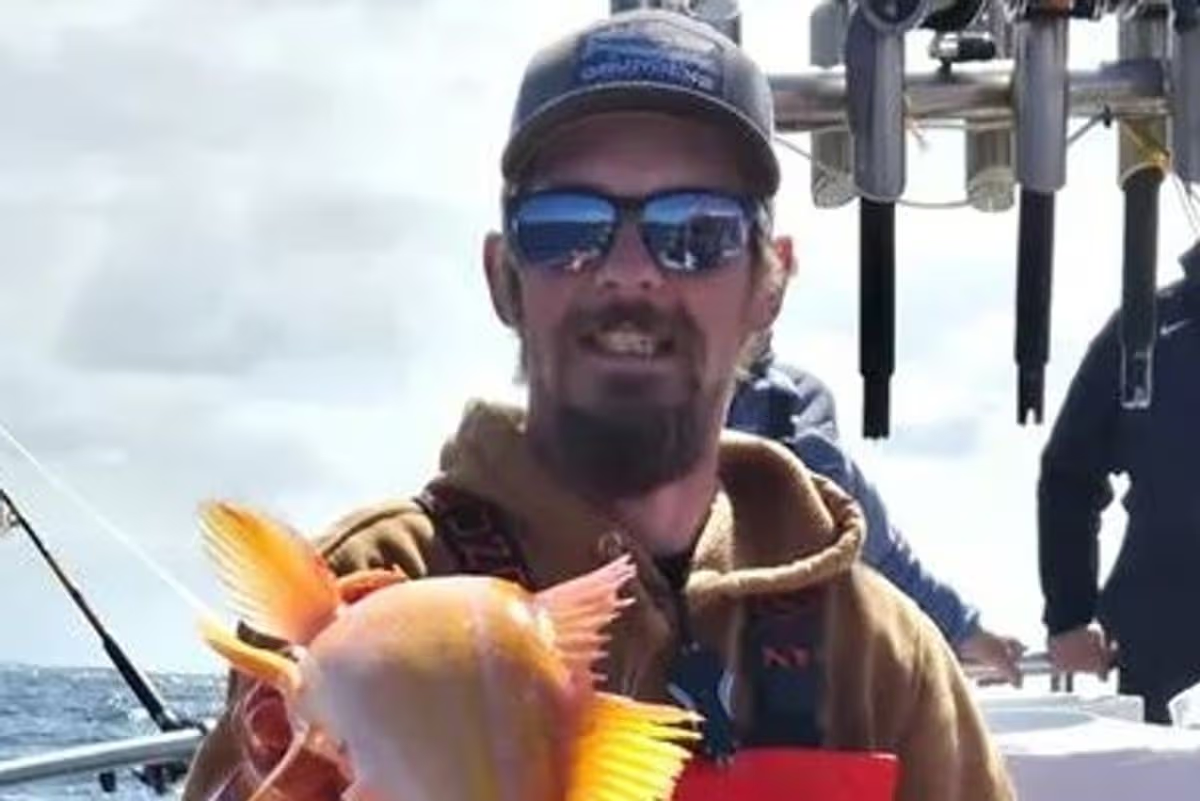
Todd Meadows – who appeared on Discovery Channel show Deadliest Catch – died aged 25 on Wednesday February 25, described as “the most tragic day in the history of the Aleutian Lady”
Todd Meadows’ passing on Wednesday rocked the reality TV world as the young presenter was a popular expert on Deadliest Catch on the Discovery Channel. Now the United States Coast Guard Arctic District says the investigation has suggested Mr Meadows fell off a boat during filming for the programme.
The boat, called the Aleutian Lady, was approximately 170 miles north of the coast when the tragedy happened. The new statement from the Coast Guard reads: “Coast Guard watchstanders at the Arctic District command center in Juneau received notification from the fishing vessel Aleutian Lady, reporting that a crew member by the name of Todd Meadows fell overboard approximately 170 miles north of Dutch Harbor.
“He was recovered unresponsive by the crew approximately ten minutes later. First aid and attempts to resuscitate were unsuccessful, and the crew transported the deceased to Dutch Harbor.”
Dutch Harbor is a point at Unalaska, Alaska, where temperatures plunged to -14C on Wednesday. Officials there continue to investigate the death, which has left his family and fans heartbroken.
Captain Rick Shelford, also on the programme, told fans the tragic news this week on Facebook. He said: “February 25, 2026 was the most tragic day in the history of the Aleutian Lady on the Bering Sea. We lost our brother, Todd Meadows. Todd was the newest member of our crew, he quickly became family. His love for fishing and his strong work ethic earned everyone’s respect right away. His smile was contagious, and the sound of his laughter coming up the wheelhouse stairs or over the deck hailer is something we will carry with us always.”
Todd, who was a dad, was known for his time on the popular Discovery Channel series about the high-stakes world of crab fishing. The Facebook tribute added: “Todd’s love for his children, his family, and his life was evident in everything he did,” Shelford added. “He worked hard, loved deeply, and brought joy to those around him. Right now, our hearts are broken in a way that words can’t fully express. We ask that you lift Todd’s children and family in prayer and keep them in your thoughts as they face the days ahead without him.”
The post, which featured several photos of Meadows, concluded: “Todd will forever be part of this boat, this crew, and this brotherhood. Though we lost him far too soon, his legacy will live on through his children and in every memory we carry of him. Rest easy brother, till we meet again.”
In a separate statement to PEOPLE, a Discovery Channel spokesperson paid tribute to Meadows. The station said: “We are deeply saddened by the tragic passing of Todd Meadows. This is a devastating loss, and our hearts are with his loved ones, his crewmates, and the entire fishing community during this incredibly difficult time.”