Warner Bros. Discovery said Tuesday that it was “reviewing” a revised offer from Paramount Skydance — the latest twist in the high-profile auction to claim one of Hollywood’s corporate jewels.
The company did not provide any details of Paramount’s bid. Paramount separately confirmed that it submitted a revised offer.
In a short statement, Warner acknowledged that Paramount had submitted a modified proposal to buy all of the company’s outstanding shares and that board members were evaluating the offer “in consultation with our financial and legal advisors.”
“We will update our shareholders following the Board’s review,” Warner said.
The Larry Ellison-backed Paramount had been facing a late Monday night deadline to boost its bid to claim the company that owns CNN, HBO, TBS and the storied Warner Bros. movie and film studios. Last week, the auction’s winning bidder — Netflix — agreed to allow Warner Bros. Discovery to reopen talks with Paramount for seven days to determine whether Paramount would bring more money to the table.
Warner instructed Paramount to present its “best and final” offer.
The move comes nearly three months after Warner’s board unanimously agreed to sell HBO and studio assets, including its deep library that includes Superman, Harry Potter, Scooby-Doo, “Game of Thrones,” and “The Big Bang Theory,” to Netflix for $27.75 a share.
Netflix’s deal, valued at $82.7 billion, does not include Warner’s basic cable channels, including CNN, TBS and HGTV.
Those channels are slated to be spun off to a new company later this year.
But Paramount, managed by scion David Ellison, has repeatedly cried foul, saying its cash bid for all of Warner Bros. Discovery, including the Warner cable channels, would be more lucrative for shareholders. Paramount, which enjoys friendly relations with President Trump, has also boasted that it has a more certain path to win U.S. regulatory approval compared to Netflix.
But Warner Bros.’ board has stuck with Netflix’s bid, saying the streaming giant’s financing was more secure.
“The Netflix merger agreement remains in effect, and the Board continues to recommend in favor of the Netflix transaction,” Warner said in its Tuesday statement.
Warner Bros. Discovery told Paramount last week that it expected the billionaire Ellison to put more money into the deal.
Paramount has previously said that the tech billionaire would guarantee more than $41 billion in equity financing that was needed to pull of the more than $108-billion take-over.
Under Paramount’s previous offer, the Ellison family was planning to contribute about $12 billion. Another $24 billion was expected to come from the royal families from Saudi Arabia, Qatar and Abu Dhabi.
In recent weeks, Paramount agreed to cover a $2.8 billion break-up fee that Warner would owe Netflix should Warner walk away from the Netflix deal. Paramount also suggested that it would increase its offer to at least $31 a share.
The move comes amid heightened political interest in the monumental deal that would reshape Hollywood.
The Department of Justice is investigating whether a Netflix takeover, or Paramount’s alternative bid, would harm competition.
Republican lawmakers have been critical of the Netflix deal, saying it would blunt competition.
President Trump has said he didn’t plan to get involved in the investigation, but over the weekend he threatened Netflix, writing on social media that Netflix must fire Susan Rice, a former high-level Obama and Biden administration official, from its board or “pay the consequences.”
Warner Bros. Discovery is consulting with investment bankers from Allen & Company, J.P. Morgan and Evercore and the law firms Wachtell Lipton and Debevoise & Plimpton.
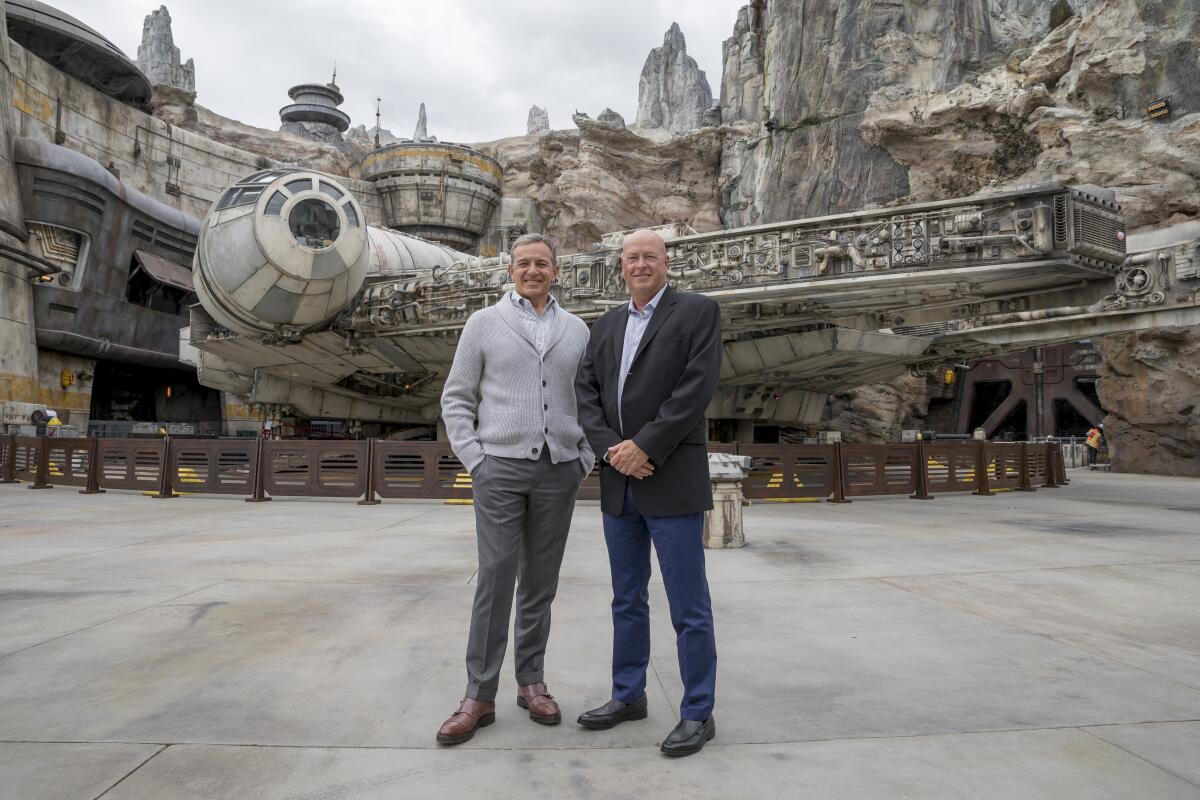
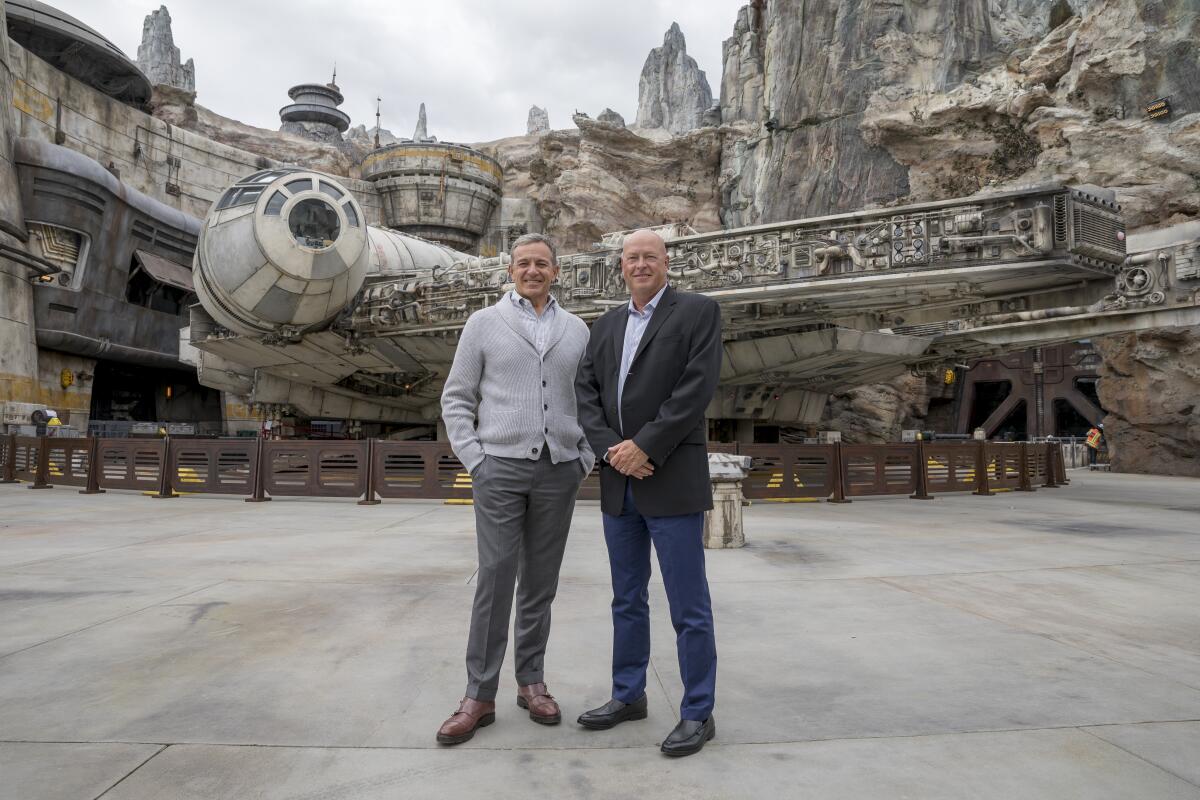
After two decades and two stints as Walt Disney Co. boss, Bob Iger finally is hanging up the reins.
Disney this week tapped 54-year-old parks chief Josh D’Amaro to succeed Iger as chief executive. The handoff is set for March 18, at the company’s annual investor meeting, with Iger staying on as a senior advisor and board member until his December retirement.
The changing of the guard atop one of America’s iconic companies marks the end of an era.
History probably will remember Iger as a visionary leader who transformed Disney by reinvigorating its creative engines through a series of blockbuster acquisitions, broadening its international profile and boldly steering into treacherous streaming terrain by launching Disney+ and ESPN+ as audiences drifted from the company’s mainstay TV channels.
Iger, 74, has long been Hollywood’s most respected and inspiring studio chief, known around town simply as “Bob.”
Disney Chairman James Gorman said in an interview that Iger’s nearly 20 years in power is framed by two epochs: “Bob 1” and “Bob 2.”
After becoming CEO in 2005, Iger presided over a period of remarkable growth. Through acquisitions of Pixar Animation, Marvel Entertainment and the “Star Wars” studio, LucasFilm, the company gained blockbuster franchises and popular characters, including Captain Marvel, Baby Yoda and Sheriff Woody from “Toy Story,” to populate movie theaters and theme parks.
“Bob steadied the company and built it out,” Gorman said. “He created an absolute powerhouse.”
“The Iger era has been defined by enormous growth, an unyielding commitment to excellence in creativity and innovation, and exemplary stewardship of this iconic institution,” Gorman said in a statement on behalf of the board, adding: “We extend our deepest gratitude to Bob Iger for his extraordinary leadership and dedication to The Walt Disney Co.”
Former CEO Michael Eisner told The Times that Iger has “succeeded masterfully” at every turn.
“From ABC Sports to ABC Television Network and then at Disney, when we inherited him in the ABC/Capital Cities acquisition, Bob created success upon success,” Eisner said. “It’s why he was picked as the Disney CEO, a role that has been his greatest success … What a record!”
Iger‘s first reign ended when he stepped down as CEO in February 2020, then retired from the company 22 months later.
But that leadership handoff proved disastrous, becoming Iger’s biggest blunder — one he has since worked hard to correct.
Bob Iger passed the CEO torch to Bob Chapek in 2020.
(Business Wire)
Former parks chief Bob Chapek stepped into the big role, but he lacked stature, creative chops and support among key executives. He quickly confronted the magnitude of the COVID-19 pandemic, which shuttered Disney’s revenue machines — theme parks, movie theaters and sporting events that anchor ABC and ESPN.
Wall Street soon soured on multibillion-dollar streaming losses by Disney and traditional entertainment firms that were jumping into streaming to compete with Netflix. The company’s stock fell.
Chapek also stumbled into a political feud with Florida’s Republican Gov. Ron DeSantis, who branded Disney as “woke.” The public tussle tarnished the Burbank company’s clean image and undermined its goal of entertaining the masses, no matter their political stripes.
The board beckoned Iger back in November 2022 to quell a revolt by senior Disney executives and allay concerns among investors.
“When I came back three years ago, I had a tremendous amount that needed fixing,” Iger acknowledged during a Monday earnings call with analysts. “But anyone who runs a company also knows that it can’t just be about fixing. It has to be preparing a company for its future.”
Succession immediately became the board’s top priority with Iger then in his early 70s. But Disney’s executive benchhad thinned through a series of high-level departures and the company’s expenditures had gotten out of control.
Iger restructured the company, which led to thousands of layoffs, and gave division executives financial oversight to, in Iger’s words, give them “skin in the game.”
His successor, D’Amaro, last spring recalled bringing a 250-page binder to Iger for review upon the chief’s 2022 return to the Team Disney building in Burbank. The book was stuffed with detailed updates for each component of D’Amaro’s enormous parks and experiences division.
The following day, Iger showed up at D’Amaro’s office, binder in hand.
“He pulled out one page,” D’Amaro recounted during an investor conference last year, adding that Iger said: “we have plenty of room to grow this business. We’ve got land in all of our locations around the world,” D’Amaro said. “We’ve got the stories [and] we’ve got the fans.”
That laid the seeds for Disney’s current $60-billion, 10-year investment program to expand theme parks and resorts, cruise lines and open a new venture in Abu Dhabi, United Arab Emirates. D’Amaro was put in charge of the effort, which is designed to cement Disney’s leading position in leisure entertainment. That mandate has become increasingly important to Disney amid the contraction of linear television and cable programming revenue.
He was dragged into a bitter proxy fight with two billionaire investors, who challenged his strategy, succession plans and Disney’s 2019 purchase of much of Rupert Murdoch’s 21st Century Fox. The move was controversial, with critics lamenting the $71-billion purchase price. Disney reduced its outlay by selling regional sports networks and other assets, but the deal left the company with significant debt just before COVID-19 hit.
The Fox deal gave Disney rights to hundreds of properties, including “Avatar,” “Deadpool” and “The Simpsons.”
Iger vanquished the proxy challenge, and this week, he again defended the Fox purchase, which gave Disney control of streaming service Hulu, National Geographic channels and FX.
“The deal we did for Fox, in many ways, was ahead of its time,” Iger said on the earnings call, noting the lofty bidding war currently underway for Warner Bros. Discovery.
“We knew that we would need more volume in terms of [intellectual property], and we did that deal,” Iger said, pointing to Disney’s deployment of its franchises beyond the big screen into its money-making theme parks. “When you look at the footprint of the business today, it’s never been more broad or more diverse.”
TD Cowen media analyst Doug Creutz still thinks the Fox deal was a dud, saying in a report: “There were plenty of value-destroying media deals before DIS-FOX, so we disagree with their assertion” despite the multiples being offered for Warner.
From left; James Gorman, chairman of the Walt Disney Co. board of directors; Disney Experiences Chairman Josh D’Amaro; Dana Walden, co-chair of Disney Entertainment; and Bob Iger, chief executive of the Walt Disney Co.
(Walt Disney Co.)
Iger is credited with astutely managing Disney’s image and corporate culture.
He was instrumental in resolving Hollywood’s bitter year of labor strife by negotiating truces with the Writers Guild of America and performers’ union, SAG-AFTRA, in 2023.
He has also sought to distance the company from divisive politics, albeit with limited success.
Disney agreed to pay President Trump $16 million to settle a dispute over inaccurate statements that ABC anchor George Stephanopoulos made a month after Trump was reelected. But free speech advocates howled, accusing Disney of bending to Trump.
In September, Iger led the company out of political quicksand amid an uprising of conservatives, including the chairman of the Federal Communications Commission, a Trump appointee, who were riled by comments by ABC late-night comedian Jimmy Kimmel in the wake of activist Charlie Kirk’s killing.
Iger maintains Disney made the decision to return Kimmel to his late-night perch independent of the political pressure from both sides.
Enormous challenges remain for D’Amaro, the incoming CEO.
He and his team, including Chief Creative Officer Dana Walden, must ensure Disney’s movies and TV shows deliver on the company’s commitment to quality, and that its streaming services — Disney+, Hulu and ESPN — rise above the competition.
In recent years, Disney’svaunted animation studios, including Pixar, have struggled to consistently release hits, though it has found success with sequels. Disney Animation’s “Zootopia 2” is now the highest-grossing U.S. animated film of all time, with worldwide box office revenue of more than $1.7 billion, and the 2024 Pixar film “Inside Out 2” hauled in nearly $1.7 billion globally.
The company also must maintain its pricey sports contracts, including with the NFL, to drive ESPN’s success. This week, Disney and the NFL finalized their deal for the league to take a 10% stake in ESPN.
And, as broadcast TV audiences continue to gray, Disney must evaluate the importance of the ABC network, where Iger got his start more than 50 years ago working behind-the-scenes for $150 a week.
Investors also are looking for D’Amaro to lift Disney’s wobbly stock, which has fallen 9% so far this year.
“The stock price doesn’t fairly reflect what [Iger] has done, but … it will,” Gorman said. “And he should get credit for it.”
In a statement Tuesday, D’Amaro expressed gratitude to Disney’s board “for entrusting me with leading a company that means so much to me and millions around the world.”
“I also want to express my gratitude to Bob Iger for his generous mentorship, his friendship, and the profound impact of his leadership,” D’Amaro said.
Times staff writer Samantha Masunaga contributed to this report.