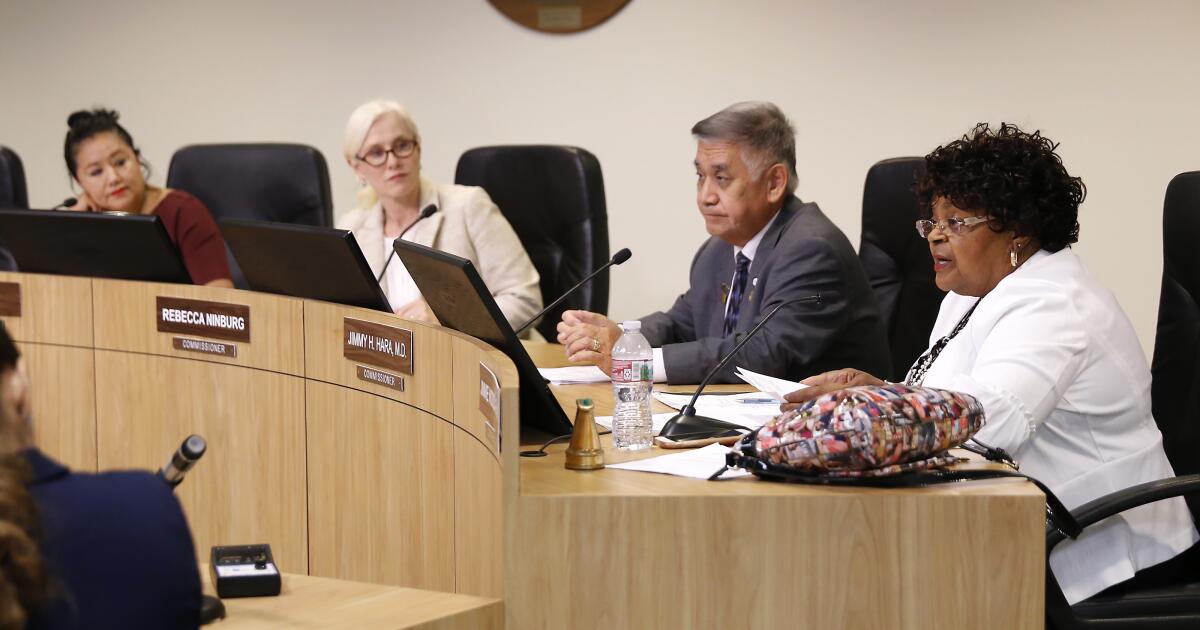
When community members crowd into a Metro meeting room next Thursday to argue for and against the proposed Dodger Stadium gondola, the board of directors will listen before they vote on whether to proceed with the project.
Will the directors speak?
In a public meeting, officials often explain their position on a high-profile issue. In the Metro meeting next week, the board of directors could vote on the gondola without any of the board members saying a word about it.
Metro released the meeting agenda late Tuesday night. The agenda includes the gondola vote as part of what public agencies call the consent calendar — that is, a package of items that can be approved with one vote, and without any discussion among the officials doing the voting.
The items on any consent calendar generally are routine. Based on a staff report, Metro considers the gondola approval to be routine too: Metro approved the gondola last year, a judge ordered fixes to the environmental impact report, and all Metro needs to do now is rubber-stamp the fixes. The gondola project still would need approvals from the Los Angeles City Council and various state agencies.
At a committee meeting last week — one week after the council had urged Metro to kill the project — Los Angeles Mayor and Metro board member Karen Bass put it this way: “Just real quickly, I just wanted to reiterate or clarify that what the vote is about today is about certifying the EIR, certifying the project’s environmental documents under CEQA, nothing more.”
Two other board members — county supervisors Janice Hahn and Hilda Solis — did address the concerns raised by the public speakers. Hahn voted no on the gondola; Solis voted yes.
Whether Hahn, Solis or any of the other 11 voting board members decide to speak up next Thursday remains to be seen. All it takes is one member to remove the item from the consent calendar and demand discussion on the issue.
The gondola, first pitched by former Dodgers owner Frank McCourt in 2018, would carry fans from Union Station to Dodger Stadium. Gondola proponents have not announced any financing commitments for a project with a construction cost estimated at $500 million and proposed as privately funded.
Ahead of winter holidays and festive trips away, a flight attendant has now shared a clever travel hack to get an extra bag on board without paying a penny more
15:14, 25 Nov 2025Updated 15:15, 25 Nov 2025
Flight attendant shares ‘genius’ method to sneak extra bag on board(Image: Adam Gerrard / Daily Mirror)
Whether it’s a summer holiday or a winter trip away, one thing is always certain and that’s packing with luggage allowance is tricky to get right. Pack too much and you run the risk of having a bag that’s too heavy or won’t fit the cabin luggage standards, but if you pack too light then you run the risk of being forced to wash your clothes whilst away.
Yet it doesn’t have to be so hard, as a flight attendant has now shared a clever travel hack to get an extra bag on board without paying a penny more.
Flight attendant Miguel Muñoz shared a sneaky trick to help passengers dodge extra luggage fees by utilising a duty-free shopping bag, and it’s the perfect trip for your Christmas getaway.
Miguel’s genius idea reurposes a duty-free bag to carry clothes and other items that won’t fit in your hand luggage, you can essentially sneak an extra bag on board.
According to Miguel, “duty-free bags don’t count as carry-on baggage,” so gate agents tend to turn a blind eye.
To take advantage of this hack, holidaymakers can either bring a duty-free bag from home or purchase one at the airport’s duty-free shop.
Miguel said: “If you have something that doesn’t fit in your suitcase or you want to bring an extra bag on board, here’s the trick.
“All you have to do is carry a duty-free bag. Or ask for one at the duty-free shop and you place whatever you want in the shopping bag. There is obviously limited space, but at least you are bringing an extra bag on the plane with you.”
He added: “Now you know. If you ever find yourself in that situation, just put whatever you want in a duty-free bag. You are welcome!”
Miguel’s trick comes after another hack has gone viral, using a “fake pillow” where passengers use a pillowcase filled with extra items, as the pillow doesn’t typically count as a piece of luggage.
This hack has been shared by hundreds of travellers on social media, who claim that security officers and gate agents rarely bat an eye.
TikTok has also been filled with tips and tricks from savvy travellers all keen to carry more, without the hefty fees for extra baggage. A savvy traveller from Handluggageonly explained on the platform, “Pack all the clothes you need in your backpack but if that person checking you in for your flight turns around and says anything about your bag being overweight and tries to charge you the excess baggage fare, simply pop over to the bathroom and wear as many clothes as possible.
“Technically, no one can say anything about the fact that you just wore your extra clothes on you instead of having them in your luggage and more importantly – they can’t charge you the extra fare as your bag weight should be much more in line.”
Banerji said in his resignation letter that he was unhappy about governance issues at the organisation, BBC News reported.
Published On 21 Nov 202521 Nov 2025
Share
Shumeet Banerji has resigned from the BBC board and criticised governance issues at the organisation, the latest blow to the broadcaster weeks after its director general quit.
The BBC confirmed Banerji’s departure on Friday, saying he stepped down only weeks before the end of his four-year term.
Recommended Stories
list of 3 itemsend of list
According to BBC News, Banerji said in his resignation letter that he was unhappy about governance issues at the organisation.
He also said he had not been consulted about key developments surrounding the abrupt exits of director general Tim Davie and BBC News chief executive Deborah Turness, BBC News reported.
Both stepped down on November 9 after mounting criticism of the broadcaster’s handling of political coverage, including the editing of a Donald Trump speech delivered on January 6, 2021, shortly before his supporters stormed the United States Capitol.
‘No legal basis’
The BBC issued an apology on November 13 for how its investigative programme Panorama edited the footage. However, it insisted there was “no legal basis” for Trump to sue for defamation.
The dispute focuses on Panorama’s documentary, Trump: A Second Chance?, broadcast in October 2024, just days before Trump secured re-election.
The film stitched together two separate lines from Trump’s January 6 address, almost an hour apart, creating the impression he urged supporters to “fight like hell” while heading towards the Capitol.
Trump and his allies say the sequence was misleading and stripped away crucial context from the speech.
They argue that Trump also told the crowd “to peacefully and patriotically make your voices heard” and encouraged supporters to “cheer on our brave senators and Congressmen and women”. The edited version, they say, suggested a more direct incitement to violence.
The scandal has intensified scrutiny of the BBC at a moment when the broadcaster is already grappling with accusations of internal bias, fuelled by a leaked internal memo.
LA28, the committee behind the Olympic Games coming to Los Angeles, quietly added to its roster of directors some high-profile Republicans with ties to President Trump.
The 35-member volunteer board of directors now includes notable Republican political figures Kevin McCarthy, the former speaker of the House of Representatives, and Reince Priebus, who was Trump’s chief of staff during his first term. Before his role in the White House, Priebus served as the longtime chair of the Republican National Committee.
Diane Hendricks, a major GOP donor who has given millions to Trump’s campaigns, and Patrick Dumont, who owns the Dallas Mavericks and is the son-in-law of another major Trump donor, were also added to the board. Ken Moelis, an investment banker who worked with Trump in the 1990s and predicted the businessman would win the presidency in 2016, is also listed as a board member.
The Trump-adjacent inflow to the board of directors, first reported by Politico, is the latest sign of the president’s involvement in the major Los Angeles event.
It is not clear why the decision was made to expand the board of directors and how the individuals were selected. A spokesperson for LA28 did not immediately respond to The Times’ questions Thursday about the move.
Kevin McCarthy
(Associated Press)
Los Angeles business consultant Denita Willoughby and philanthropist Maria Hummer-Tuttle are also newly listed as board members.
“We are thrilled to welcome this accomplished group to the LA28 Board who will help create an unforgettable Games for athletes and fans alike,” Casey Wasserman, the chair of the 2028 L.A. Olympics organizing committee, wrote in a statement.
Wasserman could not immediately be reached by The Times for further comment.
Although past presidents have taken a largely ceremonial role in Olympics that have been held on U.S. soil, there are signs that Trump is seeking a more active role in the Games, which will occur in his final year as president.
In August, he signed an executive order naming him chair of a White House task force on the 2028 Games in Los Angeles. The president views the Games as “a premier opportunity to showcase American exceptionalism,” according to a White House statement. Trump, the administration said, “is taking every opportunity to showcase American greatness on the world stage.”
Trump at the time noted that he’d be willing to send the military back to Los Angeles to protect the Games. In June, he sent the National Guard and U.S. Marines to the city amid escalating immigration enforcement actions, prompting pushback from Mayor Karen Bass.
Wasserman attended the signing at the White House in August and thanked Trump for “leaning in” to planning for the Olympics, which he said is akin to hosting seven Super Bowls a day for 30 days.
“You’ve been supportive and helpful every step of the way,” Wasserman told the president at the time. “With the creation of this task force, we’ve unlocked the opportunity to level up our planning and deliver the largest and, yes, greatest Games for our nation, ever.”
1 of 2 | Larry Summers (R), then-director of the U.S. National Economic Council, pictured Feb. 2010 next to then-U.S. Homeland Security Secretary Janet Napolitano at the White House in Washington, D.C. Summers, 70, revealed Monday that he will “step back” from all public duties, but it was unclear if that was to include his role with the artificial intelligence firm. File Photo by Andrew Harrer/UPI | License Photo
Nov. 19 (UPI) — Former U.S. Treasury Secretary Larry Summers will resign from the OpenAI board of directors following intensified scrutiny over emails between him and sex offender Jeffrey Epstein, he announced Wednesday.
“I am grateful for the opportunity to have served, excited about the potential of the company, and look forward to following their progress,” Summers told CNBC and CNN in a statement.
Summers, 70, revealed Monday that he will “step back” from all public duties, but it was initially unclear if that was to include his role with the artificial intelligence startup.
This week, Summers said he was “deeply ashamed” after emails released last week revealed years of correspondence with the late billionaire financier and convicted sexual predator Epstein.
The AI company said it respected his decision.
“We appreciate his many contributions and the perspective he brought to the board,” the OpenAI board of directors said in a statement.
Summers, former secretary of the United States Treasury under former U.S. President Bill Clinton, was later president of Ivy League Harvard University from 2001 to 2006 and director of the National Economic Council under then-President Barack Obama.
Serious financial woes have plagued the Palm Springs Art Museum for at least six years, according to internal documents obtained by The Times. Recent developments have opened a Pandora’s box.
On Jan. 15, the accounting firm conducting the annual audit of the museum’s 2024 books attached to its report a “letter of material weakness,” a standard accounting practice for alerting a client to the reasonable possibility that its internal financial statements are significantly out of whack.
Less than three months after the audit letter, in early April, the museum’s director suddenly resigned, and trustee defections began. A cascade of at least eight resignations from the museum’s board of trustees — nearly one-third of its membership — has occurred since spring. One resignation came on the advice of the trustee’s attorney. With 19 trustees remaining, according to a listing on the museum’s website, the total number has fallen below the minimum of 20 required in the museum’s by-laws.
Palm Springs Art Museum board chair Craig Hartzman did not respond to multiple requests for comment.
Accountants at Eide Bailly, citing a “deficiency in internal control” at the museum, highlighted six areas of concern, including problems with reporting of endowment spending, improper recording of the market value of donated and deaccessioned art, and faulty recording of admissions revenues.
Former museum director Adam Lerner had reportedly been negotiating a three-year contract renewal when he stepped down. Without elaborating on his unexpected decision to depart, he was cited in a museum press release as leaving for personal reasons. Lerner returned to Colorado, where he previously headed the Museum of Contemporary Art Denver.
Reached by text, Lerner declined a request for interview, referring questions to the museum.
Financial problems at PSAM are not new. According to six pages of notes obtained by The Times, compiled by a trustee who led a task force charged with examining museum finances, the ending statement on the 2019 endowment balance was $3 million higher than the beginning balance on the 2020 statement. Audits and tax returns posted on the museum website confirm the puzzling discrepancy.
The notes say it is “highly unlikely” the funds were stolen. Instead, they question internal museum accounting practices, which can create a misleading appearance of fiscal health. By the 2021 audit, the outside accounting firm that had been preparing them annually prior to Eide Bailly had quit.
“This is always a red flag,” wrote museum trustee Kevin Comer, an art collector who retired after 30 years as a managing director at Deutsche Bank in New York, and who is a former professor of accounting and fiduciary management techniques at the Ohio State University. A trustee for less than two years, Comer resigned Nov. 6.
Reached by telephone, Comer declined to discuss the accounting firm’s letter or the task force notes.
Palm Springs Art Museum
(Guillaume Goureau/Palm Springs Art Museum)
Since late July, a lengthy anonymous email has also been circulating from a self-described “whistleblower with a direct relationship” to the Palm Springs Art Museum. Fourteen itemized complaints, most concerning fiscal matters, are presented with sobriety, plus a slow burn of understandable anger. Whether or not the unidentified whistle blower has an ax to grind is unknown to me, but plainly the email is not a list of wild accusations hurled by an unreliable gadfly.
The coherent level of informed specificity certainly suggests authorship by a knowledgeable insider. Some stated grievances may have benign explanations, while others are troubling.
Comer pulled few punches in his own letter of resignation to fellow trustees, also obtained by The Times. The fiduciary expert, a former member of the board’s finance committee, said he was resigning on the advice of his attorney.
The board, Comer alleged, is sidestepping the fundamental fiduciary obligation to protect “the integrity of the museum, despite our best intentions.” The letter urges hiring both a law firm and a forensic accounting firm to review museum finances, partly to untangle apparently inappropriate methods in the past for the benefit of the current board, and partly to address potential liability.
An earlier task force suggestion to that effect was discussed by the board but went unheeded, he charges.
Especially concerning is a 2019 reclassification of some restricted funds. Task force notes suggest the $3-million discrepancy between 2019 and 2020 may have originated as a change in restricted funds to unrestricted status. Assets specifically donated for a particular function could then appear to be available for general operating purposes.
The museum consistently operated at a loss, the notes say, with some operating shortfalls covered by the 2019 reclassification. A deficit is not unusual for an art museum, but whether the reclassifications of some restricted funds were appropriate appears to be in doubt. Presumably, funds reclassified as unrestricted at the end of one year to make the financial filing look good may have had their restricted status restored at the start of the next year.
Restricted funds can include money raised through the deaccession and sale of art donated to a museum’s collection. Common museum ethical standards require income from deaccessioned art to be sequestered, used only for other art purchases, as well as for direct care of the collection. For accounting purposes, the monetary value of a nonprofit museum’s art collection is not considered a material asset to be carried on the books. Reclassification of sequestered art funds could support an appearance of general financial vigor.
During the lengthy 2020 pandemic closure, the cash-strapped museum made the controversial decision to deaccession and then sell a prized 1974 Helen Frankenthaler painting, which brought $4.7 million at auction. The 2024 audit puts total donor restricted funds for art purchases and collection maintenance at $7.8 million.
To pay the bills the museum has also been drawing down the endowment. According to the 2024 audit, the most recent financial statement currently available, the endowment is slightly more than $17 million — extremely small for a museum that last year had an operating budget of approximately $10.5 million.
“Endowment draws over the past decade totaled roughly $8 million, and contributions to the endowment totaled roughly $500,000,” the notes report. “Most years the museum operated at a loss, including for the last three years when the board believed we were profitable,” it states.
Such a disproportion between fundraising and expenditure, between money coming in and money going out, is frankly unsustainable for this — or any — art museum, especially when inflation is factored in.
The endowment is a nonprofit’s “seed corn,” eaten for short-term gain only at its long-term peril. Most disturbing: The notes suggest that while the five-person executive committee may have been aware of some of the situation’s more difficult details, the rest of the board appears not to have been fully informed of the museum’s financial position . “Bottom line,” Comer’s resignation letter astutely observes, “this is a leadership group that doesn’t know what it doesn’t know, and that is the most dangerous place in which an institution can be placed.”
The Palm Springs Art Museum has apparently wedged itself firmly between a rock and a hard place. Now, it is unclear how the museum can move forward without a full cohort of 20 trustees authorized to vote on making essential decisions — including accepting new members to the board.
Nov. 17 (UPI) — Another board member of the conservative Heritage Foundation resigned after the organization’s president, Kevin Roberts, posted video defending Tucker Carlson‘s interview with anti-Semitic commentator Nick Fuentes.
Board member Robert P. George wrote Monday on Facebook that “I have resigned from the board of the Heritage Foundation. I could not remain without a full retraction of the video released by Kevin Roberts, speaking for and in the name of Heritage, on October 30th.”
In the video, Roberts refused to distance himself from the two-hour interview, which was posted two weeks ago on YouTube, and has 6.2 million views. Counting other platforms, including X, it has been seen by more than 20 million.
George, who had been a Heritage trustee since 2019, said: “Although Kevin publicly apologized for some of what he said in the video, he could not offer a full retraction of its content. So, we reached an impasse.”
Fuentes, 27, has expressed admiration for Adolf Hitler, claiming the Holocaust was “exaggerated.” He has also said “organized Jewry” is leading to white culture’s disappearance, and that white people are “justified” in being racist, and said “a lot of women want to be raped.”
A spokesman for the Heritage Foundation confirmed the resignation in a statement to Politico, thanked him for his service and calling him a “good man.”
George, the McCormick professor of jurisprudence at Princeton University, also called Roberts a “good man.”
“He made what he acknowledged was a serious mistake,” George said. “Being human myself, I have plenty of experience in making mistakes. What divided us was a difference of opinion about what was required to rectify the mistake.”
The Foundation defended Roberts in a statement through a spokesperson.
“Under the leadership of Dr. Roberts, Heritage remains resolute in building an America where freedom, opportunity, prosperity, and civil society flourish,” the spokesperson said. “We are strong, growing, and more determined than ever to fight for our Republic.”
Roberts, in the Oct. 30 video, blasted the “venomous coalition” that has faulted Fuentes and Carlson, with the latter described as a “close friend.”
“The Heritage Foundation didn’t become the intellectual backbone of the conservative movement by canceling our own people or policing the consciences of Christians, and we won’t start doing that now,” Roberts said.
“Their attempt to cancel [Carlson] will fail,” he added. “I disagree with and even abhor things that Nick Fuentes says, but canceling him is not the answer either.”
One day later, Roberts also posted on X, elaborating on his remarks.
“Our task is to confront and challenge those poisonous ideas at every turn to prevent them from taking America to a very dark place,” Roberts wrote. “Join us — not to cancel — but to guide, challenge, and strengthen the conversation, and be confident as I am that our best ideas at the heart of western civilization will prevail.
“For those, especially young men, who are enticed by Fuentes and his acolytes online — there is a better way.”
Some staff members at a two-hour meeting on Wednesday called for Roberts’ resignation, with one attendee saying he had caused “enormous damage” to the foundation, according to the video obtained by the Washington Free Beacon.
At least five members of the foundation’s anti-Semitism task force also have resigned, CBS News reported.
The Heritage Foundation, a conservative think tank that dates to the mid-1970s and came to larger prominence for its influence on the Reagan administration, helped to spearhead Project 2025, which has been used as a guide for President Donald Trump‘s second term in the White House.
Trump, who hosted Fuentes and rapper Kanye West at his Mar-a-Lago home in 2024, on Sunday told reporters that you can’t tell Carlson “who to interview.”
Carlson hosts platforms on his platform. The Tucker Carlson Network. He has worked for CNN, PS, MSNBC (now called MSNOW) and Fox News, the latter of which he was fired from in April 2023.
George said he wished the Foundation “the very best.”
“My hope for Heritage is that it will be unbending and unflinching in its fidelity to its founding vision, upholding the moral principles of the Judeo-Christian tradition and the civic principles of the Declaration of Independence and the Constitution of the United States,” he wrote.
“I pray that Heritage’s research and advocacy will be guided by the conviction that each and every member of the human family, irrespective of race, ethnicity, religion, or anything else, as a creature fashioned in the very image of God, is ‘created equal’ and ‘endowed by our Creator with certain unalienable rights.'”
Fuentes and Vice President JD Vance have been at odds since Fuentes asked his audience “Do we really expect that the guy who has an Indian wife and named their kid Vivek is going to support white identity?”,
In 2024 on CBS’s Face the Nation, Vance called him a “total loser” and said there is “no room” for him in the Make America Great Again movement.
BOSTON — Jaylen Brown scored 33 points and had 13 rebounds, Payton Pritchard added 30 points and the Boston Celtics held off the Clippers for a 121-118 victory on Sunday.
Derrick White scored 22 points with nine assists and seven rebounds, and Neemias Queta chipped in with 14 points and nine boards for Boston.
Playing for the first time since beating Memphis by 37 points at home Wednesday, the Celtics nearly blew a 24-point, third-quarter lead but never trailed en route to their second straight victory.
Coming off his 82nd career triple-double with 41 points in a double-overtime victory at Dallas on Friday, James Harden scored 32 of his 37 points in the second half to lead the Clippers. Ivica Zubac added 16 points and 12 boards.
Clippers forward Derrick Jones Jr. was injured in a collision with Brown in the second quarter and didn’t return.
Brown’s arm struck Jones’ leg. Jones grabbed his knee as he fell to the floor and was rolling in pain before slowly getting up and being helped to the locker room, barely putting any weight on the leg. Brown was whistled for a foul on the play.
Clippers coach Tyronn Lue comforts forward Derrick Jones Jr., who holds his knee after he was injured in the game against the host Celtics on Sunday.
(Robert F. Bukaty / Associated Press)
The 28-year-old Jones has started all 13 games this season and entered averaging 10.9 points.
With Jones out, the Clippers rallied. They made it 119-118 on Harden’s three with two seconds left, but Pritchard was fouled and hit two free throws.
Harden had an open look at a potential tying three-pointer, but it hit off the rim as the buzzer sounded.
After the Clippers sliced it to 90-85 at the end of the third, Brown scored 11 of Boston’s initial 16 points in the final quarter to keep the Celtics in control, mixing a three-pointer with a conventional three-point play and a couple of mid-range jumpers.
Boston had opened it to 76-52 midway into the third behind two three-pointers from Pritchard, who was eight of 13 overall on three-point attempts.
The Clippers closed it to 90-85 with a 12-4 run that was capped by Harden’s left-wing three with 2.4 seconds left.
The Clippers play a Philadelphia on Monday, the third of a seven-game road trip.