bloom

How to find L.A. hikes where spring is in full bloom

I’ve come to resent the frenzy around superblooms.

You are reading The Wild newsletter

Sign up to get expert tips on the best of Southern California’s beaches, trails, parks, deserts, forests and mountains in your inbox every Thursday

Not because I don’t love seeing our hillsides blanketed with nature’s bounty, but because it misses the point that every wildflower that bursts out of the ground is its own sort of miracle. Have you ever slowed down on the trail just to stare at an individual California poppy and considered how in the world a seed that’s a fraction of an inch (1/20 to be exact-ish) became this bright orange delicate thing before you?

For me, each wildflower I spot on the trail is an opportunity to practice gratitude. I hope I can persuade you to consider the same.

With that same energy, I’d like to teach you how I find wildflowers and other plants I love, both as a hiker and outdoors journalist. Here is what I consider as I’m searching for the best spring hikes.

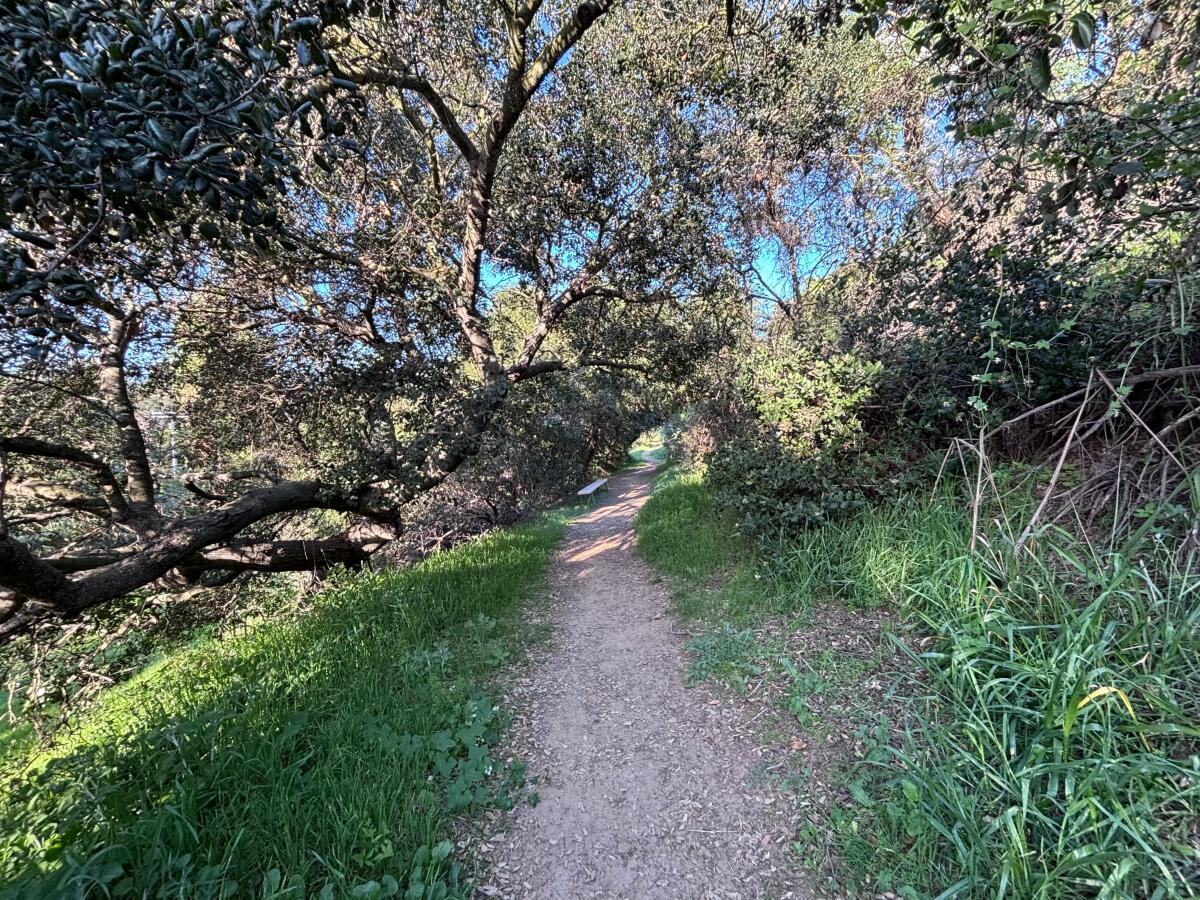
A large gnarled tree with huge brown branches with small green leaves over a dirt path.

A large oak tree provides shade over a trail in Franklin Canyon Park.

(Jaclyn Cosgrove / Los Angeles Times)

1. Learn the landscapes

L.A. County is home to a multitude of diverse plant habitats, with each offering its own range of wildflowers, shrubs, trees and more. And often, these landscapes can be interspersed among each other.

Hikers around L.A. commonly encounter plant habitats and ecosystems that include:

  • Coastal sage scrub: Found at lower elevations (generally below 3,000 feet), this fire-adapted plant community often includes bright yellow bush sunflower, sticky monkey flower (orange blooms), deerweed (orange and yellow blooms) and fragrant California sagebrush and black sage, which features white and bluish blooms; this is a great plant habitat to hike when you want to really stop and smell things.
  • Chaparral: Often said to be the most extensive vegetation type in California, chaparral is found throughout Southern California’s mountain ranges up to about 5,000 feet, although it does grow higher; chaparral is a “continuous cover of low-growing shrubs creating a mosaic in shades of green,” according to research by the U.S. Forest Service; common flowering plants found in chaparral include woolly bluecurls, chamise (white flowers), ceanothus (shrubs with fragrant purple, white and sometimes pink blooms) and manzanitas.
  • Oak woodlands: A plant habitat often found in low- to mid-elevations (generally below 5,000 feet) in foothills and valleys, this ecosystem is “officially defined as an oak stand in which at least 10% of the land is covered by oaks and other species, mostly hardwoods,” writes author Kate Marianchild in “Secrets of the Oak Woodlands”; wildflowers that often grow here include California buttercup (yellow blooms), Collinsia heterophylla (purple and white blooms), hummingbird sage (super cool plant with magenta flowers) and more.
A coast live oak with a swing, a flowering golden yarrow and a Bush monkeyflower, sometimes called sticky monkey flower.

Several coast live oaks, including this one with a swing, live along the Gabrielino Trail, left. Top right, there are several native plants and wildflowers along the Gabrielino Trail, including golden yarrow. Bottom right, Bush monkey flower, sometimes called sticky monkey flower, is a native shrub found along the Gabrielino Trail.

(Jaclyn Cosgrove / Los Angeles Times)

  • Riparian habitats: This is the term used to describe the lush landscape found around rivers, creeks and in moisture-rich canyons and includes riparian woodlands; it is less defined by elevation and more so is used to describe the life found around water. Wildflowers and plants that bloom include western columbine, scarlet monkey flower and miner’s lettuce (white and pale pink blooms). You can often also find California bay laurels, which have a zesty pungent smell (that not everyone loves).
    • Where to see it: Essentially anywhere along the 28.8-mile Gabrielino Trail, which runs parallel in several sections to the San Gabriel River and Arroyo Seco.
A funky short red plant pokes out of pine needles.

The snow plant (sarcodes sanguinea Torr.) is starting to come up around pine trees at the Chilao Picnic Area in the Angeles National Forest. It grows in the spring, after snow has melted, has no chlorophyll and gets its nutrition from fungi growing on conifer roots in the soil.

(Raul Roa / Los Angeles Times)

2. Go higher for late-season blooms

Thanks to our proximity to the San Gabriel Mountains, the wildflower season often extends into late spring and early summer.

In Angeles National Forest, you can easily hike above 5,000 feet and even farther into the sub-alpine regions where you’ll find mixed conifer forests and a range of wildflowers and other interesting plants. One of my favorites to spot is the snow plant, a funky red parasitic plant that “derives sustenance and nutrients from mycorrhizal fungi that attach to roots of trees,” according to the California Native Plant Society. Other blooms you might spot include various types of lupine, pumice alpine gold and some types of paintbrushes.

Grape soda lupine grows in Angeles National Forest, including here along the Cooper Canyon trail.

Grape soda lupine grows in Angeles National Forest, including here along the Cooper Canyon trail.

(Jaclyn Cosgrove / Los Angeles Times)

3. Determine whether an area has burned in recent years

Many of the most beloved areas of the Santa Monica and San Gabriel mountains have burned in recent years. The immediate aftermath is devastating to witness: blackened hillsides with shrubs and trees burned down to nubs and stumps.

But, as the ecosystem starts to heal, several wildflowers known as “fire followers” will start popping up.

“Often boasting beautiful blooms, some germinate only when their seeds are exposed to heat, while others take advantage of the charred, mineral-rich soil left behind, helping to secure the land and reduce erosion,” according to TreePeople.

I’ve found this to be true in areas that burned in the 2020 Bobcat fire, where trails burst with blooms from several types of lupine (including grape-soda lupine, my personal favorite), phacelias, including large flowered phacelia and caterpillar phacelia, and withered snapdragon.

A field of thick orange flowers.

California poppies bloom next to the California State Route 138 near the Antelope Valley California Poppy Reserve State Natural Reserve on March 12. The state’s wildflowers typically bloom from mid-March through April.

(Kayla Bartkowski / Los Angeles Times)

4. Check the data and help others do the same

Before heading out, I often head to iNaturalist, a citizen science app where users submit photos of animals, plants and other living organisms they observe. I will usually look at what other users have submitted in recent weeks. And on every hike, I typically submit at least 20 observations of wildflowers, lizards and trees I noticed. (As of today, I’ve submitted 675 observations of 341 species, including eight California poppy observations and seven black bear observations, which are really just photos of scat.)

To use iNaturalist, you can either visit its desktop site or use the app, which is available for iPhone and Android. You can easily search specific plants — although rare and endangered specimens will have their locations hidden — to discern whether any have been spotted along the trail you’re headed to. This is one of the ways I discovered an abundant showing of wildflowers in Towsley Canyon and in the Santa Monica Mountains, which hopefully is still there thanks to the recent rainfall.

As you can tell, there is much to learn about the diverse landscapes covering Southern California. I hope this newsletter prompts you to learn even more as you venture out there.

May your adventures lead you to a day full of springtime color and a deep sense of gratitude for whatever you find!

A wiggly line break

3 things to do

A person carries a bag of weeds.

Violet Tiul, 12, removes invasive mustard weed at Friends of the Los Angeles River’s Habitat Restoration & Earth Month Celebration at the Sepulveda Basin Wildlife Preserve in Los Angeles on May 24, 2025.

(Carlin Stiehl / Los Angeles Times)

1. Celebrate Earth Month at the L.A. River
Friends of the L.A. River needs volunteers from 8 to 11 a.m. Saturday at the Sepulveda Basin for its Earth Month habitat restoration day. Other local groups at the event will include the California Native Plant Society and the L.A. and San Fernando Valley chapters of the Audubon Society. Volunteers will yank weeds and install native plants and be rewarded with guided nature walks around the native reserve. Binoculars will be provided. Learn more at support.folar.org.

2. Explore the night sky in Joshua Tree
The Mojave Desert Land Trust will host an interactive evening exploring the night skies from 7 to 10 p.m. Friday at its headquarters in Joshua Tree. Interns from the trust’s Women In Science Discovering Our Mojave (or WISDOM) will share their research findings, and afterward, guests will be treated to s’mores and a night sky viewing with a National Park Service ranger. Learn more and register at mdlt.org.

3. Hike with bats and more in Calabasas
Malibu Creek State Park will host a guided night hike from 7:30 to 9 p.m. in Calabasas. Guests will learn about nocturnal animals as they hike about three miles round trip. Register at eventbrite.com.

A wiggly line break

The must-read

A visitor stands before wildflowers in a beautiful landscape.

Carrizo Plain National Monument in San Luis Obispo County.

(Christopher Reynolds / Los Angeles Times)

If you’re feeling up for a road trip, may I suggest heading to the Carrizo Plain National Monument? Times staff writer Christopher Reynolds outlined how, even though we are past its peak wildflower season, the monument is still a gorgeous display of springtime blooms. “By the time my wife and I arrived in the first days of April, the flowers were past their peak, but the hills were still green and many meadows popped with yellow, purple and blue,” Reynolds wrote. “If I’m reading my wildflowers handbook right, these were tidy tips, Goldfields, Owl’s Clover, thistle sage, Valley Larkspur, coreopsis, phacelia and hillside daisies.”

We are so lucky to live among such rich biodiversity!

Happy adventuring,

Jaclyn Cosgrove's signature

P.S.

Would you like to meet me IRL? I am hosting “L.A. Hiking 101” at 1:45 p.m. Sunday at Mudd Hall 203 during the L.A. Times’ Festival of Books at USC. The festival is free to attend, as are several of the panels, mine included. I will share how to find some of the best hikes around L.A., what I’ve learned writing about our local wildlands and, as a fun show-and-tell, what I carry in my pack when I’m out on a day hike. Space is limited, so grab your ticket now for my talk. I am eager to hear what questions you have. See you there!

For more insider tips on Southern California’s beaches, trails and parks, check out past editions of The Wild. And to view this newsletter in your browser, click here.


Source link

Don’t want to miss Antelope Valley poppy bloom? Now there’s a forecast

Imagine waking up early, eager to peep dazzling carpets of brilliant orange flowers at the Antelope Valley California Poppy Reserve. Instagram posts promised a spectacle.

You drive to the reserve north of Los Angeles, but the rolling hills aren’t alive with color.

Bummer. The bloom is over.

Thanks to AI, and a local scientist, such disappointment may soon be a thing of the past.

This year, Steve Klosterman, a biologist who works on natural climate solutions, launched a “wildflower forecast,” powered by a deep-learning model, satellite imagery and weather data.

In a sense, Klosterman, of Santa Monica, developed the tool to meet his own need.

Last spring, the Midwest transplant was hankering to see some wildflowers. He assumed there was some online resource that offered predictions or leveraged satellite images.

“Surely, there must be something,” he recalled thinking. “But there was nothing.”

There are tools. The state reserve operates a live cam trained on one swath of land. Theodore Payne, a California native plant nursery and education center, runs a wildflower hotline, where people can call in and hear weekly recorded reports on hot spots.

“These are all essential resources,” Klosterman said. “At the same time, they’re limited.”

Klosterman isn’t green when it comes to plants. His PhD, at Harvard, focused on the timing of new leaves on trees in the spring and color change in the fall.

For a class project, a team he was part of built a website that predicted those leaf changes in the Boston area. It was a hit.

California poppies

California poppies bloom in Lancaster, near the state natural reserve, in mid-March.

(Kayla Bartkowski / Los Angeles Times)

To create the poppy bloom predictor, Klosterman turned to AI initially developed for medical imaging. He has harnessed it to instead analyze satellite images of the Antelope Valley.

The model scans 10-by-10-meter squares of land to determine whether poppies are present by their telltale orange color. (It also identifies tiny yellow flowers called goldfields.)

The model is trained on satellite images — which go back nine years — along with past weather data.

It then uses the current forecast, and recent flower status, to peer into the future.

If the mercury is going to hit 100 degrees and wind is picking up — and in previous years that led to withering flowers — that will guide the prediction.

Right now, the model can forecast five days out and is, as Klosterman puts it, “very much a work in progress.” It would be better, more powerful, if it had 100 years to learn from.

As more data are collected, it might someday be able to forecast a week or two out.

Right now, poppies are popping at the reserve in the western Mojave Desert.

It rained throughout the fall and into winter, and poppies need at least seven inches of rain to make a good showing, said Lori Wear, an interpreter at the reserve.

Snowfall in January seems to push them to another level, but that didn’t happen this season. So it’s a good bloom, but not extraordinary, she said.

Still, poppies — California’s state flower — blanket swaths of the protected land.

“It almost looks like Cheeto dust,” she said, “like somebody had Cheetos on their fingers and just smeared it on the landscape.”

Poppies here have typically peaked around mid-April, but variable weather in recent years has made it hard to predict, she said. Klosterman believes right now is likely the zenith.

Also blooming now: goldfields, purple grape soda lupine and owl’s clover. Wear described the latter, also purple, as looking like a “short owl with little eyes looking at you and a little beak.”

An SUV drives through the wildflower blooms

An SUV drives through blooms near the reserve. “It almost looks like … somebody had Cheetos on their fingers and just smeared it on the landscape,” said Lori Wear, an interpreter at the reserve.

(Kayla Bartkowski / Los Angeles Times)

On Sunday, Klosterman experienced the blooms for himself, using his technology as a guide.

It offers predictions in two forms. The first is the amount of the valley — shown in a satellite image — covered in poppies and goldfields, expressed as a percentage. The other is an overlay of orange and yellow splotches on the land.

The map showed a fairly high concentration of poppies near a stretch of Highway 138. He went there and, lo and behold, vibrant flowers awaited him. He sent proof: a smiling selfie in front of a sea of blossoms.

Klosterman’s tool may help answer arguably more complex questions than poppy or no poppy, such as a more precise understanding of the conditions the flowers need to thrive.

Experts know rain is key, but it’s more complicated than that.

Steve Klosterman in a field of California poppies.

Steve Klosterman takes a selfie in a field of California poppies.

(Steve Klosterman)

Heavy rain can supercharge invasive grasses, crowding out the blooms. Natives actually tend to do better after several years of drought, once invasives not adapted to the arid climate die out. That’s what led to an epic superbloom in 2017, Joan Dudney, an assistant professor of forest ecology at UC Santa Barbara, told The Times in 2024.

Klosterman wondered if the recent heatwave would desiccate them. But his model didn’t show that, and neither did his trip. So it’s possible other factors play a significant role in their persistence, such as length of day.

The model could also shed light on what could happen to the flowers as the climate warms. Will they migrate to the north? Will there be fewer blooms?

To game that out, Klosterman said you could invent and plug in a weather forecast with higher temperatures.

For now, Klosterman’s forecast is limited to the Antelope Valley. But if it expands to other areas, and other flower types, it could help people like Karina Silva.

Silva woke up at 5 a.m. last Wednesday to travel from her Las Vegas home to Death Valley National Park, hoping to beat the heat and the crowds to the superbloom.

But several hours later, she and her husband, David, were still trying to find it.

The hillside behind her was sprinkled with desert golds, but the display fell short of the riotous eruption of flowers posted on social media. The superbloom ended in early March, according to park officials.

“I was just thinking it was going to be this explosion of different colors,” Silva said by the side of the road overlooking Badwater Basin.

Source link

Orlando Bloom, 49, secretly dating stunning Swiss model, 28, after split from Katy Perry

ACTOR Orlando Bloom is dating a Swiss model 21 years his junior.

The Pirates of the Caribbean star, 49, started seeing Luisa Laemmel, 28, last year after his split from singer Katy Perry.

Orlando Bloom and Swiss model Luisa Laemmel were snapped last month leaving the Super BowlCredit: BackGrid
Luisa has worked for Calvin Klein, Maybelline and YSL BeautyCredit: Instagram
Orlando and US pop star Katy split last year after nine yearsCredit: Splash

Last week the couple enjoyed a mini-reak in Switzerland, along with Orlando’s pet dog, and the Brit is believed to have met some of Luisa’s pals and family.

They stayed in a luxury suite at the Dolder Grand in Zurich, where rooms cost up to £13,700 per night, as dad-of-two Orlando took part in a promotional event for Porsche.

They then spent the weekend at the five-star Bürgenstock on Lake Lucerne.

A source said: “Orlando and Luisa have been quietly seeing each other for several months.

READ MORE ON ORLANDO BLOOM

XMAS MEET

Katy Perry MISSES Justin Trudeau’s birthday to spend Xmas with ex Orlando Bloom


FAMILY FUN

Katy Perry reunites with former fiance Orlando Bloom at Winter Wonderland

“They’ve become a proper little family unit and Orlando even flew his teacup poodle Biggie Smalls over for the trip. He is based in Los Angeles while she’s in New York, so they don’t get to see each other all the time. But they’re constantly in touch and there’s a real spark.”

The couple were first linked last month when they were seen leaving the Super Bowl arm-in-arm at Santa Clara, California.

Luisa has a degree in psychology and has worked for Calvin Klein, Maybelline and YSL Beauty.

Orlando and US pop star Katy, 41, split last year after nine years, and have a daughter Daisy, five.

Orlando also has a son, Flynn, 15, from his marriage to Australian model Miranda Kerr, 42.

A spokesperson for Luisa declined to comment, while reps for Orlando did not respond

Source link