The Cuban government is pushing ahead with its plans to transition to renewable energy, amid a de facto oil blockade from the United States that has strangled the island’s economy.
In an interview with the Reuters news agency on Monday, Cuban Minister of Energy and Mines Vicente de la O Levy explained that the blockade has forced Cuba to explore domestic alternatives to foreign fuel imports.
Recommended Stories
list of 4 itemsend of list
“We are seeking our own alternative solutions, using our own resources, our sun, wind, tides, fuel, Cuban crude oil and the gas produced in our wells,” de la O Levy said.
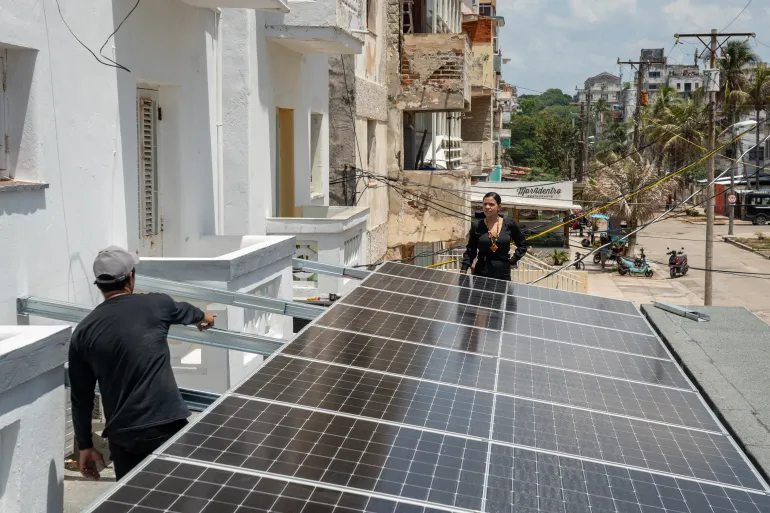
He said 144 solar farms with a combined capacity of about 1,418 megawatts have been installed on the island in recent years.
China has been the largest supplier of solar panels to the island, and shipments have increased since the blockade began in early January.
At the time, US President Donald Trump halted all oil shipments from Venezuela, a close ally of the Cuban government.
Later that month, Trump also announced he would impose heavy tariffs on any country that exported oil to Cuba, justifying the threat by calling the island’s government a “national security” threat.
Since then, only a single oil tanker from Russia has reached Havana. The US has increased its shipments of oil to Cuba’s private sector, but it has largely barred fuel exports for nationalised industries on the communist-led island.
The government-run electrical grid, widely considered to be antiquated, relies heavily on fossil fuels. Only 40 percent of Cuba’s electricity comes from domestic oil production, according to the International Energy Agency.
As of 2023, only nine percent of the country’s energy consumption was covered by renewable sources.
De la O Levy admitted in his interview with Reuters that the country was facing difficulties. The blockade has caused shortages of medicine, water and fuel, pushing Cuba to the brink of a humanitarian crisis.
“We are surviving and moving forward, little by little, even if not at the pace we would like,” he said.
“We face long hours of blackouts and lack fuel for cooking and transportation. We lack fuel, but we are gradually making headway through our own solutions and our people.”
Cuba’s production of domestic crude oil remains stable, he added, but is almost entirely allocated to power plants.
Aris Lopez Torres, owner of the Fuego Lento restaurant, speaks with technician Josecal Duarte during the installation of solar panels on the roof of her business along Havana’s waterfront [File: Lucien Migne/Al Jazeera]
The United Nations and human rights watchdogs have criticised the oil blockade as a violation of international law.
Cuban Foreign Minister Bruno Rodriguez Parrilla also condemned the oil blockade in his speech at the UN General Assembly last month.
“It is an unusual and unprecedented action,” Rodriguez said of the blockade.
“A superpower unilaterally deprives all states of their right to export the commodities that they wish to the country that they wish.”
The US has maintained an economic embargo on Cuba for more than 60 years, since the Cold War era.
But since taking office for a second term as president, Trump has sought to squeeze Cuba’s economy further, as part of a “maximum pressure” campaign. His administration has indicated that it wants to topple Cuba’s government.
On October 7, US authorities announced they had seized 90 biodiesel fuel shipments valued at over $2.8m destined for Cuba.
“These shipments were part of an attempt to unlawfully export fuel to Cuba in violation of federal export laws,” US Immigration and Customs Enforcement (ICE) said in a statement.
But in his interview with Reuters, de la O Levy denied the Cuban government had any link to the shipments.
“No Cuban state-owned company has managed to secure a fuel contract, whether for small or large quantities,” he said.
He added that any US oil shipments to private firms fall far short of the country’s requirements.
“I would venture to say that the amount entering the country doesn’t even cover 3 percent of its fuel needs,” de la O Levy said.
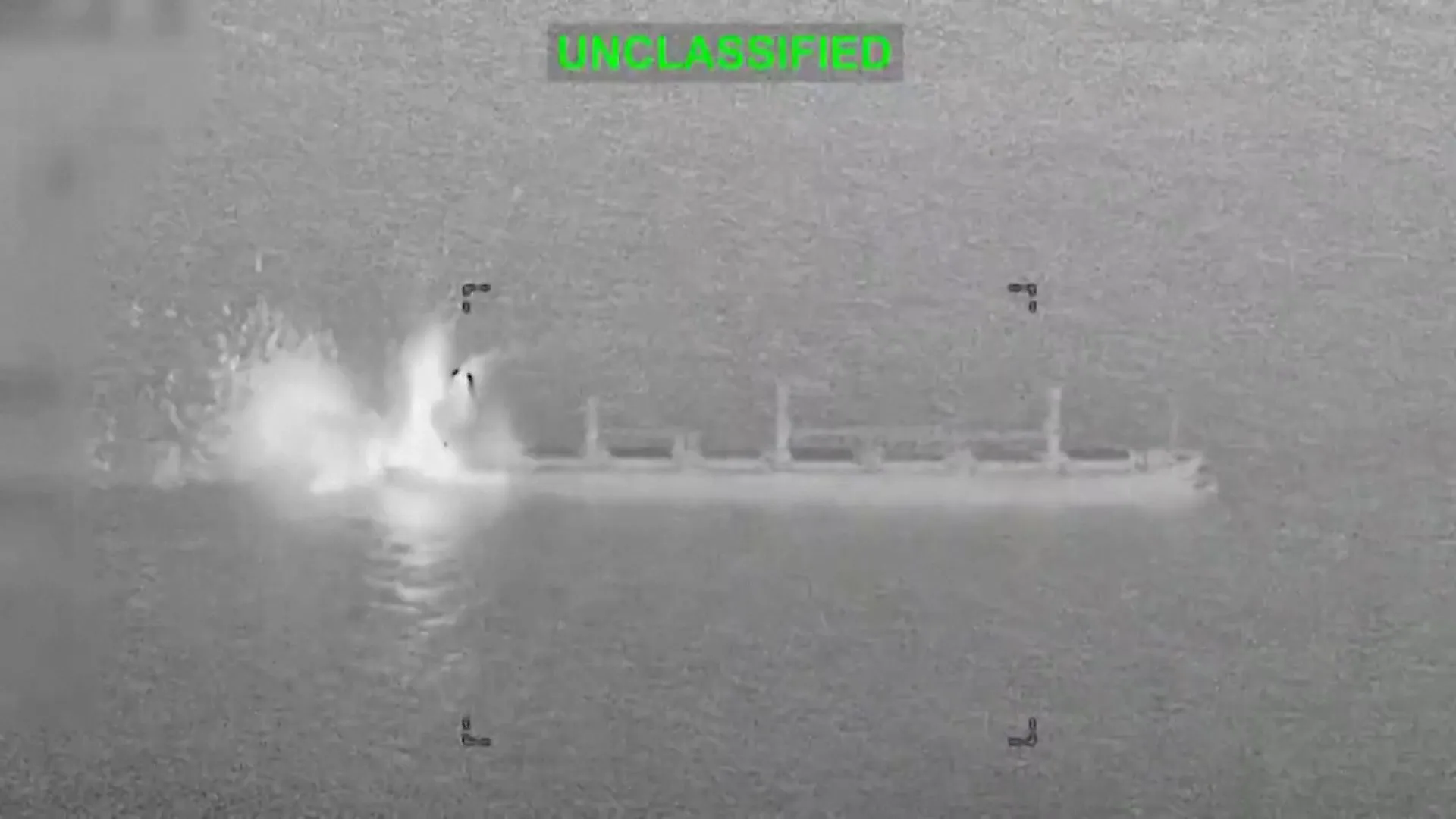
A US fighter jet bombed a commercial cargo ship in the Gulf of Oman, according to CENTCOM. The US military says the ship’s crew ignored repeated warnings and attempted to ‘breach its blockade’ of Iranian ports.
US military jet strikes stern of commercial cargo ship in the Gulf of Oman ‘without harming the crew’, CENTCOM says.
Published On 11 Oct 202611 Oct 2026
United States forces have disabled a commercial cargo vessel in the Gulf of Oman after its crew “ignored repeated warnings and attempted to run the ongoing naval blockade against Iran”, according to US Central Command (CENTCOM).
A US military fighter jet struck the stern of the Panama-flagged M/V Ocean Molica, also known as the Arika Sun, with a precision munition on Saturday, “fully disabling the ship’s propulsion without harming the crew”, CENTCOM said in a statement. The vessel was attempting to transit regional waters after “having previously departed an Iranian port”.
Recommended Stories
list of 3 itemsend of list
CENTCOM said its forces resumed their blockade against all ships “entering or departing Iranian ports on July 14”, disabling four commercial vessels and turning around 135 ships during “three months of strict enforcement”.
US forces also destroyed 10 tankers linked to the Islamic Revolutionary Guard Corps’ (IRGC’s) “multibillion-dollar shadow network” over the same period, CENTCOM said.
Meanwhile, Iran’s IRGC said it struck a vessel in the Strait of Hormuz for attempting to take an “illegal route”, as Tehran seeks to enforce its own blockade on the vital waterway.
In a statement carried by official Iranian media, the IRGC claimed Iranian forces “have taken control of the administration of the strait”.
“In carrying out this mission, a few hours ago, a giant LPG carrier named NV Sunshine, owned by NatWit, which was attempting to transit via the illegal route south of the Strait of Hormuz, was struck,” the statement said.
Vessels in the Strait of Hormuz near the beach of Bandar Abbas, Iran, October 6, 2026 [Amirhosein Khorgooi/ISNA via WANA/Reuters]
The United Kingdom Maritime Trade Operations (UKMTO) agency said on Sunday that an outbound tanker in the strait was struck on the port side by an unknown projectile, causing a fire on board. The UK agency said crew members were reported safe, while the damage and environmental impact remained unknown at the time of the report.
Tehran has attempted to enforce control over the Strait of Hormuz during the US-Israel war on Iran, insisting that ships obtain permission to cross via its preferred routes. However, vessels have increasingly risked taking an alternative route hugging the strait’s southern coast.
The UKMTO said on Thursday that a vessel sailing 94km (58 miles) north of Madinat ash Shamal, off the north coast of Qatar, was struck by multiple projectiles, resulting in a number of casualties.
The agency did not specify the origin of the ship or the number of people killed or injured, adding that authorities were investigating the incident amid a recent rise in attacks on vessels near the Strait of Hormuz.
Ships in the Gulf attempting to cross the strait, which is the sole maritime route in or out of the oil-rich region, have faced repeated attacks since the US and Israel began the war in late February.
The Strait of Hormuz remains vital to the global economy, with about a fifth of the world’s oil and liquefied natural gas passing through the passage before the war began.
Tigray was cutoff from the world during the 2020-2022 civil war, which killed around 600,000 people.
Published On 25 Sep 202625 Sep 2026
Fears of a communications blackout in northern Ethiopia have increased as fighting flares between the federal military and forces from the Tigray region and their allies.
Telecom and internet networks were reported to have stopped working on Friday as the conflict threatened to develop across the country into a full-scale war.
Recommended Stories
list of 4 itemsend of list
The interruptions have provoked fears of a repeat of the communications blackout and supplies blockade during the 2020-2022 civil war in northern Ethiopia, when Tigray was largely cut off from the outside world.
Web monitor NetBlocks said it had detected an “internet disruption in northern Ethiopia corresponding to reports of a telecoms blackout in Tigray”.
The Reuters news agency reported that Tigray’s ruling party, the Tigray People’s Liberation Front, had ordered private operator Safaricom and state-owned Ethio telecom to cut off access to phone and internet networks in the region.
Full-scale war
A source said the restrictions may be part of a tactic to neutralise the advantage of government forces using battlefield drones.
Lower-level clashes between federal and Tigrayan forces have been ongoing for some time. However, fighting intensified this week across Tigray and later spread to the neighbouring Afar and Amhara regions, after seven armed groups announced they have formed an alliance.
The Ethiopian Peoples’ Forces Alliance for Survival has committed itself to removing the government of Prime Minister Abiy Ahmed.
The Tigray Army said the federal government had launched a “full-scale offensive” involving infantry, mechanised units and drones, and said its forces had begun what they called a defensive war to counter aggression by Abiy’s government.
The alliance forces have seized three airports and launched attacks against federal troops in Afar and Amhara.
The federal government has accused Eritrea of financially backing the TPLF and its allies, which leaders in the capital Asmara deny.
Abdisalam Balema, a member of the Tigray People’s Liberation Front’s (TPLF) central committee, told Al Jazeera that the situation has become a “full war”.
The outbreak of violence is the most serious escalation since the civil war in 2020-2022. During that conflict, which killed an estimated 600,000 people, the telecoms blackout and supplies blockade imposed on Tigray caused famine-like conditions for hundreds of thousands of people.
People in Tigray are reported to have rushed to stock up on basic supplies and withdraw cash.
The renewed fighting comes at an awkward moment for the United States, which only this month lifted sanctions on Ethiopia and Eritrea related to atrocities committed during the last civil war, saying the “national emergency… has expired”.
The conflict could also draw in neighbouring Eritrea, which fears landlocked Ethiopia is planning to invade it to gain access to the Red Sea.
Nine protesters blocked access to Elbit Systems’ factory in Staffordshire by attaching themselves to five ‘lock-ons’ to launch the direct-action group ‘Silence Elbit Drones’. Al Jazeera spoke with spokesperson Audrey Corno, who said the group aims to disrupt Elbit’s operations over its supply of military equipment to Israel.