‘Love Is Blind’ Season 10 reunion: Five takeaways from the Ohio crew
The 10th season of “Love Is Blind” ventured to Ohio, yielded a record seven engaged couples and made structured cape blazers and the idea of daily Pilates classes feel like rage bait.
With the season over, and just two couples saying “I do,” the cast of the popular Netflix dating series came together for this week’s reunion special to share updates on their lives since the cameras went down — and to unpack the twists, turns and lies that played out over the season. The result was a reunion that finally provided (mostly) satisfying questions and answers about participants’ pasts and presents instead of dancing around topics.
Unable to budget the time for a trip to Cabo — or even Malibu — to process it all, TV editor Maira Garcia and I have brought our running “LIB” thread out of our Slack DMs to unpack our thoughts in this safe place.
Also in this week’s Screen Gab, our streaming recommendations include a spray-tan crime comedy and a Morgan Freeman-narrated mind trip about the rise and fall of dinosaurs. Plus, we tell you where you can stream the slate of best picture nominees ahead of this Sunday’s Academy Awards ceremony.
This is your cue to block off some “couch time” in your calendar this weekend.
— Yvonne Villarreal
Turn on
Recommendations from the film and TV experts at The Times

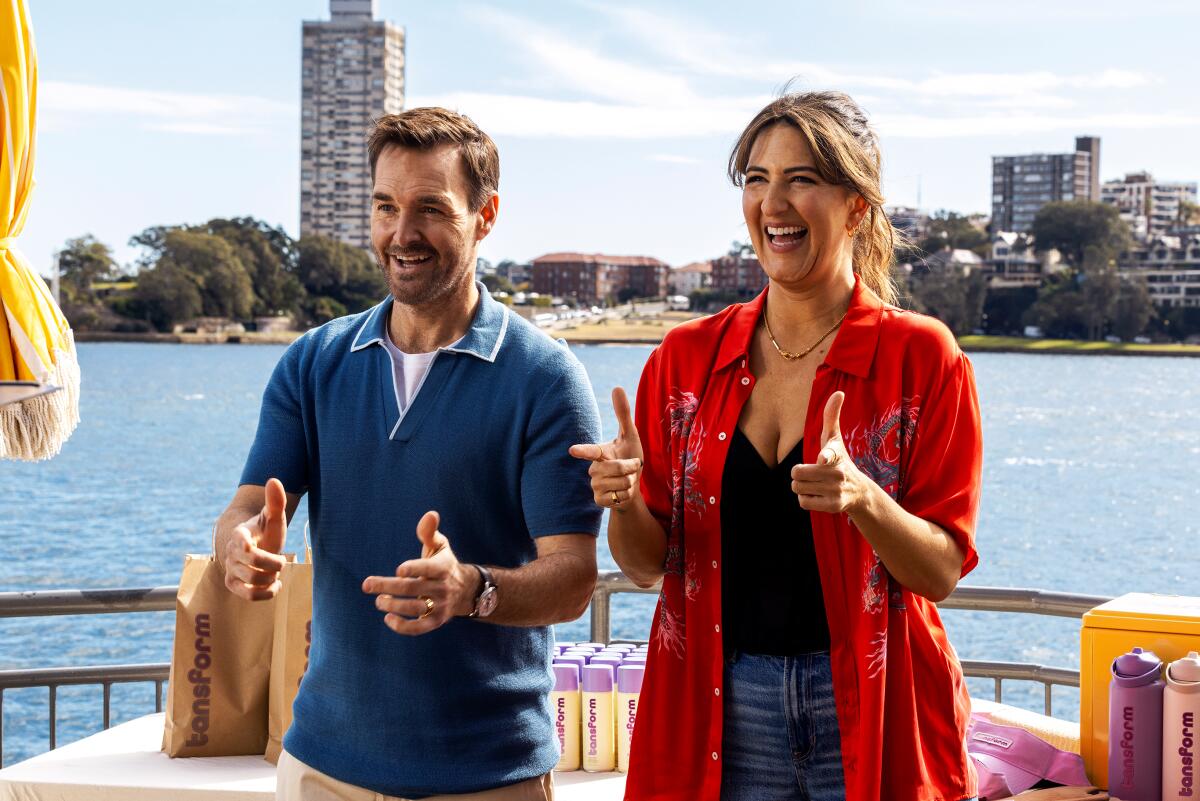
Will Forte as Martin and D’Arcy Carden as Vicki in a scene from “Sunny Nights.”
(Lisa Tomasetti / Hulu)
“Sunny Nights” (Hulu)
D’Arcy Carden fans, and I can’t imagine anyone who’s ever seen her work isn’t one, will be elated to find her at full force starring in this dark, sometimes violent Australian crime comedy alongside Will Forte, who, yes, has fans of his own. They play brother Martin (cautious) and sister Vicki (impulsive), who have traveled to Sydney to flog a tanning spray at a lifestyle convention, though Martin has an ulterior motive, to win back his wife, Joyce (Ra Chapman). What with one thing and another, they find themselves repeatedly in need of cash and mixed up with a panoply of criminals, some fairly sympathetic (former rugby star Willie Mason, excellent as former rugby star Terry; Jessica De Gouw as Susi), and others not at all (Rachel House as kingpin Mony, just out of the jug). All are trying to change their lives, or at least their business plan, including Joyce, a journalist stuck writing clickbait articles for an editor who doesn’t want to know, and Megan Wilding as Nova, an animal control worker who knows something important about an exploding crocodile. — Robert Lloyd

A still from “The Dinosaurs.”
(Netflix)
“The Dinosaurs” (Netflix)
This four-part series will have you mentioning the Carnian pluvial episode in every conversation. Aptly narrated by Morgan Freeman and executive produced by Steven Spielberg, the sweeping CGI-enhanced nature documentary traces the evolutionary history of dinosaurs, from their origins in the Triassic period to their extinction 66 million years ago. And it’s more proof that attention spans, no matter a person’s age, will always lock in for dinosaurs. Before morning, your Google search history will include terms like “Marasuchus,” “Vulcanodon,” “Heterodontosaurus” and that Carnian pluvial episode (a.k.a. the longest downpour in history, which lasted more than a million years). Prepare to have your perception of time forever altered. Still, it’s a surefire way to give your mental health a break from current events — though, for a certain generation, it may also unlock those “Land Before Time” memories. — Y.V.
Catch up
Everything you need to know about the film or TV series everyone’s talking about

Scenes from “One Battle After Another,” left, “Hamnet” and “Sinners.”
(Warner Bros. Pictures; Focus Features)
The 98th Academy Awards will broadcast Sunday at 4 p.m. Pacific. How many of the best picture nominees have you seen? Is it less than the number of think pieces you’ve read on Timothée Chalamet’s comments on ballet and opera? We’re here to help. If you’re feeling inspired to be a studious viewer ahead of film’s big night, here’s where you can stream the best picture nominees:
- “Bugonia” (Peacock): Directed by Yorgos Lanthimos, the surreal comedy thriller follows a paranoid bee keeper (Jesse Plemons) who kidnaps a pharmaceutical CEO (Emma Stone), convinced she is an alien responsible for destroying humanity. The film received four Oscar nominations.
- “F1” (Apple TV): From “Top Gun: Maverick” director Joseph Kosinski, the sports drama stars Brad Pitt as retired F1 driver Sonny Hayes, who agrees to compete in the globe’s most prestigious racing event to salvage his reputation and the failing team of his buddy. The film received four Oscar nominations.
- “Frankenstein” (Netflix): Guillermo del Toro’s adaptation of the classic horror tale transforms Jacob Elordi into the tragic monster, known here as The Creature, and features Oscar Isaac as its titular mad maker. The film received nine Oscar nominations.
- “Hamnet” (Peacock): Based on Maggie O’Farrell’s novel, Chloé Zhao’s historical drama explores the grief, love and strained marriage of William Shakespeare (Paul Mescal) and his wife, Agnes (Jessie Buckley). The film received eight Oscar nominations.
- “Marty Supreme” (Available to rent or buy on platforms like Prime Video and Apple TV): Directed and co-written by Josh Safdie, the film is loosely based on the life of American table tennis player Marty Reisman, here called Marty Mauser and played by Timothée Chalamet. It is expected to be released on HBO Max later this spring. The film received nine Oscar nominations.
- “One Battle After Another” (HBO Max): Paul Thomas Anderson’s satirical political thriller, a loose adaptation of Thomas Pynchon’s “Vineland,” follows a paranoid ex-revolutionary (Leonardo DiCaprio) trying to save his daughter when an old enemy (Sean Penn) resurfaces. The film received 13 Oscar nominations.
- “Sentimental Value” (Available to rent or buy on platforms like Prime Video and Apple TV): Joachim Trier’s Norwegian drama follows two sisters (played by Renate Reinsve and Inga Ibsdotter Lilleaas) as they reunite with their estranged filmmaker father (Stellan Skarsgard). The film received nine Oscar nominations. It is expected to be released on Hulu later this month.
- “Sinners” (HBO Max): Ryan Coogler’s gothic horror drama is set in 1932 Mississippi and follows twin brothers (played by Michael B. Jordan) who, trying to leave their troubled past behind them, return to their hometown to start anew — only to face new horrors. It became the most-nominated film in Academy Awards history with 16 total nominations.
- “The Secret Agent” (Hulu, Disney+): Directed by Kleber Mendonça Filho, the Brazilian historical political thriller stars Wagner Moura as a former professor fleeing persecution during the 1970s military dictatorship while trying to protect his son. The film received four Oscar nominations.
- “Train Dreams” (Netflix): Based on Denis Johnson’s 2011 novella of the same name, the film is an intimate birth-to-death portrait of a quiet railway laborer (Joel Edgerton) as he watches the world change around him. The film received four Oscar nominations.
Break down
Times staffers chew on the pop culture of the moment — love it, hate it or somewhere in between
It’s crazy to think that about six years ago, golden goblets, pods and “the experiment” were disparate ideas and objects that were on the precipice of infiltrating the culture. Now, you can’t think of one without the others. “Love Is Blind,” the reality dating show that tests the premise of whether singles can find love sight unseen and marry at the end, marked a milestone this year with its 10th season, filmed in Ohio.
While the series has produced a number of marriages and engagements, some have ended in breakups and divorce, as we saw on Wednesday’s Season 10 reunion. So while the answer to the question “Is love blind?” seems to be no, the series has nonetheless made for entertaining television for viewers who have made dissecting the people, fights and makeups a sport. Why are we so invested? Because it’s a reflection of where we are as a society when it comes to relationships and what we expect from partners emotionally, politically, physically and financially. With that in mind, Yvonne and I sat down with our golden goblets to unpack the Season 10 reunion. Here are five moments that stood out. — M.G.
Jordan and Amber are now divorced
Jordan Faeth and Amber Morrison were one of two couples to say “I do” at the altar. Morrison, a single mom, discussed with Faeth over the course of the show if he was ready to be a stepparent and where they would live, given that Morrison owned a home and her daughter was happy at her school. At the reunion, the couple revealed that they never moved in together and that they divorced after four months. Morrison talked about how her daughter was distraught after the breakup, leading to an emotional moment where Morrison ran offstage in tears. It raised an important question that fans have debated closely: Should parents be on the show? Seasons 6 and 9 also featured single parents, neither of whom made it to the altar. Given the compressed timeline of when people meet, become engaged and head to the altar, deciding whether marriage should include parenthood at the start adds another layer of complexity, not to mention how it could affect a child, who suddenly has a stranger in their life. The outcome wasn’t necessarily surprising, but it was sad.
Vic and Christine: boring but perfect. More, please
The other couple to make it down the aisle was Vic St. John and Christine Hamilton, who hit it off from the get-go and seemed to exist in their own blissful bubble. According to Netflix production, the show only budgets for six couples to go on a trip after the reveal and engagement. But they continued to track them, with St. John and Hamilton spending time in Malibu instead, taping dispatches together and getting to know each other without the rest of the cast in proximity. Throughout the course of the show, you see their connection grow. Their mature and thoughtful conversations about being an interracial couple and potentially raising biracial children were exactly the type of discussions you would hope they’d have before proceeding down the aisle. It may not make for dramatic TV, but it was genuinely thrilling to see a couple so well-suited for each other continuing to thrive. And in an effort to make up for not getting to go to Cabo, Mexico, with everyone else, the show offered them a trip paid by … Turbo Tax? It was an odd product placement, but if they want to foot the bill for their honeymoon, no one’s complaining. As long as it’s somewhere tropical on a beach — and not Lake Erie.
Who took accountability?
Despite not making it to the altar on screen after the blazer cape breakup, Connor Spies and Bri McNees are still together. But the bigger record-scratch moment arrived later, when it was revealed that Devonta Anderson broke up with Brittany Wicker a few days after what he told her was a work trip but was actually a getaway to Austin, Texas, to attend a concert with McNees, Ashley Carpenter and Priyanka Grandhi. Wicker didn’t seem thrilled that she had to find out about the trip from Amber (who found out from Jordan, who can’t remember that he even knew about it). McNees didn’t like the implication that she may have broken “girl code” with the whole fiasco — but if all the women are as close as they say they are, why wouldn’t you check in about such an arrangement regardless of the relationship status? (It was weird, too, that Connor thought it was a girls’ trip.) And the fact that it was the same three women who listened to Chris Fusco talk poorly about his former fiancée Jess Barrett — giant sigh. During the reunion, after Barrett voiced her disappointment in her friends about that incident, Carpenter apologized for not doing more to defend her in the moment.
Meanwhile, Nick unleashed his best attempt to channel Andy Cohen and grilled Fusco about his highly questionable behavior and the backlash over his comments to Barrett about her body, specifically stating he usually dates women who do Pilates or workout daily, and for trying to make the moves on McNees. Fusco, mostly quiet and stone-faced (could it be the shame?), acknowledged he was not proud of the moments he watched back and apologized to Barrett. His seat mate, goalkeeper Alex Henderson, was also on the defense. The self-proclaimed nomad never fully seem to vibe with his fiancée, Carpenter. He admitted she’s not his usual type. She still maintained he wasn’t telling the whole truth about his job or dating history, and overall lifestyle. Throughout his segment, Henderson was noticeably irritated by the insinuation that his stories didn’t add up. But he did seem to enjoy being asked to describe his relationship with Carpenter as if it was a soccer match, prompting him to cite a Liverpool game that ended in a tie. Are you laughing too?
Can this be a TikTok?
To commemorate the milestone season, the audience for the reunion special consisted of 150 former participants of the series. And while the time spent getting life updates with some of them throughout the show felt less forced and time-consuming than reunions past, it still felt like an add-on better suited to live in a separate (shorter) special or as social media content. If we wanted an update on these people’s lives, we can find them on social media. A gender reveal courtesy of someone’s dead grandmother, as sweet and touching and lovely as that may for an expectant couple, is not the sort of jaw-dropping moment a show like this needs. And maybe the money saved — assuming production footed the bill for those flights — could have sent every couple to Cabo.
Did you hear? Nick Lachey is from Ohio, guys.
His constant mention of his hometown roots was unquestionably the biggest declaration of love in the 90-minute special. Sorry, Vanessa.
ICYMI
Must-read stories you might have missed