blames

Albanian PM blames ‘foreign hands’ for unrest as student protests intensify | Protests News

Riot police clash with protesters for fourth day, as young Albanians protest corruption and poor university conditions

Albanian Prime Minister Edi Rama has blamed “foreign hands” for the increasingly violent student-led protests that are calling on him to resign.

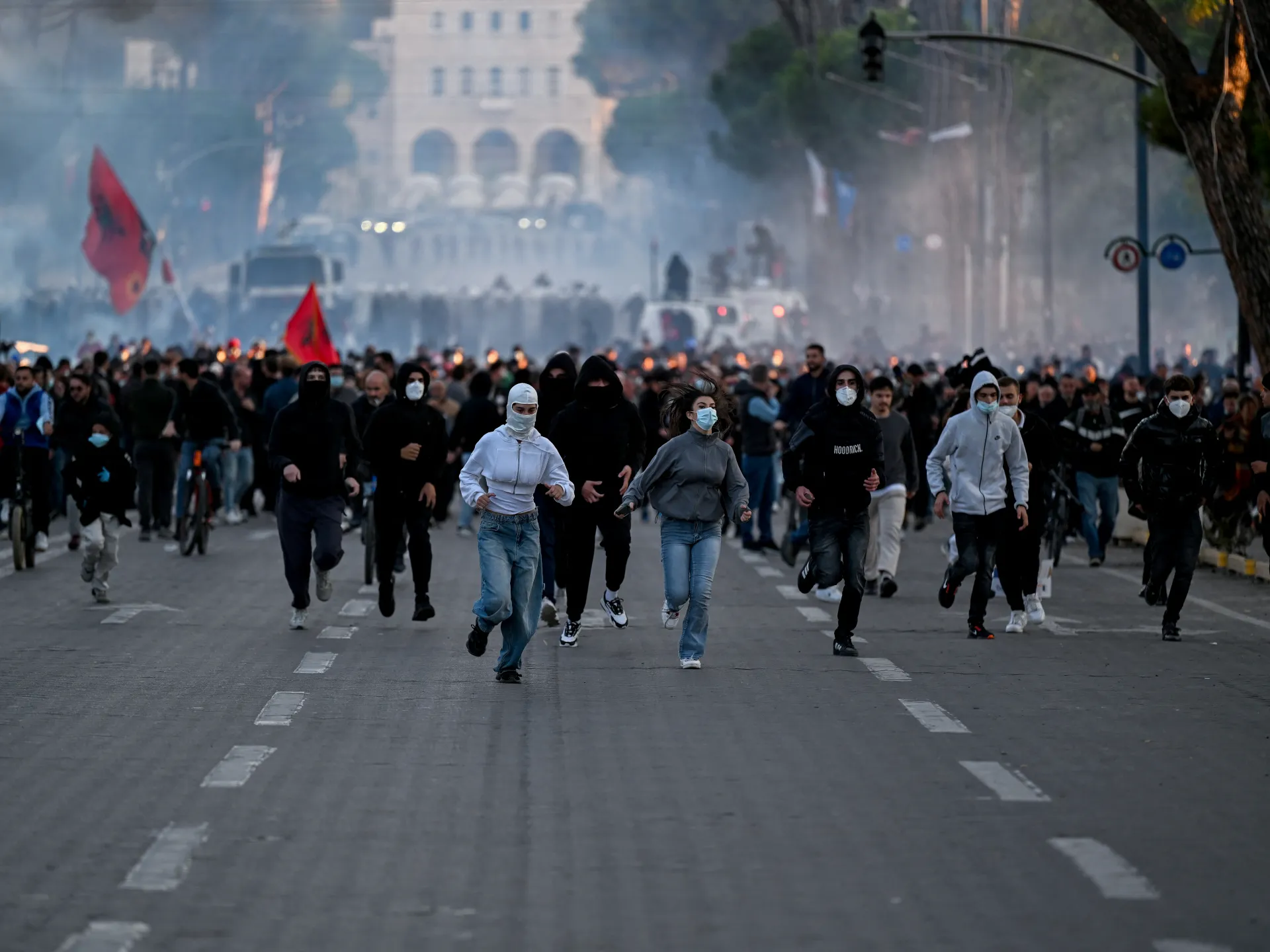
Riot police clashed with protesters outside the education ministry for the fourth day in a row, as thousands of young Albanians marched through the capital, Tirana, on Friday to protest government corruption and poor university conditions.

Recommended Stories

list of 3 itemsend of list

“This is not a student phenomenon,” Rama said in a video address on Friday. He said there were “foreign hands that do not wish for Albania to be at peace”.

Rama insisted that the protest had “absolutely nothing to do with the hardships, problems or legitimate aspirations of anyone who desires a better life”.

Police officers used water cannon and tear gas as demonstrators hurled rocks.

The protests have spread beyond the capital to Elbasan, Shkodra and Korca, where demonstrators broke windows and set fire to rubbish bins, local media reported.

The ongoing escalation follows months of mostly peaceful demonstrations, originally sparked by the sale of part of Albania’s coastline to a luxury resort development linked to Jared Kushner, US President Donald Trump’s son-in-law.

Days of unrest have increasingly targeted banks and government buildings. Protesters hurled bricks and concrete blocks at the education ministry on Tuesday. They also set fire to several buildings across the city, including the prime minister’s office, the finance and justice ministry buildings and branches of several banks.

According to a police statement, 160 people were detained over alleged acts of violence on Thursday evening.

The EU question

Demonstrators are demanding Rama’s resignation, as well as electoral and education reforms.

The prime minister, whose government denies corruption, said he would be ready to discuss rising education costs but rejected the calls to resign.

He said on Thursday, “My responsibility is to listen, address legitimate concerns and keep Albania moving forward.”

His dismissal “would be a betrayal of the Albanians who gave me a strong mandate to complete negotiations on European Union membership”, he added.

Corruption scandals have complicated Albania’s efforts to join the EU. Analysts say the country is a hub for gangs seeking to launder money from drugs and weapons trafficking.

Rama won a fourth term last year on promises to take Albania into the EU, aiming for membership as early as 2028.
Source link

Ethiopia blames regional rivals as risk of conflict spillover rises | Conflict News

As renewed fighting spreads across northern Ethiopia, the government has accused Eritrea, Sudan and Egypt of backing armed opposition groups, raising fears that the conflict could draw in regional powers.

Over the weekend, Ethiopian army chief Birhanu Jula attributed his country’s unrest to those he called Ethiopia’s “historical and contemporary adversaries”.

Recommended Stories

list of 3 itemsend of list

Birhanu accused Eritrea of being the go-between linking these external powers – including Sudan and Egypt, which he explicitly named – with armed groups inside Ethiopia.

Eritrea, Sudan and Egypt have all rejected the accusations. Speaking to Al Jazeera, Egyptian Foreign Ministry spokesperson Nader Zaki said that Egypt’s foreign policy was founded on “full respect for the sovereignty, unity and territorial integrity of states, and noninterference in the internal affairs of other countries”.

Zaki added that Egypt “is fully committed to the rules of international law and the Charter of the United Nations, and rejects any practices that would undermine regional security and stability”.

Major-General Samir Farag, the former head of the Egyptian Armed Forces’ Morale Affairs Department, also told Al Jazeera that the accusations against Egypt were false. “It has not been Egypt’s policy to interfere in the internal affairs of any state in the region,” he said.

Sudan’s military also dismissed the accusations as “baseless” and levelled its own charge of destabilising behaviour at Ethiopia, accusing it of supporting the paramilitary Rapid Support Forces (RSF), which has been fighting the Sudanese Armed Forces since 2023. Ethiopia has denied those allegations.

Troubled relations

Ethiopia’s relations with the countries it has accused have already been strained by other disputes that predate the latest fighting.

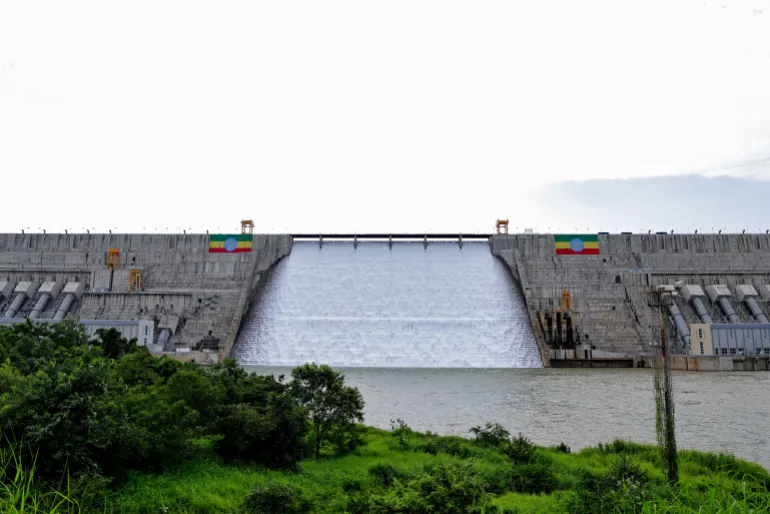
Relations between Cairo and Addis Ababa have remained tense as a longstanding dispute over the Grand Ethiopian Renaissance Dam (GERD) remains unresolved. Competition between the two has increasingly extended to regional security, the Red Sea and the Horn of Africa.

Large Ethiopian flags are displayed on the Grand Ethiopian Renaissance Dam (GERD), built along the Blue Nile, during its inauguration, in Guba, Benishangul-Gumuz region, Ethiopia, September 9, 2025. REUTERS/ Tiksa Negeri
The Grand Ethiopian Renaissance Dam, the construction of which stoked fears in Cairo that Ethiopia could choke off the Nile River, September 9, 2025 [File:Tiksa Negeri/Reuters]

Sudan’s relations with Ethiopia are similarly troubled. Since the outbreak of the Sudanese civil war, Khartoum has accused Addis Ababa of providing training, supplies and the use of Ethiopian territory to the RSF.

Eritrea had fought alongside Ethiopia against rebel groups in the latter’s Tigray region during a war between 2020 and 2022, but relations between the two neighbours have since soured, with Eritrea alarmed by Ethiopia’s attempts to gain access to the Red Sea.

Against that background, some analysts and Ethiopian opposition figures say that Addis Ababa is pointing the finger at foreign conspiracies in a bid to rally support behind its national army.

Mohamed Selim, deputy chair of the Egyptian parliament’s African Affairs Committee, told Al Jazeera that he believes the accusations were an attempt to shift attention from Ethiopia’s domestic problems by creating an external enemy and seeking to unify the internal front.

Amani al-Tawil, director of the Africa Programme at the Al-Ahram Centre for Political and Strategic Studies, similarly described the accusations as “an understandable attempt to escape from internal crises”.

She questioned why Egypt would choose this moment to intervene militarily in Ethiopia, given the two have been in dispute over GERD since 2011.

Al-Tawil said the breadth of the new opposition alliance in Ethiopia – seven groups representing disparate ethnic groups and regions announced the coalition last week – presented a challenge to Addis Ababa.

INTERACTIVE - Ethiopias ethnic groups and regions-1779798522
(Al Jazeera)

Spillover concerns

The renewed fighting in Ethiopia has spread across Tigray and into neighbouring Amhara and Afar.

Mohammed Hussein, the chairman of the Prosperity Party Afar Region Branch Office – the ruling party in Ethiopia’s Afar region – told Al Jazeera that the three regions together have a population of more than 38 million, according to his estimate, and include areas near the borders with Djibouti and Eritrea, raising fears of a regional war.

Ammar Arki, a writer focusing on Horn of Africa affairs, told Al Jazeera that Ethiopia had, at various stages, blamed Sudan, Egypt and Eritrea for contributing to instability inside Ethiopia.

He said the latest accusations could be interpreted as an attempt to redirect some domestic attention towards an external threat and build support around the federal government.

But Arki warned that the longer Addis Ababa continued to explain its internal crisis in terms of an “external conspiracy”, particularly if neighbouring states responded in the same way, the greater the risk that Ethiopia’s conflict could move beyond Ethiopia’s borders and become regional.

Source link

Huckabee blames ‘biblical illiteracy’ for waning support for Israel in US | Benjamin Netanyahu News

A Pew Research poll in April indicated 60 percent of the US adult population held an unfavourable view of Israel.

US ambassador to Israel Mike Huckabee says that the recent souring of public opinion in the United States towards Israel is the result of a lack of “biblical literacy”.

In an interview with NewsNation on Thursday, the ambassador suggested there were three sources of declining support for Israel.

Recommended Stories

list of 3 itemsend of list

He cited disinformation and foreign propaganda, a hatred of those who believe “there is a God and that he’s made up the rules for life”, and not knowing the Bible.

“You add all that together, I guess you just want to be mad at Israel and blame them for everything,” he said.

Huckabee claimed that accusations of genocide in Gaza and that Israel is an apartheid state are false, and Americans would have a more favourable view of Israel if they would “look at the truth”.

A Pew Research poll in April indicated that, although favourable opinion of Israel remained relatively strong at 65 percent among white evangelicals, such as Huckabee, 60 percent of the US adult population held an unfavourable view of Israel.

An AP-NORC poll from July suggested that Americans who believed Israel committed genocide in Gaza outnumbered those who did not, although roughly half said they did not know enough to answer.

For Israel, the decline in support has become alarming as prominent critics of Israel won several elections, including Zohran Mamdani, who became New York City mayor.

Israeli Prime Minister Benjamin Netanyahu used part of his speech at the United Nations General Assembly to lambast Mamdani, claiming that Jews in New York told him that they no longer feel safe in the city.

Netanyahu, too, has seen declining popularity in the US, with the same Pew survey indicating more than half of Americans did not trust him to do the right thing regarding world affairs.

Mamdani has previously said that he opposes hatred and bigotry, including anti-Semitism, but promised to execute an International Criminal Court warrant for Netanyahu for war crimes when the Israeli leader next visited New York City – before eventually concluding that the city did not have the legal authority to do so.

Source link