After Supreme Court loss, Trump again targets birthright citizenship with new orders
President Trump targeted birthright citizenship again Thursday by signing a pair of executive orders purporting to narrow it — including by cracking down on “birth tourism” and limiting which children born to immigrants in the U.S. qualify.
The new orders follow a U.S. Supreme Court ruling in June that rejected an attempt by Trump to end birthright citizenship outright.
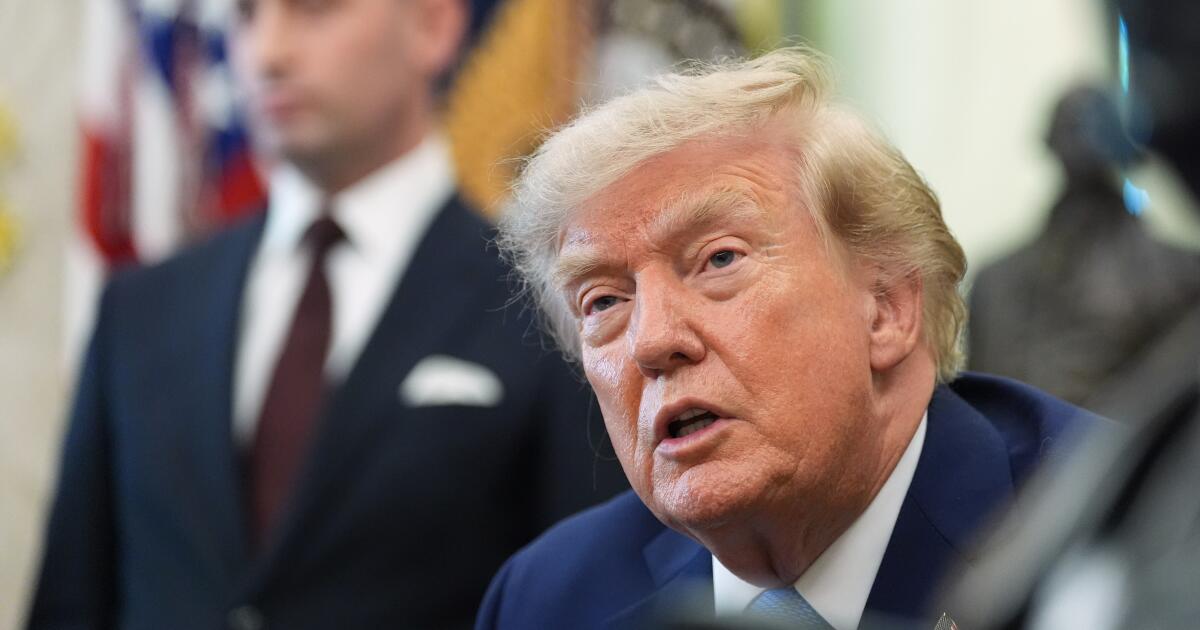
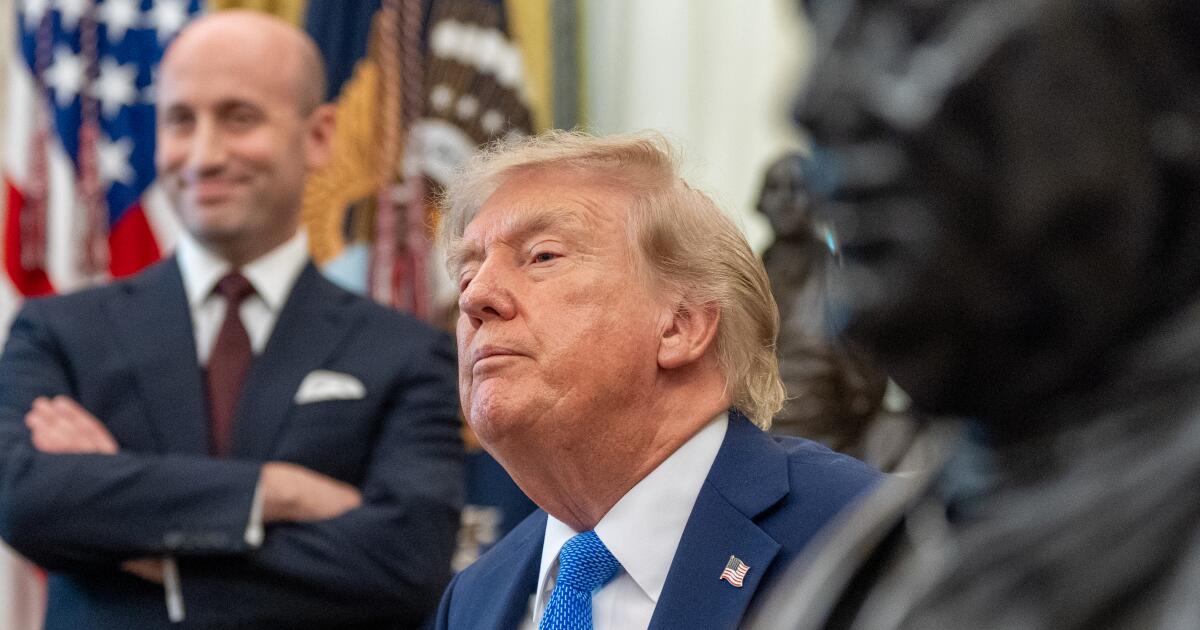
During a signing ceremony in the Oval Office, Trump called that decision by the high court “very unfair” and said the new orders were an attempt to end birthright citizenship by other means.
“Our country suffers because of it, and we’re ending it a different way,” he said.
Trump promised “big crackdowns” on birth tourism, or the practice of pregnant foreign mothers coming to the United States, or foreign fathers using surrogates already in the U.S., specifically to ensure their children receive U.S. citizenship.
Trump said an entire industry has been built up around the practice, turning birthright citizenship into “a joke.”
“Wealthy people are building businesses around birthright citizenship. That’s not the way it’s supposed to work. It’s a disgrace,” he said. “They’re buying their way in, and we’re not going to let it happen.”
The orders were immediately criticized by proponents of birthright citizenship as an indefensible attempt by the president and his administration to make an end run around the Supreme Court’s clear finding that the 14th Amendment to the U.S. Constitution cannot be undone by the president.
The amendment reads in part, “All persons born or naturalized in the United States, and subject to the jurisdiction thereof, are citizens of the United States and of the State wherein they reside.”
In an apparent response to the president’s new orders, California Gov. Gavin Newsom posted that exact language to the social media platform X. Sen. Alex Padilla (D-Calif.) also responded on the platform, writing, “Trump doesn’t understand the Constitution — but the 14th Amendment’s promise of birthright citizenship and equality speaks for itself.”
Senate Minority Leader Chuck Schumer (D-N.Y.) said in a statement that Trump’s “continued crusade to end birthright citizenship is blatantly illegal,” that Democrats would challenge the orders, and that the president had “set himself up for yet another loss in the courts.”
“If you are born in America, you are American — period. The Constitution says it and the Supreme Court has affirmed it,” Schumer said.
A spokesperson for California Atty. Gen. Rob Bonta’s office, which successfully sued alongside other Democrat-led states to block Trump’s first order purporting to end birthright citizenship, said attorneys there were reviewing the latest orders late Thursday.
The American Civil Liberties Union, which also sued to block the first order, denounced the new orders — and predicted they, too, would fall.
“The Supreme Court already decided this issue: Birthright citizenship is guaranteed by the Constitution. No additional executive order can change the meaning of the Constitution,” Cody Wofsy, deputy director of the ACLU’s Immigrants’ Rights Project, said in a statement. “Any executive order that tries to rewrite birthright citizenship will meet the same fate as the last one.”
Trump’s order on birth tourism defines the practice as “the entry of any foreign national into the United States via a nonimmigrant visa for the purpose of giving birth on American soil,” or “any effort by any foreign national to facilitate” such entry.
It orders the Homeland Security and State departments to ramp up controls to block such entries, including through the denial or revocation of visas and other travel authorizations for individuals suspecting of participating in such efforts.
“Foreign nationals seeking temporary admission into the United States must adhere to the purposes for which the Congress has authorized their temporary admission, and cannot be permitted to circumvent the immigration laws in an attempt to vest themselves and their children with lasting benefits that are irreconcilable with their nonimmigrant status,” the order reads.
The order purporting to limit which children born in the U.S. are eligible for birthright citizenship describes “certain categories of children” who it says “do not fall within the rule of birthright citizenship as announced by the Supreme Court.”
It orders U.S. agencies not to provide citizenship documents to any child whose parents are not citizens if either of their parents is a foreign government employee, ambassador or a member of a foreign terrorist organization; was “engaged in a commercial transaction to purchase or access birthright citizenship” for them or to ensure their mother was in the U.S. when she gave birth to them; or had paid for a surrogate in the U.S. to give birth to them.
Echoing arguments made before the Supreme Court in defense of Trump’s first order purporting to end birthright citizenship, Trump and other White House officials claimed on Thursday that birthright citizenship was only ever intended for the children of slaves.
“This was done right after the Civil War. This was for the babies of slaves,” Trump said.
Others have said that argument “disregards the historical record” — which clearly shows lawmakers understood that the amendment’s language was much broader than that.
White House officials said the orders would prevent a large number of children from receiving birthright citizenship, hailing it as momentous.
“It ends what has been one of the gravest and most egregious abuses of the American system, and it keeps American citizenship safe,” said Stephen Miller, one of Trump’s top advisors on immigration.
Asked if the new orders would withstand judicial scrutiny, Trump predicted they would, before directing the question to White House staff secretary Will Scharf.
“What we’re doing is taking legally validated means that are clearly within our disposal and targeting them square on to this birth tourism industry,” Scharf said. “There’s absolutely nothing in here that runs afoul of any of the Supreme Court’s opinions on the subject.”
Vice President JD Vance also hailed the move.
“Our immigration system has been exploited by those who treat citizenship as a commercial transaction, not a sacred bond. President Trump is taking bold steps to combat birth tourism and restore our sovereignty. A serious nation owes its citizens nothing less,” he wrote on X.
In its 6-3 decision in June, the Supreme Court rejected Trump’s first order purporting to end birthright citizenship outright, finding that the 14th Amendment — with very few exceptions — provided a right to children born in the U.S. that could not be undone by the president.
“Citizenship, then and now, was the right to have rights — to freely participate in our political community,” Chief Justice John G. Roberts wrote for the court. “The Framers of the 14th Amendment extended that promise to ‘every free-born person in this land.’ We keep that promise today.”
Justices Sonia Sotomayor, Elena Kagan, Amy Coney Barrett and Ketanji Brown Jackson joined Roberts in full, with Justice Brett M. Kavanaugh concurring with the outcome based on separate federal law. Justices Clarence Thomas, Samuel A. Alito and Neil M. Gorsuch dissented.
The ruling was a major defeat for Trump, and was cheered by immigrant rights advocates, including many in California, as the final say on the matter — though Trump signaled almost immediately that the fight wasn’t over.