Anne Lamott and Neal Allen share ’36 Ways to Improve Your Sentences’
On the Shelf
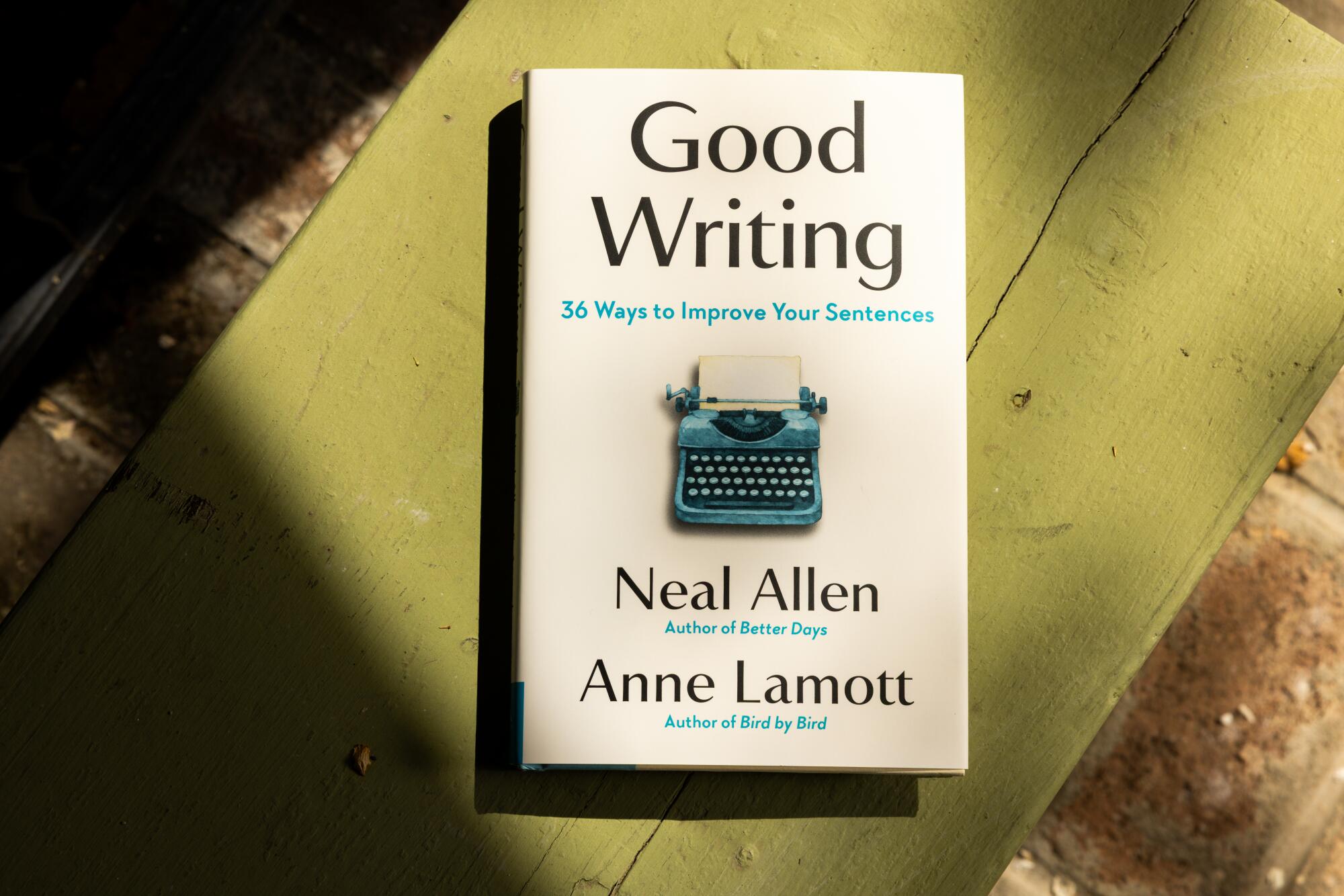
Good Writing: 36 Ways to Improve Your Sentences
By Neal Allen and Anne Lamott
Avery: 208 pages, $27
If you buy books linked on our site, The Times may earn a commission from Bookshop.org, whose fees support independent bookstores.
They’re so darn cute together, these two. Neal Allen, father of four, newspaper reporter turned corporate executive turned spiritual coach turned author of two spiritual guidebooks, stands a full head of hair taller than his dread-headed wife, who calls him her “current husband.” He calls her his “remarkable and beautiful partner” and himself “Mr. Anne Lamott.”
And no wonder. Author Anne Lamott has published 21 books, with worldwide sales in the millions. “Bird by Bird,” her 1994 writing handbook, which has sold more than 1 million copies and continues to sell approximately 40,000 copies each year, became a meme before there were memes. Thirty-two years later, the titular phrase has made appearances everywhere from “Ted Lasso” (Coach Beard: “I hate losing.” Coach Lasso: “Bird by bird, Coach.”) to a Gloria Steinem interview in Cosmopolitan (“Every writer, truth-seeker, parent, and activist I know is in love with one or more books by Anne Lamott”).
Ask a famous writer how they do what they do, and “Bird by Bird” will likely get honorable mention. Harlan Coben, whose 35 novels have sold roughly 90 million copies, calls “Bird by Bird” his “favorite writing manual.” “I use it like a coach’s halftime speech to get me fired up to write.”
In a 2007 interview, “Eat Pray Love” author Elizabeth Gilbert called herself Lamott’s “literary offspring.” Paula McLain, who wrote the 2011 blockbuster “The Paris Wife,” told me: “I return to ‘Bird by Bird’ again and again because Anne Lamott tells the truth about how hard this work is — and then somehow makes you laugh about it.”
I reached out to best-selling memoirist and novelist Dani Shapiro to ask if she had her own experience with the book. “A writer is always a beginner,” she said. “And there is no better companion than ‘Bird by Bird.’”

Lamott and Allen partnered to write “Good Writing.”
(Christie Hemm Klok / For The Times)
Lamott, 71, and Allen, 69, met in 2016 on the 50-plus dating site OurTime.com. Nine months later, they bought a woodsy Marin County home with room for Lamott’s son and grandson. Sam, when he was 1 year old, was the subject of his mom’s first bestseller, the 1993 memoir “Operating Instructions.” His son Jax was the subject, at age 1, of his grandmother’s 2012 memoir, “Some Assembly Required.”
“We were watching U.S. Open tennis one night and Neal said, ‘Can I ask you something?’” Lamott told me via email. “I barely looked away from the TV, and he asked me to marry him. I said, ‘Yes, if we can get a cat.’”
After a decade of marriage, Lamott and Allen have undertaken a professional collaboration whose outcome, like their union, is greater than the sum of its parts. “Good Writing: 36 Ways to Improve Your Sentences” is as sharply specific as “Bird by Bird” is wanderingly wonderful: as winning a companion piece as two winning companions could create. The table of contents is itself a mini-manual of writerly tips: “Use Strong Verbs.” “Sound Natural.” “Keep it Active.” “Stick with Said.” “Don’t Show Off.”

Lamott and Allen.
(Christie Hemm Klok / For The Times)
I spoke to the late-life lovebirds about their process of marital manuscript-making: the good, the not so good and the blackmailing.
Meredith Maran: How did writing “Bird by Bird” compare to co-authoring “Good Writing”?
Anne Lamott: “Bird by Bird” was literally everything I knew about writing, everything I had been teaching my students for years. It was definitely my book. “Good Writing” was definitely Neal’s book. I just foisted my attention on him and threatened to undermine the marriage if he did not let me contribute.
MM: Neal, what on earth convinced you that you could add something to one of the world’s most popular writing books —written by your wife, no less?
Neal Allen: Oh, I’m not adding anything to “Bird by Bird,” which is a complete classic. It’s everything you need to know about becoming a writer. “Good Writing” is about what comes next: a second draft. And while it’s not fair to call “Bird by Bird” a craft book — it’s much more — it’s fine to define “Good Writing” that way.

“Helping each other with our work is one of the richest aspects of our life as a married couple,” Lamott said.
(Christie Hemm Klok / For The Times)
MM: In producing this joint project, how did you two negotiate the differences between your writing styles and personalities?
AL: We didn’t need to negotiate. Neal somehow manages to be both elegant and welcoming, whereas I think I am more like the class den mother, with a plate of cupcakes, exhorting people not to give up, trying to convince them that they can only share their truth in their own voice, that their voice is plenty good, and that when they get stuck, as we all do, I know some tricks that will help them get back to work.
NA: I once asked AI to describe the difference between my writing and Annie’s. AI answered that I explain things to readers; Annie helps readers reach catharsis. I think that’s absolutely right.
MM: How did you come up with the book’s fab format, whereby each of you writes your own introduction, and then each chapter starts with Neal’s thoughts about one of the 36 rules and ends with Annie’s?
NA: Annie first asked if she could annotate what I had written. That scared the bejesus out of me. When she started writing her own essays in her own voice, I was quite relieved. One of the format’s surprising strengths is that Annie always gets the last word. I explain the rule; then she helps the reader find their way and resolve their issues with the rule. There’s a downside: I don’t get to respond when she tells the reader to ignore me.

“I’m not adding anything to ‘Bird by Bird,’” Allen said. “It’s everything you need to know about becoming a writer. ‘Good Writing’ is about what comes next: a second draft.”
(Christie Hemm Klok / For The Times)
MM: In your intro, Anne, you recall Neal telling you he was working on a writing book. “Well. Hmmmph,” you replied. “I had written a book on writing once …” How did professional jealousy, competitiveness, possessiveness, or, on the brighter side, tenderness, collaborative spirit and generosity play out as you wrote a writing book together?
AL: We have no competitiveness or jealousy when it comes to each other’s writing. We just want the other person to write the most beautiful work they can. We are each other’s first reader, and editor, and while of course I feel attacked if Neal suggests even the tiniest change to my deathless prose, I have come to understand that his suggested cuts and additions save me from myself. Helping each other with our work is one of the richest aspects of our life as a married couple.
NA: There’s no way around “Bird by Bird,” and I just have to deal with that. My worry was whether Annie really wanted to be associated with my little book. I’m envious of Annie’s brilliance, of course, but we speak the same writing language and we love it equally.
MM: What are each of you proudest of, “Good Writing”-wise?
AL: We just recorded the audio version, and I was surprised by how much practical help the book offers. Also, I love the tone, which is so conversational and sometimes, I hope, pretty funny.
NA: I had the opposite reaction to recording the audio version. I saw all the opportunities for readers to mock me. In the 18 months between writing a final draft and the book showing up in stores, we’ve both flipped from believing it reflects well on us to thinking it’s a disaster. Luckily, both of us haven’t ever thought it sucks at the same time.
MM: That is fortunate. Also, Neal, I’m not sure you answered my question.
NA: What am I proudest of? That the book exists. I carried around these rules for improving sentences for years. I think a lot of writers do a book because they notice it’s not out there, and why isn’t it? And then they shrug, ‘Well, I guess it’s up to me.’ That’s how I came into all three of my books.
AL: May I just add that I’m proud to introduce my seriously charming and breathtakingly wise husband to a wider audience.
Festival of Books
“Written by Hand: Lexicons, Storytelling, and Protecting Human Language in an Age of Artificial Everything” (featuring Anne Lamott and Neal Allen)
The Los Angeles Times Festival of Books, USC Town and Gown, Sunday, April 19, 10:30 – 11:30 a.m.
Admission is free. Ticket required.