2028 Olympic torch relay will start in Atlanta. Here’s why
She became an Olympic champion in Seoul. Janet Evans then won her fourth gold medal in Barcelona. But the star swimmer’s greatest Olympic moment came outside of a pool in Atlanta.
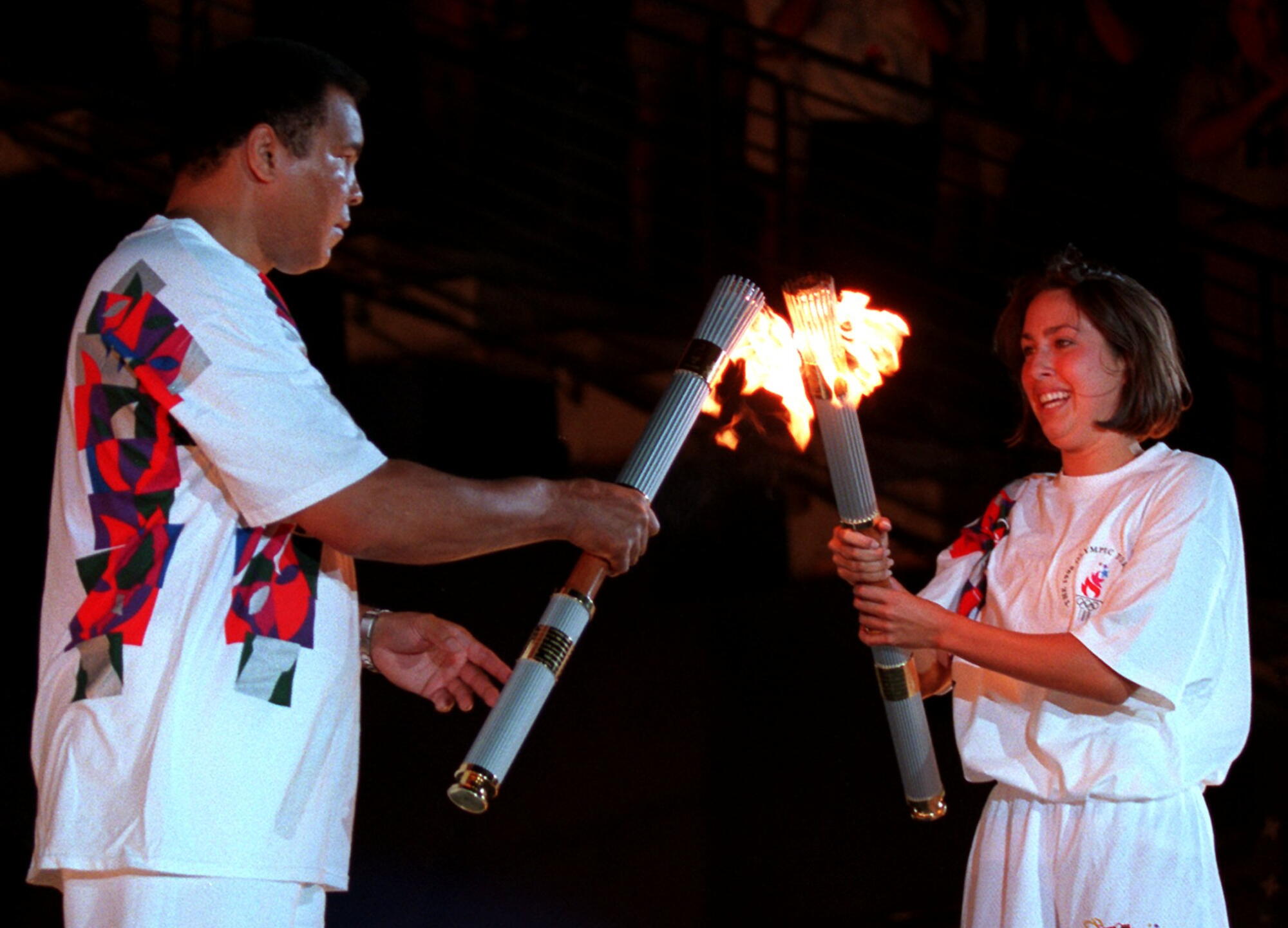
LA28 announced Tuesday it will begin the U.S. portion of the 2028 Olympic torch relay in Atlanta in a return to the city that hosted the United States’ last Summer Games and provided the Olympic movement with one of its most iconic torch relay moments. The city where Evans passed the Olympic flame to Muhammad Ali changed the swimming champion’s view on the Games and fueled her desire to bring the torch back as LA28 hopes to write an equally influential chapter of Olympic history.
“I realized when I carried that torch that the flame represents so much more than medals,” said Evans, now LA28’s chief athlete officer. “It certainly represents victory and all those attributes about the Olympics. But it also brings people together, and it’s a symbol of hope and what the Olympic movement really does for everyone.”
The torch relay, which begins in Olympia, Greece, will come to the United States in spring 2028, pass through all 50 states and culminate on July 14, 2028, with the lighting of the Olympic cauldron at the opening ceremony in L.A.
Three decades ago, the relay legs were reversed. Atlanta’s U.S. torch relay started in L.A., where Evans was one of the first people to run with it in 1996. She never thought she would carry it again during the opening ceremony.
Swimmers never attend opening ceremonies, Evans retorted when Billy Payne, president and chief executive of the Atlanta Committee for the Olympic Games, asked her to run the penultimate leg of the torch relay. She would be competing the next day and needed to rest her legs ahead of her final Olympic races. She didn’t believe him when he promised that carrying the torch in the opening ceremony would surpass any Olympic medal she could win.
Running past her fellow Olympians in Centennial Olympic Stadium made Evans finally understand. At the top of a large ramp, Ali emerged out of the dark night. Evans felt a deep rumble as the boxing champion came into view. The stadium felt like it would collapse.
Ali, trembling from the effects of Parkinson’s disease but with strength still evident, held the flaming torch aloft.
Payne was “worried to death” that Ali could drop the torch, he said, 30 years later. Payne instructed Evans that if that happened, she was to grab his arm, pick up the specially engineered torch that would never extinguish and light the fuse ball together.

Janet Evans passes the Olympic flame to Muhammad Ali during the 1996 Summer Olympic Games Opening Ceremony on July 19, 1996.
(Associated Press)
When Evans faced Ali to pass the flame, she knew she wouldn’t need to resort to Plan B.
“I saw it in his eyes,” Evans said. “I still talk to people that were in the stadium, and they say it changed me. It made me realize that I can do great things just like him.”
The torch and the flame endure in an ever-changing Olympic movement. The Games are no longer just a sports competition. They’re the biggest sporting event in the world. They’re seen as a symbol of unity. For host cities, they can also be seen as a high-stakes burden that must bring economic, commercial and civic success. Anything short of perfection feels like disaster on the world stage.
Now less than two years until the Games open, LA28 chairman Casey Wasserman acknowledged there can be some “angst” around the process that is kicking into the delivery phase.
LA28 is still trying to secure millions of dollars in funding to ensure smooth transportation during the Olympics and Paralympics. The nightmare scenario of running over budget and saddling local taxpayers with debt hangs over the organizing committee.
With no permanent venues to build in advance, much of LA28’s spending will take place in the final stages. It’s almost that time to spend, Wasserman acknowledged. Getting to finalize major touchpoints such as the torch relay, the mascot and the medal designs while preparing to makeover existing venues signal excitement and confidence in the organization’s process.
“The part now [that] we are in is making sure all of our plans are clear, all of our difficult decisions are being made, so that when we go, we have as few changes and as few course corrections as possible,” Wasserman said. “Not that there won’t be any, but to limit those as much as possible, so that we operate towards the start line with as much certainty as possible, which is the only way to deliver a project of this scale.”
LA28 will announce the full torch relay route in 2027. The private organizing committee has a rough sketch of the path that will snake through all 50 states. The nationwide tour was one of Wasserman’s earliest plans for the relay. While he was intent to bring the Olympics back to L.A. for the third time, he has always wanted these to be “America’s Games.”
Payne is jealous that LA28’s torch relay will reach every corner of the United States when Atlanta only managed 42 states. LA28’s route promises to pass through iconic cities and landmarks, but Wasserman is most keen on carrying the torch through small towns, per advice he received from Payne.
“If you want to see the power and the impact of what you’re doing, that’s where you will feel it,” Wasserman said his Atlanta counterpart told him. “Because that city, that community, it will be the biggest thing in that town. That is the power of the Olympic movement.”
Payne calls it “the burden and the joy” of the torch. During his Olympic planning process, he was never more nervous than when he carried the flame through the University of Georgia’s Sanford Stadium, where he met his wife, Martha, and played for legendary football coach Vince Dooley. Hampered by a hip injury, Payne limped through only a third of his allotted distance. He still cherished every painful step.
“The sense of the entire history of the Olympic world, the hopes and dreams of all the athletes, indeed, all the people of my community, my city, my country, they were all supporting us,” Payne said. “It was an amazing emotional time, and one I think [of] every single time we do the Olympic torch relay. It impacts people very similarly.”
The flame is lit during a ceremony at Olympia, the birthplace of the ancient Olympic Games, using a mirror and light from the sun. It will run through Greece before being transferred to the United States. Since the modern torch relay tradition began in 1936, the flame has burned underwater (Sydney 2000) and in space (Atlanta 1996) and traveled by plane, train, automobile, boat, pony and even camel.
To continue the tradition, LA28 will call upon thousands of torchbearers. LA28 will announce information on the torchbearer nomination process in the coming months.

The Olympic flame is passed to a torch during a ceremony in Olympia, Greece, in November 2025 prior to the Milan-Cortina Winter Olympic Games in Italy.
(Milos Bicanski / Getty Images)
Once it gets to the final 25 to 30 torchbearers, Wasserman said, each runner has to be “fundamentally important, connected and relevant to what we’re doing.” Runners could honor the Olympic movement’s past or future while celebrating L.A. and sports before passing the flame to the final torchbearer to light the cauldron.
The ultimate honor is typically reserved for sporting heroes from the host country, often with Olympic excellence on their resume. Since 1980, only two Summer Games have featured a cauldron lit by a non-Olympic or Paralympic athlete. Ali’s iconic moment set a high bar for the LA28 Games, but with 22 months left before the opening ceremony, the question of who will light L.A.’s cauldron remains a fun parlor game, Wasserman said.
He can make only one promise, which he first told Rafer Johnson. The legendary decathlete who climbed 99 steps to light the cauldron at the Coliseum in 1984 just begged Wasserman not to repeat the punishing path.
“Who lights it and how they get there, I don’t know,” Wasserman said, “but there won’t be however many stairs he ran up to get up to the bottom of the peristyle.”