Solar stocks fell sharply on Thursday, led by First Solar’s (FSLR) 10.3% plunge to a new 52-week low, as high borrowing costs add pressure to an industry that depends heavily on project financing.
Losses among solar stocks were broad, including Enphase
At midseason in high school football, the Chaminade High passing duo of sophomore quarterback Jeremy Mellalieu and senior receiver Andrew Cordero has surpassed many of the players ranked higher in preseason forecasts. That’s what happens frequently when it’s time for gauging performance over potential.
Mellalieu, who won the starting job with three games left in his freshman season, has led the Eagles to a 5-0 start.
“He’s really letting the ball fly and trusting us, and we’re making good catches,” Cordero said. “He’s definitely running a lot harder when he breaks the pocket. He’s confident and when he has to, he’s tucking the ball and running.”
Mellalieu, who is 6 foot and 180 pounds, has passed for 1,071 yards and 12 touchdowns with three interceptions. Cordero, 6-0 and 175 pounds, has shown excellent speed in breaking away from defenders while catching 20 passes for 455 yards and seven touchdowns.
“I think he’s played on a different level of confidence,” Mellalieu said of Cordero. “I feel he’s really finding himself in being more elusive when he catches the ball and making plays. He’s turning a bubble screen into a 50-yard gain or first down.”
Together, the duo and their teammates have the Eagles ready for a competitive Mission League schedule. Sierra Canyon remains the overwhelming favorite, but the Eagles’ improvement after a 5-6 season in 2026 is noticeable.
Quarterbacks have been the story at midseason, with teams passing a lot more and quarterbacks showing off their ability to run and pass. The performance of JSerra quarterback Hayes Cloutier last week against Bishop Amat perfectly explains the trend. He ran for 124 yards and three touchdowns and passed for 190 yards and two touchdowns.
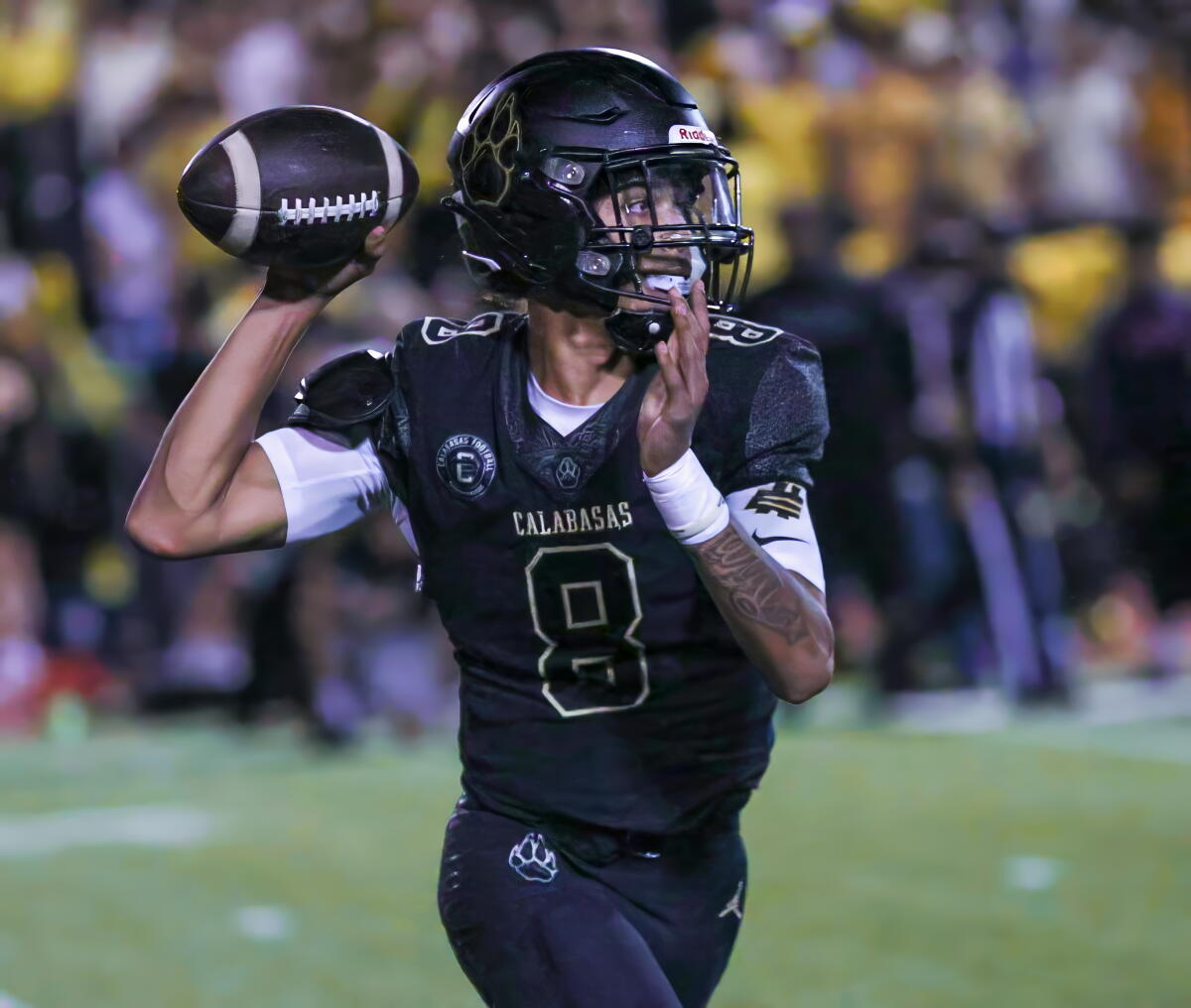
Calabasas quarterback Dominik Hardy threw four touchdown passes in 27-17 win over Birmingham.
(Craig Weston / For The Times)
Star Thomas of Orange, Chase Curren of Crespi, Chris Fields III of Carson, Ryan Rakowski of Palos Verdes, Jaden Jefferson of Corona Centennial, DJ Mitchell of La Habra, Dominik Hardy of Calabasas and Grady Long of La Serna have been showing off their ability to pass and run. Among the passers with strong five-week efforts have been Matthew Escobedo of Cantwell-Sacred Heart, Jordan Malikin of Warren, Gerald Torres of King/Drew, Seth Solorio of San Pedro and Nicholas Hoang of Culver City.
With quarterbacks throwing often, receivers are putting up impressive statistics. Landon Lattimore of Saugus has 11 touchdown receptions. Owen Martinez of Cantwell-Sacred Heart has 41 receptions. Paul Turner of Birmingham is separating himself from all City Section receivers with his big-play catching ability. Gavin Honore has been keeping the Mater Dei offense afloat. Quentin Hale of Corona Centennial has been close to uncoverable.
For running backs, AJ McBean of Gardena Serra, Jaxsen Stokes of Sierra Canyon, Adrian Petero of Santa Margarita, William Fredericksen of JSerra, Maliq Allen of St. John Bosco, Gatsbee Gumban of Nogales, Salvador Villa of Simi Valley, Arman Papazyan of Glendale, Brandon Hernandez of Panorama, Tru Warrior Casas of Fairfax and Ceasar Reyes of Garfield have been dependable running machines. Gumban has 926 yards rushing in five games.
There’s one blocker who has established himself as the best in Southern California. Lucas Rhoa of Orange Lutheran needs to be observed and copied the way he is using his size, strength and agility. If anyone resembles a future NFL player, it’s him.
It was the battle in the trenches between Orange Lutheran and Sierra Canyon, which won 28-10.
(Craig Weston / For The Times)
When it comes to delivering as expected, Sierra Canyon’s defensive line made up of the trio of Kasi Currie, Stephen Harrison and Marcus Fakatou can’t be stopped. They’re distrupting offenses similar to the lineman group that was at Santa Margarita last season during the Eagles’ successful Division 1 title run. Junior defensive end Kingston Sula of Carson has recorded five sacks.
Sophomore linebacker Eli Zamorano of Sierra Canyon gets tackle against Orange Lutheran.
(Craig Weston / For The Times)
Among linebackers, junior Luke Ulibarri of El Camino Real has been credited with 86 tackles in five games. Sophomore Eli Zamorano of Sierra Canyon and freshman Aydan Steen of Santa Margarita have been the best first-year varsity contributors. Mater Dei’s linebacker group, led by Mike Davis and Dailon Clanton, have led a very good defense.
Jalen Flowers of Palos Verdes takes off on punt return vs. Carson.
(Nick Koza / For The Times)
Special teams players have been coming through, from Tucker Murray of Corona del Mar (one punt return, one kickoff return for touchdowns) to Jalen Flowers of Palos Verdes. Among kickers, Charles Szares of Sherman Oaks Notre Dame is five for five on field goals and 23 for 23 on PATs. Mateo Akerman of Corona del Mar came out from the soccer team and has been booming almost every kickoff into the end zone for a touchback.
The impressive two-way contributors include sophomore Roshaun Brown of Jefferson. He has five interceptions and five touchdowns receiving. Nolan Scott of Corona del Mar continues to make impact as a tight end and defensive end.
There are 46 unbeaten teams left. Among the surprises are Harvard-Westlake, San Marino, St. Bernard, Royal, all of which have struggled to obtain winning records in recent years.
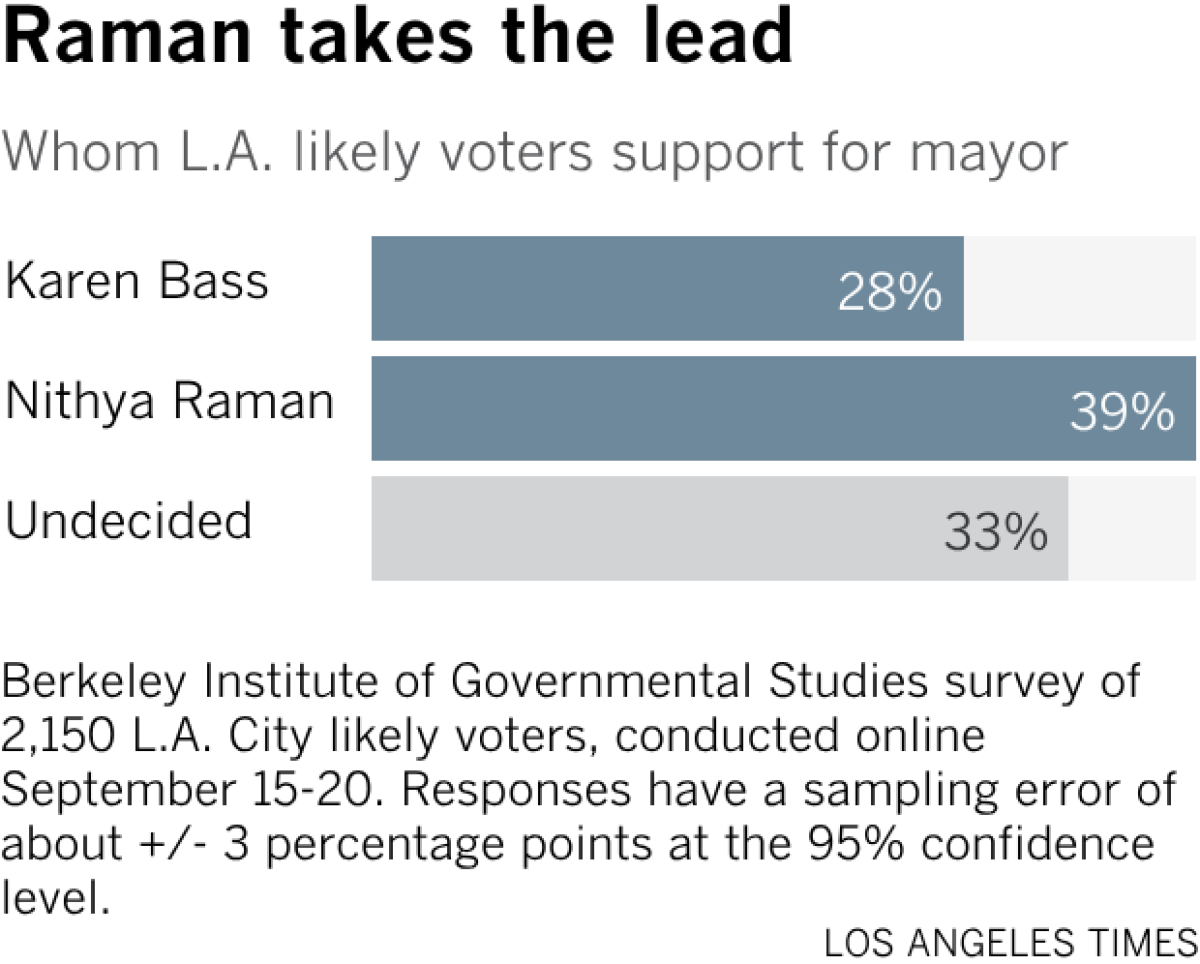
Los Angeles Councilmember Nithya Raman has taken a wide lead over incumbent Karen Bass in the L.A. mayor’s race, according to a new poll released Wednesday, although a high percentage of voters remain undecided less than two weeks before mail-in ballots are sent out for the Nov. 3 election.
Raman is favored by 39% of likely L.A. voters, compared with 28% for Bass, according to the poll by the UC Berkeley Institute of Governmental Studies, which was co-sponsored by The Times. The poll found that 33% of voters were undecided.
“Raman clearly has the advantage. Her task is a little less onerous than Bass’,” said Mark DiCamillo, the director of the Berkeley IGS Poll.
Adding to Bass’ low poll numbers are high unfavorability ratings.
The mayor had 63% unfavorable ratings, the poll found, with 28% favorable and 9% having no opinion. By comparison, 40% had a favorable view of Raman, according to the poll, while 39% said they had an unfavorable view of her and 21% had no opinion.
The survey released Wednesday was conducted online with a sample of 2,150 likely city voters between Sept. 15 and Sept. 20. It has a margin of error of about 3 percentage points.
The poll represented the strongest showing yet for Raman, who trailed Bass in almost every poll during the primary campaign and who came in second to Bass in the primary election, with 29% of the vote compared with Bass’ 34%.
Mayoral candidate and Councilmember Nithya Raman, center, enjoys a light moment with Alliance of Californians for Community Empowerment (ACCE) Action members at La Cita Bar in downtown Los Angeles.
(Genaro Molina / Los Angeles Times)
Even so, DiCamillo said the large number of undecided voters means the race is far from over.
“It’s extraordinarily unusual to see this many undecided voters at this point in the race,” he said. Mail-in ballots will be sent out beginning Oct. 1, local elections officials say.
The large number of undecided voters can be linked to the elimination of mayoral candidate Spencer Pratt in the June 2 primary, according to DiCamillo. The former reality TV star received 26% of the vote in the primary, and most of the voters who cast ballots for him — 63% — say they haven’t decided whom to vote for in the runoff, the poll found.
Among those Pratt voters who have decided, 22% favored Bass compared with 16% for Raman.
One of the most significant findings in the poll was a massive “generational divide” among L.A. voters, DiCamillo said.
Raman, 45, dominated the 72-year-old Bass among younger voters, with 66% of likely voters ages 18 to 29 choosing the council member while just 4% chose Bass, according to the poll.
Raman also had 64% of likely voters ages 30 to 39 compared with Bass’ 12%, and the council member had 50% of likely voters ages 40 to 49 compared with Bass’ 18%. Raman also was leading among voters 50 to 64 years old by a slim margin of 35% to 33%.
Bass, meanwhile, led among the oldest set of voters — those 65 and up — but not by the same margins. Bass had 41% of likely voters in that group compared with Raman’s 21%.
According to the poll, 56% of likely voters thought Bass did a poor or very poor job responding to the disaster, which killed 12 people and destroyed more than 4,000 homes, including Pratt’s.
Fourteen percent of the likely voters thought Bass had done either an excellent or a good job and 17% thought she had done a fair job.
Mayor Karen Bass campaigns at Ernest E. Debs Regional Park on Sunday.
(Kayla Bartkowski / Los Angeles Times)
The most important issues to likely voters were fixing city infrastructure, moving homeless people indoors, crime and public safety, and building more affordable housing, the poll found.
The poll shows Raman leading in nearly every geographic area of the city. Bass was leading in South Los Angeles and the Harbor region, 37% to 34%, but central Los Angeles as well as northeast and the east side of Los Angeles broke strongly for Raman.
The San Fernando Valley went 34% to Raman and 26% to Bass with 40% still undecided. The Westside favored Raman by a single percentage point, at 35% to 34%.
Raman has led in other polls recently, though none by as wide a margin as in the Berkeley IGS/L.A. Times poll. Shortly before the primary, a separate Berkeley IGS/L.A. Times poll showed Raman leading Bass in a potential head-to-head matchup by just four percentage points, with 32% support compared with the mayor’s 28%.
On the negative side, Raman was booted from her position in the council as chair of the Housing and Homelessness Committee, a move she said was politically motivated.
The pop star duo have revealed exactly what happened during the tense row
Pop stars Jedward sparked chaos in the Big Brother house (Image: ITV)
Jedward have broken their silence on the heated Big Brother row that left them “traumatised”.
The pop star duo, whose real names are John and Edward Grimes, joined the reality show on Sunday and had already sparked chaos by Monday night. It all started when they offered 21-year-old Rhianna some friendly advice while relaxing in the garden hot tub.
Rhianna approached the pair and asked for their unfiltered opinions about her, and they didn’t hold back. They criticized her relationships in the house and encouraged her to get out of her comfort zone, telling her “you’re not in Love Island“.
The conversation spiralled out of control when Rhianna reported it back to her close friend Chelsey, revealing she was really upset. Fellow housemate Lynx then realised the young woman was sad and decided to confront Jedward.
When Lynx approached the twins, the discussion became even more heated and ended with John splashing Lynx with water from the hot tub.
John has now explained exactly what happened in that heated moment, arguing that the water splashing was “innocent”. Speaking on Big Brother’s companion show, The Group Chat, he said: “I had given the girl [Rhianna] a bit of advice.
“She left, I literally thought she was calling it a night. Suddenly Chelsey is back and I’m like ‘Ok that must be it then’. And he [Lynx] was about to – I don’t know if he was about to get into the tub – but the water was just there.”
He went on to add: “It could have got way worse. I think the splashing was just innocent. It was just an innocent moment.” Other housemates were forced to step in after the splashing incident as Lynx was left furious with the twins.
Edward revealed his own perspective on the argument, adding: “I’m traumatised, I’m gonna have to check into a therapist. I will never get into a hot tub and not think of this.”
The musicians were at the heart of drama throughout their Big Brother journey but they have insisted they didn’t set out to “make trouble”. They had actually hoped to form some connections and enjoy a few days in the famous house.
However, Jedward’s time on the show came to end in Tuesday’s (September 22) episode. They returned to social media before their final scenes had even aired and shared unfiltered posts about the remaining housemates.
Writing on X, formerly Twitter, one post said: “The truth hurts I guess I think we deserve a medal for the honesty and impact we brought to the house authentic vibes always. They acting too pretentious and predictable and raging we clocked.”
While another added: “Don’t ask for an opinion if you can’t handle the truth I was calm, collected, fair and straight with them #bbuk.”
Big Brother’s The Group Chat is streaming now on ITVX
Two housemates were then forced to say their goodbyes on Friday night (September 18), with fake contestant Tays leaving alongside bartender Millie. But viewers have also been watching romances bloom between Chelsey and Lynx, as well as Omar and Rhianna.
However, this won’t be Rhianna’s first love story to play out on screen. She previously dated Made in Chelsea star Freddy Knatchbull and appeared in several episodes of the show alongside him.
In her first scene on the Channel 4 series, the 21-year-old revealed that she doesn’t use the name she was given at birth. The Russian star actually chose her current name at just six years old, after her mother became a British citizen.
“I’m Russian but I’ve lived everywhere,” she explained to Freddy’s friends. When asked what her real name is, Rhianna shared: “I changed my name too, when I was like six. Because my mum became a British citizen.”
She went on to reveal her potential choices: “As a six-year-old, she’s asking me ‘Oh, change your name if you want.’ And I was like ‘Okay.’ Gave her three options: Zendaya, Rihanna like the singer, or Kylie Jenner.”
Try ITVX Premium free for a week
This article contains affiliate links, we will receive a commission on any sales we generate from it. Learn more
ITVX Premium offers exclusive ad-free content that can be streamed on-demand and on the go, with everything from Hollywood blockbusters to bingeable British box sets.
An annual plan costs £59.99 – equal to £4.99 per month – after a seven-day free trial.
The Big Brother star didn’t reveal her birth name on the show. But she touched on her unusual upbringing, during which her mother hired a full-time bodyguard to stop her being a “wild child”.
Reflecting on her teenage years, Rhianna said: “I would meet people for the first time and they’d be like ‘Rhianna, by the way, there’s someone following you.’ Can you imagine trying to meet guys and then a bodyguard is with you?”
The so-called stay-at-home daughter is now hoping to win over the nation and take home the Big Brother crown. Living with strangers will also be a new experience for her. “I’ve never done that before,” she admitted before starting the show.
“I’ve never stayed in a hostel, gone to summer camp or boarding. I’ve never been in a situation where I have to stay the night with complete strangers and that is really exciting for me. I get to meet people that I most likely wouldn’t have met in my day-to-day life.”
Big Brother continues on ITV2 and ITVX tonight at 9pm
When Dodgers manager Dave Roberts said earlier this week that the best was yet to come, his expectations were centered on the offense.
In the Dodgers’ 10-4 rout of the San Francisco Giants on Saturday, that better version of the offense was on display, putting together a pair of three-run rallies in back-to-back innings to take pressure off the pitching staff.
“This is the first time, seems like all year, that we’ve had four or five hitters swing the bats well for four or five games,” Roberts said. “So it’s been really good to see.”
This month, Mookie Betts, Kyle Tucker and Teoscar Hernández have led the group, with Max Muncy and Will Smith heating up this week. The Dodgers’ 15 hits Saturday were their most in a game since July 2 against the San Diego Padres, and just two shy of their season high.
Reinforcements should be coming soon too. Shohei Ohtani (right biceps and left knee) hit off the Trajekt machine Saturday and ran the bases before the game. Roberts said there’s a “good chance” that he’ll be activated off the 15-day injured list during the Dodgers’ series against the San Diego Padres this week. He can be reinstated as early as Wednesday.
Center fielder Andy Pages (fractured left hand) went through a simulated game Saturday. He could return Tuesday.
“You’re going to go through your waves,” said Betts, who finished the day with three doubles and a single. “You’ve just got to ride them. … Right now we’re getting them across, and we’re just going to keep giving ourselves chances. That’s the main thing.”
The offense kept the Dodgers in the game, despite Tarik Skubal struggling.
Skubal pitched only five innings, tied for his shortest start with the Dodgers. And he surrendered four runs, the worst mark of his Dodgers tenure.
Entering the game, Skubal appeared to be peaking. His previous two starts, both against the Reds, were some of his most efficient.
That efficiency, however, regressed against the Giants (64-91).
“Fastball command wasn’t great,” he said. “Not driving it up and in, kind of pulling the ball down at times, pushing it up at times. I think almost [all] pitching is all fastball command, and mine wasn’t great today.”
Though he got through the first two innings without giving up a run — thanks in part to a diving catch by Tucker in the right-center field to end the first — he issued two-out walks in each.
The Dodgers’ offense used that time to mount a lead. Betts hit the first of those doubles in his first at-bat, and Muncy authored his own to drive in the first run.
The next inning, rookie Josue De Paula’s walk, and singles from Alex Freeland and Betts combined to push in another run.
Dodgers baserunner Kyle Tucker slides head first into Giants catcher Andrew Knizner while scoring a run in the fifth inning Saturday.
(Gina Ferazzi / Los Angeles Times)
Then Skubal began to struggle. With a runner on second and one out, he pitched to a full count against designated hitter Victor Bericoto. Skubal missed down the middle with a fastball, and Bericoto sent it 425 feet to center field. It landed on the netting on the other side of the wall to tie the score.
The Dodgers’ offense, coming alive in September, struck back in the third. Smith hit his second home run in as many nights, launching the second pitch of the inning into the left-field pavilion.
The Giants took a different approach to tie the score for a second time. After back-to-back singles, they used back-to-back sacrifice bunts to advance the runners and score another run.
Then the two teams traded runs again. Betts put the Dodgers (95-60) up with an RBI double in the fourth. Skubal gave up back-to-back doubles in the fifth.
That marked both the end of Skubal’s start and the beginning of the Dodgers’ offensive onslaught.
“Obviously, I wasn’t very good today,” Skubal said. “But the offense and defense and bullpen picked me up big time. And that’s what good teams do, they pick each other up and win series and win baseball games. So, hats off to them.”
The Dodgers brought seven batters to the plate in the fifth, and all but one reached base. Tommy Edman hit a two-run single. And pinch-hitting Miguel Rojas almost matched him, but Giants left fielder Turner Hill made a perfect throw to nab Edman in a close play at home to end the inning.
Betts’ and Smith’s bats stayed hot to open the sixth with a leadoff double and one-out RBI single, respectively. The Dodgers took advantage of the Giants’ sloppy infield play to load the bases for De Paula, who lined a two-run single into shallow center field.
Those were the kinds of stifling rallies that had defined the Dodgers’ offense earlier in the season, when they were scoring regularly in double digits.
“I think our potential’s winning the World Series,” Tucker said. “So until we do that, then I can say we reached it. But we feel like we’re in a good spot right now. Our pitching staff’s done a great job all year giving us an opportunity to win every single night. Our defense has played pretty well behind them, and then offensively we’ve done a solid job as well.
“Right now we’ve got a few guys that are feeling good, a few guys that are banged up. But we’re still out there grinding, trying to win as many games as possible before the season ends and just trying to carry it all the way to the playoffs.”
Tucker picked up some extra bumps and bruises Saturday, most notably fouling a pitch off his right knee in the third inning. Once the game became a blowout, Roberts pulled him.
“I feel like everyone’s grinding at this point in the season,” Tucker said. “But I’ll be good with it.”
The Big Brother house has reportedly been locked down temporarily
22:32, 21 Sep 2026Updated 22:36, 21 Sep 2026
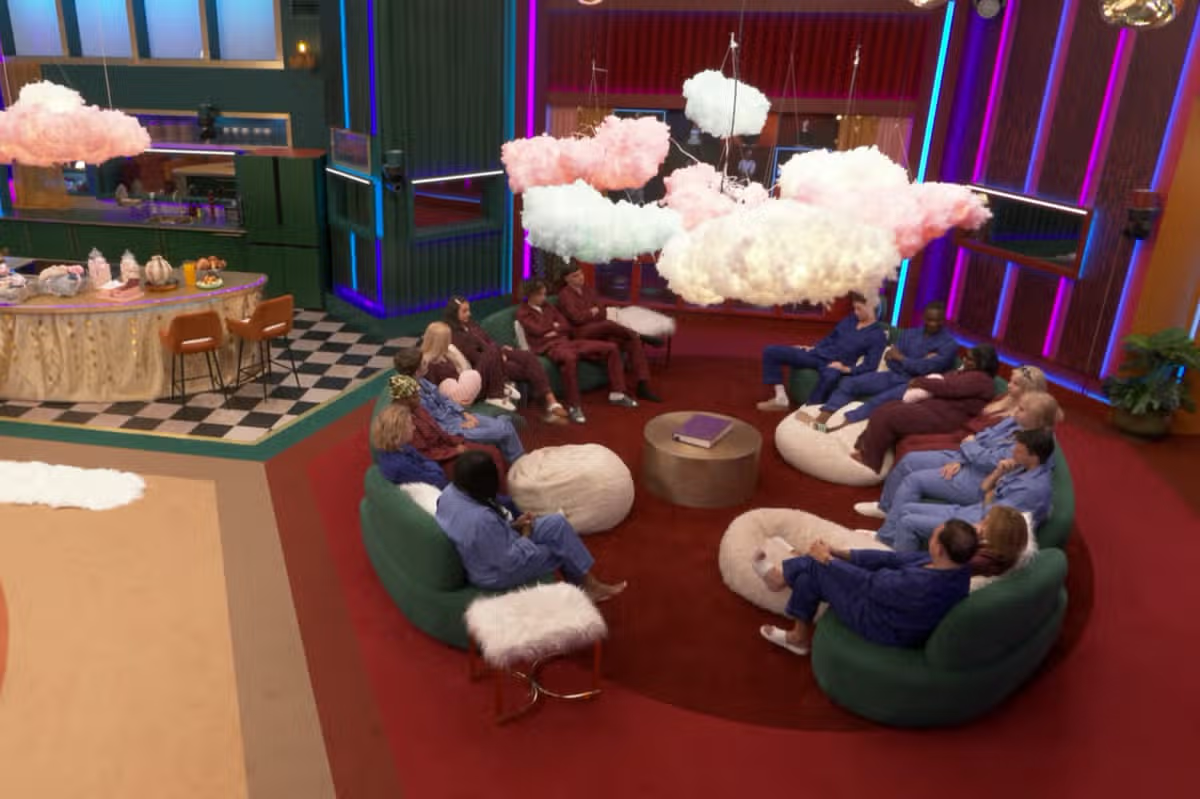
There has already been plenty of chaos in the Big Brother house(Image: ITV)
The Big Brother house has reportedly been locked down after a huge security breach.
Tensions reached boiling point in Monday’s (September 21) episode with explosive rows breaking out and the house divide continuing. Jedward, who entered the house for a week of double trouble this week, found themselves at the centre of drama after their hot tub chat took a dramatic turn.
When speaking to Rhianna, Edward told the former Made in Chelsea star: “I don’t think you’re gonna continue on in here if you don’t just get on with the vibes, you can’t be like looking at people…”
John added: “Yous aren’t in Love Island. Just letting yous know. For real… This is Big Brother, just always remember that.” Unimpressed, Rhianna told Chelsey who also became irate with comments made, but when word got back to Lynx, he attempted to confront Jedward before things turned heated.
Their the conversation quickly becomes sour when Lynx was seen annoyed with the comments and Jedward splashed him from the hot tub. Being forced to intervene, the housemates separated the group as the heated clash continued.
Big Brother was also seen intervening, calling Lynx to the Diary Room to calm down as well as separating Jedward from the rest of the group, meaning they had to sleep in another room for the night.
Despite the chaos being crowned “TV gold” by viewers, the drama comes following a security breach which reportedly put the whole house on a lockdown.
Housemates were allegedly told to leave the garden immediately and order into the house after fans were seen throwing tennis balls over the fence and into the garden.
In an attempt to communicate with the housemates, the act was deemed a security risk with security on hand to ensure the safety of the cast.
According to The Sun, a source confirmed: “The housemates were rushed into the house as tennis balls began flying over the compound walls and into the garden. Producers leapt into action and ordered them into the house and locked the doors.”
It was branded a “huge breach” as the housemates were on a lockdown as the team secured the site. It is no the first time fans of the show have attempted to communicate with the housemates.
It it also not known whether the security breach will be shown on TV or how long the lockdown will occur, but tensions continue to rise in the iconic house,with the drama continuing in tomorrow (September 22) night. ITV have been approached for a comment.
Big Brother continues tomorrow at 9pm on ITV2 and ITVX.
FROM brand-new swimming pools to restaurants, bars and adventure activities – some holiday parks are undergoing major upgrades.
What’s even better is that they’re still as cheap as ever to book with some costing as little as £7pppn.
Skirlington Coast holiday park in Yorkshire is undergoing a £20million makeoverCredit: UnknownIt will be adding a brand-new outdoor swimming pool and entertainment to the parkCredit: Unity Holidays
Unity Holidays Skirlington Coast, Yorkshire
Back in July, Unity Holidays‘ Skirlington Coast in Yorkshire was given the green light for a major £20million glow up.
There will be upgraded dining spots and leisure facilities, as well as a new entertainment zone and outdoor pool surrounded by sunloungers.
Sign up for the Travel newsletter
Thank you!
Kids aren’t left out either, with a new splash pad including a children’s pool.
Accommodation at the park will be expanded as well, with 92 new caravans planned for the site – currently it has 680 caravans and 400 pitches for tents.
A spokesman for Unity Holidays said: “We thank the council’s planning committee for approving our application to redevelop the land on our park currently occupied by Skirlington Market, as well as the buildings on that land used by the market.
“We look forward to commencing work on that project as soon as possible, which will see us add indoor and outdoor sport and leisure facilities as well as re-landscaping the entire area.”
There’s plenty open already at Skirlington Coast holiday park if you fancy booking a break sooner rather than later.
A family of four can book a four-night stay the holiday park from £119 in a Bronze 2 Bed Caravan this October.
If you want to wait it out, the price is the same for a stay in May 2027.
92 new caravans will be added to Skirlington CoastCredit: Unity Holidays
Parkdean Resorts, UK
If you’re looking for a holiday park break next year, then two Parkdean Resorts are getting major makeovers for spring 2027.
It’s part of a £10million upgrade across multiple sites – those which have already undergone transformations include Highfield Grange Holiday Park in Essex and Vauxhall Holiday Park in Great Yarmouth.
One of its new additions will be the Hat-Tricks Sports Bar which is a family-friendly spot which will have pool and darts.
Joe’s American Grill is its new dining spot and there will be Minigolf & Adventure Activities which include high ropes, low ropes and climbing wall.
The second resort undergoing an upgrade is Skipsea Sands in East Riding of Yorkshire.
Thorness is one of Parkdean’s parks to undergo an upgrade to its facilitiesSkipsea Sands in Yorkshire will unveil its new upgrades in spring 2027Credit: Trip Advisor/ Skipsea Sands Management
On its Facebook account, Skipsea Sands Holiday Park revealed: “Skipsea Sands Holiday Park is getting a multi-million pound makeover, bringing even more to see, do, eat and enjoy from Spring 2027!
“Here’s a little taste of what’s coming… Exciting new activities and adventures, More ways to splash, play and have fun, New and improved family experiences, Even more indoor and outdoor fun, whatever the weather.”
It will be getting a Clip & Climb wall, Bear Grylls Escape Rooms and Fairground Golf.
You can book for 2027 already if you want to get ahead of the game.
A family of four can book to stay in a Bronze 2 Bedroom Caravan at Skipsea Sands (which sleeps up to six) from £128 in May 2027.
Lyons Robin Hood, Wales
Lyons Robin Hood in Rhyl has invested £1million into the park so farCredit: UnknownThe next to be upgraded will be its gym facilities
Lyons has announced new planned investment at one of its biggest sites which is Lyons Robin Hood in Rhyl.
The firm has invested more than £1million at its Rhyl site this year and opened a brand-new Altitude Adventure Hub in May.
New activities included Altitude Aerial Adventure, Nitro Go Kart Track, Mini Aerial Adventure, a climbing wall, bungee trampolines and bouncy pillows.
A new adventure-playground also opened earlier this year too – and there are still more upgrades to come.
A spokesperson said: “We’re excited to announce further investment coming to Lyons Robin Hood for the 2027 season.
“As part of our continued commitment to investing in the park and enhancing the experience for our owners and their families, we’re investing in our gym facilities for 2027.
“It’s another exciting addition to a growing list of investments designed to make your time at Lyons Robin Hood even better.”
UCLA head coach Bob Chesney, offensive coordinator Dean Kennedy and starting quarterback Nico Iamaleava were all in alignment after UCLA’s Week 2 win over San Diego State.
The Bruins’ offense had to get better.
UCLA wasted no time following through on their promises, scoring 21 first-quarter points against Purdue — the most UCLA has scored in the inaugural quarter against a conference opponent since 2016 against Oregon State.
Sign up for UCLA Unlocked
A weekly newsletter offering big game takeaways, recruiting buzz and everything you need to know about UCLA sports — exclusive to L.A. Times subscribers. Free Members receive a partial preview of each edition.
By continuing, you agree to our Terms of Service, which include arbitration and a class action waiver. You agree that we and our third-party vendors may collect and use your information, including through cookies, pixels and similar technologies, for the purposes set forth in our Privacy Policy such as personalizing your experience and ads.
While the Bruins’ offense exploded, their defense imploded, giving up 38 points and 488 yards to the Boilermakers.
But in a homage to “Pac-12 After Dark,” it was only natural that UCLA outpaced Purdue, rumbling to a 52-38 win over the Boilermakers on Saturday night at the Rose Bowl in the Bruins Big Ten opener.
Here are three key takeaways from UCLA’s third win of the season, matching its victory total from last season in just three games.
Running backs are elite
UCLA running back Anthony Woods is hoisted up by offensive lineman Julian Armella after scoring against Purdue at the Rose Bowl on Saturday.
(Ronaldo Bolanos/Los Angeles Times)
UCLA has returned to its roots.
With a rich history of churning out premier tailbacks, including Maurice Jones-Drew, DeShaun Foster and Zach Charbonnet, the Bruin offense has lacked a formidable rushing attack the last few years and finished as the nation’s third-worst ground unit in 2024.
But the Bruins may have struck gold in 2026.
UCLA ranks third in the country in rushing yards, first in rushing scores and fourth in yards per carry. Leading the charge is fifth-year tailback Wayne Knight who has 345 rushing yards and eight touchdowns in just three games — matching the Bruins’ total rushing touchdown mark from last season. Knight finished with his third multi-touchdown game of the season against Purdue, reaching the end zone twice to go alongside 200 all-purpose yards.
Through three games, Knight is exceeding the yardage and touchdown output from Reggie Bush’s 2005 season and Mark Ingram’s 2009 campaign — both of which featured Heisman Trophy wins.
But what makes UCLA’s ground attack so special is that it is a four-headed monster. And the Bruins proved it for the third straight week against the Boilermakers.
All three starting running backs — Knight, fifth-year Anthony Woods and senior Jaivian Thomas — reached the end zone and averaged more than six yards per carry in at least nine rush attempts. And Iamaleava added 55 rushing yards of his own to the 369 total the offense tallied.
After three games of consistent rushing dominance, it is becoming less of a coincidence and more of a pattern — UCLA may have one of the most potent rushing attacks in the country.
And one of its most valuable assets is the ground game’s ability to open up the passing offense.
Iamaleava answers the call
UCLA quarterback Nico Iamaleava hurdles over Purdue defensive back Hudauri Hines during the fourth quarter at the Rose Bowl Saturday.
(Ronaldo Bolanos/Los Angeles Times)
Iamaleava challenged himself to play better after a shaky start to the 2026 season.
After failing to complete a touchdown pass while throwing two red zone interceptions during the first two games, Iamaleava and Chesney knew that the signal caller left plays on the table.
“It’s not his best game, he knows it’s not his best game,” Chesney said after beating San Diego State. “I just think that the grit and the toughness that he played with though when he needed to get a couple first downs that really, really mattered to keep drives alive and put his body on the line and you know peeled himself off that ground and just kept fighting for his teammates, that’s special. But there’s a whole lot we got to do there.”
Iamaleava responded Saturday night, going 19-for-31 through the air for 276 yards and three touchdowns.
Not only did Iamaleava light up the stat sheet, but more important, he also passed the eye test. After looking impatient against San Diego State, consistently leaving the pocket early and failing to let plays develop downfield, he looked like a totally different player Saturday night.
Iamaleava looked poised in the pocket, going through multiple reads and hitting pass catchers across the field in an array of spots and formations. He also protected the ball against a solid Purdue defense.
But what was most impressive from the Bruin signal caller was his resilience and toughness on the field. After taking some bruising hits during the Bruins’ first two games, Iamaleava was fearless on scrambles and designed quarterback runs against Purdue, taking big hits downfield to gain extra yards. He also looked willing to take hits in the pocket to make deep or layered throws.
Although some of the hits led to time off the field — he cut a finger on his throwing hand and later took a crushing hit to his throwing shoulder that left him lying on the turf for some time — he always returned to the game. Chesney said he repeatedly asked Iamaleava whether he was sure he could continue playing and the senior kept insisting on returning to the game once he was cleared by the UCLA medical staff.
“He’s just a straight dog, there really isn’t much to say about that,” Knight said. “He’s battling. He gets hurt and he gets back up. He plays the next play. He’s doing this for his brothers.”
Same defense, different opponent
Purdue quarterback Ryan Browne scrambles out of the pocket while being chased by UCLA players Saturday.
(Ronaldo Bolanos/Los Angeles Times)
Purdue’s offense revealed glaring holes the San Diego State offense could not expose.
Aztec quarterback Jayden Denegal only threw for 45 passing yards against UCLA, consistently missing open receivers downfield that had gained considerable separation on the Bruins’ cornerbacks. And even when he did find them, the receivers were not able to haul in catches.
Boilermakers quarterback Ryan Browne, on the other hand, had no problem picking apart the UCLA secondary. Browne went 19-for-30 for 378 yards and three scores, and while he did throw an interception to cornerback Rodrick Pleasant, it came with less than six minutes remaining when the Bruins were already up two scores.
Purdue’s slot receivers tore through the UCLA secondary, running through multiple layers of coverage. Receivers Asaad Waseem and Xavier Townsend combined for 14 receptions, 311 yards and two touchdowns.
Not only did the Purdue offense score five touchdowns, but the pace at which the team scored illustrated the lack of resistance the Bruins’ secondary gave the Boilermakers. Three of the five touchdown drives took less than two and a half minutes, with the first touchdown coming on one play — courtesy of completely broken coverage.
When asked about the impact of Purdue’s receivers Wednesday, defensive coordinator Colin Hitschler said he would have to wait for the game to answer certain questions.
“When you have 10 personnel and that many receivers that can catch the ball, it can create mismatches, and we play a lot of man, so who’s going to fold first?” Hitschler said. “Are we going to be able to man them up or are we having to play more zone? Those are questions that will play out as the game dictates by who’s winning the one-on-one matchups. It’s the chess match that always happens in any game.”
It was obvious who won the chess match.
Two forced fumbles from linebacker Sammy Omosigho and a formidable run defense that held tailback Fame Ijeboi to 2.8 yards per carry helped mitigate the defense’s problems.
How many games UCLA can win the rest of Big Ten play may rest on the defense’s ability to rebound from a brutal win over Purdue the way the Bruins’ offense did after an ugly win over San Diego State.
Few have felt the transformation quite as deeply as Iamaleava, who was the face of both teams.
“Shoot, it means everything,” Iamaleava said of the team’s 3-0 start. “I think that just speaks to the growth of the team and speaks to Coach Ches, of how he got us to buy into this process and his winning, his winning ways. It feels good to be 3-0, and we’ve got to keep going.”
Women’s soccer scores signature win
The UCLA women’s soccer team has take on grueling schedule, facing off with four teams ranked in the top 25 so far this season.
The No. 21 Bruins (5-3-1, 2-1-0 Big Ten) made the most of their fourth opportunity for a signature win, earning a 1-0 win at No. 5 Ohio State (6-1-1, 2-1-0) on Thursday night. It was the Buckeyes’ first loss this season.
Kara Croone set up Leena Powell for the game winner fired from just outside the box in the 25th minute. UCLA goalkeeper Daphne Nakfoor recorded five saves to maintain the shutout victory.
“Amazing performance for the girls,” UCLA women’s soccer coach Gof Boyoko said. “We needed a solid performance, and they did it. We scored a good goal, we didn’t concede, and we were strong defensively.”
UCLA alum Jordin Canada, who has dealt the ball with expert precision this season, had 11 points and 10 assists for the WNBA-playoff bound Dream.
UCLA alum Gabriela Jaquez, who has enjoyed a strong rookie season with a rebuilding Sky team, finished with 14 points, three rebounds, two steals and one assist. Chicago was eliminated from playoff contention, but Jaquez has been a bright spot for the team all season.
Bruins on deck
Here are all UCLA games scheduled to be played this week across all sports, with all times Pacific:
Monday, Sept. 21
Women’s golf at Canadian Collegiate Invitational, All day
Tuesday, Sept. 22
Women’s golf at Canadian Collegiate Invitational, All day
Do you have a comment or something you’d like to see in a future UCLA newsletter? Email newsletters editor Houston Mitchell at houston.mitchell@latimes.com. To get this newsletter in your inbox, click here.
Sports editor Iliana Limón Romero contributed to this report.
UCLA offensive coordinator Dean Kennedy stressed that his offense needed to come out swinging Saturday against Purdue after going scoreless in the first half against San Diego State last week.
And the Bruins heeded the advice, scoring 21 first-quarter points before pulling away in the second half to take a 52-38 win in their Big Ten opener Saturday night at the Rose Bowl.
UCLA improved to 3-0 and matched its 2025 win total with its first 50-point game against a Power Four program since November 2022. Bob Chesney joined Terry Donahue and Jim Mora as the only coaches to start their UCLA tenures 3-0.
Fifth-year tailback Wayne Knight spearheaded the offensive outburst, rushing for 177 yards and two touchdowns for a Bruins team that had 369 yards and four touchdowns on the ground via an average of 7.7 yards per carry. Knight has eight touchdowns in three games, matching the Bruins’ total output for rushing touchdowns last season.
“The biggest thing for us was to just put it all together. And I think that we stepped up to that challenge — what we did on the ground, in the air,” Knight said. “But the guys up front, no matter who is in there as guys are rotating all the time, whoever is in there is going to put up front. They are working as a team.”
While Chesney made sure to acknowledge his running backs — with all three starters reaching the end zone — he made a point to recognize the man under center, highlighting senior quarterback Nico Iamaleava’s resiliency.
After posting two interceptions to zero passing touchdowns through the first two weeks of the season, Iamaleava completed 19 of 31 passes for 276 yards and three touchdowns while rushing for 55 more. Iamaleava looked much more comfortable and confident in the pocket, despite playing through multiple injuries.
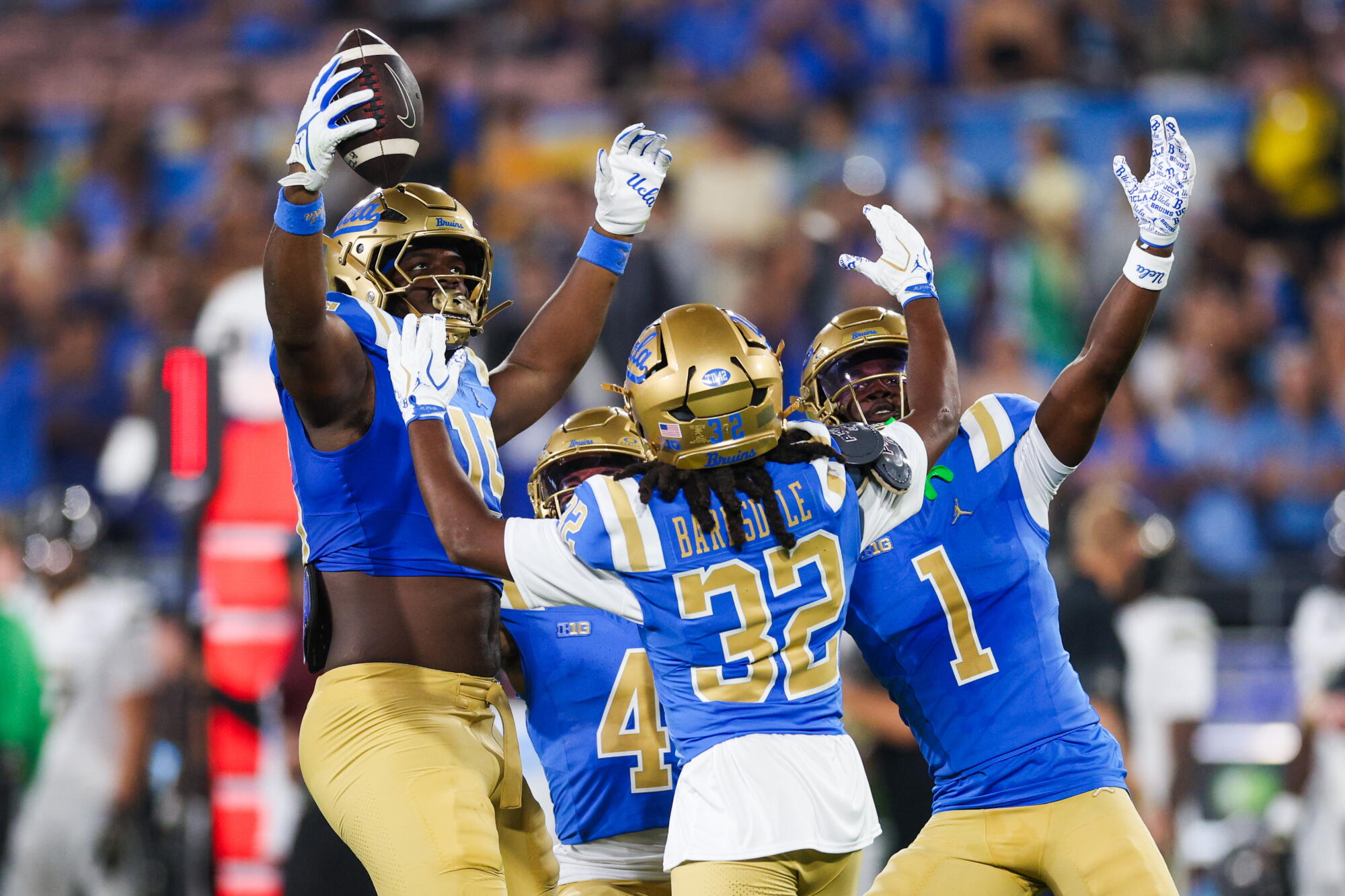
UCLA defensive players celebrate after defensive lineman Sahir West (15) recovers a fumble against Purdue Saturday at the Rose Bowl.
(Ronaldo Bolanos/Los Angeles Times)
“Last week, I told you it wasn’t his greatest game. We watched him go out here today, and I think he was near perfect for a stretch in the beginning of that game, finding all kinds of different receivers and being able to carry the ball himself a little bit,” Chesney said. “And just what a warrior, because he was pretty nicked up out there in moments, and he just wanted to keep fighting.”
Iamaleava found security in senior wideout Semaj Morgan, who hauled in four passes for 72 yards and two touchdowns. In three years at Michigan, Morgan had just four receiving touchdowns. Outside of Morgan, fifth-year wide receiver Leland Smith caught three passes for 59 yards despite playing just one snap across the previous two weeks, potentially giving Iamaleava and Kennedy a big target to look to going forward.
James Madison transfer Landon Ellis, who returned to the field for the first time since going down with a head injury in the beginning of the second half against California, scored his first touchdown as a Bruin. And South Carolina transfer Brian Rowe Jr. caught two passes for 65 yards despite getting targeted eight times, including a deep shot from Iamaleava in the end zone that bounced off his chest.
Although UCLA’s offense turned in 645 yards of total offense, its defense struggled to hold back a Purdue team that lost its 19th consecutive conference game.
UCLA quarterback Nico Iamaleava passes during the first quarter Saturday against Purdue.
(Ronaldo Bolanos / Los Angeles Times)
While the Bruins held Aztec signal caller Jayden Denegal to just 45 passing yards, the secondary found itself facing a different beast in Boilermaker quarterback Ryan Browne, who completed 19 of 30 passes for 378 of Purdue’s 488 total yards, with a touchdown and an interception. Xavier Townsend had 162 yards receiving and two touchdowns.
“I felt like the pressure mounted a little bit and we were not as clean in our technique as we needed to be,” Chesney said. “We can’t put ourselves in panic mode, which might have hit us a little bit throughout today. But when we needed it the most, we were able to get a stop.”
Chesney said the UCLA defense has the personnel and ability to compete with anyone, but penalties and a fake punt that resulted in a first down allowed the Boilermakers to get within one score and added unnecessary pressure.
Fortunately for the UCLA secondary, linebacker Sammy Omosigho put the defense on his back.
Omosigho led the team in tackles with 12, but more important, he had two sacks and two forced fumbles. He has four forced fumbles in three games.
“That’s his third game in a row forcing a fumble. There’s other things he’s going to want to clean up in there too and other schematic things that he can do better,” Chesney said of Omosigho. “But at the same point in time, the one play that stuck out to me was a running back, and it looked like he was going to go and get the edge, and Sam just put out one arm and just crumbled this kid with one arm. The strength he has, the poise he plays with, the toughness he plays with and the strength to be able to execute and finish on those tackles, are things that are pretty impressive.”
UCLA running back Anthony Woods is hoisted up by offensive lineman Julian Armella after scoring a touchdown against Purdue at the Rose Bowl on Saturday.
(Ronaldo Bolanos/Los Angeles Times)
James Madison transfer Sahir West recovered both of Omosigho’s takeaways — the Boilermakers’ first two giveaways this season — and they set up UCLA touchdowns.
While Purdue (1-2) kept up with UCLA for most of the game, its hopes of a comeback ended when senior defensive back Rodrick Pleasant picked off Purdue quarterback Ryan Browne with less than six minutes left.
Despite the Bruins’ difficulty thriving on both sides of the ball during the same game, Chesney said he is confident in his team’s ability to compete going forward.
“We heard the guys on defense saying thanks for getting our back,” Chesney said. “The offense struggled last week, we’re going to need them at some point. The defense is going to need that at some point, and then we’re all going to need the special teams at some point. We haven’t played the perfect complementary game yet, but there’s one in there and I’m looking forward to seeing that day because it exists. There’s fibers in here of a really high level football team.”
PM Anthony Albanese asks Apple CEO Tim Cook to back Canberra’s online safety laws to ‘keep Australians safe’.
Published On 20 Sep 202620 Sep 2026
The Australian government is seeking support from global tech giants as it works to strengthen the country’s online safety laws and artificial intelligence (AI) regulations.
Prime Minister Anthony Albanese, who met Apple CEO Tim Cook at the tech company’s headquarters in Cupertino, California, on Saturday, said that “Australia can’t do it alone” when it came to protecting children from the dangers of the internet.
Recommended Stories
list of 3 itemsend of list
“We spoke about what we’re doing to protect children from online harm and the work ahead,” Albanese wrote on social media.
“We’re putting stronger rules in place to keep Australians safe online,” he said. “And now, big tech companies like Apple are stepping up too.”
Albanese, who is also in the United States for the United Nations General Assembly, used his trip to call for stronger AI regulation after dire safety warnings from industry leaders.
Australia will introduce new standards for AI by the end of the year, he said.
In a video posted to his X account, Albanese said his Labor government is “making sure technology works for Australians”, and not the other way around.
In a post on X, Cook also said he shared with Albanese new “strong and intuitive controls to help keep kids safe online”.
New Australian legislation unveiled this month would place a “duty of care” requirement on the firms behind popular platforms, such as Facebook, TikTok and Instagram, and allow users to turn off their algorithms.
The draft laws will be introduced to parliament later this year after consultation with social media companies, industry bodies and civil society groups.
The opposition Liberal-National Coalition opposes the bill “in its current form”, according to a statement published on September 10, saying that it “contains inadequate safeguards for free speech and journalism, and leaves too much power in the hands of the Communications Minister”.
Australia implemented legislation barring children under 16 from social media platforms last year as part of a world-first crackdown designed to protect children from online bullying and “predatory algorithms”.
However, data last month found that Australians under 16 continued using social media apps such as Instagram and TikTok despite the ban.
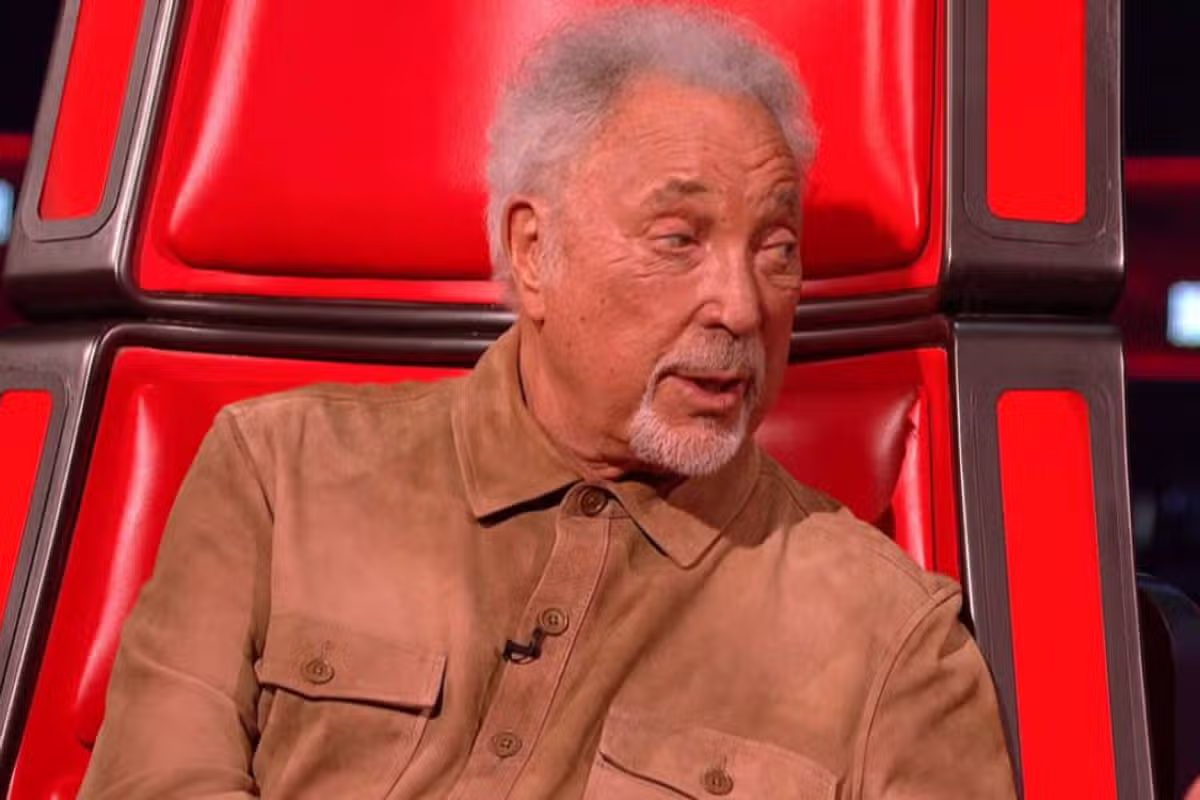
Sir Tom Jones proved he’s “still got it” on The Voice UK tonight with an impromptu rendition of It’s Not Unusual.
Hayley Anderson Screen Time TV Reporter
21:29, 19 Sep 2026Updated 21:32, 19 Sep 2026
ITV The Voice UK fans say axing Sir Tom Jones is a ‘huge mistake’ (Image: ITV)
The Voice UK fans slam ITV’s “huge mistake” in getting rid of Sir Tom Jones as he shares heartwarming story about his career.
ITV’s hit singing contest The Voice UK returned tonight, Saturday, September 19, as the judges continued to blindly listen to singers hoping one of stars would give them a chance.
As always was veteran The Voice UK icon Sir Tom Jones who recalled when he first realised the moment he “made it” in his music career, after he was asked by Will.i.am.
“It’s Not Unusual I did in 1964 so that was 61 years ago”, Tom said.
“My band and myself were driving back to London and It’s Not Unusual came out on the Friday but I didn’t know until I picked up the Sunday paper in a transport cafe, and there it was, It’s Not Unusual, number 10.
“There were truck drivers there right and I was like ‘You see this!’ And they were like ‘yeah, yeah, yeah yeah!’
“And just seeing my name at number 10 I thought ‘This is it. It was a tremendous feeling.’
This story then prompted the audience to ask for him to sing It’s Not Unusual which Sir Tom happily obliged with many fans impressed by his performance.
However, it also angered viewers as they were reminded that the 86-year-old will not be returning for The Voice UK next year as he will be replaced by former Girls Aloud star Cheryl.
“To the powers that be at The Voice UK this is the legend you dropped!”, someone angrily wrote.
A second agreed: “ITV making a very big mistake getting rid of Sir Tom Jones, idiots.”
Another agreed: “It was such a huge mistake axing Tom Jones”, with another writing: “Still can’t believe they fired THE Tom Jones. He’s amazing.”
While a fellow viewer added: “Don’t care what anyone says Sir Tom Jones has still got it!” Silliest move to let this frigging legend go..shame on you producers who make stupid decisions on The Voice UK.”
Sir Tom has also shared that it wasn’t his decision to go, explaining on social media: “The reason given is because of a financial difficulty with insurance.
They now say in the press they wanted to ‘refresh’ the show, and with a new coaching line-up there wouldn’t be a chair for me.”
He has instead been offered a reduced role in the series, something that Sir Tom isn’t “thrilled” about.
The Voice UK continues every Saturday on ITV and ITVX
COMSTOCK, Texas — The Trump administration has started building a border wall through a west Texas section of the Big Bend region, marking the first major construction in an area of the U.S.-Mexico border where the administration’s plans have met heavy, bipartisan opposition.
The start of construction marks a milestone in the administration’s $46-billion efforts to line the border with walls, barriers, roads and technology as it seeks to make good on a campaign promise by President Trump to finish the wall. And it comes as Customs and Border Protection says it has doubled the pace at which it is building the wall across the border.
Customs and Border Protection said in a statement to the Associated Press that “border wall panel installation is underway” in a 47-mile stretch of Hudspeth County in west Texas known as Big Bend 1. There are five project areas that make up the roughly 500-mile Big Bend region stretching from an area of Hudspeth County south of El Paso to Lake Amistad.
CBP said the first panels were erected Wednesday. On a map on the agency’s website where it posts updates of wall construction along the southern border, a photo showed a crane lifting one of the 30-foot-tall steel wall panels into place as construction workers looked on.
The new activity was separate from a border infrastructure project in the nearby Big Bend National Park, where the administration has suspended construction in an attempt to reach out to opponents.
In the broader Big Bend region of Texas, CBP has run up against concerted opposition from landowners, environmental groups, business owners and ranchers who say the remote region isn’t a high-traffic area for illegal immigration. Political leaders from both parties, including U.S. Sen. John Cornyn (R-Texas), have joined the opposition.
Activists said Friday they would continue opposing the border infrastructure projects in the rest of the Big Bend region, even as the panels were being installed.
Clara Benson, one of the founders of the No Big Bend Wall Coalition, which has been fighting against CBP’s plans, said in an interview Friday that the organization had been receiving reports of trucks moving supplies into the remote area along the Rio Grande and that contractors had been clearing yards to stage supplies.
Speaking from Washington, D.C., where she and others in the coalition were meeting with lawmakers, she said that the organization and others would continue to fight the wall-building plans across the region.
“We will continue to fight for this land no matter what the outcome is. We will continue fighting to the end,” said Benson. “You talk to people in west Texas and they say even if they put it up, we’ll fight for them to take it down. So this fight is not over.”
The news comes as the administration is speeding forward with a plan to line the entire border with a combination of 30-foot-tall steel bollard walls, barriers designed to stop vehicles from crossing the border, new patrol roads, and various technologies to deter and detect migrants or smugglers from crossing the border.
Customs and Border Protection said it is building an average of 12 miles of barriers per week along the 2,000-mile border with Mexico and recently reached a milestone of 200 miles of new barriers built since the second Trump administration took office. The 12-miles-a-week average is double the pace that the agency’s head, Rodney Scott, cited earlier this year.
The agency has faced opposition from environmental groups, a small town that worries the wall will cause flooding in its area, Native Americans who say the construction is disturbing sacred sites and landowners who say the construction will infringe on their land.
In Texas, much of the opposition has centered on the agency’s plans for Big Bend National Park, in the state’s southwest on the Rio Grande that is a draw for tourists from around the world. But up- and downriver outside the park, much of the land is owned by private landowners, many of whom have organized against the government’s efforts.
Earlier this week, landowners, ranchers and business owners in the Big Bend region along with a nonprofit organization dedicated to protecting the region’s landscape and heritage sued to stop the administration’s plans.
Activists and landowners have also shown up at county meetings to push their elected officials not to cooperate with contractors hired by CBP to build the wall, and many landowners have refused to allow government officials or contractors onto their land to survey it.
Big Brother star Millie has addressed her time in the ITV show after becoming the first evicted housemate of the 2026 series
23:04, 18 Sep 2026Updated 23:11, 18 Sep 2026
Millie has been booted from the Big Brother house(Image: ITV)
Axed Big Brother star Millie has shared her true feelings about one housemate after being voted out of the ITV show.
This series got off to a dramatic start earlier this week as Big Brother planted a fake housemate, Tays, amongst the cast. His mission was to cause mayhem in the house throughout the week, aided by his hand-picked deputy Philip. The pair were also handed the power to put three housemates up for the first eviction.
They selected bartender Millie, carer Pauline and housewife Rochelle for nomination, leaving the public to decide who would be shown the door. After the votes were counted, Millie was axed and ordered to leave the Big Brother house immediately.
Speaking to hosts AJ Odudu and Will Best upon her exit, Millie confessed that she was “shocked” because she heard fans cheering for her outside the house.
The 19-year-old also addressed her run-in with fellow housemate Rochelle earlier this week, during which Millie shared her plans to undergo weight loss surgery. Rochelle chimed in, saying: “You can’t just have it and think ‘Oh, I’m going to carry on eating s***’ because it doesn’t work like that.”
She went on to advise Millie to try other methods but Millie insisted she has already tried other weight loss strategies. To which Rochelle replied: “You’re saying you have but I see what you eat.”
Bartender Millie was left upset by the interaction and later vented her feelings to Big Brother. Now, she has spoken about the situation revealing that she doesn’t think Rochelle fully grasps that she hurt her feelings, reports OK!.
“I think she just thinks I was being too sensitive, to be honest. Like, she’s from a different time and I think she didn’t even realise she was upsetting me. I think she’s just stuck in her ways, to be honest with you,” Millie said during the live eviction.
She went on to admit that there were times they “got along,” before adding: “But I just think after that my respect was on the floor for her because I didn’t appreciate it at all.”
Despite the spat, the axed housemate reflects on her time on the show fondly. “I had the best time and I love absolutely everyone in there. So do you know what? A win is a win! A win is a win! It broke my heart seeing them [housemates] all start crying that actually broke my heart,” she said.
Before Millie was evicted, content creator Tays was finally unmasked as the original mole, before being instructed to leave the house straight away. The remaining housemates had actually sussed out that Tays was the secret spy just hours before the eviction, after noticing he only had a handful of outfits in his wardrobe.
Following his departure, the fake contestant admitted: “That was stressful”. He also disclosed that Lynx immediately recognised him from his social media content on the opening night, which could have easily blown his mission to remain undetected. But he managed to fly under the radar for some time.
The 23-year-old further confessed he wasn’t convinced by his nominations. “I wouldn’t have picked any of them. At the start I didn’t know them,” he said, before admitting they were “clutching at straws” when selecting the three nominees.
While Purdue is not projected to be a Big Ten juggernaut this season, UCLA coach Bob Chesney and his team expect to be challenged during their first game against Big Ten competition on Saturday at the Rose Bowl.
The Boilermakers’ defensive line features five high-impact players that are at least 6-foot-3, and a nose tackle who weighs in at 301 pounds and anchors a defensive front that ranks second in the Big Ten with 17 tackles for loss.
“They’re talented in who they’re as individual players, there are some game-wreckers in there,” Chesney said. “They are as vertical as can be, they jump out of their stances, they’re jumping snap counts and they’re violent. They pose a giant problem, and we are not going to be able to push them around, and we are not going to be able to find ourselves in a spot where they tire. This is going to be a battle on the inside throughout the entire course of that game.”
While UCLA’s ground attack has dominated through the first two games of the season — rushing for 277 yards and six touchdowns against California and 214 yards and four scores against San Diego State — it might be harder for the Bruins’ running backs to have their way against the Purdue defense.
Purdue held both Indiana State‘s and Wake Forest’s starting running backs to less than four yards per carry, and has conceded just two rushing touchdowns to those starters this season.
“There’s some things that I think Purdue does a really good job defensively, in terms of getting off the ball,” said UCLA offensive coordinator Dean Kennedy. “They have got a lot of length. They’re a very, very big team, it will probably be one of the biggest teams we will face, so we have to be prepared for that.”
However, the Boilermakers have struggled to stop quarterbacks on the run — allowing Indiana State’s Elijah Owens and Wake Forest‘s Gio Lopez to combine for 118 rushing yards and two touchdowns — giving Bruins senior quarterback Nico Iamaleava the opportunity to rely on his legs.
While Iamaleava should have wide receivers Landon Ellis and Brian Rowe Jr. back to full strength, fortifying the aerial attack, the signal-caller will be without Mikey Matthews, after the slot receiver went down with a lower-body injury against San Diego State.
“There’s a fine line. Understanding what the coverage is doing, when is it time to take off and go,” Kennedy said. “If you are going through your read, from a clock standpoint, and it’s not there, it’s a great time to take off and go. It’s our job as an offense to create explosives, whether it’s him taking off or it’s him creating a scramble drill. We look at scramble drills, that we have to create explosives, and that’s something we have to do a better job of.”
Defensively, the “Bruin Bullies” will be tasked with stopping running back Fame Ijeboi, who has run for 201 yards and four touchdowns on 5.3 yards per carry this season. Chesney said that Ijeboi has a “Wayne Knight” feeling to him, where he plays low to the ground, displays proficient body balance and leg drive, allowing him to be influential in the passing game and break tackles.
While UCLA has already faced formidable rushers in Cal’s Adam Mohammed and San Diego State’s Lucky Sutton, Ijeboi could be the most impactful yet. And no one knows that more than Bruin defensive coordinator Colin Hitschler, who went to the same high school as the Boilermaker running back.
“It’s been fun to watch his growth, following him through high school, and watching him earn those scholarships and opportunities,” Hitschler said. “Those first two games, he jumped off the tape. He’s got great potential and he’s going to go a long way. We have to do a good job putting a physical shoulder on him and knocking him down because he’ll run through contact and does a great job of finding the edges.”
If Ijeboi is unable to get it going, it will have to be up to Purdue quarterback Ryan Browne to generate offense.
While the signal-caller struggled last season — throwing nine touchdowns with 10 interceptions — Browne has looked like a new player in 2026, passing for 646 yards and four touchdowns.
Browne has benefited from the addition of two premier slot receivers in Florida Atlantic transfer Asaad Waseem and Iowa State transfer Xavier Townsend. They have combined for 25 receptions, 277 yards and one score.
“What makes them unique is there are a lot of them,” Hitschler said. “When you have 10 personnel and that many receivers that can catch the ball, it can create mismatches, and we play a lot of man, so who’s going to fold first?” Hitschler said. “Are we going to be able to man them up or are we having to play more zone? Those are questions that will play out as the game dictates by who’s winning the one-on-one matchups. It’s the chess match that always happens in any game.”
The Bruins’ defense will look to force turnovers, but that is no easy feat as the Boilermakers have yet to turn the ball over this season.
THE SUMMER holidays are in the rearview mirror now, so it’s likely you’re already daydreaming about next year’s getaway.
As for where to book, these spots have been revealed as the trending destinations for 2027 including one place in Europe with tropical-looking beaches, and another country with highs of 30C even in winter.
One of the country’s tipped to be popular next year is called ‘Europe’s Maldives’Credit: AlamyEgypt has been increasing in popularity and this will continue into next yearCredit: Getty
Advantage Travel Partnership, a UK-based consortium of independent travel businesses has said Albania as the destination to watch for 2027.
The country is much lesser-visited by Brits than the likes of France, Spain and Greece – but it has so much to offer, including beautiful beaches and hot summers.
Sign up for the Travel newsletter
Thank you!
One spot along the Albanian Riviera called Ksamil is regularly labelled the ‘Maldives of Europe,’ for its stunning coastline.
The village is in the south of Albania very close to Corfu – in fact on a clear day you can see across to the island.
Ksamil has white-sand beaches, turquoise waters, and offshore islands that you can swim to from the mainland, giving it similar attributes to the Maldives.
The easiest way to get to Ksamil is actually to fly into Corfu Airport and take a quick ferry crossing across.
Another spot in Albania that is loved by singer Dua Lipa is the seaside village, Dhermi, which in the summertime is called a ‘bustling seaside paradise’.
It has pebbled beaches, beach clubs, a historic old town, and one of the biggest attractions is Pirates’ Cave.
Albania during the spring sits around the mid-20s, and during summertime can be over 30C.
There are direct flights from London Heathrow, Stansted and Luton to the country’s capital, Tirana, which start from £30.
Ksamil has been called Europe’s Maldives thanks to its white-sand beaches and clear watersCredit: Alamy Stock Photo
Visitors to Albania have been steadily rising, previous statistics reveal that tourists visiting Albania nearly doubled from 6.4million in 2019 to 11.7million in 2024.
Other places that the data revealed are on the up next year include Egypt, an affordable winter sun hotspot.
The country and particularly Red Sea resorts attract Brits in the later part of the year thanks to its high temperatures.
In October, Egypt can still bask on the beach in 30C heat – meanwhile the UK’s average is around 10C.
Marsa Alam is one of the quieter spots that’s gaining popularityCredit: AlamyHong Kong could be set to welcome more British travellers next yearCredit: Getty
He named Sharm El Sheikh as a popular spot for couples with its blend of relaxation, vibrant nightlife, and world‑class reefs.
Hurghada is a spot that’s “especially popular with families thanks to its impressive all‑inclusive offering, shallow beaches, and brilliant snorkelling”.
Nearby Marsa Alam is also gaining in popularity thanks to its “pristine beaches, exceptional diving, and a more laid‑back atmosphere”.
There are plenty of direct flights to Egypt from the UK, particularly in the winter months, with an average flight time of just over five hours.
Two other on-the-rise destinations for 2027 include Hong Kong and Vietnam.
Further afield, Vietnam is another country that’s set to ‘trend’ in 2027Credit: Getty ImagesHeading to Vietnam make sure to stop by unique Train StreetCredit: Alamy
James said: “From the moment I touched down in Hanoi, Vietnam’s capital, I knew my trip would be unforgettable.
“The city doesn’t just welcome you — it wraps you in its embrace with the hum of motorbikes, the aroma of street food, and a culture so vibrant you can’t help but fall in love.
“My favourite memories of Hanoi, however, were on Train Street. This narrow alley is famed for its railway, which runs straight through the centre, so close to the tiny cafés flanking the street that you can feel the rush of air when the carriages whoosh past.”
Outside of the capital, one popular activity is kayaking along Ha Long Bay which has emerald waters and is surrounded by towering limestone cliffs.
No one will be disappointed by the food and drink scene in Vietnam, James enjoyed Huda beer, crispy fried spring rolls, and a stir-fried rice noodle dish for less than £8.
The duo entered the experiment on Sunday (September 13), alongside 14 other contestants. But they have now been spotted laying together in bed and holding hands, prompting fans to suggest that they have already ‘hard launched’ their connection.
The moment came during Thursday (September 17) night’s episode, when the house was transformed into a ‘dreamland’. While nominated housemates Millie, Pauline and Rochelle stayed in the main house, the remaining contestants were sent to a much smaller ‘nightmare room’.
As they were settling into the their new living space, Chelsey and Lynx were seen holding hands while chatting with their co-stars. And the duo didn’t appear to be hiding their intimate body language from the rest of the house.
This has sparked conversation on X, formerly Twitter, where one viewer wrote: “Finger interlocking holding hands in front of basically everyone, oh they really hard launching this romance thing init #bbuk.”
Many fans have complained about the pair’s alleged “showmance,” arguing that they are treating the social experiment like a dating show. “Chelsey & Lynx need to realise this is not Love Island #BBUK,” said one.
Another frustrated viewer posted: “Stop trying to make a chelsey and lynx showmance happen! it’s not going to happen! #bbuk,” while a third added: “they’re holding hands now? #bbuk.”
Someone else chimed in with: “Do they know its not love island ffs stop holding hands #bbuk,” with a final viewer putting forward: “We’ll have to get one of Lynx or Chelsey out soon if they continue, they think they’re on Love Island. #bbuk,” reports OK!.
Although their romance has come under fire, Chelsey and Lynx have separately attracted some support since joining the show. Manchester-based Chelsey has been described as “a sweetheart”, with one fan writing: “I really like Chelsey so far, she’s got a great bubbly personality. #BBUK.”
Lynx has his admirers, too. “I like lynx #BBUK,” one supporter posted, while another declared: “Lynx might be the coolest name i’ve ever heard #bbuk.” Chelsey and Lynx aren’t the first pair to find a connection on the series. 2025 contestants Marcus and Elsa, who met on the show, recently announced their engagement and first pregnancy together.
Away from the romances, the house is preparing for an eviction. Big Brother’s undercover moles, Tays and Philip, nominated Millie, Pauline and Rochelle, leaving the public to decide who goes.
The result will be revealed during Friday’s live broadcast, with AJ Odudu and Will Best on hand to interview the departing housemate.
Big Brother continues on ITV2 and ITVX tomorrow night at 9pm
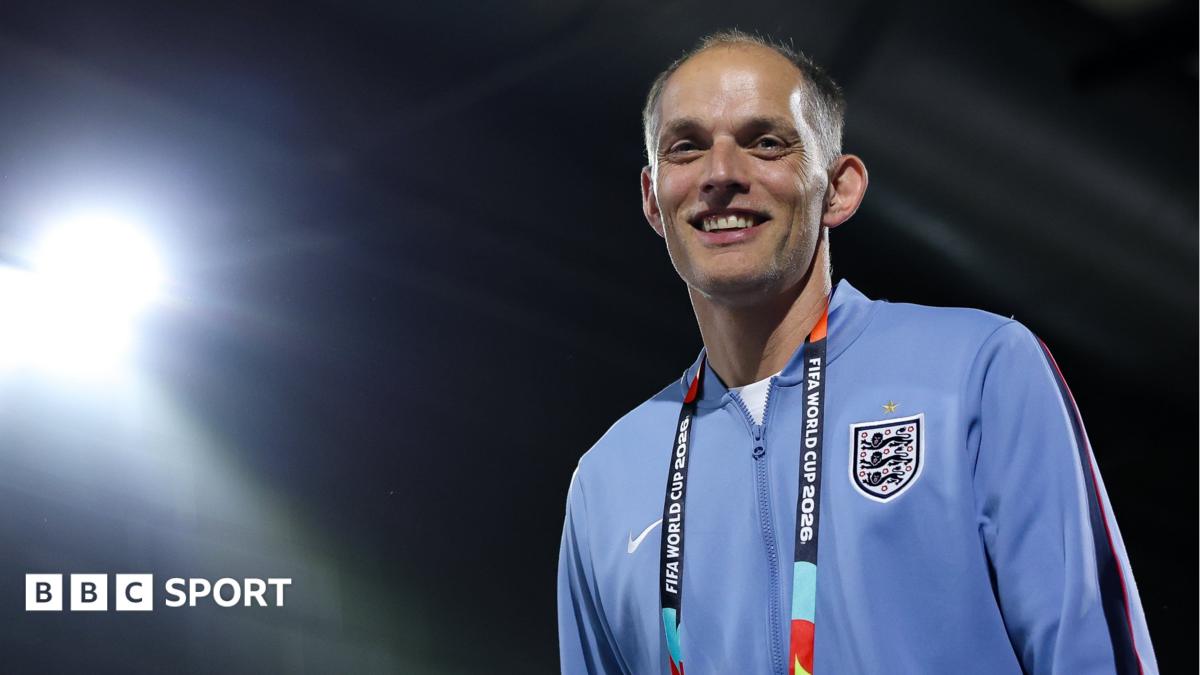
Sami Mokbel: Rio Ngumoha and Lewis Hall are among the players to have been named in England manager Thomas Tuchel’s provisional squad for the forthcoming Nations League internationals, though it remains to be seen whether they make the final cut.
Liverpool winger Ngumoha was part of a contingent of young players that flew with the England senior squad for their pre-World Cup training camp in Palm Beach.
He was unexpectedly handed his debut in the warm-up game against New Zealand, impressing in a second-half cameo.
But the 18-year-old is yet to be picked in a full senior England squad – although he is in with a chance of being selected by Tuchel for the forthcoming games against Spain, the Czech Republic and Croatia.
Hall’s World Cup omission raised eyebrows given England entered the tournament without a natural left-back.
Before naming his full squad on Friday, Tuchel is required to submit a preliminary squad of players from which he will name his final party.
It is understood Bournemouth midfielder Alex Scott, Arsenal’s Myles Lewis-Skelly and Everton’s Kiernan Dewsbury-Hall are also among the names selected in Tuchel’s extended list.
Attacking duo Cole Palmer and Phil Foden are on there too, after being two of the biggest omissions from Tuchel’s squad for the World Cup.
That decision was deemed a mistake from certain circles, given they are two of English football’s most creative players.
Meanwhile, Tuchel is expected to omit Jordan Henderson, Dean Henderson and John Stones because of injury.
Below-par showings were forgiven last season as Celtic simply just had to get by to stay in touch at the top before eventually leapfrogging Heart of Midlothian on the final day with a seventh successive league victory.
That Premiership-winning streak has been extended to 13 games following six straight victories to start the campaign, but concerns about performance level remain. Four of those six wins have been by a one-goal margin.
Twelve goals over three wins at Kilmarnock, Dundee United and in the first leg of the Champions League play-off against LASK sent an ominous warning to Celtic’s domestic rivals amid a period of high spending, particularly in forward areas.
Camilo Duran has been the standout summer recruit so far with six goals and three assists in 10 appearances, while record signing Kasper Hogh and fellow big-money arrival Haissem Hassan are yet to fully settle.
Sutton said his old club have been “flat-track bullies” by “beating the teams you expect them to beat”, but the collapse in Austria, plus Sunday’s bruising loss, has highlighted glaring deficiencies.
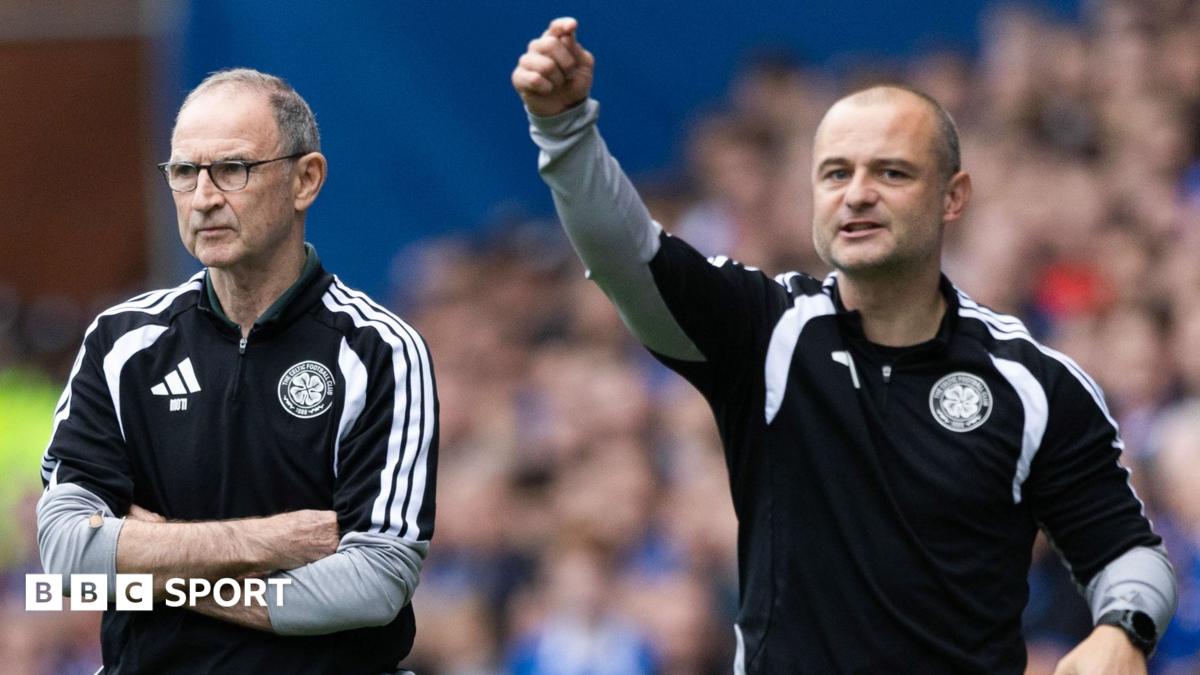
Speaking on BBC Radio 5 Live’s Monday Night Club, former striker Sutton also expressed his “great concerns” for O’Neill’s men and said they have “big issues” after a “lightweight” midfield was “run all over” by Rangers.
Celtic have struggled to build up play against coherent pressing teams, which results in opposition sides being offered too much encouragement when the ball turns over.
They faced a whopping 60 shots across both legs with LASK. Forty of them came in a mess of a second leg. In the Premiership alone this season, they have faced 64 attempts, the same number as Hearts and six more than Rangers.
Over just six games, that tally already makes up almost a quarter of the total they faced in the entirety of the 2024-25 league-winning campaign under Brendan Rodgers.
That said, in comparison to last term, which was overseen by Rodgers, Nancy and O’Neill, Celtic’s Premiership numbers show they are currently averaging a far better goal concession rate while scoring and shooting more.
Come Sunday, though, the most crucial statistic could be in the points column.
With a rapid rematch against Rangers offering the chance to move eight points clear of their city rivals after a test against European-level opposition, the next four days will at least be mood-shifting.
Whether that is to O’Neill’s benefit remains unclear.