Windy conditions are not unusual to the festival, which attracts roughly 125,000 attendees to the Empire Polo Club each of its weekends, but it’s rare to see the weather cause performances to be canceled.
“Due to strong wind conditions affecting Anyma’s stage build, he is unable to perform. Coachella & Anyma have made this decision together with your safety as the priority,” the fest wrote in a message on its app just after midnight on Saturday morning.
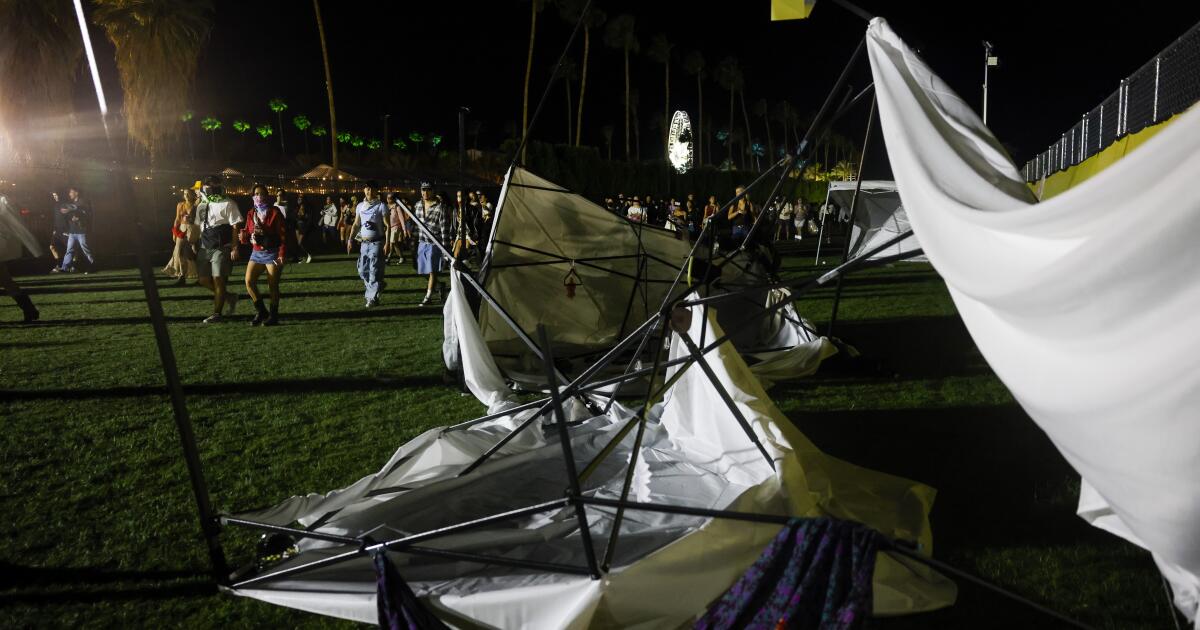
On Friday night, there were social media reports that showed that the Do Lab — a stage on the southern side of the festival grounds, which includes shade structures with colorful bolts of fabric — was closed for the night with yellow caution tape around the area and that a speaker may have fallen to the ground.
Festival promoter Goldenvoice and the organizers of the Do Lab stage did not provide comment at the time of publication.
The wind wreaked havoc in the campsite as well, blowing tents and canopies over.
“It was definitely pretty impactful last night. The wind reports in the area saw gusts up to 35 to 40 mph yesterday during late afternoon,” said Isaac Longley, a meteorologist with AccuWeather. “Unfortunately, that was when there were a lot of performers on the main stages, and a pretty impactful situation with the tents at Coachella.”
According to the online forecast for the weekend from the National Oceanic and Atmospheric Administration, temperatures in Indio were expected to reach 86 degrees on Saturday with 5- to 10-mph winds in the afternoon and a low of 56 degrees with the winds increasing to 15 to 20 mph and changing direction after midnight. Gusts were expected to be up to 30 mph later into the evening.
“As we head into Saturday afternoon and evening, we expect pretty similar conditions to [Friday] and for winds to pick up,” Longley said. “I would definitely consider staking my tent down.”
Sunday’s forecast was cooler, with a high of 79 and winds of 10 to 20 mph in the day. The expected low is 53 with winds expected at 15 mph with gusts of up to 30 mph.
There’s also an air quality alert for the windblown dust through 5 a.m. Sunday.
Jesse Kardon has come a long way from his days as a teenager messing around with Ableton in his bedroom. The 33-year-old DJ and producer better known as Subtronics is now an established EDM star. Over the last 15 years, he has built a career that has taken him from playing small clubs in his hometown of Philadelphia to a fall headlining set at the Sphere in Las Vegas and then a landmark run of six sold-out shows at L.A.’s Shrine Auditorium in December.
Back in 2022, he performed a surprise set at Coachella’s intimate electronic-focused Do Lab stage, but this year marks his proper Indio, Calif., debut where he is the highest-billed dubstep-rooted artist, playing the massive Sahara Tent on Sunday and April 19. He will also perform two Southland shows between his Coachella sets at the Fox Theater in Pomona on Tuesday and at the GV Surf Club in Palm Springs on April 18.
While EDM has emerged over the years as a dominant force, comprising nearly 45% of this year’s lineup, artists from the sometimes polarizing dubstep/riddim scene are rarely given such a prominent platform.
Subtronics’ sound has expanded in recent years. His remix of John Summit’s “Crystallized feat. Inéz” has garnered praise, while “Fibonacci Pt. 2,” his latest in a set of math-inspired releases, interweaves the melodic with the heavy. “Infinity,” featuring fellow EDM DJ Grabbitz, and “Contour,” featuring vocalist Lyrah, stand out.
Although his work has evolved to include more melodic soundscapes, Subtronics remains committed to bringing more people to a better understanding of the genre that first brought his life into focus. He will never forget how playing drums for years as a kid taught him the foundations of rhythm, and he carries the gritty sounds of Philadelphia hip-hop and trap that shaped that sound into his work today.
Dubstep has affected his life in deeply personal ways. As a kid, a shared love of the scene brought him closer to his sister. Later on, he met Sonya Broner, the dubstep artist known as Level Up. Broner is now his wife, and they often collaborate.
In a remote conversation from his new home in Laurel Canyon, Subtronics talks about his milestone Coachella run and shares thoughts on everything from what to expect from his set to his legacy in dubstep and beyond.
This interview is lightly edited and condensed for clarity.
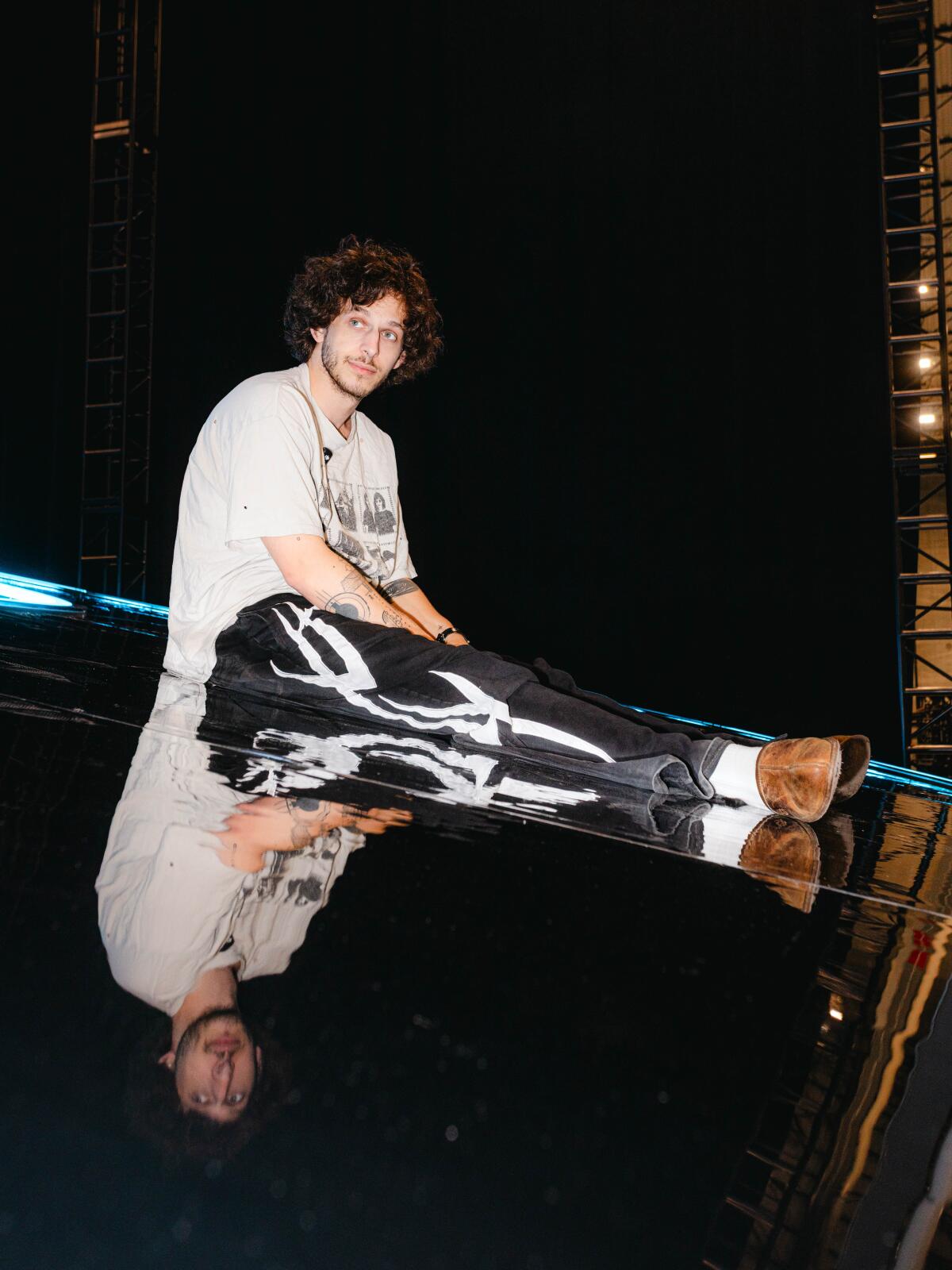
I’m really hopeful to introduce bass music to a lot of new people, because I believe the rising tide raises all ships,” Subtronics said.
(Jason Fenmore)
What is your mindset? How are you feeling going into this weekend?
“I’ve been really super hyper focused on Coachella for about, pretty much the moment we finished the tour, which was about two, three weeks ago. It’s been really all hands on deck, nonstop working on that.”
Take me back to when you first got the news that you booked Coachella. Was that something you and your team had been working specifically toward?
“It was honestly, an almost several year plan where that really was the goal, and we were kind of thinking of the different opportunities we’ve had over the years, and the things we were going to have going forward, and how could we strategize in a way where we can work our way towards Coachella, and that’s kind of what the Shrine was. The hope was like, if we can sell out three [nights at Shrine], we’ve got a pretty good chance of getting a booking, and then we sold out a ton of them. It’s such a good time slot on such a great stage…both me and my inner child are completely freaking out.”
Did you take a moment to celebrate?
“Absolutely, yes. And you know what? It always comes in the form of, like, little moments. Because I do get so… I do have these “pause” moments where it’s like, ‘Stop and appreciate how far you’ve come.’ ‘Stop and realize the gravity of this. You’re really doing these things; all of this hard work has manifested and paid off. This Coachella slot, and even just playing at all, is ammunition to fight back against the imposter syndrome. It’s beyond my wildest dreams and expectations. I never expected any of this to get this far, and I was just trying to learn how to make cool sounds.”
Do you think about historical context, where you fit in in the history of electronic music and in Coachella’s history?
“Oh, man, I love that question so much, because it’s my No. 1 thing. When I first started, aside from wanting to learn and get good at it… my goal was to contribute to the culture and leave a mark that’s remembered, because I’m really passionate about the history of both dubstep and dance music. So many historic moments happened at Coachella. And it really is such an honor, because I just think of ‘Oh my God, dude.’ Like, Daft Punk, you know? I can’t even wrap my head around it, but it is the thing that matters most to me: being remembered years from now and doing things that really feel like they contributed to the culture.
I’m really hopeful to introduce bass music to a lot of new people, because I believe the rising tide raises all ships. There’s a lot of us dubstep and bass music makers. And I think anytime one of us gets an opportunity, it really kind of raises the ceiling for the whole scene, and we are all in it together… there’s so many talented producers that deserve to be able to make a living off of it. And the bigger the scene gets, the more people can fit under the umbrella, and pay their rent and live a successful life doing what they love.”
The highest-billed dubstep-rooted artist on this year’s festival lineup, Subtronics views his performances as a chance to introduce bass music to mainstream audiences.
(Jason Fenmore)
Have you been feeling any pressure? And if so, how have you been handling it?
“Yeah, definitely, because I think I feel pressure from multiple angles. I’ll feel pressure from the very core fan base to stick to a certain style. And then I’ll feel pressure as both a DJ and a music producer. And whenever I get these opportunities, they’re so far outside of, you know, the core of dubstep, I feel the opposite end of pressure where it’s like, you should read the room, be a DJ, you know, like, figure out what their energy is. So it’s kind of pulling me in two different directions, and my answer to that has been to have faith in my own taste — to ignore both of them, to just completely ignore everybody, and to trust what I like and have faith that my taste is what got me here in the first place.”
What is your overarching goal for these shows?
“I make a bunch of stuff, but I do mostly identify as a dubstep and bass music artist. So, to be able to represent that on such a gigantic platform to a whole ton of people who might not necessarily be 100% EDM festival attendees… to play for them is really exciting. And then the livestream as well, it’s like there’s a crazy amount of viewers who might be completely new to bass music or new to dubstep, you know, tuning in. I take it as a responsibility to introduce people to bass music and contextualize it in the best way I can. And also expressing myself as honestly and authentically as I can — having that moment of individuality and uniqueness.
What do you think mainstream audiences might not understand about dubstep?
“Something that I do think is interesting is the original wave of dubstep, the original U.K., 2004 through 2008, it was on the radio. It was melodic, it was musical. It wasn’t nearly as polarizing. Obviously, it got more aggressive and became more of a huge, showy, crazy, overstimulating thing as it, as it moved its way over to the States. But I seek to strike a middle ground. Something I experienced a lot when I first started touring was being in a sub-genre incorrectly labeled [as riddim].
The issue is that riddim is already a genre: dancehall. It already exists…I think that’s not a very well-known thing. It should have been called swamp or something like that…trench. A few names were being thrown around. I called it “wonky step” at the time because it was just really wonky and repetitive. I guess riddim is what stuck for whatever reason. I was playing for a group that was much more melodic, much more theatrical, and everyone who came up to me after the shows told me, ‘I don’t like riddim. I’ve never liked riddim before, but hearing it in your set…it makes sense to me now. So I hope to be almost like a translator. My goal is to express myself authentically and honestly, playing all original music in a way that makes sense to both groups of people [mainstream and insiders].”
Do you remember your very first performance as Subtronics? And is there something from that time you carry with you going into this weekend?
The first time I was ever actually on stage, like at a dance music venue with my name on the screen, like playing my own songs. I was opening at SoundGarden Hall, which is now known as the Ave. One of the things that early on that blew my mind the most, I was playing an after party in one of the worst neighborhoods in Philadelphia, one of the most dangerous places I’ve ever been to, maybe in my whole life, and I was standing by the front door where they’re dealing drugs and selling nitrous and some a stranger walks in the door, someone who I didn’t know, and I heard them say, ‘I heard Subtronics is playing tonight. Is that true?’ And it exploded my brain. It was the first time I had a fan that I didn’t know personally, and I will never forget that. I will never, ever, ever, ever forget as long as I live.”
Coaching high school basketball since the 1979-80 season and being the second-winningest coach in state history with 1,127 victories, Mike LeDuc is one of those old-school coaches who likes to push his players forward and fade into the background when team success comes.
This season at Damien, LeDuc can take a bow for guiding the Spartans to the state Division I championship with little size but a group of players who loved to shoot threes, never stopped hustling on defense and executed close to perfection on the biggest stage at Golden 1 Center and during his team’s playoff run.
For turning a group of players he fondly called “overachievers” into champions, LeDuc is The Times’ boys’ basketball coach of the year.
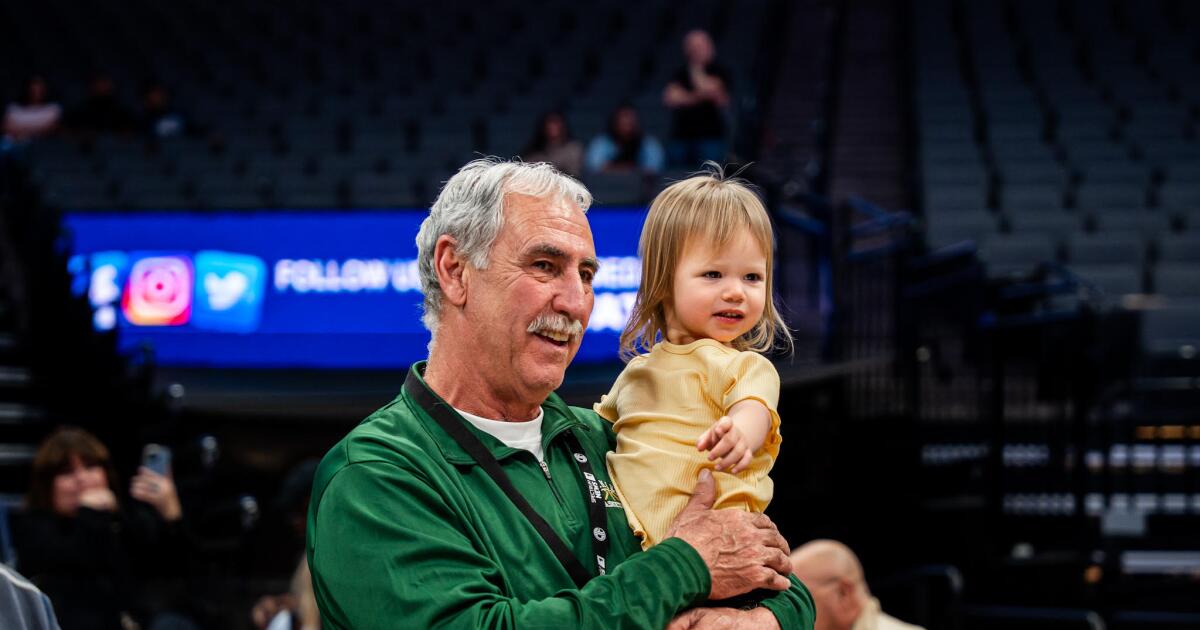
Through his many years of coaching at Damien and previously at Glendora, he’s mentored such outstanding players as Tracy Murray, Casey Jacobsen and Cameron Murray. Now Cameron’s sophomore son, CJ, plays for Damien. It’s a full circle moment for LeDuc, who was holding his granddaughter at the awards ceremony in Sacramento.
As the years go by and the game keeps changing, LeDuc continues to adapt, adjust and power on.
LeDuc‘s answer is, “Basketball is a real simple game. It’s a game of repetition and if you do it over and over, you expect it to be done perfectly.”