A Bangkok-raised chef is now serving vibrant Thai street food such as pan-fried noodles, grilled Isan sausage, Wagyu short rib with herbs and sticky rice, and flame-kissed pork jowl in Old Pasadena. To drink, there’s local ube beer and natural wine.
“I love to eat street food so much,” said Thaim chef-owner Ruethai Boonlieng. “I go back to Thailand all the time, and I always ask my friends, “Hey, don’t take me to the mall — take me to street food. It’s a true food for my soul, and people make the street food with care.”
Boonlieng’s Thaim is a portmanteau of “Thai” and “I am.” While some of her recipes are traditional — such as her mom’s preparation of Sukhothai pad Thai — others are modern spins, like brightening her sweet-spicy mango salad with fresh dill or turning her childhood favorite, egg tofu, into a deep-fried egg custard.
The chef grew up in Bangkok and learned to cook by watching her mother prepare home meals, then took pastry courses in Thailand as an adult. Boonlieng studied finance but entered the restaurant industry to help an aunt and a friend open a Thai restaurant — then discovered she loved it. She opened multiple restaurants in the Bay Area, then moved to Los Angeles to help open another and never wanted to leave.
As an owner of sweets-focused cafe U Dessert Story, with two locations in the Bay Area, Boonlieng wanted to incorporate some of her signature desserts at Thaim, too. Look for Thai tea panna cotta, matcha lava cakes and more.
Pierce Brosnan, 73, has been spotted with his rarely seen wife Keely, 63, as they went out to dinner in LACredit: BackGridKeely, looked stunning in a white summer dress and lemon cardigan which she paired with Chanel sandalsCredit: BackGrid
Keely, looked stunning in a white summer dress and lemon cardigan which she paired with Chanel sandals and sunglasses.
The pair looked as loved up as ever as they drove back home after their lunch date.
Sign up for the Showbiz newsletter
Thank you!
Pierce and Keely have been married for 25 years and met at a beach party in 1994 – she was a journalist and had flown out to interview Cheers actor Ted Danson, who had attended the same party.
When Ted left, Keely found herself talking to Pierce, and the two hit it off.
The couple looked as loved up as ever as they drove back home after their lunch dateCredit: BackGridThe couple first dated in 1994 after meeting at a beach party in MexicoCredit: Feature FlashPierce with their first son Paris BrosnanCredit: GettyPierce played James Bond in four films from 1995–2002Credit: Alamy
They shared their first date a few days later in Mexico, sitting under the stars as they held hands and talked until 3am.
The couple married at Ballintubber Abbey in County Mayo, Ireland, in 2001, just six months after welcoming son Paris.
“He was captivating. Tall, dark, and handsome. Everything that everybody would immediately be attracted to,” she said.
“He had a mischievous sparkle in his eyes.”
Pierce has said that when he first laid eyes on sultry brunette Keely at the beach party, he fell head over heels.
Shared on X, it featured two snaps: one from the 1996 Governors Ball for the Academy Awards and another of the couple at the 2008 Mamma Mia! premiere.
The vile troll captioned it: “Dear men, this is why marriage should be avoided.”
The cutting words, which took a cruel swipe at Keely’s weight, sparked outrage. She was inundated with comments of support.
But insiders told us that Pierce, who shares sons Dylan, 29, and Paris, 25, with Keely, has reached his limit with it all.
A pal of the star told me “He was really furious about it and finds it incredibly sad that their whole marriage is reduced to talk about Keely’s weight.
“It is truly devastating for him that her body is all anyone talks about. For him, Keely is everything.”
Pierce has described his wife, who he tenderly calls “my girl”, as “a strength I wouldn’t be able to live without”.
He gushed in the past: “I love her vitality, her passion. When Keely looks at me, I go weak at the knees.”
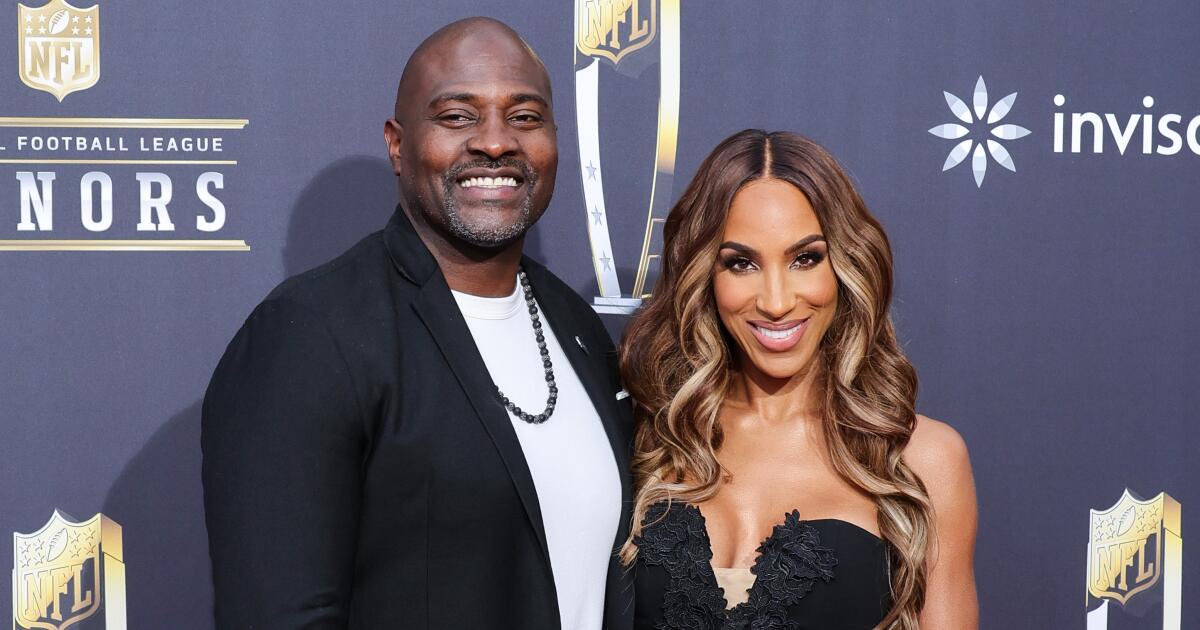
Former Chargers defensive end and Los Angeles sports radio personality Marcellus Wiley has denied explosive allegations from his wife — including that he raped her and physically abused her and their children — that led to a judge granting her a temporary restraining order against him.
Annemarie Wiley, a nurse anesthetist and former cast member of “The Real Housewives of Beverly Hills,” made the accusations in a declaration submitted Monday to the Superior Court of Los Angeles County with her request for a restraining order against her husband of 12 years. She filed for divorce the same day.
The former Pro Bowl player responded Tuesday on X to what he called “baseless claims.”
“I owe it to my children to truthfully document what they and I have endured,” he wrote. “To do that, I must address the lies Annemarie has told about me by telling the truth about her and our marriage.”
According to the temporary restraining order, Marcellus Wiley must have no contact with his wife and their three children, ages 6-10, and must not come within 100 yards of them. Annemarie Wiley now has sole custody of the children and her husband was given no visitation time. The order remains in effect until a hearing scheduled for July 24.
On Saturday, Marcellus Wiley was arrested in Florida after his wife told police he poked her in the face with his finger and threatened to kill her. According to the arrest affidavit, Annemarie Wiley told a deputy that her husband “had an unreported history of violence toward her and she was planning to divorce him when they returned home to California.”
Marcellus Wiley was released the next day on $1,000 bond and faces a possible charge of misdemeanor domestic battery. An arraignment hearing has been scheduled for Aug. 4. He denied all the allegations against him Monday on X.
In her court filing, Annemarie Wiley provided details of an alleged incident that led to her husband’s arrest. She wrote that on Saturday he “warned me to watch how bad he was going to make things for me, which I understood to be a threat that his abuse would become more severe. During this same incident, Marcellus pushed our ten-year-old son, Marcellus, Jr. I called the police.”
Annemarie Wiley also documents numerous alleged incidents that she says demonstrates “a continuing and escalating pattern of physical violence, sexual abuse, verbal and emotional abuse, financial control, and intimidation, much of which our children have witnessed.”
She mentions four instances in which her husband allegedly raped her — once in 2012 and three times in January — as well as alleged physical abuse that includes striking her in the face or head, breaking her right thumb and throwing heavy objects at her.
In his most recent X post, Marcellus Wiley states that he has “videos, photographs, text messages, emails, and other evidence that directly contradicts those baseless claims and provides a factual record of our family and the events leading to this unfortunate divorce.”
“To be frank, many friends, family members, and fans have opined that after she was kicked off The Real Housewives of Beverly Hills, she lost her mind!” wrote Marcellus Wiley, a Compton native who also played for the Buffalo Bills, Dallas Cowboys and Jacksonville Jaguars during his 10-year NFL career. “Unfortunately, I must agree.
“I never wanted my family’s issues and struggles to become public for any reason, including divorce leverage. But I unfortunately knew this day was inevitable. I was willing to endure anything —even hell itself — if it meant being with my children every single day. I am their hero, and now I am fighting to make sure the positive and real image they know of me is the one that endures.
“I am prepared to address these allegations and related matters through the legal process and with evidence. My focus remains on my children, my integrity, and the truth.”
Multiple women have accused Wiley in civil lawsuits of sexually assaulting them in the past. Wiley has denied all the allegations against him in court documents and publicly.
Advertised as “from the world of ‘Legally Blonde,’” the new Prime Video series “Elle” revisits that film’s heroine, Elle Woods (Lexi Minetree), as a 16-year-old high school student, suddenly transported from Beverly Hills to Seattle after her plastic surgeon father (Tom Everett Scott) botches a nose job and has to lie low.
Set in 1995, six years before the events of the first “Legally Blonde” film, with Seattle still living through the long tail of first-wave grunge — Kurt Cobain, Eddie Vedder and Chris Cornell are mentioned almost in a single breath — it shares with the big-screen mothership only its indomitable protagonist, who loves pink and her Chihuahua, Bruiser. (The dog gets its own origin story: It was “rescued” from the Spellings, as in Aaron, who found that its “earth tones” didn’t match “their new color palette.”)
There’s a passing reference to the lawyer Elle might (and does) become, and surely some things I missed, but if you’ve never seen “Legally Blonde,” you will not be at any particular disadvantage. (Possibly you will be at a disadvantage if you have seen it.) Bruiser aside, nothing that happens here affects what happens there. Don’t think twice, or even once, about canon. This is something else entirely.
What that is is a high school comedy, which is to say it’s full of familiar characters swept up in teenage drama. And because this is an eight-episode series and not a two-hour movie, relationships will shift more than once. Indeed, they will not be done shifting by the season’s end; a second is clearly in the producers’ sights.
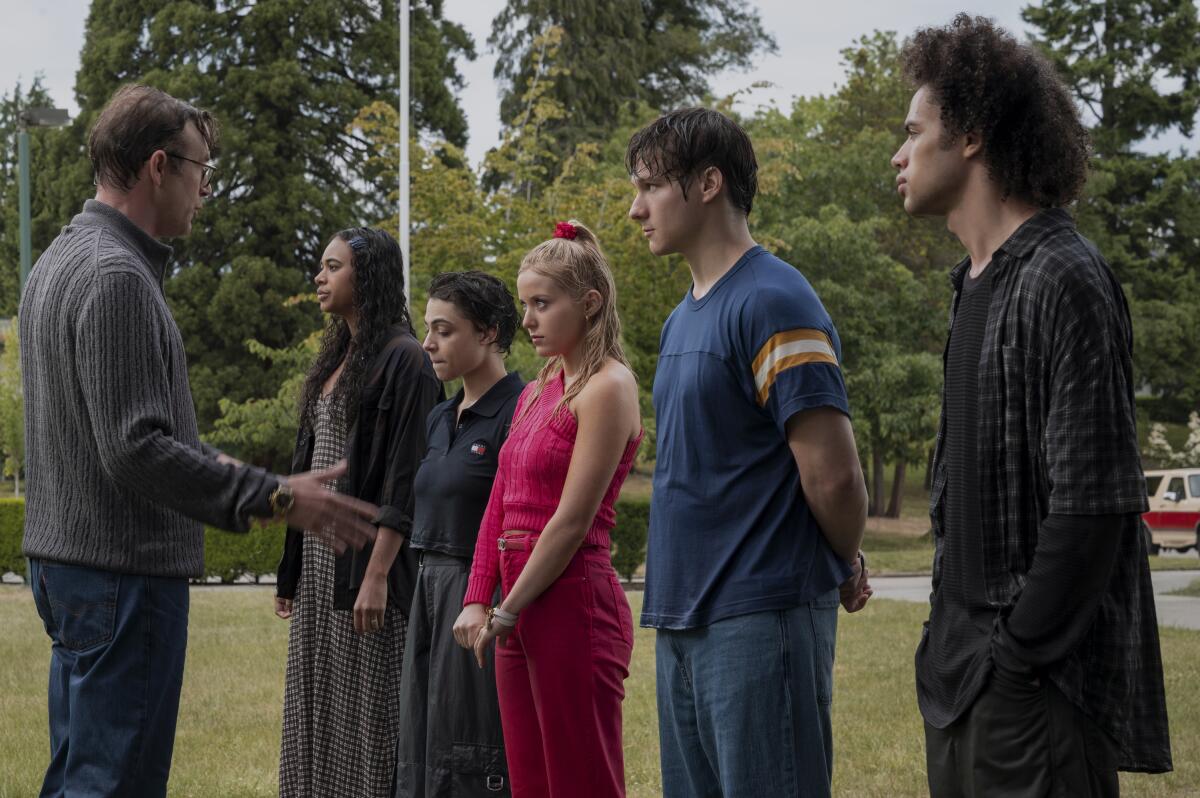
The series is a fish out of water story as Elle moves from Beverly Hills to Seattle. From left, Kimberly (Chandler Kinney), Liz (Gabrielle Policano), Elle (Lexi Minetree), Miles (Jacob Moskovitz) and Dustin (Zac Looker).
(Kimberley French / Prime Video)
Floating into her new school on a bubble of positivity that will stubbornly refuse to burst, Elle is a spot of color in a sea of black and plaid. (There’s a joke that all the cliques — “jocks, D&D nerds, stoners, kids with parents with Microsoft money, kids with parents with Boeing money” — dress exactly alike.) Her surface mistaken for her substance, she’s mocked by Kimberley (Chandler Kinney), the Mean Queen Bee in a reversal of the usual dynamic; it’s the supposedly deep, authentic characters looking down on the privileged, seemingly shallow one. (Not understanding that Bikini Kill is a band, Elle will offer, “Bikini Kill? I know bikinis … that kill.”) Introducing herself to the skeptical Liz (Gabrielle Policano), who makes music and works in a record store, she says, “I like iced coffee, the month of July and when people dress kind of tennis-y, even when they don’t play tennis.”
At the same time, Elle will quickly bond with Shannon (Danielle Chand), the school’s self-appointed one-woman welcoming committee, and Miles (Jacob Moskovitz), a central-casting nice guy who literally collides with her, as is traditional. (His jacket is blue denim to set him apart.) Socially aware quasi-outsider Dustin (Zac Looker) will take a second longer to sway. Inevitably, all will fall before her goodness, her school spirit and her No Doubt karaoke, though her good intentions will have unintended consequences as well, and she’ll have things to learn — it’s a fish out of water story in which the water will change the fish, and the fish the water. In a late-season plotline, in order to give them something to think about than one another, they’ll become a Scooby Gang (with explicit references to “The Breakfast Club”), investigating adult shenanigans. Well, we love a Scooby Gang.
Chief among the grown-ups is Elle’s equally blond mother, Eva (June Diane Raphael), who will become involved in the mayoral campaign of (the late) James Van Der Beek’s Dean Wilson. At school, there are prickly Principal Anderson (Matt Oberg) and Donna (Amy Pietz, nice to see her), his good-hearted secretary, a champion of needy teens and, it will be revealed, Liz’s mother. It feels wrong to saddle the lovable Scott, as Elle’s father, Wyatt, with a fugitive-from-malpractice plot, such as it is — they had to get the family out of Beverly Hills somehow — and just as his character is lying low, so does he disappear, sadly, a little into the scenery. He does get a nice line about meeting someone named Mike McCready, the Pearl Jam guitarist, in a coffee shop and maybe getting together to play, and a chance to lead partygoers in Oasis’ “Wonderwall.”
Minetree is an apt choice to play a younger Reese Witherspoon (an executive producer), with a dash of “Clueless” Alicia Silverstone stirred in, and the younger cast is likable across the board. Written by Laura Kittrell, “Elle” is lightweight, often obvious and oddly, refreshingly innocent — Elle is waiting for “a perfect first kiss from a perfect guy” — both for the genre and the setting. (As Robyn Hitchcock sang of Seattle in “Viva! Sea-Tac,” “They’ve got the best computers and coffee and smack.”) In a way, it feels like a show made for those who already want what it’s selling, but that’s not me, and I had a perfectly fine time.
More than any other artist in the 20th century, David Hockney defined Los Angeles in the public imagination. When he first arrived in January 1964, age 26, his mental image of the city had been forged not by art but by Hollywood movies, which he had watched as a young boy in Yorkshire, England. In later life, he often recollected the sharp-edged shadows cast by the Californian sunlight in movies such as Laurel and Hardy’s “Big Business.
Before he ever went to L.A., Hockney — who died Thursday at 88 — knew that he would love it. Writing about his first descent into the city, he recalled how “as I flew over San Bernardino and looked down — and saw the swimming pools and the houses and everything and the sun, I was more thrilled than I’ve ever been arriving at any other city, including New York.” By this time, the glamour of Hollywood had been compounded by other influences, including the homoerotic magazines that an American friend had given him at the Royal College of Art in London. Titles such as Physique Pictorial, published in L.A. by the pioneering “beefcake” photographer Bob Mizer, held out a promise of California as a paradise of rippling men and permanent sunshine. A darker, no less thrilling image of the city had arisen from Hockney’s reading of “City of Night,” the 1963 novel by John Rechy that tells the story of a hustler in the gay underworld of downtown L.A.
Los Angeles itself felt young to Hockney. He loved the light, the architecture, the sense of space and the sense of possibility — not least the possibility of greater sexual freedom. West Hollywood boasted a large gay bar, the Red Raven on Melrose Avenue, that was unlike anything he had found in London or New York. There was also the lure of the beach, with its pageant of sculpted physiques. Venice Beach struck him as a more body-beautiful version of London’s Portobello Road.
Before long, his work shifted from generic fantasies of the city (a young man showering in Beverly Hills, for instance) to vivid portrayals of its real-life pools, palm trees, architecture and people. American artists such as Edward Ruscha and Edward Kienholz were producing their own canonical images of L.A. in these years, but for Hockney, there were no artistic precedents — “no ghosts,” as he later put it — to live up to. “People then didn’t even know what it looked like,” he once said. “And when I was there, they were still finishing up some of the big freeways.… I suddenly thought: ‘My God, this place needs its Piranesi, Los Angeles could have a Piranesi, so here I am!’ ”
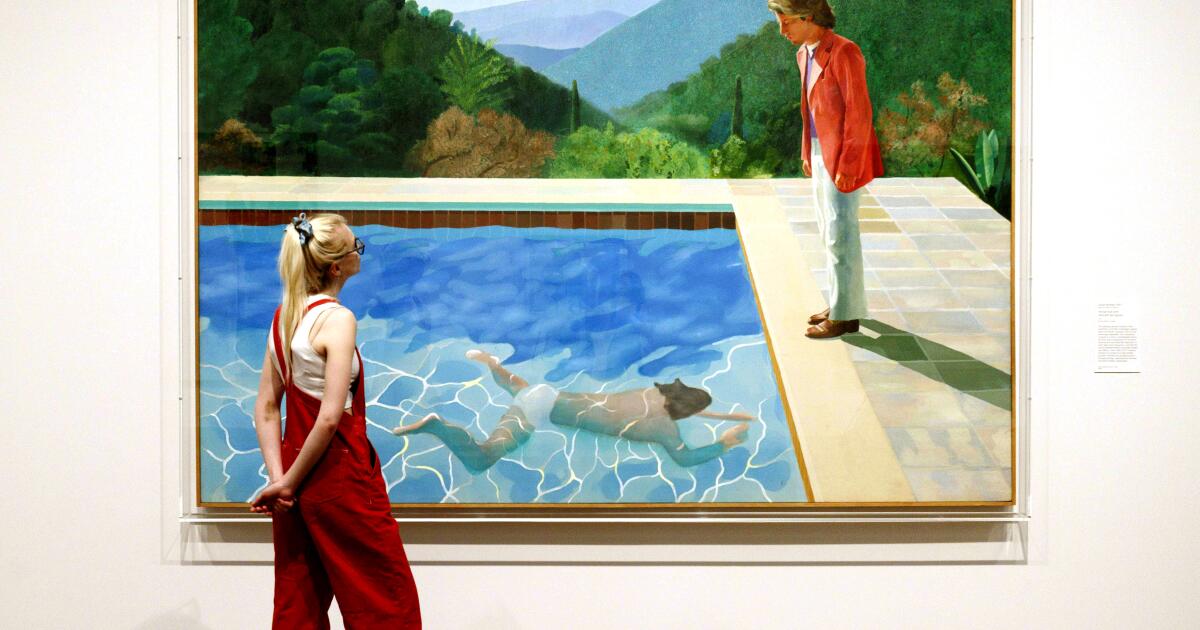
He was true to his word, even if his luminous, serene images of the city were a far cry from Giovanni Battista Piranesi’s feverish visions of Baroque Rome. “Beverly Hills Housewife” (1966), a portrait of a pink-dressed collector in her modernist home, marked the onset of a realist style that would define Hockney’s work for the next decade. This era gave rise to paintings that became icons of their time and place. Among them were “A Bigger Splash” (1967), which was based on a magazine cover that he came across on a newsstand, and “Christopher Isherwood and Don Bachardy” (1968, sold last year at Christie’s New York for $44.3 million). Inspired by Hans Holbein, this portrait of the English novelist and his artist partner was one of the first celebratory portrayals of a gay couple. Hockney would later recount how Isherwood proclaimed: “Oh David, we’ve so much in common; we love California, we love American boys, and we’re both from the north of England.” Hockney’s beloved American boy at this time was Peter Schlesinger, a young artist he had met while teaching at UCLA in the summer 1966 — and a recurring presence in the early L.A. pictures.
According to Norman Rosenthal, who curated a major survey of Hockney’s art at the Fondation Louis Vuitton in Paris last year: “It is astonishing that a boy from a poor family in Bradford became the person — partly because of his gayness, but also his talent — who defined what everybody now thinks of as California. L.A. had no real image in the world before then, unlike New York.”
Despite his enchantment with Los Angeles, Hockney didn’t settle there until 1978, after a decade of bouncing between America and Europe. In the summer of 1979 he moved into a house in the Hollywood Hills, and soon adorned its pool with swishing strokes of blue paint. In the early 1980s, he converted the paddle tennis court into a studio. The meandering routes and Mediterranean scenery of the Hills were a fresh source of amazement, giving rise to monumental depictions of Mulholland Drive and Nichols Canyon in a newly abstract style.
By this time, the city was deeply familiar — a second home — and he had a close circle of friends around him who included the patron Betty Freeman (subject of “Beverly Hills Housewife”), the designer Gregory Evans, the gallery owner Nicholas Wilder and the film producer Joe Simon. “L.A. had represented a whole new world for him,” says Simon, who remained in regular contact with the artist until his final days. “He just loved the light. He was like a kid in a candy store when he first came. But David was all about the work. Everything came back to that.”
In recent decades, Hockney’s name had become synonymous with the landscapes of his native Yorkshire, which he began painting prolifically in the early 2000s. But Los Angeles never lost its newness and promise. His house in the Hills remained a sanctuary until his final years, when he was too frail to travel. L.A. was where he had come of age, and it remained an indelible part of his life and psyche — not least in terms of its egalitarian spirit and its tendency toward the horizontal. “The great thing about Hockney was that he spoke to everybody,” says Rosenthal. “Few artists of his world and his generation could do that.”
James Cahill, a novelist and an art critic, is the author of, among other books, “David Hockney” and the forthcoming “The Beverly Hills Housewife: Hockney’s Californian Muse and the World Beyond the Pool.”
Sony Pictures Television has acquired controlling interest in the reality TV production company behind “Real Housewives of Beverly Hills” and “Vanderpump Rules.”
The Culver City studio, which produces “Jeopardy!” and “Wheel of Fortune,” announced Monday that it has closed its purchase of a majority stake of Alex Baskin’s three-year-old production firm, 32 Flavors. Baskin’s company has been expanding beyond its audience-addicting programs on Bravo to develop podcasts and documentaries.
NBCUniversal will continue to own “Real Housewives” and the other programs it televises, including “The Valley,” and spinoff show, “The Valley: Persian Style.” Baskin will continue as executive producer on his Bravo shows and stay on as chief executive of his production company.
Sony declined to disclose deal terms.
“Real Housewives of Beverly Hills” and “Real Housewives of Orange County,” are produced through Baskin’s company.
“32 Flavors has been on a remarkable trajectory, and with Sony’s support, we expect that momentum to accelerate meaningfully,” Baskin said in a statement.
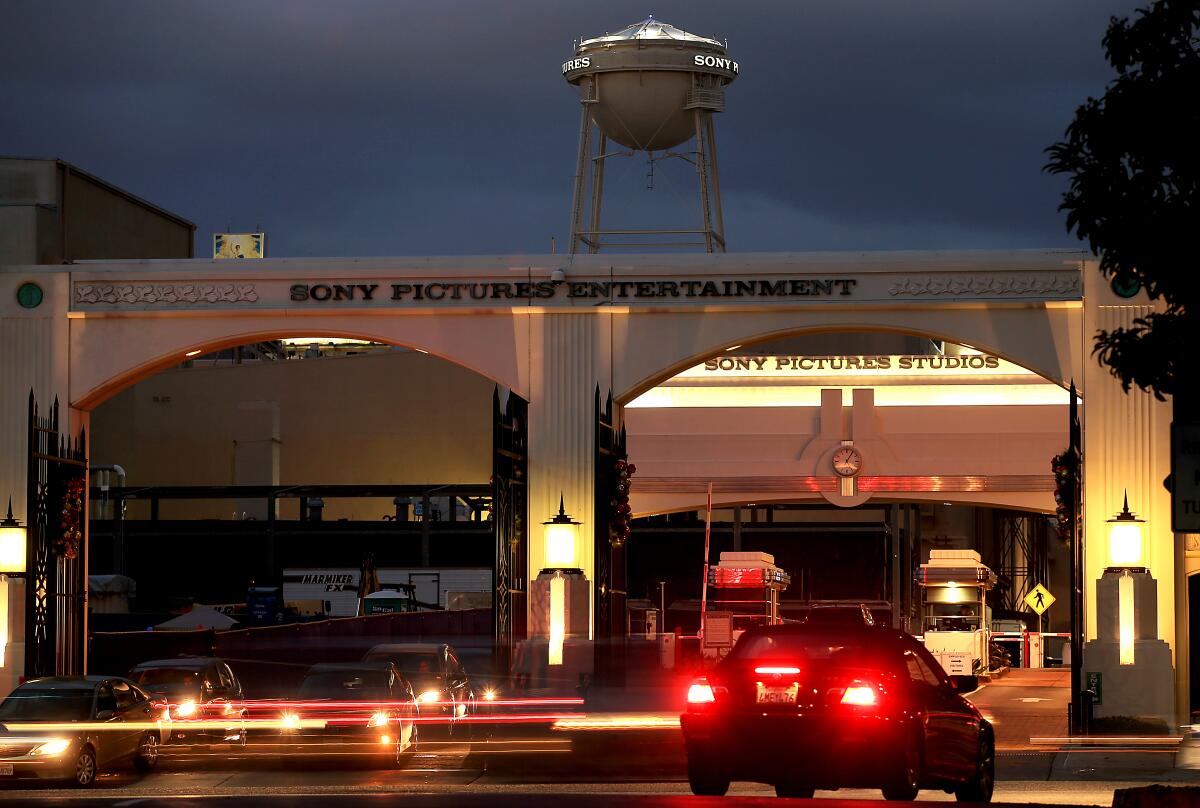
Sony Pictures Entertainment studios in Culver City.
(Luis Sinco / Los Angeles Times)
Sony already owns nonfiction production companies, including Sharp Entertainment, Embassy Row, Brass Monkeys Media and 19 Entertainment, the powerhouse behind “American Idol.” It also owns formats for “Shark Tank,” and “90 Day Fiancé,” and an upcoming adaption of the board game, Clue.
“As the market evolves, we see real opportunity in premium nonfiction, and 32 Flavors strengthens our ability to deliver high-impact, returnable formats that connect with audiences and buyers around the world,” Katherine Pope, president of Sony Pictures Television Studios, said in a statement.
Pope gained responsibility for the unscripted TV business earlier the spring as part of a restructuring and dramatic downsizing, which resulted in hundreds of layoffs in the Japanese company’s entertainment business. At the time, Sony said the cuts reflected a business shift under Sony Pictures Chief Executive Ravi Ahuja.