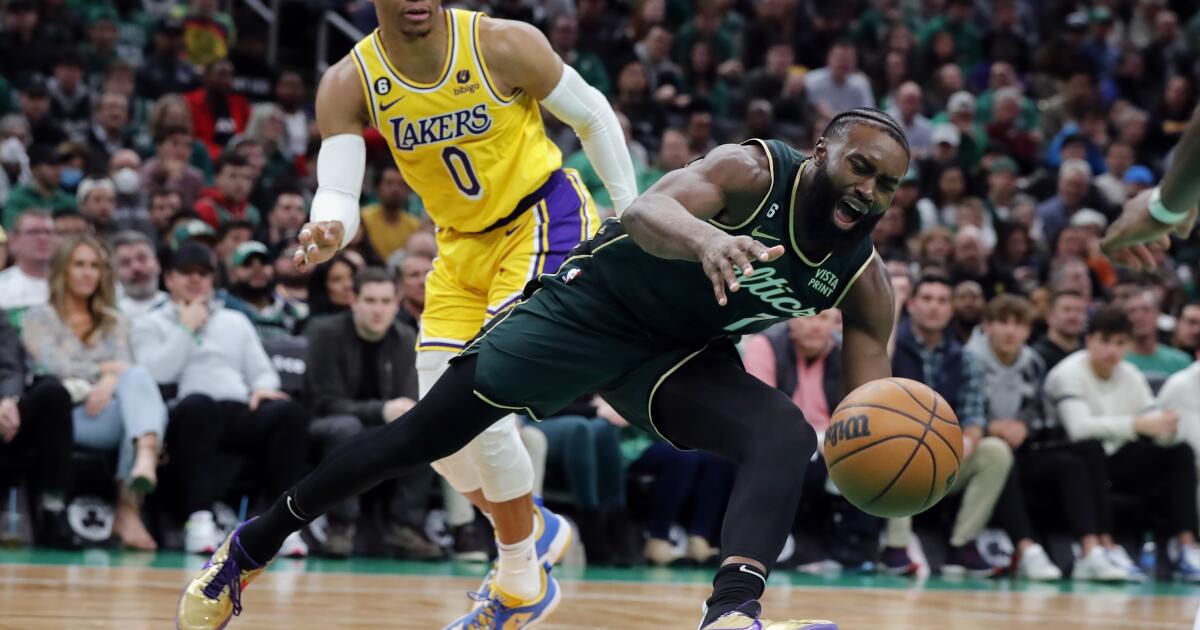
Boston Celtics star Jaylen Brown is not satisfied with an apology he received from the city of Beverly Hills on Thursday, days after police shut down an event he was hosting in the city’s Trousdale Estates neighborhood.
The apology was not for shutting down the event. Instead, it was for including what the city called “inaccurate information” in its initial statement about the event.
Brown told ESPN’s Andscape he is considering legal action against the city after it “embarrassed my brand and my team” and then continued “to tell untruths in [its] apology statement.”
The promotional event for Brown’s performance brand, 741, was held last weekend at the home of Oakley founder Jim Jannard on the eve of the NBA All-Star Game at Intuit Dome. It was scheduled to include a panel discussion featuring National Basketball Players Assn. president Andre Iguodala followed by an after-party with around 200 invited guests.
In an X post after his event was stopped, Brown wrote, “300k down the drain.” On Thursday, in response to the city’s statement, Brown wrote on X: “You targeted me and my @741Performance event based on biased information then you give a half a— apology after the damage is already done.”
The Times reached out to the city of Beverly Hills on Friday for a response to Brown’s comments concerning the incident, including his mention of possible legal action. A representative referred The Times to the statement released the previous day.
The city’s first statement, issued Sunday, said that “an event permit had been applied for and denied by the City due to previous violations associated with events at the address” and “organizers still chose to proceed with inviting hundreds of guests knowing that it was not allowed to occur.”
On Thursday, the city issued a second release saying that upon further internal review it had determined that “no permit application was submitted nor denied for the event and the residence does not have any prior related violations on record.”
The release included a statement from city manager Nancy Hunt-Coffey, who apologized for the inaccurate information but asserted that the city still had reason to shut down the event.
“The City’s previous statement about the weekend event at the Trousdale home was inaccurate, and on behalf of the City, I would like to apologize to Jaylen Brown and the Jannard family,” Hunt-Coffey said.
“The City has a responsibility to its residents and neighborhoods to ensure adherence to established regulations for events held at private residences. These are designed to support the safety and welfare of neighbors and attendees. City staff observed circumstances that are believed to be City code violations and for that reason alone, the event was ended.”
Brown was far from satisfied with the apology.
“The city has now stated the event was shut down because officials believed codes were being violated,” he said in a statement released by Jalen Brown Enterprises Inc. “A private gathering cannot lawfully be terminated based on assumption alone, particularly when no official ever entered the residence to observe conditions or verify any alleged violation.
“This was a private, invitation-only gathering at a private home among friends and partners, not a public or commercial event requiring a permit. … No proof of any alleged violation was ever produced to the homeowner, our team, or legal counsel. Without observation, documentation or confirmed violations, enforcement action based on belief alone raises serious due-process concerns.
“Jalen Brown Enterprises Inc. supports lawful compliance and cooperative engagement with municipalities wherever we operate. However, this private residential gathering was interrupted without substantiated cause, resulting in significant financial and reputational harm.”
“We remain open to a constructive resolution with the city of Beverly Hills.”
Brown had more to say on the matter after the Celtics’ 121-110 win over the Golden State Warriors on Thursday night in San Francisco.
“This is All-Star Weekend at 7 p.m. I just wanted to enjoy myself. And I feel like that got taken away, and I got embarrassed to some degree,” said Brown, who was named an All-Star starter for the first time this year. He added, “I feel like that apology, you know, even in the statement they put out, they included some stuff that wasn’t true, even in an apology. So I don’t think that apology was acceptable.
“I lost a lot of money … and then people were making assumptions, like we didn’t go through the proper protocols. So that’s just all around a bad look, leaves a bad taste in my mouth. I’m extremely offended. My team is offended still. I’m not sure what the conclusion is going to be. All I know is that, that was some bulls—.”
Brown said he heard about the city’s most recent statement on his way to the game and that it fueled his third triple-double of the season (23 points, 15 rebounds, 13 assists).
“I wasn’t even thinking about the game,” said Brown, who will be back in Los Angeles when the Celtics play the Lakers on Sunday. “I was pissed. I was still pissed.”
NBA star Jaylen Brown had a public spat with the Beverly Hills Police Department Saturday night after police shut down a brand event he was hosting.
Brown, who signed a $285-million contract with the Celtics in 2023, was in Los Angeles for the National Basketball Assn.’s All-Star festivities.
He told ESPN that the event was hosted at Oakley founder Jim Jannard’s house. Brown is sponsored by Oakley.
The event took place in the Trousdale section of Beverly Hills and was shut down about 7 p.m. In a video posted on Brown’s Instagram account, the NBA star could be seen arguing with a BHPD officer who was shutting the party down.
“The owner didn’t say we needed a permit,” Brown told the officer in the video. Brown claimed the event was not a party, but rather a panel on culture.
“300k down the drain,” Brown wrote in a post on X after the incident, tagging the Beverly Hills Police Department.
“An event permit had been applied for and denied by the City due to previous violations associated with events at the address,” BHPD said in a statement.
“Despite the fact that the permit was denied, organizers still chose to proceed with inviting hundreds of guests knowing that it was not allowed to occur,” the statement continued.
Brown plays for the Boston Celtics, a historic rival of the Los Angeles Lakers, but added that he was surprised at his treatment by the city of Beverly Hills.
“I feel like we’re being targeted right now,” he said in a video posted to Instagram.
Carlos Aranibar is a former Downey public works commissioner and remains involved in local Democratic politics. But until a few weeks ago, the son of Bolivian and Mexican immigrants hadn’t joined any actions against the immigration raids that have overwhelmed Southern California.
Life always seemed to get in the way. Downey hadn’t been hit as hard as other cities in Southeast L.A. County, where elected officials and local leaders urged residents to resist and helped them organize. Besides, we’re talking about Downey, a city that advocates and detractors alike hyperbolically call the “Mexican Beverly Hills” for its middle-class Latino life and conservative streak.
That’s now going up in flames. But it took a while for Aranibar to full-on join the anti-migra movement — and people like him are shaping up to be a real threat to President Trump and the GOP in the coming midterms and beyond.
On Jan. 27, Aranibar saw a Customs and Border Protection truck on the way home from work. That jolted Aranibar, an electrician with the International Brotherhood of Electrical Workers’ Local 11, into action.
“It’s not something like that I was in a bubble and I was finally mad — I’ve been mad,” the 46-year-old said. “But seeing [immigration patrols] so close to my city, I thought ‘That’s not cool.’”
He Googled and called around to see how best to join others and resist. Someone eventually told him about a meeting that evening in a downtown Downey music venue. It was happening just a few days after Border Patrol agents shot and killed Minneapolis resident Alex Pretti after he tried to shield a fellow protester from pepper spray, and a few weeks after immigration agents tried to detain two Downey gardeners with legal status before residents hounded them away and recorded the encounter.
Aranibar joined more than 200 people standing shoulder to shoulder for the launch of a Downey ICE Watch group. They learned how to spot and track immigration agents and signed up for email updates. A box of whistles was passed around so people could alert their neighbors if lamigra was around.
“Who here has been a member of a patrol?” an organizer asked from the stage.
Only a few people raised their hands.
“I saw familiar faces and new faces, energized — it was really nice,” Aranibar said afterward. “I got the sense that people in Downey have been fired up to do something, and now it was happening.”
A similarly unexpected political awakening seemed to be happening just down the street at Downey City Hall, on the other side of the political aisle.
Mayor Claudia Frometa set tongues wagging across town after video emerged of her whooping it up with other Latino Trump supporters the night he won his reelection bid. Activists since have demanded she speak out against the president’s deportation deluge, protesting in front of City Hall and speaking out during council meetings when they didn’t buy her rationale that local government officials couldn’t do much about federal actions.
“Mayor Frometa is not a good Californian right now,” councilmember Mario Trujillo told me before the Jan. 27 council meeting. During the previous meeting, Frometa cut off his mic and called for a recess after Trujillo challenged Frometa to talk to “her president” and stop what’s going on. “It’s not a time to deflect, it’s not a time to hedge — it’s a time to stand up. She’s giving us a bulls—t narrative.”
Even Downey Mayor Claudia Frometa, a supporter of President Trump, has called out his immigation policies.
(Ronaldo Bolanos/Los Angeles Times)
That night, Frometa listened to critics like Trujillo slam her anew while wearing a wearied smile. When it was her turn to speak at the end of the night, she looked down at her desk as if reading from prepared remarks — but her voice and gesticulations felt like she was speaking from somewhere deeper.
“This issue [of deportations] which we have been seeing unfold and morph into something very ugly — it’s not about politics anymore,” Frometa said. “It’s about government actions not aligning with our Constitution, not aligning with our law and basic standards of fairness and humanity.”
As she repeatedly put on and removed her glasses, Frometa encouraged people to film immigration agents and noted the council had just approved extra funding for city-sponsored know-your-rights and legal aid workshops.
“This is beyond party affiliation,” the mayor concluded, “and we will stand together as a community.”
Suddenly, the so-called “Mexican Beverly Hills” was blasting Trump from the left and the right. Among Latinos, such a shift is blazing around the country like memes about Bad Bunny’s Super Bowl halftime show. Trump’s support among former voters has collapsed to the point that Florida state senator Ileana Garcia, co-founder of Latinas for Trump, told the New York Times that the president “will lose the midterms” because of his scorched-earth approach to immigrants.
Former Assembly member Hector de la Torre said he’s not surprised by what’s happening in a place like Downey.
“When it hits home like that, it’s not hypothetical anymore — it’s real,” he said. De La Torre was at the Downey ICE Watch meeting and works with Fromenta in his role as executive director of the Gateway Cities Council of Governments, which advocates for 27 cities stretching from Montebello to Long Beach to Cerritos and all the southeast L.A. cities.
“People are coming out the way they maybe didn’t in the past “ he continued. “It’s that realization that [raids] can even happen here.”
Mario Guerra is a longtime chaplain for the Downey police department and former mayor who remains influential in local politics — he helped the entire council win their elections. While he seemed skeptical of the people who attended the Downey ICE Watch — “How many of then were actual residents?” — he noted “frustration” among fellow Latino Republicans over Trump and his raids.
“I didn’t vote for masked men picking people up at random,” Guerra said before mentioning the migra encounter with the gardeners in January. “If that doesn’t weigh on your heart, then you’ve got some issues. All this will definitely weigh on the midterms.”
Even before Frometa’s short speech, I had a hint of what was to to come. Before the council meeting, I met with the termed-out mayor in her office.
The 51-year-old former Democrat is considered a rising GOP star as one of the few Republican Latino elected officials in Los Angeles and the first California Republican to head the nonpartisan National Assn. of Latino Elected and Appointed Officials. Her family moved to Downey from Juarez, Mexico when she was 12. Whites made up the majority of the suburban city back then, and it was most famous in those days as the land that birthed the Carpenters and the Space Shuttle.
Now, Downey is about 75% Latino, and four of its five council members are Latino.
So what did Frometa expect of Trump in his second term?
“I was expecting him to enforce our laws,” she replied. “To close our border so that we didn’t have hundreds of thousands coming in unchecked. I was expecting him to be tough on crime. But the way it’s being played out with that enforcement and the tactics is not what we voted for. No. No.”
Over our 45-minute talk, Frometa described Trump’s wanton deportation policy as “heartbreaking,” “racial profiling,” “problematic,” “devastating” and “not what America stands for.” The mayor said Republicans she knows feel “terrible” about it: “You cannot say you are pro-humanity and be OK with what’s happening.”
Asked if she was carrying a passport like many Latinos are — myself included — she said she was “almost” at that point.
A home in Downey shows support for Trump in 2024.
(Gina Ferazzi/Los Angeles Times)
Frometa defended her relative silence compared to other Latino elected officials over the matter.
“We live in a time that is so polarizing that people want their elected officials to come out fighting,” she said. “And I think much more can be accomplished through different means.”
Part of that is talking with other Southern California Republicans “at different levels within the party” about how best to tell the Trump administration to “change course and change fast,” although she declined to offer details or names of other GOP members involved.
I concluded our interview by asking if she would vote for Trump again if she had the chance.
“It’s a very hard — It’s a hard question to answer,” Frometa said with a sigh. “We want our communities to be treated fairly, and we want our communities to be treated humanely. Are they being treated that way right now? They’re not. And I’m not OK with that.”
So right now you don’t know?
“Mm-hmm.”
You better believe there’s a lot more right-of-center Latinos right now thinking the same.
Hello! I’m Mark Olsen. Welcome to another edition of your regular field guide to a world of Only Good Movies.
Movies that had limited awards releases last year are seeing their full-fledged openings this week. Top among them is “Pillion,” the debut from British writer-director Harry Lighton, starring Alexander Skarsgård and Harry Melling as two men who become engaged in a dominant-submissive relationship.
Alexander Skarsgård, left, and Harry Melling in the movie “Pillion.”
(A24)
In her review, Amy Nicholson writes of the film, “This fetishy adventure is a minimalist romantic comedy in which submissive meets dominant, and submissive explores his physical and emotional vulnerabilities. Marriage and a baby carriage are off the table; the journey matters, not the destination. … Lighton’s biker BDSM rom-com might sound niche, but free yourself to see it and you’ll discover it’s a universal romance.”
Emily Zemler asked Skarsgård about what has been guiding his decisions lately when choosing roles. As he said, “People think there’s this invisible ladder and you have to get to the next rung of the ladder. It’s easy to forget to check in with yourself and ask, ‘Well, what do I want to do?’ You can get swept away. I’m trying to get down the ladder to the ground.”
For most of the month of February, the New Beverly will refashion itself into the Eros, the adult movie theater it was called throughout much of the 1970s. (There’s even a commemorative T-shirt.) Married film dudes throughout the city are presumably coming up with inventive rationales and/or excuses as to why they simply must attend some of these screenings.
The programming leans into what was referred to in The Times as “porn chic” — movies that were meant to work as cinema, even appealing to couples, while also fulfilling the needs of the raincoat crowd. This Friday and Saturday will be a double bill of Just Jaeckin’s 1974 “Emmanuelle,” starring Sylvia Kristel, and Bitto Albertini’s 1975 “Black Emmanuelle,” starring Laura Gemser.
When The Times’ Charles Champlin reviewed “Emmanuelle” after it opened in 1975 at the Fine Arts in Beverly Hills, he noted, “It may be the first porno film designed for people who don’t really want to see one.”
Other notable titles during the New Bev’s Eros month include “The Opening of Misty Beethoven,” directed by Radley Metzger under the pseudonym Henry Paris, Russ Meyer’s “Vixen” (with star Erica Gavin in-person), Ingmar Bergman’s “Summer With Monica,” Roger Vadim’s “Pretty Maids All in a Row,” “The Fireworks Woman,” directed by Wes Craven (credited as Abe Snake), Nagisa Oshima’s “In the Realm of the Senses” and Gerard Damiano’s “Deep Throat.”
Quentin Tarantino’s “Once Upon a Time … in Hollywood” will be playing on Fridays at midnight, which includes a knowing line about the Eros when Margot Robbie asks, “What’s happening at the dirty movie place?”
A 1976 article in The Times by Barry Siegel states that there were then 47 adult theaters operating within the city limits of Los Angeles, even while charting the rapid rise and quick decline of porn-chic movies in the wake of the success of “Deep Throat” in 1972.
‘sex, lies and videotape’ with starLaura San Giacomo
Laura San Giacomo in the movie “sex, lies and videotape.”
(Criterion Collection)
The Los Angeles Film Critics Assn. continues its 50th anniversary series at the Egyptian Theatre on Tuesday with a screening of Steven Soderbergh’s 1989 debut feature “sex, lies and videotape,” a key title in kicking off the independent filmmaking scene of the 1990s. Actor Laura San Giacomo, who won LAFCA’s New Generation Award for her performance, will be there for a Q&A moderated by Lael Loewenstein.
Soderbergh was all of 26 years old when the film premiered at what was then called the U.S. Film Festival (the precursor to Sundance), where it won the audience award before heading to Cannes, where it won the Palme d’Or. (James Spader picked up an acting prize there too.) Among the film’s many other accolades, Soderbergh would also be nominated for an Academy Award for original screenplay.
Spader plays Graham, an enigmatic wanderer who inserts himself into the lives of his old friend John (Peter Gallagher), his wife Ann (Andie MacDowell) and her sister Cynthia (San Giacomo), drawing out all manner of confessions and revelations.
In her original review of the film, Sheila Benson called the film an “electrifying psycho-sexual comedy … the funniest and saddest American movie since Jim Jarmusch landed straight in the middle of our consciousness, and it’s possibly the most compelling.”
Benson added, “What is not apparent from a thumbnail description is the film’s lacerating wit, its beautiful look and sound, and the bravura quality to each performance. Or the terrible vein of melancholy that Soderbergh touches.”
‘In the Soup’ in 35mm
Steve Buscemi and Seymour Cassel in the movie “In the Soup.”
(Factory 25)
Winner of the Grand Jury prize at 1992’s Sundance — the same year “Reservoir Dogs” premiered there — is “In the Soup.” Directed and co-written by Alexandre Rockwell, the film follows an aspiring filmmaker (Steve Buscemi) who falls in with an irresistibly charming gangster (Seymour Cassel, who won Sundance’s first acting award) as his erstwhile producer. A recently restored 35mm print of the film will be playing in L.A. for the first time Sunday at Brain Dead Studios.
The cast of the film also features Carol Kane, Jim Jarmusch and Jennifer Beals, the last married to director Rockwell at the time. Reviewing the film in November 1992, Kenneth Turan called it “a charming pipsqueak of a movie, a playful film of ragged and shaggy appeal.”
Director Michael Almereyda on the ’90s vampires of ‘Nadja’
Elina Löwensohn in the movie “Nadja.”
(Arbelos Films)
As much a survey of late-night diners, bars and 3 a.m. conversations, Michael Almereyda’s “Nadja” is very much a vampire film. It is also a wonderful example of the creative freedom of the ’90s indie boom — everything from its cast to its look to its deadpan humor.
Executive produced by David Lynch (who paid for the film out of his own pocket and appears in a small role), “Nadja” combines the 1936 horror film “Dracula‘s Daughter” with Andre Breton’s 1928 surrealist novel “Nadja.” In the movie, a New York City vampire (Elina Löwensohn) looks to avenge the death of her father at the hands of Dr. Van Helsing (Peter Fonda) while also dealing with a complicated swirl of relationships involving her brother (Jared Harris), his nurse (Suzy Amis), Van Helsing’s nephew (Martin Donovan) and his wife (Galaxy Craze).
Re-released by Grasshopper Film and Arbelos Films with a streaming and home video release to follow, the new 4K restoration of the film’s original version that premiered at the 1994 Toronto International Film Festival is a few minutes longer than what played at Sundance just a few months later. (It was there that Almereyda also made the documentary “At Sundance,” interviewing filmmakers for their thoughts on the future of movies.) This new “Nadja” is playing on Feb. 6 and 8 at the Philosophical Research Society, then at Vidiots on Feb. 21 and 22 and Frida Cinema on Feb. 25 and 26.
On the phone from Sao Paulo, Brazil, where he is prepping an adaptation of Don DeLillo’s 2016 novel “Zero K,” the thoughtful and reflective Almereyda shared some of his memories of making the film.
Peter Fonda, left, Jared Harris, Martin Donovan and Galaxy Craze in the movie “Nadja.”
(Arbelos Films)
How did you get the idea of combining “Dracula’s Dracula” with Breton’s “Nadja”?
Michael Almereyda: It was fairly spontaneous. David Lynch had offered to help me make a movie if I could come up with something that was definably genre. And I went to [NYC movie theater] Film Forum at a time when — do you remember [film historian] William K. Everson? He would show up at Film Forum unannounced to start talking before the movie. This was one time when I showed up late and he was talking and they read a raffle ticket and there was silence. And I reached in my pocket: I had won the raffle. And that was to get a book of William K. Everson’s about horror movies. And so it was kind of a gift that I read about “Dracula’s Daughter.” I’d never seen it and I liked the outline of the plot and I chased it down and it felt like I could retrofit a number of ideas I had about New York with that story. It felt like the two things talked to each other.
One thing about vampire movies is that the best ones are always about something else. For you with “Nadja,” what’s the something else?
Almereyda: It’s not really a scary movie and it wasn’t really designed to be. It’s certainly atmospheric but the emotion of it, when I saw it again recently, had to do with both the comic aspects of being in love and the miserable aspects. It’s kind of a side-winding answer, but that’s partly what it’s about. It’s about family ties, obviously. I think I made or wrote enough scripts about tangled families that I began to sort of get over it. But we all come from these families.
David Lynch in the movie “Nadja.”
(Arbelos Films)
Did David Lynch‘s presence impact the tone at all? Do you feel the movie became in any way Lynchian?
Almereyda: Well, David’s impact on me and my whole generation of filmmaking and the generation behind us is vast. And I wouldn’t want to pretend it’s not, but direct influence is kind of minimal. It might be more fair to say that David’s art school background rhymes with mine. And that we had similar influences. People don’t really talk about how much David did or didn’t know about Maya Deren and Cocteau, but it’s kind of hard to miss. And there was just a certain sensibility and attitude. I felt close to David’s Midwestern-ness, and you combine that with some fondness for and knowledge of French culture, including surrealism, and you’re halfway to David Lynch without specifically thinking about it.
I really haven’t addressed this question much, but when he died, I ended up writing a fair bit of my memories and it’s moving to me how much impact he had when he died. There was such a wave of mourning and celebration, too, that it felt more phenomenal than he could have anticipated. It was clear how famous he was — how recognizable he was — within the time I knew him. But the love of David Lynch is really moving to me and it’s still something we’re swimming in, I hope, in a dark time.
For all the difficulties of being an independent filmmaker, what keeps you doing it?
Almereyda: I’m stumped. I was just going through my head and I know you just interviewed Ethan Hawke and he’s a true comrade that I’ve been lucky to work with a few times. And he was in the interview with Rick Linklater when we did our “At Sundance” movie. They had “Before Sunrise” at the festival and Rick started by quoting Truffaut, talking about the future of film is the personal film.
Even if it’s a fantasy, even if it’s a vampire movie, you’re still relating to your experience and your sense of an emotional reality. So that feels like a candle that doesn’t go out for me. And despite all the derailments and dead ends, I don’t question continuing. It just feels like a natural path, even if it’s winding and difficult.
In other news
Timothée Chalamet, tributee
Timothee Chalamet in the movie “Marty Supreme.”
(A24)
I will leave the ins and outs of this year’s awards campaigns to my trusted colleague Glenn Whipp at The Envelope, but one event jumped out as worth noting: Announced this week and immediately selling out is an eight-film American Cinematheque retrospective of Timothée Chalamet‘s movies, with the actor in person for all screenings.
Chalamet is currently an Oscar nominee as both actor and producer for “Marty Supreme.” And he has an impressive roster of collaborators who will be appearing with him to show their support, including Edward Norton with “A Complete Unknown,” Denis Villenueve with “Dune” and “Dune: Part Two,” Christopher Nolan with “Interstellar” and Elle Fanning with “Beautiful Boy.”
If there were some murmurs last year that Chalamet didn’t do enough conventional campaigning to win for his turn as Bob Dylan in “A Complete Unknown,” this year he seems to be pulling out all the stops.
One way to honor your 93-year-old host: by calling him a “f— gangster” who’ll “slit your throat for a hit record.”
That’s how Monte Lipman big-upped Clive Davis on Saturday night at the Beverly Hilton, where Davis had convened an invite-only crowd of celebrities and music-industry insiders for his annual night-before-the-Grammys gala. Lipman, who runs Republic Records, was there to receive the Recording Academy’s Industry Icon award along with his brother and business partner, Avery; clearly, the commendation had gotten him feeling all warm and fuzzy about the record-biz machers who paved his way.
An incomplete list of stars in the Hilton’s ballroom for Saturday’s soiree: Joni Mitchell, Nancy Pelosi, Stevie Wonder, Colman Domingo, Frankie Valli, Martha Stewart, Lana Del Rey, Karol G, Brandi Carlile, Bill Maher, Teyana Taylor, Gladys Knight, Bryan Cox, Jeff Goldblum, Max Martin and — speaking of record-biz machers — Motown founder Berry Gordy, who at 96 had to have been the only person at the party with more experience on him than Davis.
Jennifer Hudson performs.
(Kayla Bartkowski / Los Angeles Times)
At least a few of these luminaries had come, no doubt, to see the Lipmans pick up their prize; among the many, many successes they’ve racked up in recent years include blockbusters by Taylor Swift, Morgan Wallen, Sabrina Carpenter, Chappell Roan, Post Malone and the lovable cartoon assassins of “KPop Demon Hunters.”
But mostly folks had come to schmooze and to take in the entertainment Davis had arranged.
As always, the show featured a blend of beloved old-timers and ascendant youngsters, including three of the nominees for the Grammys’ best new artist award: Sombr, pouting extravagantly through a pretend-sleazy “12 to 12”; Olivia Dean, downright luminous as a horn section added some swing to “Man I Need”; and Alex Warren, who’s beginning to look like he may never want to sing “Ordinary” again.
Sombr spins Olivia Dean during his performance.
(Kayla Bartkowski / Los Angeles Times)
Clipse and John Legend performed “The Birds Don’t Sing,” from the rap duo’s “Let God Sort Em Out,” which is up for album of the year at Sunday’s Grammys ceremony. The women of “KPop Demon Hunters’” Huntr/x turned up to sing “Golden,” which is nominated for song of the year.
MGK and Jelly Roll tag-teamed an homage to the late Ozzy Osbourne, while Jennifer Hudson saluted the late Roberta Flack; her typically virtuosic rendition of “The First Time Ever I Saw Your Face” brought the room to as close to quiet as it got all night.
Pusha T of Clipse, left, and John Legend perform.
(Kayla Bartkowski / Los Angeles Times)
There were also tributes to two living legends: Bernie Taupin and Art Garfunkel. For the former, Darren Criss sang “Bennie and the Jets” — just one of the classics Taupin co-wrote with Elton John — then brought out Laufey for a surprisingly frisky take on John and Kiki Dee’s disco-era “Don’t Go Breaking My Heart.” (Free idea: Somebody cast Criss and Laufey in a reboot of “Grease.”)
To honor Garfunkel, the country duo Dan + Shay performed “Mrs. Robinson” before throwing to the 84-year-old himself, who sauntered onstage in a tuxedo and Phillies ball cap, sat down on a stool and — after having read a bit of poetry scrawled on the back on an envelope — closed the show with a touching if slightly wobbly journey across “Bridge Over Troubled Water.”
Behold more pictures from Saturday’s event:
Art Garfunkel performs.
(Kayla Bartkowski / Los Angeles Times)
Clive Davis, left, addresses the crowd.
(Kayla Bartkowski / Los Angeles Times)
Karol G on the red carpet.
(Kayla Bartkowski / Los Angeles Times)
Adam Lambert on the red carpet.
(Kayla Bartkowski / Los Angeles Times)
Darren Criss, left, and Laufey perform.
(Kayla Bartkowski / Los Angeles Times)
Jelly Roll, left, and Bunnie Xo on the red carpet.
(Kayla Bartkowski / Los Angeles Times)
Monte Lipman, left, and Avery Lipman on the red carpet.