Josh Hartnett and Charlie Heaton on creating a father-son bond in ‘Below’
Josh Hartnett and Charlie Heaton know how to brood.
The actors both found fame in their early 20s playing characters prone to pining and sulking: Hartnett became a heartthrob in the late ’90s and early 2000s with mellow roles in films including “The Virgin Suicides,” “Pearl Harbor” and “Black Hawk Down.” Heaton, meanwhile, spent most of the last decade embodying the introverted Jonathan Byers on “Stranger Things.”
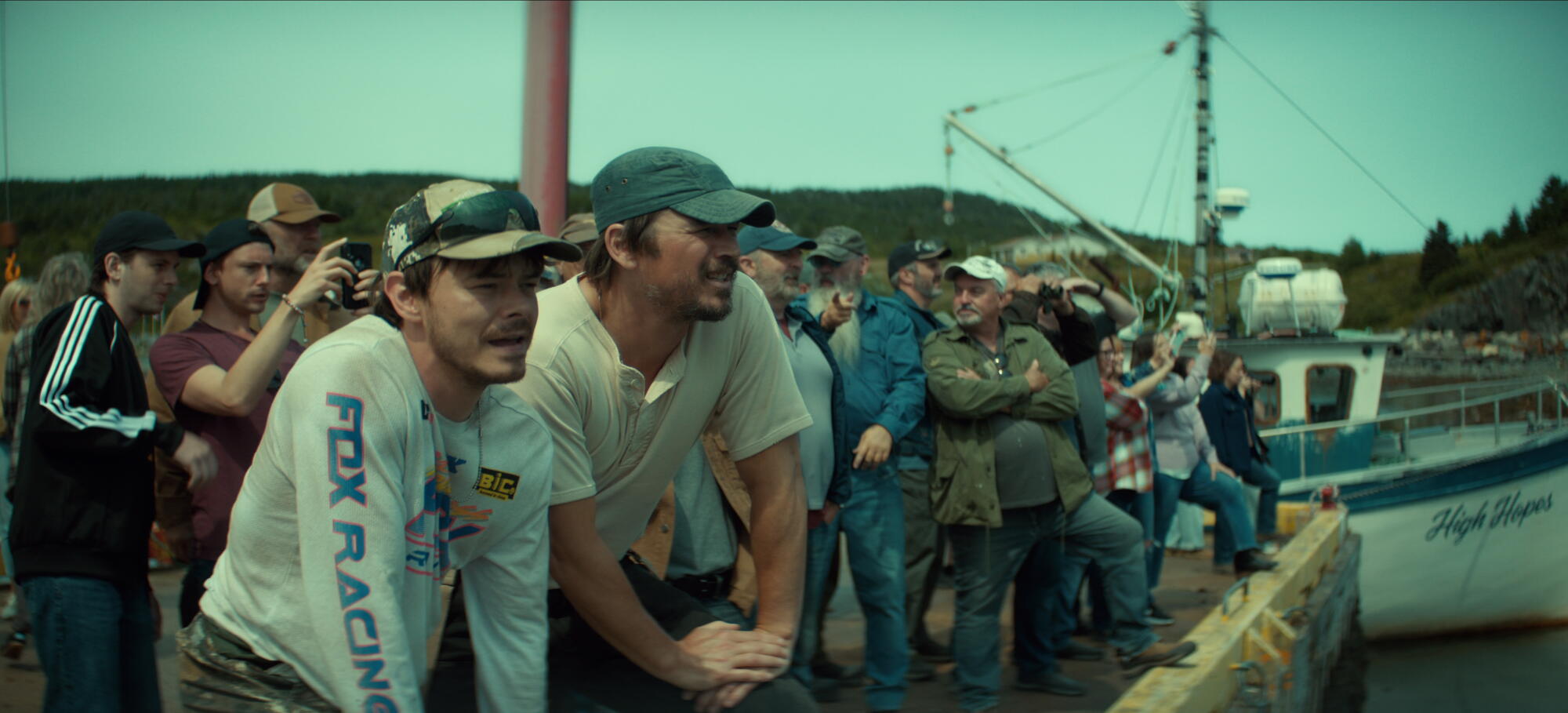
But now, the duo are wearing their hearts on their sleeves in “Below,” a six-episode Netflix miniseries now streaming, in which they play a father and son living in a misty Newfoundland fishing village that is increasingly terrorized by something mysterious in the iceberg-filled waters.
As Calvin and Wade Penney in “Below,” the actors are passionate and emotional. They get into animated family arguments and gleefully celebrate when things (occasionally) go their way.
“It’s all on the page,” Hartnett said. “All I had to do was show up and feel those things toward Charlie.”
Filmed on location in Newfoundland, Canada, “Below” is the latest unexpected project for Hartnett, 48, who has been cultivating a career renaissance in recent years with roles in “Black Mirror,” “Oppenheimer,” “Trap” and this month’s “Verity.”

Charlie Heaton as Wade, left, and Josh Hartnett as Calvin in Netflix’s “Below.”
(Netflix)
Heaton, 32, has likewise been diversifying his post- “Stranger Things” portfolio. He played an ill-fated financial journalist in the fourth season of “Industry” and will next star in a “Peaky Blinders” sequel series.
“I like trying to surprise people, and maybe surprise myself too,” Heaton said.
When they convened for a joint video interview in late September, Heaton had recently returned to his London home from a music video shoot. Hartnett had just finished putting his four children (with wife, the actor Tamsin Egerton) to bed at their countryside home in Hampshire, England. These are edited excerpts from the conversation.
What attracted you both to this project?
Hartnett: I was in “Black Mirror” a couple of years ago, and Jessica Rhoades, who produced “Black Mirror,” sent me the [“Below”] script probably about two months before production was supposed to start. I loved the script but I had some questions, so I had to speak to [creator] Jesse [McKeown] and a couple of the other EPs, just to get the lay of the land. After that conversation, I was like, this sounds really fresh and nuanced and organic.
Heaton: It seemed to have so much warmth and mystery. I do remember having a conversation with my agent because, obviously, I’d come off “Stranger Things,” and there was a little concern of, “Is it too similar?” But Wade is such a fun character. I’m from a working-class fishing town [Bridlington, England]. He’s also working class. Everyone knows somebody like Wade.
Hartnett: Willow Kean, who plays my sister, his aunt, saw Charlie on set when he first arrived. He was in his outfit and smoking a cigarette, and she was like, “I think somebody’s on set who shouldn’t be” — because he looked like a local. He fully embodied the mood of this character immediately.
How did the two of you meet? Had you crossed paths in the industry before?
Hartnett: We hadn’t. We met on Zoom. We did a bunch of stuff with the full cast, and it was more to learn the accent than anything else. Once we started to get into the accent work together, just shooting the s— online, it was great.
Heaton: We wanted the family to all sound like they were from the same place. But the accent is so hard to hear in the beginning. So, we were all getting it wrong together.

Heaton and Hartnett hadn’t crossed paths before being cast in “Below,” but they created a rapport by trying to learn the show’s Newfoundland accent together.
(Jason Armond / Los Angeles Times)
What was the biggest obstacle with the Newfoundland accent?
Heaton: I’ve done a fair amount of accents, but it’s hard to understand the rules of this one. It’s like, well, that word’s Irish, that word’s kind of American. It took me a while to be able to hear it. We had Ali [Alison Kelly], who was our voice coach, and a lot of the extras that we had on set also were local artists, so you could really lean on them.
Hartnett: Everybody was so welcoming. The most difficult part for me was hearing the rhythm of it. So, I listened to this thing called “The Broadcast,” which used to be called “The Fisheries Broadcast.” It’s a radio show that’s been on since 1951. Every day they’re talking to someone about something that’s happening on the island, so you’re getting all these different versions of the accent, but you’re also getting an overall perspective of how people speak in Newfoundland. It was really revealing.
How familiar were you with Newfoundland before doing “Below”?
Hartnett: I knew very little. I knew the “Come From Away” story about all the people stranded in Gander after 9/11. I knew that it was where Leif Erikson landed a long time ago. I knew that it was the closest place in North America to Europe, so when people would do transatlantic flights up until relatively recently, they would stop in Newfoundland. I knew there were puffins.
Heaton: I’m going to be very honest. I hadn’t even ever heard of it. But I learned a lot. We were there for a long time, and Newfoundlanders are extremely proud of their history and their culture, and they love talking.
What was it like shooting on location and out in nature?
Heaton: It was powerful and beautiful. Where we shot, Snook’s Arm, was this bay called Brigus South. You’d come down in the morning, and just that sheer amount of nature every day I found really moving.
Hartnett: One of the first days we were there, they took me out on a whale-watching tour. I was like, “Oh, cool. That sounds touristy but fun.” It was a spiritual experience. I’ve never been anywhere where I felt so small and insignificant next to another animal. These humpback whales, they’re right underneath these tiny little boats, and if they wanted to, they could just flick their tail, and you’d be off in the sea. I had never experienced nature in the sea the way that I experienced it there.
You play father and son, but you’re not that far apart in age.
Hartnett: Fifteen-and-a-half years! I did the math.


Heaton and Hartnett play father and son in “Below,” but in reality they’re just shy of 16 years apart. (Netflix)
How did you develop your onscreen dynamic?
Hartnett: Charlie was so in character as Wade, it was very easy to feel a real sense of protectiveness and an incredible amount of love.
Heaton: What I really admired about working with Josh [is] he is such a leader. You really care, and you’re so generous with everyone, and I got to see your family, and I got to see how you are as a dad. So, those projections weren’t that difficult to come up with in my head, honestly. It’s cool that I get to be your son.
Hartnett: So sweet, man. Thank you.
Charlie, do you remember any of Josh’s past work that stood out to you?
Hartnett: [Pretends to cover his camera] I’m just going to turn this off.
Heaton: One of my favorite films for a while was “Lucky Number Slevin.” When I was younger, I used to watch that quite a lot. I might rewatch that, Josh. It’s been a while.
Hartnett: Well, tell me if it holds up.
Josh, were you familiar with Charlie’s work?
Hartnett: I was a big fan of “Stranger Things,” and I saw “Industry.” Then, when he came on the first Zoom as Wade and was so already intact as a character, I was like, “He’s a star, man. This guy’s a star.”

Charlie Heaton as Jonathan Byers in “Stranger Things.” Hartnett says he was a fan of his work.
(Netflix)
You both found fame in your early 20s, but at very different points in the industry. What are your memories of first realizing, “Oh, people know who I am offscreen and something has shifted?”
Heaton: I remember the exact moment. I was shooting a movie in a small town in Asturias in the north of Spain. “Stranger Things” had been out for only a couple of days. I was in this little town, and a family came up to me that could barely speak English, but they recognized me. Then, I walked down the street a little further and another kid came running up to me.
The show blew up overnight, and before you knew it, you’re going to the Emmys and the BAFTAs with all these people who you have admired. I think we all felt impostor syndrome. Like, what am I doing on a carpet where Bryan Cranston and Helen Mirren are? If I think back to it now, it’s very overwhelming. I don’t really know if I processed how that changed so fast and how you are expected to know how to deal with it.
Hartnett: It was a long time ago for me. There was no social media, obviously, but we did have a pretty intense paparazzi problem. So, the initial success of films like “The Faculty,” “Halloween: H20” and “The Virgin Suicides” was a nice level of, like, people knew who I was and I was able to get more work, but there wasn’t a crush of paparazzi waiting outside the hotel.
When “Pearl Harbor” came out, that changed. I was in Morocco shooting “Black Hawk Down,” and I had to come back to do press for “Pearl Harbor.” Suddenly, that’s when I couldn’t go anywhere. That was an odd thing to encounter because I was 22, and I was not ready for it. Right after I finished “Black Hawk Down,” I decided to get back to Minnesota, where I grew up … There’s no paparazzi in Minnesota. That’s where I stayed for about two years.
Heaton: Those seismic changes are such a strange thing to go through. I always felt like, I haven’t changed but everyone else around me has changed — and that’s a weird thing to get used to. But there are great opportunities and great things that come out of it.
Hartnett: One hundred percent. My life is so much better now than it probably would have been had all that not happened.
Josh, you’ve said that you felt celebrity culture was “vacuous” and that you didn’t want to do things like “Cribs” or “Punk’d.” Did you feel like you were being pushed to fit a certain mold as a teen heartthrob?
Hartnett: That stuff wasn’t for me. Being a young celebrity, you’re always going to be pushed toward the cusp of insanity, the stuff that people are going to look back on and cringe not too far into the future. I was lucky enough to avoid that side of it.
In our business, it’s about surviving your 20s to get to the place where you have the respect of the people on set that you’re working with, and they allow you the leeway to create characters the way that you want to create them.
Charlie, how are you approaching your post-“Stranger Things” career?
Heaton: After wrapping the final season, I wanted to do “Industry,” which felt extremely different to me. I got to use my own accent. It’s a much more adult show than I’ve ever been in. And playing a man was important. I’d been playing a perpetually 21-year-old for like 10 years. I keep getting older. [Jonathan] stays the same. He gets further away from me. But I just want to do things that hopefully allow me to show range.