Sacramento — A veteran California political consultant has agreed to plead guilty in a scheme to steal campaign funds from Xavier Becerra, now a leading candidate for governor, when he served in the Biden administration, according to filings in her criminal case on Thursday.
Dana Williamson will plead guilty to three counts, including bank fraud and lying to authorities. In exchange, the federal government will dismiss 20 other counts against her related to her tax filings and a federal COVID-era loan she received.
A court hearing is scheduled Thursday morning.
Williamson, a former chief of staff to Gov. Gavin Newsom, was arrested in November and pleaded not guilty. The government secured guilty pleas in December from two advisors who worked with alongside her to skim money from Becerra.
Prosecutors say that Williamson, Becerra’s then-chief of staff Sean McCluskie and lobbyist Greg Campbell took part in a scheme to siphon money from Becerra’s dormant campaign account and funnel it to McCluskie.
McCluskie needed the money, according to prosecutors, so he could afford to fly home frequently to see his family in California while working for Becerra, who was Biden’s health secretary, in Washington, D.C.
As part of the scheme, Williamson and another consultant charged Becerra’s account up to $10,000 a month to manage one of his dormant state campaign accounts.
Becerra approved the payments, even though he had never paid such a high amount for a similar job. He told The Times that McCluskie told him to pay the fees.
Becerra’s rivals in the governor’s race are hammering him over his decision, arguing he should have known something wasn’t right. Becerra has said that he didn’t know about the criminal behavior and has called the charges a “gut punch.”
Known as an hard-nosed and aggressive operator, Williamson’s career in politics also included working for former governors Jerry Brown and Gray Davis and mentoring other women.
McGregor Scott, Williamson’s attorney, told reporters last year that federal authorities initially approached Williamson about helping them with a probe into Newsom. She refused, he said, and was subsequently charged.
Details contained in the indictment and other public records suggest that federal authorities were looking into the state’s handling of alleged sexual harassment at Activision Blizzard Inc., a video game company.
SACRAMENTO — As Xavier Becerra rose to the top echelons of power in Washington and Sacramento over the last two decades, his trusted advisor Sean McCluskie joined him at every step.
The son of a Scottish immigrant, McCluskie had a reputation as a political street fighter and his gruff style complemented Becerra’s more measured, cerebral approach.
Rivals in the California governor’s race have seized on the case to question whether Becerra, one of the front-runners in the contest to succeed outgoing Gov. Gavin Newsom, is fit for office and could be swept up in the case.
“We can’t have someone who is running as a Democrat who could run into legal difficulties,” said candidate Tom Steyer, who is close to Becerra in the polls.
Becerra has not been accused of wrongdoing, and prosecutors’ court filings describe him as a victim. He told The Times that he cooperated with investigators, including appearing before the grand jury.
“Sean was as close as any staffer that I’ve ever had,” Becerra said in an interview last week, describing how McCluskie moved across the country twice to work for him.
He added that he’s “racked” his brain to understand the case involving McCluskie and his longtime political consultant, Dana Williamson, both of whom he described as “very highly accomplished people.”
Williamson, who also served as Gov. Gavin Newsom’s chief of staff, was indicted in November. She had refused to cooperate with federal investigators and pleaded not guilty, but recently discussed a plea deal with prosecutors. A court hearing is set for Thursday, according to court filings.
Former Orange County Rep. Katie Porter, one of the Democrats who has watched Becerra’s rapid ascent in the race, said in a CNN interview Monday that California can’t risk having Becerra in the race with the specter of the ongoing criminal case.
She acknowledged that “I do not have the facts” about the case, but said if Becerra were to finish in the top two in the June 2 primary and then be indicted by the Trump administration’s Department of Justice, a Republican ultimately could win the governor’s race in November.
“Secretary Becerra cannot and has not guaranteed or promised the people of California that he will not be named as a co-conspirator and indicted,” she said.
Other candidates, and reporters, have questioned whether Becerra had a blind spot in trusting McCluskie.
Appearing on Fox40 News last year, Becerra likened the criminal case to being “married for 20 years” and “all of a sudden you find out that your spouse has been cheating.”
According to prosecutors, McCluskie, Williamson, and another consultant skimmed $225,000 from one of Becerra’s dormant campaign accounts and funneled it to McCluskie through various entities.
McCluskie, who declined to speak to The Times, sought the money because he’d taken a pay cut after joining Becerra in Washington when Becerra became Health and Human Services secretary in 2021, according to prosecutors.
And unlike Becerra, he didn’t move full-time to D.C., and was splitting his time between the nation’s capital and California, where his family lived.
On a phone call recorded by the FBI in 2024, McCluskie talked about the scheme and told a consultant, “This money you guys are giving me is helping me fly back and forth to D.C. and live there half part time.”
Becerra, in an interview, said McCluskie never mentioned his money problems. The pair worked together when Becerra served in Congress and as California attorney general.
After President Biden appointed Becerra to lead Health and Human Services, the pair discussed the move back to D.C.
“Even before we went to HHS, we had talked about whether we wanted to do this,” Becerra said. “We both agreed, ‘Yeah, you know, it’s going to be a sacrifice. We’re going to have to make changes.’”
Former Becerra staffers told The Times that Becerra and McCluskie were such a close team that they have a hard time imagining Becerra working in government without McCluskie.
Another former staffer, Amanda Renteria, said the two men bonded over their humble immigrant backgrounds. McCluskie’s family came from Scotland and Italy; Becerra’s relatives came from Mexico.
McCluskie relished going to battle for those less fortunate, she said.
“When Becerra became A.G., [people questioned] whether or not he had the style that could really take on Trump. If you were to meet Sean, you’d be like, Oh yeah, Sean is totally ready for a fight, he’s ready to take him on.
“That was sort of a difference with Becerra. Becerra had that fight in him. Sean wore it a little bit more,” said Renteria, a political strategist.
Becerra has faced repeated questions about his financial judgment after the criminal case revealed that he agreed to pay up to $10,000 a month to Williamson and another consultant to oversee one of his dormant campaign accounts.
The consultants charged him the fee as part of the scheme to divert money to McCluskie, prosecutors allege.
At the time, Becerra, a Biden Cabinet member, was barred from involving himself in campaign matters.
Becerra defended the payments during an interview with Fox40 last year, stating, “I was told that’s the rate I would have to pay to get someone who could manage that and make sure that I don’t have to worry about [violating any federal rules].”
Campaign finance records show Becerra had never paid such a high fee for his other accounts.
Becerra told The Times that his longtime attorney Stephen Kaufman, whom he was also paying to oversee the account, didn’t flag the payments. “I would have expected him to raise issues if he thought there was something wrong,” Becerra said.
Kaufman didn’t respond to questions about the account.
Los Angeles-based political consultant Eric Hacopian told The Times that the fees are “certainly high.”
“It’s obviously something he should’ve noticed. Either he was not paying attention, or was too trusting of these people,” said Hacopian, who isn’t involved in the governor’s race. “At the end of the day, he’s the primary victim.”
At a debate last week, rival candidate Antonio Villaraigosa pounced on the payments made by Becerra, saying that the politician “has to be under suspicion because it doesn’t pass the smell.”
Danni Wang, a spokesperson for Steyer, said in a statement, “So, which is it — did Becerra know about the illegal payments and participate in the campaign’s corruption, or was he a totally incompetent manager oblivious to what was going on underneath his nose?”
Renteria, the former Becerra staffer, said the allegations against McCluskie and others are particularly surprising given Becerra’s reputation as a “straight A student.”
“Part of it broke my heart,” she said.
Jonathan Underland, a Becerra spokesperson, said Becerra “has always been consistent and clear: Every action he took was in accordance with the law.”
“What he didn’t know — and what the FBI’s own investigation goes out of its way to clarify — is that his staff cooked up a scheme designed to deceive him.”
Becerra, in an interview, repeatedly said that he relied on McCluskie. It was McCluskie, he said, who advised him to make the payments. “I trusted him to handle the accounts,” he said.
He also said he was unaware of some of the details laid out by prosecutors.
Prosecutors said Williamson and others created a “no show” job for McCluskie’s wife, Kerry MacKay, to do work for the consultants.
MacKay never was paid, however, and the money went to an account controlled by McCluskie. MacKay, who didn’t respond to requests for comment, was not charged.
McCluskie’s plea agreement states that he told Becerra about his wife’s job with the consultants, though he didn’t tell the politician that his wife wouldn’t actually be doing any work.
Becerra, in an interview, said he didn’t recall McCluskie informing him about his wife’s work.
McCluskie’s sentencing is scheduled for June 4, two days after the primary.
After winning his first race for Congress in 1992, 34-year-old Xavier Becerra credited a wave of community supporters in Los Angeles, many Latino, for backing his upstart campaign, saying he hoped his win was proof that grassroots politics was more valuable than “heavy dollars.”
More than 30 years later, Becerra, 68, is again an upstart candidate — this time for California governor. Again he is facing monied competition — including from chief Democratic rival Tom Steyer, a self-funded billionaire — and relying on Latino and other grassroots support.
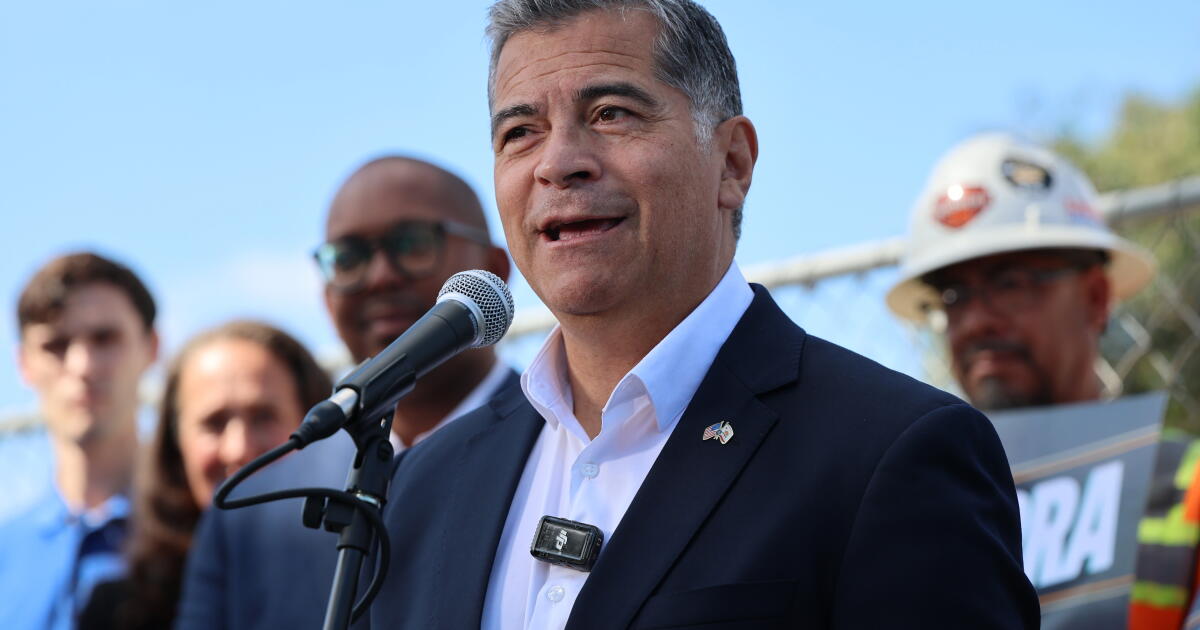
California gubernatorial candidate Xavier Becerra speaks during a campaign event in Los Angeles on April 18.
(Jae C. Hong / Associated Press)
“You are the people power that it takes,” he told a crowd of supporters at a recent “Fighting for the California Dream” town hall in Los Angeles. “California wasn’t built by billionaires. It was built by your families. It was built by our families.”
That Becerra is still fighting in the race — and drawing new people to his events — reflects a remarkable and hard-to-explain turnaround for a campaign that appeared all but dead less than a month ago, then bounded back into contention after Rep. Eric Swalwell dropped from the race and resigned from Congress amid sexual assault allegations.
Before Swalwell’s collapse, Becerra’s biggest splash in the race came in March, when USC excluded him and other low-performing candidates from a planned debate. The criteria left every candidate of color out, and after Becerra and others complained, the forum was canceled.
A California Democratic Party tracking poll, released in early April before the Swalwell scandal broke, showed Becerra near the bottom of the field with 4% support among likely voters. In a party poll taken after it broke, Becerra’s support jumped to 13% — the biggest increase of any candidate.
Certainly some of Swalwell’s supporters shifted to Becerra, but political observers are still pondering why so many did — and not to Steyer, former Orange County Rep. Katie Porter or other Democrats with single-digit support, such as former L.A. Mayor Antonio Villaraigosa or San José Mayor Matt Mahan.
Whatever the answer, Becerra’s surge has sparked fresh interest in his candidacy. It also has raised questions about his time as California attorney general, when he sued the first Trump administration more than 120 times, and U.S. Health and Human Services secretary, when he backed the Biden administration’s strict COVID-19 rules and oversaw the agency’s response to a massive influx of unaccompanied minors at the southern border.
It has also put a growing target on Becerra’s back — including at Wednesday night’s gubernatorial debate, when rivals criticized him as a “D.C. insider” with poorly detailed plans for the state — and sparked hope among many Latinos that California will elect one of them as governor for the first time in state history, sending a strong message of resistance to the intensely anti-immigrant Trump administration.
Of course, Becerra faces hurdles. Steyer, a hedge fund founder who has donated more than $130 million to his own campaign, has been ahead of him in polling, as have two Republicans: Silicon Valley entrepreneur and former Fox News host Steve Hilton, who has President Trump’s endorsement, and Riverside County Sheriff Chad Bianco. Only the top two candidates in the June 2 primary advance to the November election.
Still, Becerra now has a path to victory, one that did not exist even a month ago, and new funding. Many Democratic voters remain undecided, and many — shocked by the Swalwell scandal — are looking for another Democratic front-runner to back.
In an interview with The Times, Becerra said he’s the man for the job, because “California needs a work horse, not a show horse.”
Xavier Becerra, left, gathers with other candidates for Los Angeles mayor in 2000.
(Gary Friedman / Los Angeles Times)
Rising wave of Latino political power
A Sacramento native and the son of a Mexican immigrant mother and a Mexican American father, Becerra graduated from Stanford Law School and served as a deputy to California Atty. Gen. John K. Van de Kamp before being elected in 1990 to the California Assembly.
In 1993, Becerra entered Congress on a rising wave of Latino political power and the heels of a fractious presidential election in which former White House aide Pat Buchanan challenged President George H.W. Bush in the Republican primary on a stridently anti-immigrant, “America First” message — one Trump repurposed in both 2016 and 2024.
It was a defining political moment for Latinos across the country, and for Becerra personally, said Fernando Guerra, founding director of the Center for the Study of Los Angeles at Loyola Marymount University.
“He certainly has been and is part of the incorporation of Latinos into California history and California politics, and it really begins in the early ’90s,” Guerra said. “His rise and political career is really a reflection of the rise and political incorporation of Latinos.”
In 1994, Becerra helped oppose Proposition 187, a state initiative to deny undocumented immigrants access to public education and healthcare. In 1996, he sharply criticized the passage of the Personal Responsibility and Work Opportunity Reconciliation Act, which cut federal benefits for many legal immigrants. By 1997, Becerra — just 39 — was chair of the Congressional Hispanic Caucus and the first Latino member to serve on the powerful House Ways and Means Committee.
By 2016, Becerra, 58, was the highest-ranking Latino in Congress when then-Gov. Jerry Brown tapped him to replace a Senate-bound Kamala Harris as California attorney general. There, Becerra played a key role in defending the Affordable Care Act, known as Obamacare, against Republican attacks.
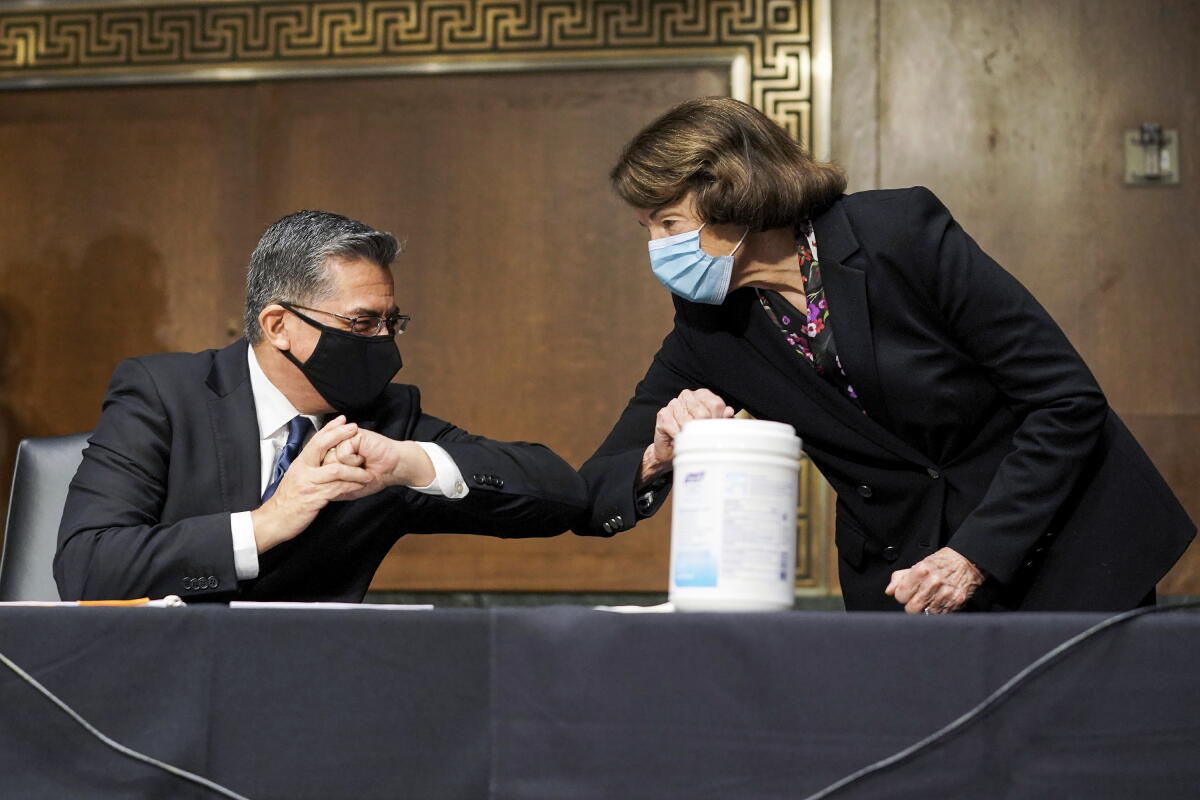
Then-U.S. Health and Human Services Secretary Xavier Becerra arrives for a hearing to discuss reopening schools during the COVID-19 pandemic in 2021.
(Greg Nash / Associated Press)
Criticism and praise
In a rush of endorsements in recent days, Becerra’s supporters have lauded his executive experience, calling him a “proven leader” who, amid constant threats from the Trump administration, is “ready to fight back on day one.”
Becerra’s critics also have pointed to his leadership record, but to highlight what they contend are glaring failures.
Steyer spokesman Kevin Liao alleged Becerra was “absent, ineffective, or too late” in responding to COVID-19 and other public health crises as health secretary, and that California “cannot afford incompetence, or someone who disappears when things get hard.”
The remarks echoed others made during the pandemic, including by Eric Topol, who is executive vice president of Scripps Research in La Jolla, a professor of translational medicine and a cardiologist. During the pandemic, Topol accused Becerra of being “invisible” in the fight to control it. In a recent interview, he said he still believes that.
Topol said the Biden administration’s COVID response was defined by poor data collection and “infighting” among agencies such as the National Institutes of Health, the Centers for Disease Control and Prevention and the Food and Drug Administration, including on vital issues such as when Americans should receive booster shots and how long they should isolate after infection.
Becerra “basically took a very absent, low profile — didn’t show up, didn’t harmonize the remarkable infighting,” Topol said. “The buck stops with him.”
Dr. David A. Kessler, the Biden administration’s top science official on COVID-19 and now a professor of pediatrics and epidemiology at UC San Francisco, fiercely defended Becerra, crediting him with rolling out some 676 million vaccines and steering the nation out of a wildly unfamiliar health crisis with substantial success — what Kessler called a “historical achievement” that proved government “can do big things.”
Kessler said Becerra rightly assessed that the country needed to hear from medical experts, not politicians, and so deferred at times to the doctors, epidemiologists and vaccinologists he smartly surrounded himself with and trusted — but he was never absent. “He enabled us. He was there. Anything I needed, he helped deliver,” Kessler said.
Becerra said there were a lot of people involved with the COVID-19 fight, including a White House team launched before his confirmation as health secretary. Still, it was his agency that ultimately led the response, and helped bring the pandemic to an end, he said.
“At the end of four years, when we had put some 700 million COVID shots into the arms of Americans and pulled the country and our economy out of the COVID crisis, it was HHS — and I was the secretary of HHS,” he said.
Becerra’s rivals in the governor’s race also have attacked him for how he responded to an influx of unaccompanied immigrant minors during the pandemic. They allege Becerra rushed their release to relatives and other sponsors while ignoring concerns from career health staff that some of those placements weren’t safe — resulting in thousands of kids being lost to the system, forced into child labor or trafficked.
The criticism stems in part from a sweeping New York Times investigation that found the health department couldn’t find some 85,000 children it had released, that Becerra had relaxed screening processes for sponsors and that placement concerns from career health staff went ignored or were silenced.
The investigation by reporter Hannah Dreier found that thousands of the 250,000 or so migrant children who arrived in the U.S. between early 2021 and early 2023 had “ended up in punishing jobs across the country — working overnight in slaughterhouses, replacing roofs, operating machinery in factories — all in violation of child labor laws.”
Atty. Gen. Xavier Becerra holds a news conference in Border Field State Park in San Diego in 2017.
(Francine Orr/ Los Angeles Times)
It found there were many signs of “the explosive growth of this labor force,” and that staff had repeatedly flagged concerns about it in reports that reached Becerra’s desk. It also reported that, during a staff meeting in the summer of 2022, Becerra had pressed staff to move children even more quickly through the process, comparing them to factory parts.
“If Henry Ford had seen this in his plants, he would have never become famous and rich. This is not the way you do an assembly line,” Becerra said, according to a recording of the meeting obtained by the newspaper.
Danni Wang, another Steyer spokesperson, said children “were handed to gang members, traffickers, and abusers because [Becerra] stripped the background checks that had protected them for years.”
Becerra said the controversy is one he has addressed publicly for years, including in multiple congressional hearings. He said his team worked diligently to properly vet sponsors and do right by the thousands of children in their care, despite Congress failing to provide the budget needed to restore a system of licensed care facilities that the first Trump administration had dismantled.
“It was a wreck. They had closed facilities, they had fired the licensed caregivers. And remember, this was during COVID, [when] you didn’t want anyone to be near each other,” he said. “How do you take care of thousands of kids in a center that could house maybe 50 kids?”
He said he led an aggressive push to stand up temporary facilities — including in places like the San Diego Convention Center — while rebuilding the licensed care facilities Trump had dismantled and working to place kids into the community as quickly and safely as possible.
Ron Klain, who served as Biden’s chief of staff for the first two years of the administration, said Becerra helped lead the administration out of the crisis by being “an outspoken advocate” for the children in its care.
“Xavier was very, very insistent in meetings and very outspoken on the risk that some of these people [the kids] were being placed with were not the proper people to place them with, and pushed hard for more rigor in the process,” Klain said.
Becerra also has faced criticism and questions related to the federal indictment of his former chief of staff Sean McCluskie, who pleaded guilty to conspiracy to commit fraud after authorities accused him of stealing some $225,000 from Becerra’s dormant state political campaign account.
Becerra was not implicated in the scandal — which he’s previously described as a “gut punch” — and said he did everything he could to ensure McCluskie and others were held accountable once it came to light, including by providing “testimony and documents” to the FBI and federal prosecutors.
Hilton has said the scandal, which also implicated a former aide to Gov. Gavin Newsom, showed that “corruption has become totally ingrained and systemic” under Democratic rule in California.
Looking ahead
Experts said Becerra’s long resume will help him stand out in a race with less experienced competitors and no household names — and that Californians electing a Latino for the first time, as the Trump administration conducts one of the largest ever deportation campaigns, dismantles immigrant rights and targets people on the street based largely on their looking and sounding Latino, would be a major political moment.
Becerra said his extensive experience should matter to voters, because such experience will be necessary in the pivotal and no doubt chaotic Trump years ahead, when “pizzazz and dazzle” will matter less than steady competence from “someone who’s actually been in the midst of that hurricane” before.
“It helps to have gone through these things. I’ve been there, I’ve done that, and I’ve done it successfully,” he said. “I’ve proven that, whether it was taking on Donald Trump toe to toe as the [attorney general], whether it was getting us out of COVID working closely with the White House to deploy the resources and get that done, we made it happen.”