beautiful game

Iran is right. FIFA, U.S. government must be better World Cup hosts

How it started: A dream. A French machine-gun officer in the trenches during the First World War. A man named Jules Rimet, who believed an international soccer tournament would bring the nations together with the goal of peace.

How it’s going: The world’s biggest party. A 48-nation celebration of the world’s most beloved sport. Expected to generate about $8.9 billion, it’s become such a big deal that it’s being hosted by three countries — one of which, yes, launched a war on a competing nation in the months before the tournament.

The United States’ war with Iran, costly in all the profound ways that war is, also laid the groundwork for an uneven — and possibly precedent-setting — playing field.

At this World Cup, Team Melli has been subjected to shifting travel restrictions and uncertainty unlike the other 47 teams, spending the tournament commuting between Southern California and its base in Tijuana.

And still, after Sunday’s 0-0 draw against Belgium, the world’s No. 10-ranked team, Team Melli is in position to not only get out of its group at the World Cup for the first time, but to win Group G.

Iran’s treatment only makes its performance more impressive — while bringing into question the future of a tournament that purports to be apolitical. And conjuring up concerns about how the Olympics will operate when L.A. is supposed to open its arms to the world two years from now.

Will we be laying down blanket bans again? Will it be easier to ditch diplomacy than to deal hospitably with a global audience for a global event?

Russia and Qatar were capable of implementing systems that relaxed visa requirements to accommodate every team and its fans in the previous two World Cups. Why couldn’t the United States?

Instead, the U.S. State Department suspended visa issuance for nationals from not only Iran, but also from participating countries Haiti, Senegal and Ivory Coast. Iraq’s striker, Aymen Hussein, was held and questioned for nearly seven hours at Chicago’s O’Hare airport.

And the U.S. has allowed members of Iran’s team — discounting the 15 administration officials who reportedly were denied entry — to enter the country only within 24 hours of a match and leave the same day.

And those arbitrary restrictions — they’re OK 24 hours before a match, but not 48? — have put Team Melli at a competitive disadvantage.

“I think that united us even more,” said winger Alireza Jahanbakhsh, who spoke eloquently in English postmatch, a gracious statesman in Adidas sneakers. “That’s one of the things that I think we showed today — we showed a great team character. And part of it comes from the situation we are in.”

Through an interpreter, coach Amir Ghalenoei broadened the scope of what Iran has been facing in its runup to the World Cup.

“We were in a state of war for six months, we didn’t have a league and I remember once during a FIFA qualifying day, we traveled 40 hours by land to another country to play,” Ghalenoei said. “Everybody knows about the visa issues. Everyone knows about our coming to America. A part of the team was in competition conditions and part of them had their domestic league suspended because of the war … and many of the teams that were supposed to play us, canceled.

“I think we entered the World Cup in the worst possible conditions. This is the part I wanted the whole world to know … but the players who entered the World Cup under these conditions are truly commendable.”

It’s been a spirited rebuttal to what’s felt like a counterattack on the inherent values of the World Cup. A reminder that governments and governing bodies can get it wrong, but the beautiful game stays undefeated.

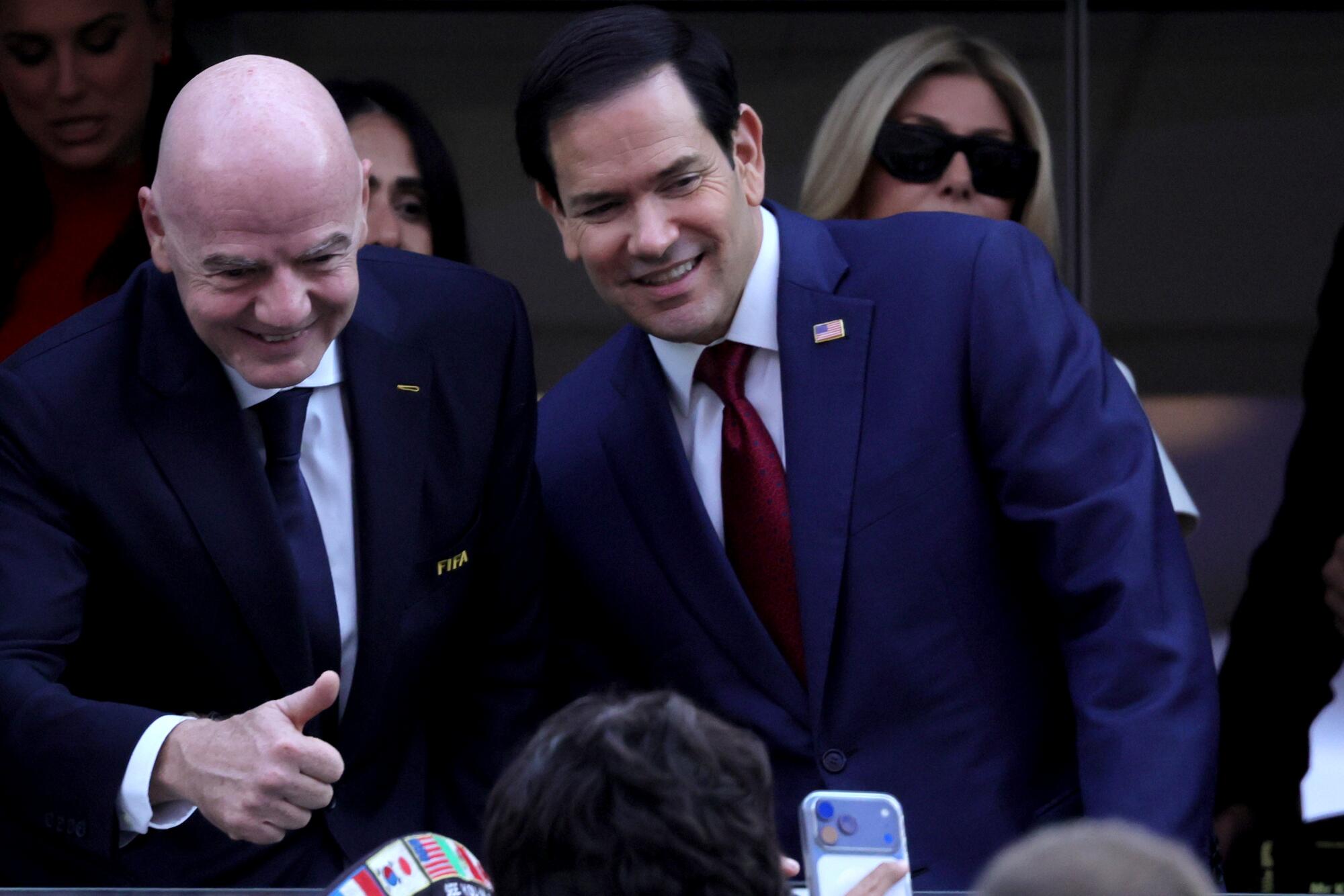
FIFA president Gianni Infantino, left, and U.S. Secretary of State Marco Rubio pose for a photo.

FIFA president Gianni Infantino, left, and U.S. Secretary of State Marco Rubio pose for a photo before a World Cup game between the U.S. and Paraguay at SoFi Stadium on June 12.

(Robert Gauthier / Los Angeles Times)

But what about FIFA?

What about the all-powerful governing body that runs the sport, whose motto is “Football Unites the World”?

The world’s foremost party planning committee, with the cachet to override branded venue names with generic, location-based names — Los Angeles Stadium instead of SoFi Stadium — on Google and Apple maps?

What has FIFA done to flex its muscle to maintain the integrity of the world’s beautiful game?

Not much.

There have been niceties and brownnosing, but no sanctions or threats thereof. Not even a hint of repercussions for diminishing the integrity of the event.

No fines, like what FIFA imposed on six national football associations in response to racist incidents involving supporters during the qualifiers for the World Cup.

No bans, like what FIFA leveled in 1988, when it ousted Mexico from all FIFA competitions for using four overage players in the Under-20 World Cup, or in 2006, when Myanmar was banned from qualifying after refusing to play Iran in an Asian qualifying match for the 2002 World Cup.

Peace talks are ongoing between the United States and Iran, but Iran’s footballing ambassadors haven’t been free to move or to prepare as they wish ahead of its matches against Belgium, and before that, their 2-2 draw against New Zealand.

Apparently, though, Iran will get greater control over travel arrangements before its now hugely consequential final group-stage match is in Seattle against Egypt on June 26, or so Ghalenoei believed when he addressed reporters Saturday.

“What my problem is, why didn’t they let ‌us come ⁠earlier for the first two games as well?” Ghalenoei asked. “If they’ve managed to do this now, why didn’t they do that for our first game and for this game?”

Good questions.

Questions no one should be asking at the World Cup.
Source link

L.A. museum highlights Jewish roots of most popular soccer styles

Béla Guttmann may be the most consequential soccer coach you’ve never heard of. But if it weren’t for Guttmann, you may never have heard of Pelé.

And Brazil may never have become the greatest soccer-playing country on Earth.

That’s because Guttmann changed the shape of modern Brazilian soccer — and changed the sport forever — when he imported the revolutionary 4-2-4 system from Hungary to Sao Paulo in 1957. A year later, Brazil won the first of five World Cups and the joga bonito was born.

But what Guttmann brought to Brazil isn’t nearly as interesting as how he got it there. That’s just one of the fascinating stories in “The Beautiful Game … The Untold Story,” the exhibit that will open the Holocaust Museum LA on Sunday at the Goldrich Cultural Center, a $70-million expansion that will double the size of the Pan Pacific Park museum’s campus to 70,000 square feet.

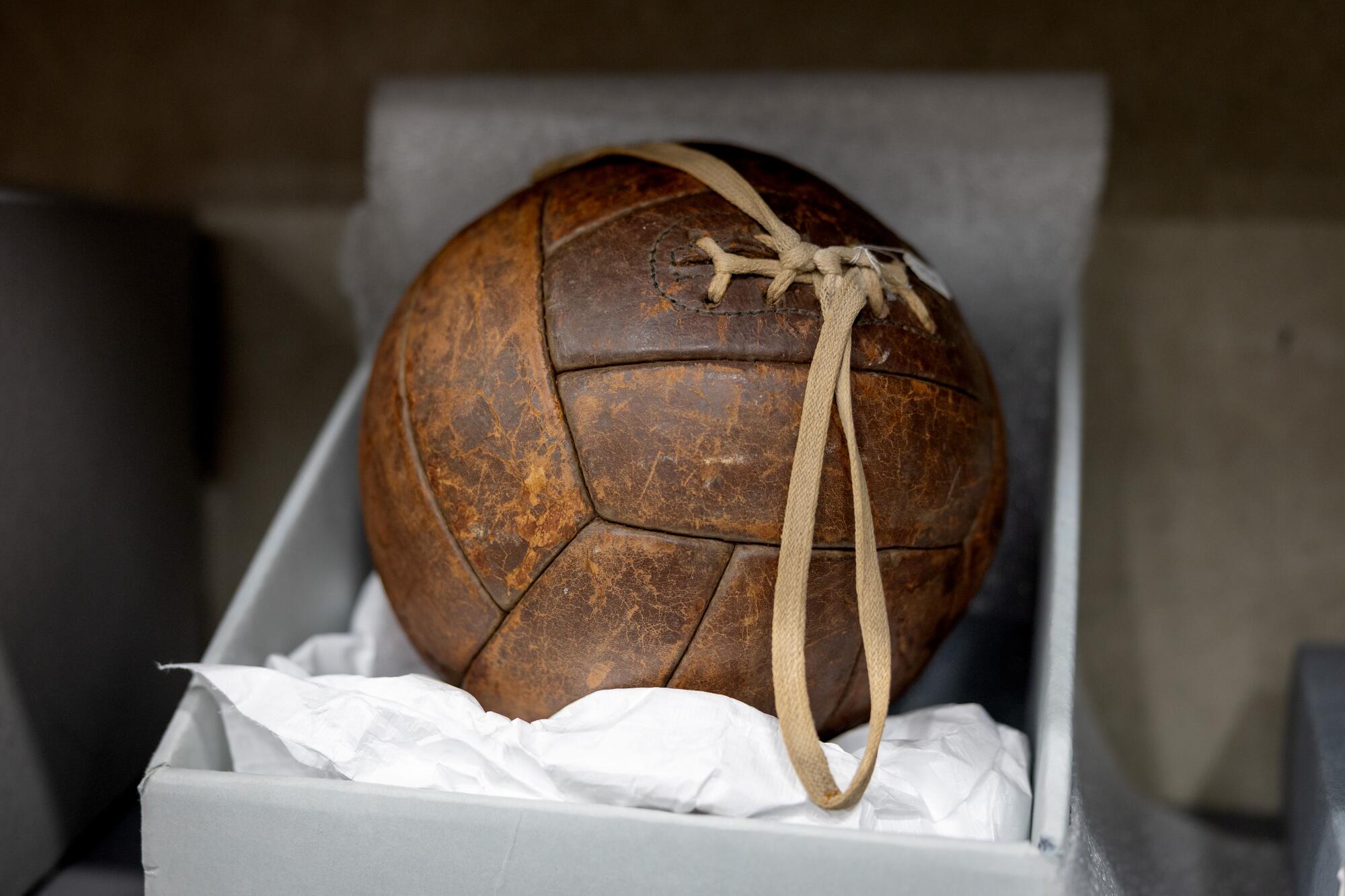
A soccer ball from the holocaust is among the items on display in the exhibit "The Beautiful Game … The Untold Story."

A soccer ball from the holocaust is among the items on display in the exhibit “The Beautiful Game … The Untold Story” at the Holocaust Museum LA.

(Eric Thayer/Los Angeles Times)

The exhibit was unveiled during a private reception on Saturday followed by a free preview day open to the public from 10 a.m. to 5 p.m. The grand public opening will take place in August.

The show’s launch coincides with eight local World Cup matches, which kicked off with the United States’ 4-1 win over Paraguay on Friday at SoFi Stadium, and it shines a light on the important but largely overlooked relationship between Jewish life and the global game, as well as how Jewish innovators like Guttmann shaped the modern rhythm, style and culture of the sport.

“It was in the same intellectual level as jazz, as art and everything modern and progressive,” journalist Allon Sander, who helped curate the exhibit, said of Jewish participation in European soccer in the years before World War II.

“The origin of the game and how it intersects with Jews and the Holocaust and the impact that these Jewish footballers and coaches had to shape the game and help popularize the sport is so fascinating,” added Beth Kean, the museum’s CEO. “And it’s an unknown history.”

Much of that story can be told through Guttmann, who was born in Budapest in the final year of the 19th century and developed into one of the sport’s first Jewish stars, representing Hungary in the 1924 Olympics and playing for nine teams in two countries before retiring to become a coach.

But none of that success mattered when the Hungarian government began introducing anti-Jewish laws in 1938, costing Guttmann his job and nearly his life when he was sent to a Nazi forced-labor camp, where he was tortured. Just days before he believed he would be shipped to Auschwitz, which meant certain death, he escaped alongside Erno Erbstein, another Jewish coach.

Erbstein revolutionized soccer in Italy before dying in 1949, along with the entire Torino team, when their plane crashed into a hilltop outside Turin. Four years ago, he was inducted into the Italian soccer hall of fame. Guttmann, meanwhile, who lost much of his family in the Nazi death camps, would go on to coach for 42 years in 14 countries, winning championships in six of them yet only staying in a single place for more than two years just once.

“He’s running away from his demons,” said Ronen Dorfan, a journalist and sports historian based in Budapest whose research was instrumental in putting the exhibit together. “His father was murdered, his sister was murdered. You never know how you survived in Budapest during the war so he had guilt feelings.”

A jersey worn by player Max Wozniak and a jersey from the 1930s are displayed in an exhibit.

A jersey worn by player Max Wozniak and a jersey from the 1930s are displayed in an exhibit called “The Beautiful Game … The Untold Story.”

(Eric Thayer/Los Angeles Times)

The exhibit was designed in three sections, the first devoted to the years before World War II, the second is about the Holocaust and the third is the postwar years. And while it details Jewish participation in, and influence on, global soccer, it also challenges the cliché that Jews were intellectuals, artists and laborers but not athletes.

“We are always trying to challenge stereotypes. Stereotypes that we might have about ourselves and even stereotypes that we believe about others,” said Jordanna Gessler, the museum’s vice president of education and exhibits who helped curate the show. “It’s crucial to help people find their place and their voice and really see the unity, the similarities between people.

“This is a story that was lost in time and we’re really bringing it out,” Gessler added. “To really have this conversation and encourage people to explore stories that they might not know.”

One thing people might not know is that in the 1920s and ‘30s, Europe’s best teams weren’t in England, Germany or France, but in Austria and Hungary, where they were led by Jewish players and coaches such as Hugo Meisl, Jozsef Braun, Arpad Weisz, Marton Bukovi, Gusztav Sebes and Gyula Mandi. Weisz and Braun were both killed by the Nazis.

A soccer ball from the 1974 World Cup is displayed at an exhibit called "The Beautiful Game … The Untold Story."

A soccer ball from the 1974 World Cup is displayed at an exhibit called “The Beautiful Game … The Untold Story.”

(Eric Thayer/Los Angeles Times)

The surge of antisemitism and fascism in Germany, Italy and Eastern Europe helped spread the influence of those revolutionary players and coaches around the world.

“With the rise of the Reich and the Holocaust, the coaches ran away,” Dorfan said. “And they ran to every corner of the world, to Brazil, to Argentina, to Portugal [and] provided coaches to Real Madrid, to Barcelona, to Benfica, to Flamengo.

“There isn’t one of these clubs that doesn’t owe its tactical development in the ‘40s and ‘50s to the Jewish coaches, which came primarily from Hungary.”

The primary tactical development was the shift from the popular but rigid 2-3-5 formation, which required immense physical endurance and tactical discipline, to the fluid 4-2-4, which spread the wingers to the touch line and allowed for improvisation and creativity on the attacking end, a formation pioneered in Budapest in the 1920s.

“They developed a more refined game of passing the ball, keeping it on the carpet rather than the English kick and run, and really put thought into tactical thinking,” Dorfan said.

Guttmann, who played or coached for more than two dozen teams in his career — including one, in Romania, that paid him in vegetables during the postwar period — brought the Hungarian approach to Brazil in 1957 when he coached Sao Paulo to a championship. After Vicente Feola, the manager Guttmann replaced at Sao Paulo, took over the national team a year later, he brought the formation with him, popularizing many of the tactics still used in modern soccer, such as fluid defensive wingers, overlapping full backs, the use of a withdrawn striker and an attacking midfield.

The soccer team at the Theresienstadt concentration camp's flag is displayed in a Holocaust Museum LA exhibit.

The soccer team at the Theresienstadt concentration camp’s flag is displayed in a Holocaust Museum LA exhibit called “The Beautiful Game … The Untold Story.”

(Eric Thayer/Los Angeles Times)

“He is the whole exhibition in one man,” Dorfan said of Guttmann.

“Obviously if we wouldn’t have had the Holocaust, those [coaches] wouldn’t be kept out of Europe, Europe would be much stronger, much more developed. [And] then the development of Brazil or the success of Brazil would be coming much later,” Sander said.

Dorfan spent the better part of two years tracking down many of the more than 100 trophies, uniforms, photos and trinkets that make up “The Beautiful Game” exhibit, a search that required determination, perseverance and more than a little luck. Many of the items, because of their ties to Jewish athletes and teams, were hidden during the war and presumed lost. Others resurfaced only through detective work that sent Dorfan following leads that spanned decades and crossed more than a dozen borders.

That also cost money. So Alan Rothenberg, the man who, as president of the U.S. Soccer Federation, first brought the World Cup to Los Angeles 32 years ago, stepped up to lead an effort that raised more than $1 million to fund the exhibit.

“The story really needs to be told, particularly with what’s going on right now with respect to antisemitism,” Rothenberg said. “It’s really important for people to realize what can happen. And soccer is a great vehicle to draw them in. The one main thing in the museum is bringing schoolkids in.”

The Nazis and their collaborators failed in their attempt to erase the history of Jewish soccer pioneers; in fact, they inadvertently popularized both the men — and women — and their ideas. But the sport also helped other Jews survive a dark period and Kean said that may be the most beautiful and uplifting part of “The Beautiful Game.”

“The main reason we decided to do this exhibition in the first place is because for years so many survivors, when they talk about their life before the war, so many of them talk about soccer. So many of them were passionate and fond of the sport,” she said.

“We knew the exhibit opening was going to coincide with the World Cup. L.A. is going to be on the world stage. This is a great opportunity for the museum to get these stories out.”

Source link