A CLASSIC British rock band’s touring plans have been put on hold until one member gets a bill of clean health.
The band YES was due to embark on an 11-date European tour this month, launching in Glasgow on April 22nd – but the group’s guitarist Steve Howe has to undergo essential surgery, forcing the band to announce a change in plans.
Sign up for the Showbiz newsletter
Thank you!
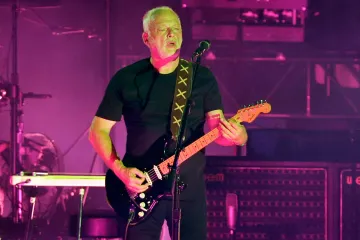
YES was due to embark on an 11-date European tour this month – but the group’s guitarist Steve Howe has to undergo essential surgery, forcing the band to announce a change in plansCredit: GettyThe band formed in 1969, with many members coming and going over the years. The line-up of Anderson, Howe, Bruford and Wakeman is pictured in 1989Credit: GettyYES were set to play their much-loved 1971 album Fragile in full, after the success of their North American tour in 2025Credit: GettyHowe is the only remaining member of his eraCredit: Getty
YES was set to play their much-loved 1971 album Fragile in full, after the success of their North American tour in 2025.
But taking to Instagram, the group have issued a statement explaining the need to postpone.
“The upcoming YES ‘Fragile’ UK and EU Tour has had to be postponed as guitarist Steve Howe requires an essential operation that requires recovery time,” read the statement on social media.
“This decision has been made to ensure that Steve can return to the stage in full health and deliver the performances that fans deserve.
“We are working hard to reschedule the UK and EU shows to a later date, with full details to be announced after Easter.
“Steve Howe and YES would like to thank their UK fans and hope for their continued support at this time.”
The post explained that tickets would be valid for the rescheduled dates and that the concerts would take place later in 2026.
Fans took to the comments underneath the post to express concern for Steve, wishing him well.
One wrote: “The most important thing is Steve’s health… wishing a full and speedy recovery to one of rock’s greats!”
YES released Fragile as their fourth album – and it’s widely considered their best among fans and critics alike.
The group formed in 1969, but Steve didn’t join until a year later, replacing original guitarist Peter Banks.
The group gained considerable recognition with their third and fourth albums – The Yes Album and Fragile – which were both released in 1971.
The latter included famed single Roundabout.
Over the decades, 20 different members have been part of YES, including founding members Jon Anderson, Chris Squire, Bill Bruford and Tony Kaye.
Steve is the only remaining member of his era, now joined by lead singer Jon Davison, drummer Jay Schellan, keyboard player Geoff Downes, and Billy Sherwood on bass.
In 2017, the group had to cut another tour short due to personal circumstances when Steve’s 41-year-old son tragically died from a heart attack.
YES are considered the pioneers of progressive rock by many music fans, known also for their impressive live performances, and are members of the Rock & Roll Hall of Fame.
The band originally split in 1980, with some members attempting to launch spin-off groups, which mostly failed to take off.
One of these groups ended up comprising mostly of ex-YES members, and in 1983 the band was re-launched.
More incarnations of the group followed, with Steve eventually leaving in the early 1990s, returning later that decade, before the group split again in the early 2000s.
They reformed again in 2009 and have recorded new material and toured on-and-off ever since, marking their 50th anniversary in the process.
In 2024, former keyboardist Rick Wakeman left the group, saying he felt it was “time to call it a day”.
Steve and the other current line-up have continued with the group without Rick over the past two years.
The band explained in a statement that the decision had been made to postpone so that “Steve can return to the stage in full health and deliver the performances that fans deserve”Credit: Getty“We are working hard to reschedule the UK and EU shows to a later date, with full details to be announced after Easter,” the band said on InstagramCredit: Getty
PIANO Man Billy Joel has recorded a special interview to air during Eurovision thanks to his song named after host city Vienna, I can reveal.
Afterwards, Austrian singer Cesar Sampson, who finished third in 2018, will cover the song before the results are revealed.
Sign up for the Showbiz newsletter
Thank you!
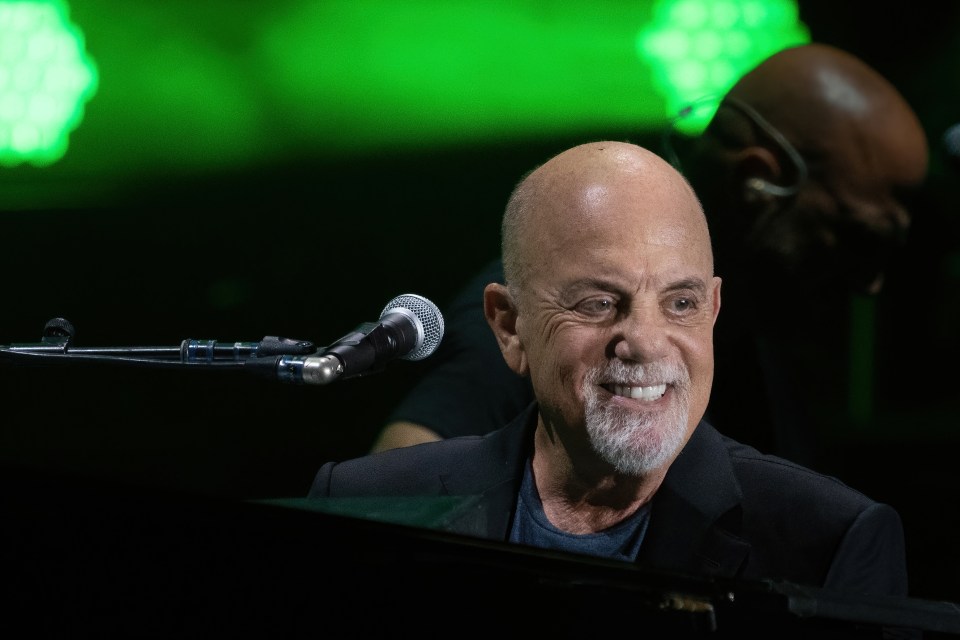
Billy Joel has recorded a special interview to air during Eurovision thanks to his song named after host city ViennaCredit: AFP
I’m told there were hopes Billy could fly over to make a surprise appearance at the contest.
But it was ruled out on health grounds.
Billy was diagnosed last May with a rare neurological disorder that can cause issues with hearing, balance and vision, although he is having physical therapy to treat it.
The musician has already cancelled all of his 2026 concerts, including shows in Edinburgh and Liverpool.
However, he did make a surprise appearance in Florida on January 2.
A source close to the singer, who will turn 77 a week before the final on May 16, said: “Billy has recorded an interview talking about his love for Vienna and his links to the city, which is all tied into his song.
“Organisers originally hoped he could perform but that was ruled out. They will be making a big deal of this very rare interview with him.”
He has sold more than 160million records and is one of the best-selling artists of all time.
Vienna was released in 1977 as the B-side to Just The Way You Are, and is now among his most popular tracks.
Ultravox’s 1980 hit, also called Vienna, is arguably even more popular.
But frontman Midge Ure certainly won’t be there, as he will be in the middle of a UK tour.
The 70th edition of the contest will take place at the Wiener Stadthalle arena after 166million tuned in to see Austrian singer JJ win with Wasted Love last year.
Celine Dion had been in talks to perform at the 2025 event in Switzerland, but it didn’t happen as she continued to battle Stiff Person Syndrome.
I’ll have to keep my fingers crossed that the Eurovision entries themselves provide plenty of entertainment instead.
Long Covid is when the symptoms of Covid-19 – extreme fatigue, shortness of breath, joint pain, aching muscles and brain fog – last longer than 12 weeks
Zara Zubeidi Deputy Showbiz Editor
00:01, 01 Apr 2026
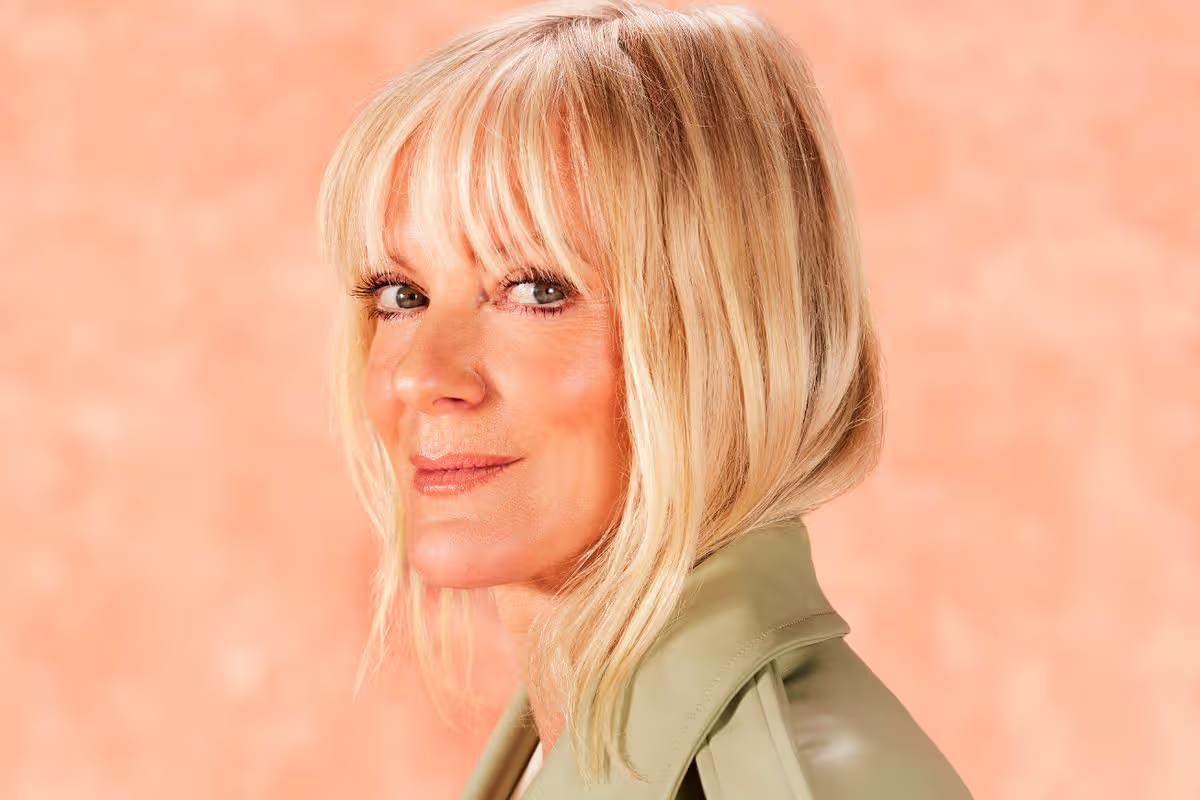
(Image: courtesy of ‘Prima / Sarah Brick’)
Hermione Norris has revealed she has suffered from long Covid, which left her concerned about her ability to take on physical challenges. The Cold Feet star, 59, said she is now much better but the change to her body has been a “shock”.
Norris is one of seven celebrities who embarked on a pilgrimage through north-east England to one of Britain’s most important pilgrimage sites, Lindisfarne, for new BBC series Pilgrimage: The Road To Holy Island.
She was joined by stars including Ashley Banjo, Patsy Kensit and Tasha Ghouri for the programme but said she had concerns about her health before setting off.
She told Prima magazine : “I’m not great at extreme discomfort. I had long Covid a few years ago, so I was worried about my physical fitness and the demands of walking so much every day, plus carrying the backpack. But we did a couple of massive walks and I was fine. I was pleasantly surprised.”
She added: “Having been ill [with long Covid], my focus is on being well and healthy. It’s about exercising, not to make me look good but to keep me strong. I stretch a lot, and I’ve really got to start lifting weights.
“I also use an infrared sauna for my autoimmune condition. I get really stiff joints. I’m so much better after the long Covid, but I feel different, physiologically. It gave me a shock, as I’ve always been quite fit and strong.”
Long Covid is when the symptoms of Covid-19 last longer than 12 weeks, according to the NHS website. Symptoms include extreme fatigue, shortness of breath, joint pain, aching muscles and brain fog.
Norris, best known for her role as Karen Marsden in cult 90s drama Cold Feet, said she has also noticed significant changes since going through the menopause, telling the magazine: “Menopause talk is everywhere now. But the alchemy that happens is unquestionable. The masks drop.
“I feel like a different person from who I was in my 40s – mentally and physically – in a good way. Now I enjoy simple things. My morning coffee, a walk, my doggies, beautiful skies. The joy is in the day-to-day of living, not the big things.”
Read the full interview in the May issue of Prima , on sale now
Pilgrimage: The Road To Holy Island airs on BBC2 5-7 April
A BITTERLY fought five-year dispute between an EastEnders star, his wife and their neighbours over a dog bite on a Lord’s estate has finally ended.
TV actor and film star John Blundell and his wife Mercina were locked in a bitter legal fight with neighbouring lodge owners Alison and Andrew Girdiefski after the row over their tiny pooch Ziggy.
Sign up for the Showbiz newsletter
Thank you!
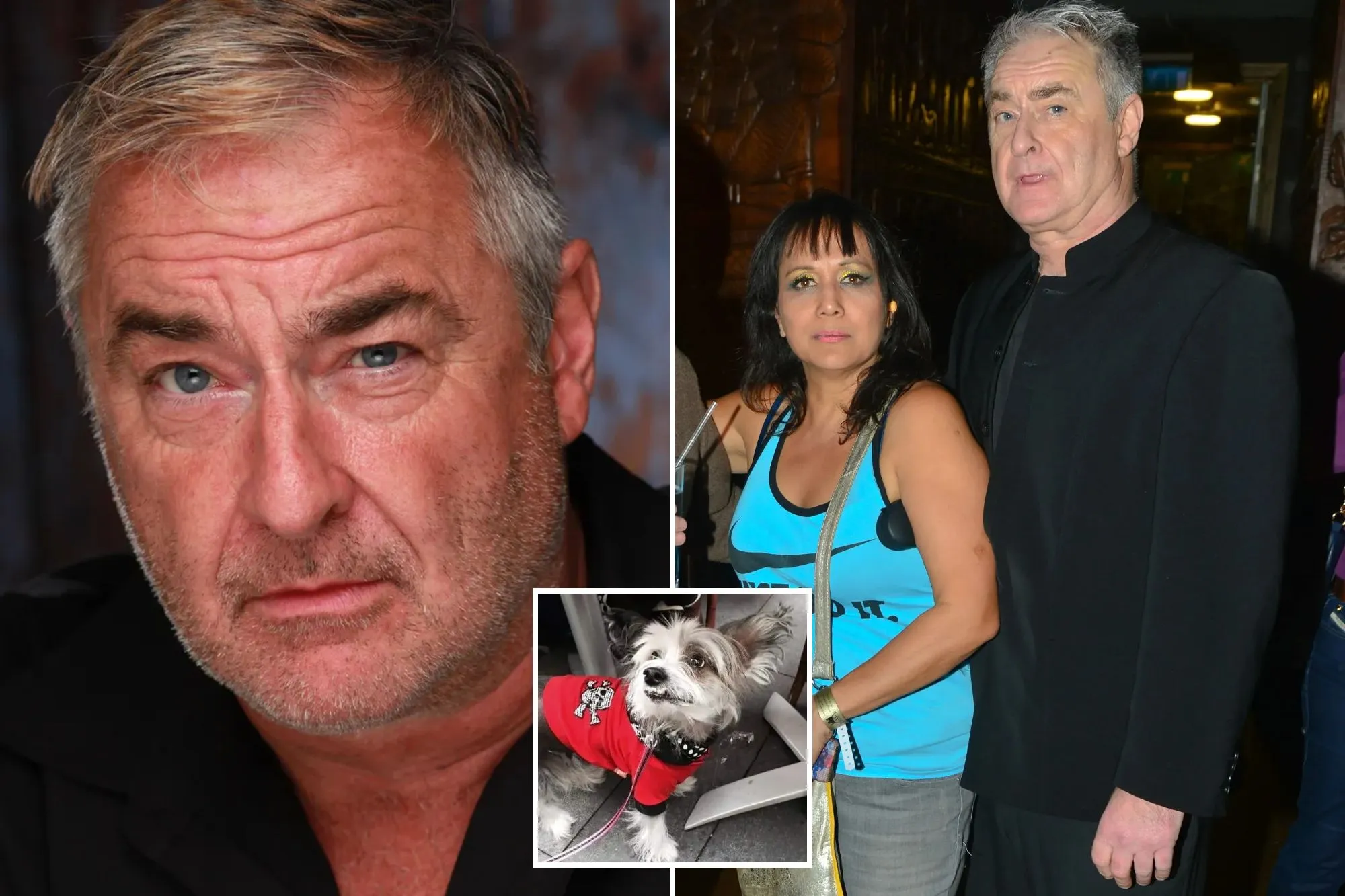
Mercina and John Blundell are now selling their holiday lodge after the Girdiefski’s made their lives’ hellCredit: B176Alison and Andrew Girdiefski ended up settling out of courtCredit: FacebookZiggy, the Chinese crested dog, that caused a four year feud was placed on the dangerous dogs registerCredit: Instagram/Alison Girdiefski
The Sun can now confirm that Mercina and John have finally seen a closure in their favour, with an out of court payment after bringing a civil court case.
John – who also starred in Quadrophenia and Scum – and his wife are understood to be delighted by the result.
The long-running saga dates back to 2021 at the plush Fritton Lake estate in Norfolk, a 5,000-acre retreat owned by aristocrats Hugh and Lara Crossley, Lord and Lady Somerleyton.
The row all kicked off when Mercina had been visiting her neighbours’ lodge to admire renovation work when she says their small hairless Chinese crested dog, Ziggy, suddenly bit her on the wrist.
The attack, they claimed, left her with a half an in inch wound that later scarred, with the actor’s wife needing hospital treatment.
With the row spiralling out of control – John and Mercina then launched a civil case at Norwich County Court seeking damages.
The Sun has now confirmed the long-running dispute has been settled out of court.
It brings to an end to years of acrimony.
Court officials told The Sun the matter was settled out of court using a Part 36 offer – a formal settlement under the law.
A source close to the couple told us: “While the couple are selling their property at Fritton they are reluctant to talk.
“It has been a very difficult few years for the Blundell’s, who really have done nothing wrong at all.”
Back in 2021, what should have been a tranquil countryside getaway quickly spiralled into a toxic feud involving police, lawyers and estate bosses.
Relations between the couples then soured dramatically.
Lord Somerleyton – pictured with his wife Lara – even tried to mediate between the Blundell’s and Girdiefski’sCredit: ArchantThe 115 lodges at the resort, owned by Lord Somerleyton, sell for up to £350,000 and are set in secluded locations in the 5,000-acre groundsCredit: Fritton LodgeThere is a floating sauna on Fritton Lake as part of the resortCredit: TripAdvisor
The dispute even drew in Norfolk Police, with officers speaking to both sides.
Ziggy was added to a register of dangerous dogs, but no further action was taken due to the time elapsed.
Complaints of harassment were also investigated by Norfolk Police – but no offences were ultimately found.
Mercina also accused the pair of taunting them by singing “who let the dogs out” and filming them nearby.
Frustrated, the Blundells launched civil action – setting them for a court showdown.
The pair even recruited James McNally – known as “The Dog Bite Solicitor” who specialises in getting civil damages on dog attacks.
The Blundells said at the time they had been quoted £1,500 for a plastic surgeon to fix Mercina’s wrist – and were believed to be seeking up to £30k in costs and damages.
And the Girdiefskis had said ahead of the looming case that they found the figures “ridiculous”.
“The sort of money you would expect to be paying somebody who has had their face ripped off by a dog, not this mere 1.2cm cut,” said Alison in July 2025.
Speaking at the time, she added: “From day one, we have accepted responsibility.
“Our Ziggy did bite Mercina and we have never denied this.”
But the dramatic court clash never happened after the Girdiefskis agreed to settle.
A court spokesperson said: “This case was settled out of court by way of accepting a Part 36 offer, therefore there is no final order or settlement details to provide.
“Both sides had solicitors so in the end the court was not involved.”
John said the retreat, meant to be a peaceful escape, had instead become “a living nightmare”.
Both couples are now trying to sell their lodges on the exclusive estate.
The Girdiefski’s and Blundells have been approached for comment.
The Sun have also contacted Lord Somerleyton.
John Blundell starred in Quadrophenia, The Bill and EastendersCredit: IMDBJohn Blundell in The Bill, 1987Credit: ITVJohn Blundell as PC WILLIS in soap EastendersCredit: BBCJohn Blundell playing Banks in film ScumCredit: BBCJohn playing the leader of the rocker gang in cult film Quadrophenia
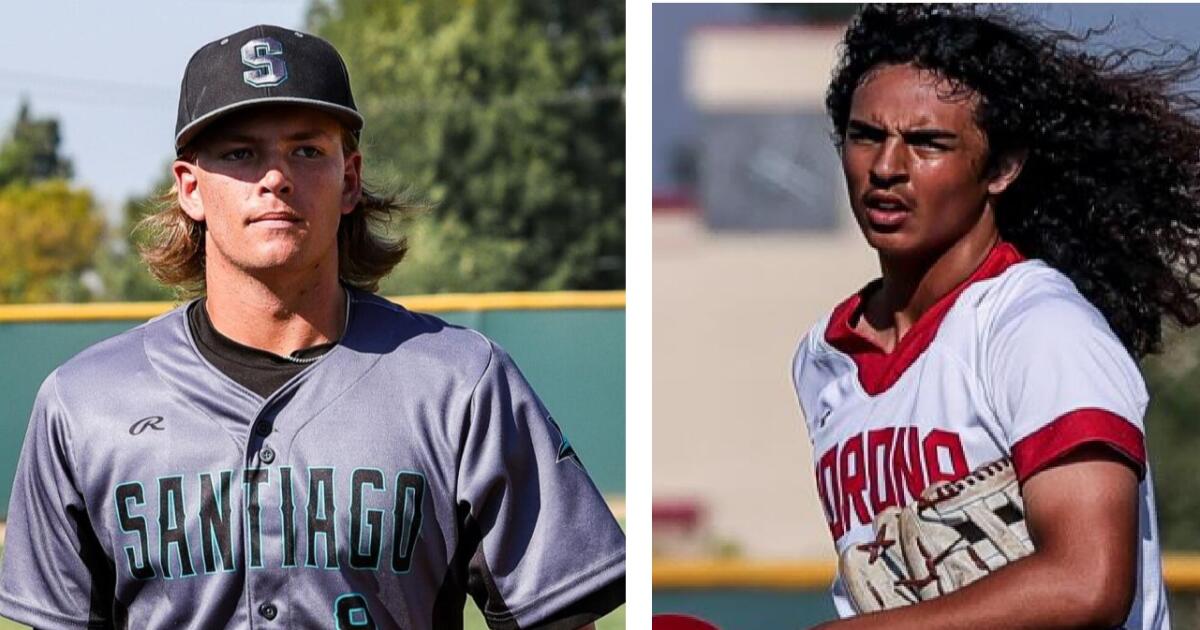
Corona High baseball coaches have been joking about seeking an NIL deal for sophomore pitcher Chris Woodson regarding his hair that moves in many directions while blowing in the wind as he tries to keep his hat on.
Think former NFL star Troy Polamalu, who has been featured in Head & Shoulders shampoo commercials showing off his hair.
When Woodson and Corona Santiago’s Striker Pence were facing each other on Wednesday, it was the battle for hair supremacy. Pence still has blond hair sticking out from the back of his hat after he recently got his hair cut.
“Me and his dad are both bald and both had hair when we were young,” Corona coach Andy Wise said of Woodson. “We’re both not letting him cut it. It’s flowing. He has a 4.0 GPA and is an awesome kid that everyone loves.”
During his days coaching at Granada Hills, starting in the 1970s, Darryl Stroh used to require players to cut their hair to a certain length. Think Army.
As long as Woodson isn’t distracted, Wise is fine with it.
“Be yourself kid,” he tells him.
This is a daily look at the positive happenings in high school sports. To submit any news, please email eric.sondheimer@latimes.com.
Jesy Nelson has revealed that her “heart is super heavy” as she shared an SMA screening battle update to social mediaCredit: Instagram/@jesynelsonJesy also shared a beautiful video clip of her gorgeous daughter OceanCredit: Instagram/@jesynelsonThe doting parent has been relentlessly campaigning for SMA1 screenings in EnglandCredit: Shutterstock Editorial
Jesy took to Instagram and said “Today my heart feels super heavy. It’s a very bitter sweet moment today knowing that Scotland has become the first UK nation to screen babies for SMA.
“We’re so close yet so far.
“I will never be able to understand why we are still not testing for it in England.
“To know that my girls lives and so many other children in England could look so different if this had of been there for them.
“But never the less I will keep fighting and pushing for change because nobody should ever have to go through this heartache.”
Earlier, Jesy also shared a beautiful video clip of her daughter Ocean sitting up, as she said: “She’s proving everyone else wrong,” and that they are “going to get there.”
It comes after the second series of her show Jesy Nelson: Life After Little Mix has already been confirmed and will be coming to the small screen later this year.
The popstar confirmed she’ll be fronting the follow-up programme on Amazon Prime Video focussing on her little girls’ health battle.
The singer, 34, rose to fame in the band after they were created on talent show The X Factor, but left the group in 2020 – with the girls continuing on as a three-piece following her departure.
It was the second time Jesy had tried to take her own life following an overdose in 2013, which she previously opened up about in her NTA-winning BBC documentary Jesy Nelson: Odd One Out.
Jesy broke down in tears after reaching over 100K signatures on her petition to fund SMA1 screeningsCredit: InstagramThe former X Factor star gave birth to her little girls prematurely at 31 weeks in May last yearCredit: Instagram/JesyNelsonThe beautiful tots have the most severe form of a rare muscle wasting disease and may never be able to walkCredit: Instagram/JesyNelson
A BELOVED actress has been remembered as a “powerhouse of vitality and goodwill” after tragically dying following a battle with breast cancer.
Carrie Anne Fleming, 51, passed away in Sidney, British Columbia, and was best known for her role in the fantasy drama Supernatural.
Sign up for the Showbiz newsletter
Thank you!
Carrie Anne Fleming, 51, has tragically died after a battle with breast cancerCredit: GettyFleming’s death was confirmed by her Supernatural co-star Jim Beaver in a touching Facebook tributeCredit: Alamy
She is survived by her daughter Madalyn Rose.
Fleming was confirmed dead by her co-star and friend Jim Beaver in a statement to Variety.
The star died on February 26, from complications after battling the deadly illness.
Later, in a lengthy heartfelt tribute posted to Facebook, 75-year-old Beaver called Fleming his “soulmate”.
“To find a soul mate once in life is something of a miracle. To find one twice is almost unimaginable,” he said.
“To love and be loved is a pearl above price, but such pearls do come more than once or twice to the lucky.”
Beaver said loving her had been devastating, after losing Cecily – the mother of his child – to the same disease.
“I lost Cecily to cancer in 2004,” he said.
“Thursday, I lost Carrie to the same disease. I never thought my heart could break so badly more than once.
“But it has. But, oh, the two torches I carry – what bright, bright light they shed.”
He continued, recounting the first time they met on the set of the popular television series.
“Carrie Anne Fleming was cast as my wife on Supernatural in my fifth season on the show,” he said.
Beaver revealed he had “fallen for her hard” just seconds after meeting her for the first time.
He said he had been “shocked” to find she felt the same way.
“To find oneself paired with someone who not only loves and is loved, but who seems by magic or the grace of the gods to understand you, to want what you are, to want you to be what you are, who GETS you and never feels the need to have you defend who you are, and about whom you feel the same – how many of us can say that spark of divinity has alighted on us once, much less twice? I can,” he said in the heartbreaking tribute.
The pair bonded over both having daughters named Madeline Rose, with Beaver saying the discovery had been “the beginning of a beautiful friendship”.
The star was known for her roles in numerous popular TV showsCredit: GettyShe was born in Digby, Nova ScotiaCredit: Alamy
“We ran lines of dialogue together in my trailer and talked for hours that first day, and the electricity between us was practically visible,” he wrote.
Beaver said the actress had “an amazingly good nature … a rapturous laugh and an utterly adorable personality that didn’t seem to have an off switch”.
“I was so in love I think my eyes turned silver,” he said.
“She seemed to think I was worth hanging around with, too.”
Fleming also starred in other popular shows including iZombie, Smallville, Good Luck Chuck, The L Word, Married Life and Supergirl.
Born on August 16, 1974, in Digby, Nova Scotia, Fleming studied at Mount Douglas Senior Secondary in Victoria, British Columbia, and later attended the Kaleidoscope Theatre as well as the Kidco Theatre Dance Company for drama.
She broke into the industry through an uncredited appearance in Adam Sandler’s Happy Gilmore, and later in a role in Viper.
In 2005 she was cast in Dario Argento’s show Masters of Horror, starring as a disfigured woman with cannibalistic urges.
She went on to appear and star in other horror shows, including Bloodsuckers and The Tooth Fairy.
More recently Fleming played Candy Baker on five seasons of the CW’s iZombie.
She also appeared in the 2015 TV film The Unauthorized Full House Story, exploring the behind-the-scenes making of the hit sitcom.
Fleming played the mother of Full House star Candace Cameron Bure, who portrayed D.J. Tanner on the show.
Fleming also performed in a number of British Columbia stage productions, including Steel Magnolias, Noises Off, and Romeo and Juliet.
Sophie Kasaei is willing her boyfriend Jordan Brook better as he battles viral meningitisCredit: Instagram/Sophiekasaei_Jordan’s been in hospital for 12 daysCredit: Instagram
Worried Sophie, 36, was only able to see Jordan for the first time two days ago following his admission and admits she’s never felt so much fear as he goes through treatment.
Alongside loved-up photos of them together, she wrote on Instagram: “Life can come at you really fast. Literally in the blink of an eye.
“One minute you’re dreaming about your future together… and the next, you’re sitting in a hospital room, holding onto hope with everything you have.
“Watching the person I love in pain and fear, something I can’t fight for them is the hardest thing I’ve ever known. And through all this I’m carrying the tiniest piece of us, a reminder that even in the darkest moments, life is still growing, still holding on.”
Sophie continued: “I never imagined I’d feel this much fear and this much love all at once. Life really can change in the blink of an eye. Please don’t take a single moment, a single person, for granted.
“Everyday I fall in love with you more and more @jordanbrook11 this whole thing feels like I’m living in a nightmare waiting to be woke up by you next to me in bed but I’m just grateful your here and fighting for your family.
“Our little baby boy is what is keeping this family going. I love you @jordanbrook11.”
Jordan replied in the comments and vowed he would give everything to recover.
“My darling girl,” he wrote. “I can’t thank you enough for the strength to help me battle this. I will not give up on us.
“I love you more and more every single day.
“‘This too Shal pass’ – we will smile again with our special boy and family.”
The conditions are potentially life threatening, causing inflammation of the brain and spinal cord lining.
In a video posted from his hospital bed, Jordan said: “This is the first time I’ve really been able to speak strong enough about what’s going on.
“I’ve been diagnosed with not one but two joining viruses that are attacking a similar part of my body. I have got viral meningitis and encephalitis together.
“That’s the inflammation of the brain and the lining around it. So this isn’t something small or minor.”
He has had CT scans, MRI lumbar scans, and lumbar punctures — the extraction of cerebrospinal fluid from the lower vertebrae — to find out what is wrong.
Jordan continued: “I’m on IV drips, everything antiviral, pain management, physio, seizure monitoring, to minimise seizure risk at the minute.”
The star added: “But unfortunately the swelling on my brain is getting worse. Really, really tough, even with the simple day-to-day activities and normal things that aren’t easy right now.
“So this is what I’m dealing with day-today.”
What is meningitis?
It can be mistaken as the flu or even a hangover – but knowing the symptoms of potentially deadly meningitis could save your life.
If it is not treated quickly, meningitis can cause life-threatening septicaemia (blood poisoning) and result in permanent damage to the brain or nerves.
The two forms of the disease have different symptoms.
Shaun Ryder on the beach in 2000Credit: Denis JonesShaun with wife Joanne and kids, Pearl and Lulu in 2017Credit: Matthew Pover – The SunShaun at a Happy Mondays gig in 2000Credit: Julian Makey
But, then again, putting the potty-mouthed and straight-talking singer on live telly is always a risk.
In an exclusive interview with The Sun, the Mancunian reveals that ITV did not appreciate his story of a drugs raid that happened when he was up for a Brit award in 1996.
Back then, Shaun’s other band, Black Grape, had been nominated for British Breakthrough Act.
Shaun says: “I told him I went to score and the gaff where I went to score got raided by the police as I’m scoring and the cops cottoned on who I was.
“And I’m saying, ‘Oh, I’m getting a Brit Award here’ and they let me go.
“They busted a heroin house and they let me go because I was up for a Brit Award.”
You might think that Shaun, who has already published two autobiographies, has no fresh stories.
But the singer, who has a new memoir out now and who is writing material for Happy Mondays’ first album in 20 years, always has plenty of tales to tell.
In his latest book, 24 Hour Party Person, he recalls facing down what he believes was a killer orangutan, escaping a gun battle and being held hostage by an armed robber.
There are also numerous car crashes from which he somehow escaped alive.
Shaun, who quit drugs aged 40 after 20 years of substance abuse, admits: “I have used up more than nine lives.”
It could all have ended shortly after Happy Mondays’ first album, Squirrel And G-Man Twenty Four Hour Party People Plastic Face Carnt Smile (White Out), came out in 1987.
Shaun, who was not famous at that point, went to Amsterdam to live for a short while.
He remembers: “Some nutcase we knew from Manchester, who was doing armed robberies and was then in Amsterdam, hijacked a load of people, put them in the canal and shot them and then turned up at the gaff where we were staying and held us hostage for a day or two.”
Luckily, Shaun managed to talk the robber into letting them go.
But there was no way of having a nice discussion with a great ape that appeared in front of Shaun on a Barbados beach when he was recording Happy Mondays’ fourth album in 1992.
At the time there were stories in the local Press about a dangerous orangutan, nicknamed Jack the Ripper, on the loose.
Shaun claims: “This thing just dropped out of the trees right in front of me. It was a f***ing big orangutan.”
Telling himself “don’t show any fear”, the musician stood tall and shouted, “Grrr, arrrgh, f*** off, just f*** right off”, at the animal.
Remarkably, the orangutan did as it was told.
Orangutans are not native to the Caribbean, so there is a good chance it was indeed Jack the Ripper.
And Shaun, who was “smoking up to 50 rocks of crack cocaine a day” in Barbados, insists it was not a hallucination.
Bez at a Happy Mondays gig in 2000Credit: Julian MakeyDuring one trip to Jamaica, Shaun and Kermit found themselves in the middle of a gun battle while trying to buy drugs
The album, Yes, Please!, failed to generate enough sales to justify the £150,000 spent making it and the following year the Happy Mondays broke up.
Shaun formed Black Grape in 1993 with his dancer mate Bez and rapper pal Paul “Kermit” Leveridge.
But it did not help keep him out of trouble.
During one trip to Jamaica, he and Kermit found themselves in the middle of a gun battle while trying to buy drugs.
He recalls: “I was going scoring and someone got shot, shot in the head. We just ran for it. If you’re a junkie going scoring, that’s the sort of s**t you come across.”
It was getting together with third wife Joanne which finally helped Shaun give up drugs and stop boozing.
They had dated briefly before Happy Mondays had hits, but he says: “She blew me out.”
Joanne, who now manages the TV part of his career — which has included two appearances on I’m A Celebrity . . . Get Me Out Of Here! — remained in the same circle as him.
The couple got together more than 20 years ago and married in 2010.
They have two daughters, Pearl, 17, and Lulu, 18.
Shaun, who also has four other children with previous partners, says: “She reeled me in and it’s a good job. “She didn’t let me get away with half of the stuff.
“If she hadn’t I’d have just carried on with crashing, but once I hit 40, I was determined to give up drugs anyway.”
His older children had to deal with his absences and spells in rehab.
But the youngest two have grown up in a more stable environment.
Shaun, who is also stepdad to Joanne’s son Oliver, explains: “I’ve still got two kids at home, so for the last 18 years, I’m just Dad.
“They’ve grown up coming and watching us at music festivals, and they’ve seen me in the jungle, but they’ve never seen that Shaun Ryder who’s off his nut.
“I pick them up from college and all that sort of thing, and drop them off. I’m the f***ing taxi service.
“In this house, you know, we don’t even have booze or anything, so, we’ve just been like a normal f***ing mad family for the past 18 years or whatever.”
Shaun says he did not see much of his older children and admits he was not a good dad to them.
But he says: “I’ve had really no trouble off my kids, I’ve been very lucky with the kids.”
This year is going to be an important one for Shaun.
Apart from the book and new album out next year, he is doing a Q&A tour and is on the road with Happy Mondays.
The return to the studio is due to former Creation Records label boss Alan McGee.
Shaun reveals: “I’m writing it now. Alan McGee wanted a new Mondays album, so Alan usually gets what he wants.”
An orangutan like the one Shaun says attacked himCredit: Getty
When it comes out, it will be 40 years since the Manchester group’s first release in 1987.
These days various health problems, including a recent bout of pneumonia, means performing is harder than ever for Shaun.
One legal substance that has helped keep him on the road is the fat jab Ozempic.
Shaun says: “You just raid the medicine cabinet, don’t you, and get on with it, so the show must go on.
“I have an overactive thyroid, so even if I ate f***ing lettuce and tomatoes, I would be big.
“Since I started on the injections my thyroid started to get better.”
If Shaun has his way he will keep performing until the Grim Reaper finally catches up with him.
And the singer would settle for dying on stage, like the comedian Tommy Cooper.
He says: “In this game, you’re doing some Tommy Cooper style, you know what I mean?
“As long as you enjoy it, do what you do, f***ing do it and I still do.
“I’ll still make music and go play music out there until I f***ing drop dead on stage.
“It’s a good place to go, innit? To drop dead on stage, singing Kinky Afro.”
Shaun’s new book 24 Hour Party Person is available from awaywithmedia.com.
Shaun’s new book 24 Hour Party Person is available from awaywithmedia.comCredit: Supplied
PHOENIX — Dodgers president of baseball operations Andrew Friedman went into the offseason expecting outfielder Kyle Tucker to sign elsewhere.
Sure, Friedman was confident in what the Dodgers could provide on and off the field to the 29-year-old four-time All-Star. And Tucker was a rare hitter who could actually elevate an already star-powered Dodgers lineup. But with the team unwilling to offer a super long-term deal, their chances at landing the best free-agent hitter available this past offseason felt “incredibly low.”
“I can’t remember a time where a player has taken a shorter-term, higher-AAV deal when they’ve had an actual long-term contract on the table,” Friedman said Wednesday.
The Dodgers, however, had already pulled off a bigger surprise when closer Edwin Díaz chose them over returning to the Mets this past December.
The team’s pitch, which included a conversation with the Dodgers’ director of family programs Patricia Romero, discussions about preparation and player resources, and a championship track record, helped land both top-tier free agents.
Of course it didn’t hurt that though Tucker’s contract was only four years, it was worth $240 million. Taking deferrals into account, the net-present day value set an MLB record at about $57 million per year.
The Dodgers’ aggressive offseason, coming off consecutive World Series titles, once again makes them the favorite entering the 2026 season.
They wrap up their Cactus League schedule this week, as World Baseball Classic participants trickle back into camp, and baseball operations leadership make final opening day roster decisions.
Before Friedman headed back to Los Angeles, he spoke with The Times on a range of topics. Here’s part of that conversion, edited for length and clarity.
Q: When it comes to the WBC, there’s variance on how supportive teams are. You have Shohei Ohtani participating as a position player, Yoshinobu Yamamoto pitching after an extra-short offseason, Kiké Hernández supporting Puerto Rico in person while rehabbing. How have you landed in being highly flexible?
Friedman: Obviously everything is case by case. But in a vacuum, we are incredibly supportive of the World Baseball Classic and what it does for our game worldwide. We saw it in ‘23, we saw it this past year, with just how important this is to the players, the staff, the fans — and just how exciting it is for baseball.
So that part’s easy. Now you layer on our situation, us trying to win a World Series. For position players, it’s easier to justify. For pitchers, it’s way harder. Throwing at that intensity in March is really, really challenging. And so we feel like our role is to work with each of our players and have conversations and share our thoughts, listen to their thoughts, and then answers kind of fall out of that.
Q: It’s such a cliche to say you can never have too much pitching, but with this group, are you close?
Friedman: I’ve learned my lesson to never say that we have enough pitching. But I do feel like we are breaking camp with the most talented one through 20 arms — which gets at, obviously, who we’ll break with, and then depth behind it — that we’ve ever had.
Q: Between Díaz, who’s part of that equation, and Tucker, you signed two players this offseason who you didn’t necessarily expect to land. What does that say about this organization and what you’ve done the last few years?
Friedman: Our biggest, most overarching goal is to be a destination spot, where our own players don’t want to leave, where players on other teams are looking longingly, because we feel like championships fall out of that. By having the right environment, having the right culture, that helps your star players want to stay, it helps in the recruitment of others. So we’re way better at it today than we were five years ago. But it’s like a living organism that we have to continue to foster and nurture and develop. And we hope we’re way better at it five years from now.
Q: On that note, the Dodgers are very much caught in the middle of CBA posturing with the current agreement expiring this year. You hear a lot of players saying the Dodgers are doing it the right way and other teams could be doing something similar. On the other hand, the league appears to be floating a salary cap, and plenty of fans are accusing the Dodgers of “ruining baseball.” What’s it been like to see those conflicting narratives?
Friedman: Obviously see it, come across it, hear it quite a bit. But we’re just not that focused on it. We’re a really healthy organization, and the partnership we have with our fans is our guiding light. And we’re doing everything we can to put a team out there that our fans really connect with, and that they feel that partnership with all that they pour into us, and don’t really think about it in any other terms.
And so obviously, there’s a lot of narratives that get extrapolated from that. But our sole focus is on ourselves and the partnership we have with our fans and the rest of it to us, it’s kind of just noise.
Q: You guys raised the bar years ago to, “We’re going to be in the postseason every year.” But there were clear frustrations from the fan base when that wasn’t consistently leading to championships. Is it fair to say that this continued push is almost a response to that frustration?
Friedman: Each year we’ve poured everything we have into winning. And in October, you need a really talented roster, and you need some good fortune. And there’s years where we haven’t been as talented as we wanted to be, whether it’s injuries or lack of performance. There’s years we’ve had really bad fortune, there’s years we’ve had good fortune. And a lot of that is the game, and it’s what I both love and hate about it.
I wouldn’t say our mindset is all that different. But obviously, when you’re in a moment in time with an incredibly talented roster, I think the mindset is, ‘Don’t sit back on your heels, be aggressive, and don’t be nonchalant about the opportunity that we have in front of us.’ And so it’s more the idea of pressing an advantage and being aggressive on that front.
Q: I’m sure when you were pursuing Ohtani, you looked into the revenue ramifications of signing him. Has this been about what you expected? Has it exceeded your expectations?
Friedman: Oh, it’s far exceeded. I don’t think the human brain could have comprehended it correctly. It’s been a perfect storm on a lot of levels, and something that has definitely far exceeded our expectations.”
Q: A three-peat seems to be the goal. Is there such a thing as a successful season without winning a championship, or has this team gotten to a point where you really have to win a World Series in order to claim success?
Friedman: Everything for us, all of our energy and focus, is on doing everything we can to win a championship this year. And our first goal is to win the division and be in position to have a bye. Last year, we added to the degree of difficulty [by winning the division but having to play in the wild-card round] in a way that I’d like to avoid this year.
So that’s the first goal. And then obviously that puts you in the best position to accomplish our ultimate goal, which is winning a World Series. So that’s what all of our energy and focus is on.
And, obviously, if we win the World Series this year, it will be a three-peat. But it’s not how my brain processes it. We’ve won back-to-back, and those are in the bank. And now it’s, do everything we can to win this year, and it’s its own unique, disparate year.
A smelter of Korea Zinc. The company is scheduled to hold a high-stakes shareholders’ meeting Tuesday. Photo by Korea Zinc
SEOUL, March 20 (UPI) — Korea Zinc’s incumbent management and its major shareholder, Young Poong, are locked in a fierce showdown ahead of a regular shareholders’ meeting Tuesday.
The world’s largest non-ferrous metal producer said Friday that it posted record sales and profits last year, which led to high dividends and other shareholder-friendly policies.
Citing the strong performance, Korea Zinc has called for the leadership continuity, as the 2026 shareholders’ meeting would select at least five board members out of 15 seats. The term of Chairman Yun B. Choi is also set to expire.
“We believe that our continued efforts to improve corporate governance and expand shareholder returns have laid the foundation to steadily grow our business and operate our organization in a stable manner,” the firm said in a statement.
But, Young Poong argued that proxy advisers and the National Pension Service, another key Korea Zinc shareholder, have effectively supported its position by opposing the reappointment of Choi as an inside director.
According to Young Poong, such decisions suggest that “this is no longer merely a management control dispute, but judgment over potential structural flaws in corporate governance and failures of oversight.”
Since early 2025, Korea Zinc has been fighting to repel an aggressive takeover bid from Young Poong, which has teamed up with the country’s leading private equity firm, MBK Partners.
The battle came to a head at the March 2025 shareholders’ meeting, and another high-stakes clash is looming at this month’s gathering.
Each side reportedly controls roughly 40% of the voting shares, while NPS holds a 5.2% stake.
Meanwhile, the labor union at Korea Zinc expressed strong support for the current board, urging the NPS to immediately reverse its decision.
“We will fight to the end to prevent the dark hand of speculative capital from tainting our sacred workplace at this shareholders’ meeting,” the union said in a statement.
“If our warning is ignored and the company is undermined, we will mobilize all possible means, including a general strike, to wage an all-out struggle,” it said.
Iran’s national football team returned to their war-torn nation after several of the players sought asylum in Australia.
Published On 20 Mar 202620 Mar 2026
Iranian authorities on Thursday gave the national women’s football team a hero’s welcome after their return from Australia, where some had made and then withdrawn asylum claims, amid accusations Iran had pressured their families.
Six players and one backroom staff member who travelled to Australia for the Women’s Asian Cup sought asylum earlier this month after they prompted criticism from hardliners in Iran for failing to sing the national anthem before their first match.
Recommended Stories
list of 4 itemsend of list
Five of them later changed their minds and returned home along with the rest of the team, including captain Zahra Ghanbari, with their fate prompting international concern amid the US-Israel war on Iran.
Activists have accused Iranian authorities of pressuring the women’s families, including summoning their parents for interrogation, while Tehran has alleged that Australia sought to force the athletes to defect.
Several thousand people, many holding Iranian flags, turned out for the welcome ceremony on Thursday evening in Valiasr Square in central Tehran, where other pro-government rallies have taken place in recent weeks, state TV images showed.
“My Choice. My Homeland,” read a slogan on a giant billboard on the square that showed the players in their national kit and mandatory hijabs saluting the Iranian flag.
Flanked by team members, Iranian football federation President Mehdi Taj said on stage, “What is certain is that these athletes are loyal to the homeland, flag, leader and revolution.”
Iranian government spokeswoman Fatemeh Mohajerani, one of the most high-profile women in Iranian politics, told the team members: “All Iranians were waiting for you; welcome to Iran.”
Members of Iran’s women’s national football team in Tehran on March 19 [Alaa Al Marjani/Reuters]
‘Threatening their families’
As onlookers cheered the players, giant AI-generated images of the women were projected on a screen showing them pledging loyalty to the Iranian flag against a background of Iranian national landmarks.
Two squad members have remained in Australia, but the remainder of the team, including the five other women who initially applied for asylum, arrived in Iran on Wednesday after a long journey home via Malaysia, Oman and Turkiye.
Activists have accused Iranian authorities of pressuring these five women into changing their minds through intelligence agents putting pressure on their families at home.
“The regime in Iran started threatening their families and basically took their families hostage. Because of that, they were forced to withdraw their asylum and go back to Iran,” Shiva Amini, a former Iranian national football player, who now lives in exile and campaigns on women’s rights, wrote on social media.
But Farideh Shojaei, an Iranian football official who travelled to Australia, said the players had been offered “houses, cars, money, promises of contracts with professional clubs, as well as humanitarian visas”.
“Fortunately, the members of our team valued their national identity above all else and turned these offers down,” she told Iranian media.
Before their opening game, the Iranian team fell silent as the national anthem played, although they later sang it in subsequent matches. An Iranian state TV presenter branded the players “wartime traitors”.
A central feature of the welcome ceremony in Tehran was singing the national anthem of the Islamic Republic, with players and officials joining in.
Members of Iran’s women’s football team arrive by bus at the Gurbulak border crossing on the Turkish-Iranian border on March 18, 2026 [Ali Ihsan Ozturk/AFP]
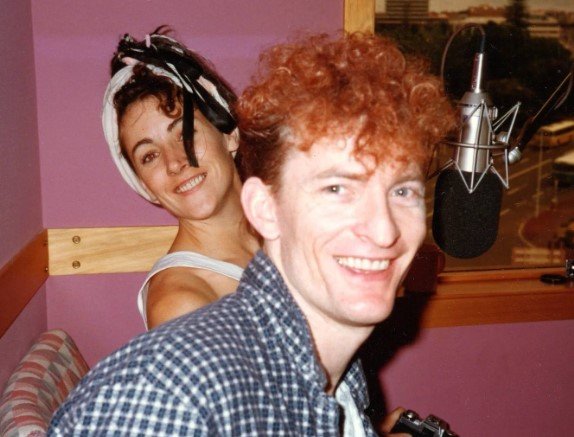
Eurogliders founder Bernie Lynch died after battling with throat cancer.
Sign up for the Showbiz newsletter
Thank you!
Perth musician Bernie Lynch has died aged 65 after a battle with cancerCredit: genBernie last performed with Eurogliders in November during a brief remission of his cancerCredit: http://www.perthnow.com.au
His death was announced this morning by fellow band member Grace Knight, who gave an emotional tribute.
Brit-born Grace wrote: “It’s with the heaviest heart I’m posting this to let everyone know that Bernie passed away last Thursday evening in palliative care in Perth.
“Some of you will be aware that Bernie was diagnosed with throat cancer in early 2024 and underwent treatment.
“I am heartbroken and don’t know how to proceed without him.”
An Oscars slugfest for the ages ran its course, with “Sinners” and “One Battle After Another” duking it out and tallying up wins while the low but steady hum of host Conan O’Brien’s patented brand of weirdness tied the room together. A few unnecessarily curt speech interruptions threatened the calm, but mainly, this was a smoothly run machine of a show, devoid of mishaps. Even the rare circumstance of a tie was handled expertly by live-action-short award presenter Kumail Nanjiani, never bringing to mind the immortal confusion of “Moonlight” vs. “La La Land.”
But what didn’t make it to the telecast? Here are some flavorful takeaways — small yet memorable — that stick in mind from our several reporters in the room on Sunday.
A parade of praise for Jessie Buckley
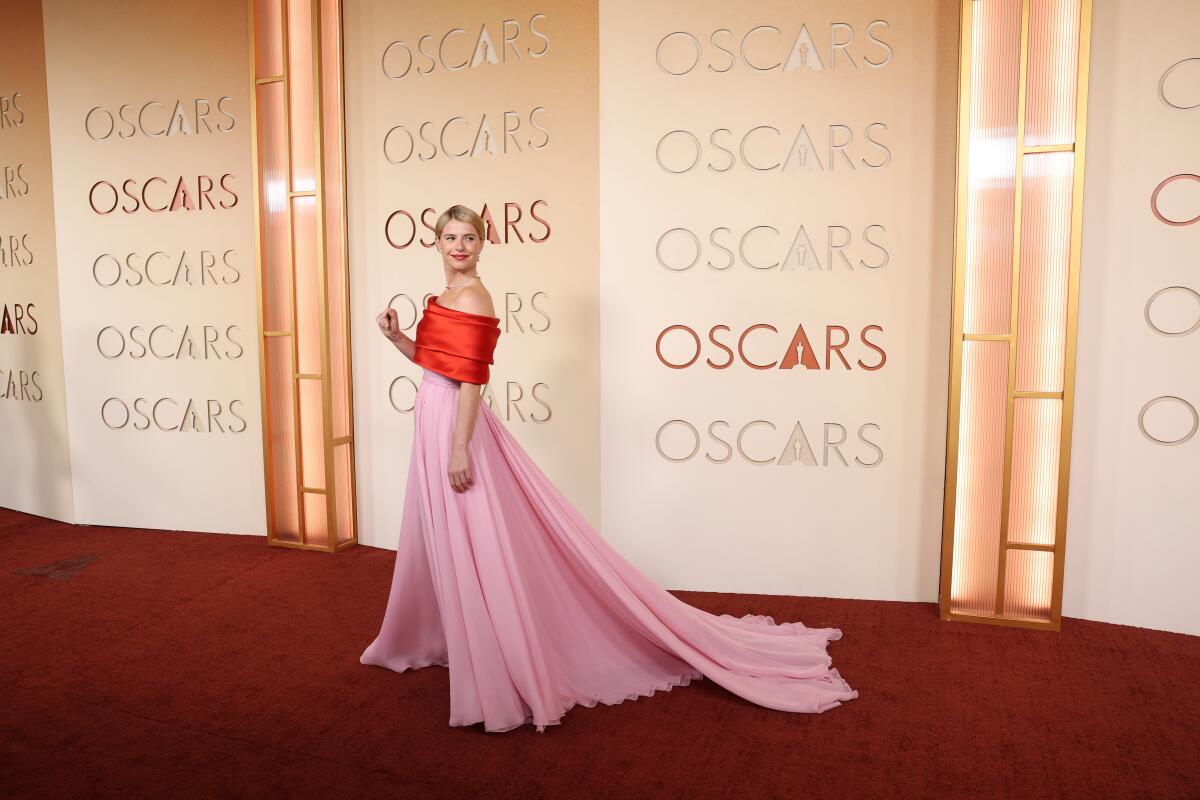
Jessie Buckley arrives on the red carpet at the 98th Annual Academy Awards.
(Myung J. Chun / Los Angeles Times)
As she strode through the lobby of the Dolby Theatre pre-show, Jessie Buckley, nominated for lead actress for her role in “Hamnet,” was fanned with praise by other attendees. Even in the restroom, she couldn’t escape the well-wishers. On her way back to the buzzing lobby, she held the train of her red and pink Chanel gown graciously saying, “Thank you, thank you.” — Brittany Levine Beckman
The pressure’s off for stars during commercial breaks
Elle Fanning and Demi Moore hug during the 98th Academy Awards.
(Robert Gauthier / Los Angeles Times)
During the telecast’s first commercial break, supporting actress nominee Elle Fanning of “Sentimental Value” took her loss in stride and leaned over her seat to chat with former “A Complete Unknown” costar Timothée Chalamet, nominated this year for “Marty Supreme,” and his partner, Kylie Jenner.
Across the aisle, “One Battle After Another’s” Leonardo DiCaprio stood up and reached over to lock fingers with Benicio Del Toro. — Yvonne Villarreal
The Oscars address inflation with a goodie box
A note from Conan O’Brien left for attendees in snack boxes.
(Jessica Gelt / Los Angeles Times)
Each year, guests at the Academy Awards are given a small cardboard box of snacks left beneath their seats to get them through the always lengthy ceremony. A note from the host is generally inside. This year’s note, signed by Conan O’Brien, read, “I hope you enjoy this Conan O’Brien ‘Moderately Happy Meal’ ™. These snacks may not look like much but in any movie theater they would run you $85.” The snacks in question were a box of Junior Mints (Times reporter Josh Rottenberg got Raisinets), a small bag of Skinny Pop and a tin bottle of water. — Jessica Gelt
Jesse Plemons won’t succumb to ‘peer pressure’
Kirsten Dunst and Jesse Plemons arrive at the 98th Academy Awards at the Dolby Theatre in Hollywood.
(Myung J. Chun / Los Angeles Times)
“Bugonia” star Jesse Plemons stood near the main lobby bar talking with friends and posing for pictures with fans while finishing the dregs of a drink. A server approached him and asked if he’d like another. Plemons politely declined and the server laughed, saying, “Sorry, I didn’t mean to give you any peer pressure.” — Jessica Gelt
Amy Madigan inquires about press room rules; ‘Is it like bingo?’
Amy Madigan after winning the Oscar for supporting actress for “Weapons.”
(Kayla Bartkowski / Los Angeles Times)
After taking the stage to accept her first Oscar win for “Weapons” on Sunday, Amy Madigan paused operations in the press room to ask how moderators decide who gets to ask questions of the night’s winners.
“Is it like bingo?” the actor asked. As laughter swelled across the crowd in response, she clarified hers was a “serious question.” — Malia Mendez
After a loss, Stellan Skarsgård knows the meaning of ‘Sentimental Value’
Megan Everett-Skarsgård and Stellan Skarsgård at the 98th Annual Academy Awards.
(Myung J. Chun / Los Angeles Times)
Stellan Skarsgård, of “Sentimental Value,” enjoyed a cocktail in a VIP room just off the main auditorium fresh off of losing the Oscar for supporting actor to Sean Penn for his performance in “One Battle After Another.”
Fans rushed Skarsgård anyway, shaking his hand and telling him how much his performance as a troubled alcoholic father and artist resonated with them. “We had four actor nominations on an international film,” Skarsgård told one of them. “That’s never happened before.” — Jessica Gelt
Two of this Oscar season’s tallest figures share a moment
During a commercial break, 6-foot-5 “Frankenstein” star Jacob Elordi and 6-foot-6 Oliver Laxe, director of international feature nominee “Sirāt,” greeted one another at the lobby bar. The pair, who have been impossible to miss as two of the tallest people at various events throughout awards season, shared a warm, high-altitude embrace and Elordi introduced the French-born Laxe to his date for the Oscars: his mother, Melissa. — Josh Rottenberg
‘The Singers’ and ‘Two People Exchanging Saliva’ winners are happy to share their Oscars success
From left, producer Jack Piatt and director Sam A. Davis, makers of “The Singers,” pose with Natalie Musteata and Alexandre Singh, co-directors of “Two People Exchanging Saliva.” All of them won Oscars for live-action short.
(Kayla Bartkowski / Los Angeles Times)
Gasps erupted in the press room after presenter Kumail Nanjiani announced the seventh-ever tie in Academy Awards history Sunday evening, between live-action shorts “The Singers,” directed by Sam A. Davis and produced by Jack Piatt, and “Two People Exchanging Saliva,” directed by Alexandre Singh and Natalie Musteata.
Speaking to the press room after the ultra-rare event, Piatt was unbothered and even enthused by the outcome, saying he wished there could be a “five-way tie” among all the category’s nominees.
Davis agreed, confiding that he’d previously told the “Two People Exchanging Saliva” team “in confidence, that if we lost, I hope we lost to them.”
Shortly thereafter, Musteata said tying with “The Singers” folks was “such a dream.”
“Someone on Reddit asked us if we would be happy to share the award, and we were like, ‘Heck yeah, we would love to share it with another film that is equally beautiful and totally different.’ ” — Malia Mendez
Elle Fanning soothes Timothée Chalamet after lead actor Oscar goes to Michael B. Jordan
Elle Fanning talks with Stellan Skarsgård during the 98th Academy Awards. Timothée Chalamet was seated in front of Fanning during the show.
(Robert Gauthier / Los Angeles Times)
When Michael B. Jordan walked off stage and the show went to commercial break, Timothée Chalamet, who was up against Jordan in the lead actor category, took a sip of his drink as Elle Fanning, sitting behind him, gave him a pat on the back.
Fanning talked to her “A Complete Unknown” co-star throughout the night, who barely turned around to look at her. Kylie Jenner kept rubbing and patting Chalamet’s hand while he nervously jiggled his right leg. — Yvonne Villarreal and Jessica Gelt
Autumn Durald Arkapaw receives standing ovation in press room after historic win
Autumn Durald Arkapaw accepts the Oscar for cinematography for “Sinners” — the first woman to win the award.
(Robert Gauthier / Los Angeles Times)
“Sinners” shooter Autumn Durald Arkapaw on Sunday became the first woman to win the Oscar for cinematography. As she arrived backstage following her historic win, the press room erupted into applause, with many reporters delivering a standing ovation.
Arkapaw was equally thrilled, telling the room, “A lot of little girls that look like me will sleep really well tonight.”
“I heard Karen O say once at a concert… ‘You have to see you to be you,’” she said. “Ryan gives us, the women on this film, and our heads of department, he gives us those opportunities to shine and be ourselves and work in a creative environment where we’re leading.”
Such trust is rarely extended by directors, Arkapaw said, and she is grateful. — Malia Mendez
As anticipated, it ended up being One Battle After Another’s night at the 98th annual Academy Awards, with the political thriller carting away six Oscars out of a total of 13 nominations.
But while Paul Thomas Anderson’s magnum opus continued its march towards award-season domination, there were moments of genuine surprise and subversion in Sunday’s ceremony.
Recommended Stories
list of 3 itemsend of list
Some of those moments had to do with the current political climate in the United States.
Host Conan O’Brien and his fellow presenters deftly avoided mentioning President Donald Trump by name, but their barbs took direct aim at his policies since returning to office.
Other surprises came from within the filmmaking community itself. For only the seventh time in Oscar history, a tie was announced: Two films had gotten an equal number of votes for Best Live Action Short.
As a result, both the surrealist thriller Two People Exchanging Saliva and the moody bar-room drama The Singers shared the Academy Award.
Here are six key takeaways from the night.
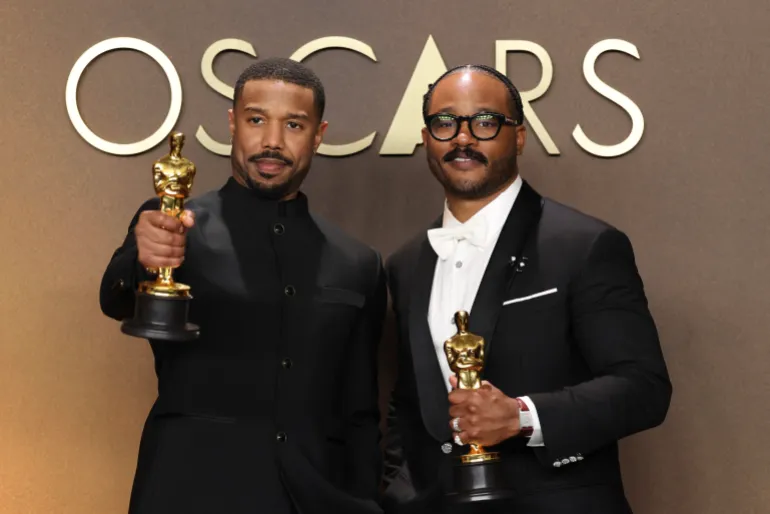
Actor Michael B Jordan holds the Oscar for Best Actor next to director Ryan Coogler, who earned an Oscar for Best Original Screenplay [Valerie Macon/AFP]
A two-horse race between Sinners and One Battle
The vampire film Sinners came into Sunday night’s ceremony with a record 16 Oscar nominations. But the big question of the night was: How many nods could it actually convert into wins?
Its biggest competition was, of course, Anderson’s One Battle After Another, which had the second highest tally of nominations.
Sinners director Ryan Coogler and Anderson were in direct competition in several top categories, including Best Picture and Best Director.
In both cases, Anderson came out ahead, though he acknowledged how fickle such awards can be.
“ I just want to say that, in 1975, the Oscar nominees for Best Picture were Dog Day Afternoon, One Flew Over the Cuckoo’s Nest, Jaws, Nashville and Barry Lyndon,” the four-time Best Director nominee said, listing films now considered to be Hollywood classics.
“There is no best among them. There is just what the mood might be that day.”
In the categories for Best Supporting Actor and Best Film Editing, One Battle After Another also triumphed, as well as for the inaugural award for Best Casting.
But in a sign of how well matched their two films were, both Coogler and Anderson emerged from the night with writing Oscars.
Anderson picked up Best Adapted Screenplay award for his use of the Thomas Pynchon novel Vineland, while Coogler made off with the Best Original Screenplay Oscar for Sinners, a work inspired by his uncle’s love of the blues.
US cinematographer Autumn Durald Arkapaw poses in the press room with her Oscar for Best Cinematography [Valerie Macon/AFP]
Jordan dunks on Chalamet in Best Actor race
Sinners, which won four Academy Awards overall, earned some of the most emotional, nail-biting victories of the night.
In the Best Cinematography category, for instance, Autumn Durald Arkapaw became the first woman to top the field.
It was her first nomination and first win, with Arkapaw besting veteran cinematographers like Marty Supreme’s Darius Khondji and Frankenstein’s Dan Laustsen, both multiple nominees.
Another big win for Sinners came in the form of Michael B Jordan, the actor whom Coogler has cast in every film since his directorial breakout in 2013’s Fruitvale Station.
Jordan, 39, was in a tight race for Best Actor with another young performer, 30-year-old Timothee Chalamet of the 1950s ping-pong drama Marty Supreme.
But Chalamet’s aggressive campaigning may have ultimately sabotaged his prospects. Multiple cracks were taken throughout the night at Chalamet’s recent comments disparaging opera and ballet.
“Nobody cares anymore” about either art form, Chalamet said in an interview last month.
“We can change society through art, through creativity, through theatre and ballet and also cinema,” director Alexandre Singh said pointedly during his acceptance speech for Best Live Action Short.
O’Brien, meanwhile, acknowledged the backlash with a joke about heightened security at the night’s Oscar ceremony.
“I’m told there are concerns about attacks from both the opera and ballet communities,” O’Brien said, before turning to Chalamet. “They’re just mad you left out jazz.”
Irish actress Jessie Buckley celebrates her win during the 98th Annual Academy Awards [AFP]
A conga line of snubs
Given the dominant performances from Sinners and One Battle After Another, plenty of critically acclaimed films left empty-handed, or nearly so.
Guillermo del Toro’s Frankenstein, as expected, earned three wins in technical categories, including Best Production Design, Best Costumes and Best Hairstyling and Makeup.
Netflix’s smash hit KPop Demon Hunters, meanwhile, also fulfilled expectations that it would dominate in its categories, Best Animated Feature and Best Original Song.
But then there were former frontrunners like Hamnet that failed to generate much traction, including for director Chloe Zhao, a past Oscar winner. Out of eight nominations total, it only came away with one win: a Best Actress trophy for Irish performer Jessie Buckley.
Marty Supreme and the Brazilian film The Secret Agent fared worse, however. Despite having nine nominations and being considered an early shoo-in for Best Actor, Marty Supreme scored no wins.
The Secret Agent, which swept the Best Actor and Best Director categories at the 2025 Cannes Film Festival, also earned nothing at this year’s Oscars.
Same was true for the quirky kidnapping drama Bugonia, from Oscar darling Yorgos Lanthimos.
South Korean-US singer Ejae poses with the Oscar for Best Original Song for the film KPop Demon Hunters[Angela Weiss/AFP]
Fears about artificial intelligence
The ceremony, however, did occasionally veer away from the competition between the films to discuss issues facing the film industry and the country as a whole.
Among those was the creeping growth of artificial intelligence (AI) in the creative sector.
In the weeks leading up to the 98th Oscars, an AI-generated video clip had gone viral, appearing to show Hollywood icons Brad Pitt and Tom Cruise in a rooftop brawl worthy of a James Bond movie.
The clip had been generated through AI software developed by the Chinese firm ByteDance, and Hollywood leaders quickly denounced it as a threat to their livelihood, not to mention a copyright infringement.
Those concerns reverberated on the Oscar stage on Sunday, with O’Brien and others addressing the growing use of AI.
“Tonight we are celebrating people, not AI, because animation – it’s more than a prompt,” actor Will Arnett said emphatically as he introduced the animation awards.
O’Brien, meanwhile, joked that, by next year, his hosting gig would be taken by “a Waymo in a tux”.
Host Conan O’Brien performs onstage during the 98th Annual Academy Awards [Patrick T Fallon/AFP]
Trump skewered for threatening free speech
Another concern looming over the night’s Oscar ceremony came in the form of President Donald Trump, who has courted controversy by launching deadly military attacks in Venezuela and Iran, as well as leading a violent immigration crackdown in the US.
At no point was Trump mentioned by name. But his leadership was alluded to throughout the night.
O’Brien, the host, set the tone early on with his oblique jabs at the Republican president in his opening monologue.
“When I hosted last year, Los Angeles was on fire,” the two-time Oscar emcee said in remarks dripping with sarcasm. “But this year, everything’s going great.”
Fellow comedian Jimmy Kimmel was even more direct. Last September, his show was briefly suspended after Trump criticised the comedian.
The head of the Federal Communications Commission, a Trump appointee, subsequently threatened the broadcasting license of the TV channel Kimmel performs on.
“There are some countries whose leaders don’t support free speech. I’m not at liberty to say which. Let’s just leave it at North Korea and CBS,” Kimmel quipped, referring to another channel that cancelled a fellow late-night comedy show.
Several filmmakers honoured at the Oscars likewise waded into the controversies surrounding Trump.
Best Documentary Feature winner David Borenstein, for instance, implied a parallel between his film — an exploration of authoritarianism in Russia — and what is currently happening in the US.
“Mr Nobody against Putin is about how you lose your country,” Borenstein explained.
“What we saw when working with this footage is that you lose it through countless small little acts of complicity: when we act complicit, when a government murders people on the streets of our major cities, when we don’t say anything, when oligarchs take over the media.”
Indian actress Priyanka Chopra and Spanish actor Javier Bardem present the award for Best International Feature Film [Patrick T Fallon/AFP]
Political speeches avoid mention of Iran war
The Oscars come roughly seven months ahead of the pivotal midterm elections in the US, which could see Trump’s Republican Party lose its majorities in Congress.
But while several filmmakers did hint at their anti-Trump stances, few explicitly denounced his policies.
For example, Norway’s Joaquim Trier, the winner of the Best International Feature category, veiled his criticism in a James Baldwin quote about the duty to protect children.
“Let’s not vote for politicians who don’t take this seriously into account,” Trier said.
No artist during the night referenced the US and Israeli war against Iran either, though its effects were felt among the participants of this year’s Oscar crop.
Writer-director Jafar Panahi, whose work was up for two Oscars on Sunday, has already said he plans to return to his native Iran after the awards season concludes.
Meanwhile, Iranian politician Sara Shahverdi — the subject of a nominee in the Best Documentary Short category — was prevented from attending the Oscars at all due to Trump’s ban on visas for 39 countries.
Palestinian actor Motaz Malhees, star of the Oscar nominee The Voice of Hind Rajab, likewise told media outlets he could not be present at the ceremony due to the travel ban.
The most pointed acknowledgements of the US-led and US-backed conflicts in the world were brief. When Spanish actor Javier Barden took the Oscar stage to present an award, he offered up six words, “No to war, and free Palestine!”
Russian filmmaker Pavel Talankin, meanwhile, made a similar appeal to the audience. “In the name of our future, in the name of all of our children, stop all of these wars now,” he said.
But by and large, the Oscar winners and presenters kept their remarks vague, emphasising global unity over political criticism.
“If I can be serious for just a moment, everyone watching right now around the world is all too aware that these are very chaotic, frightening times,” O’Brien told the audience at the outset of the night.
“It is at moments like these that I believe that the Oscars are particularly resonant. Check it out. Thirty-one countries across six continents are represented this evening, and every film we salute is the product of thousands of people speaking different languages.”
Cinema, he and others argued, transcended borders. The talent on stage was not the US’s alone.
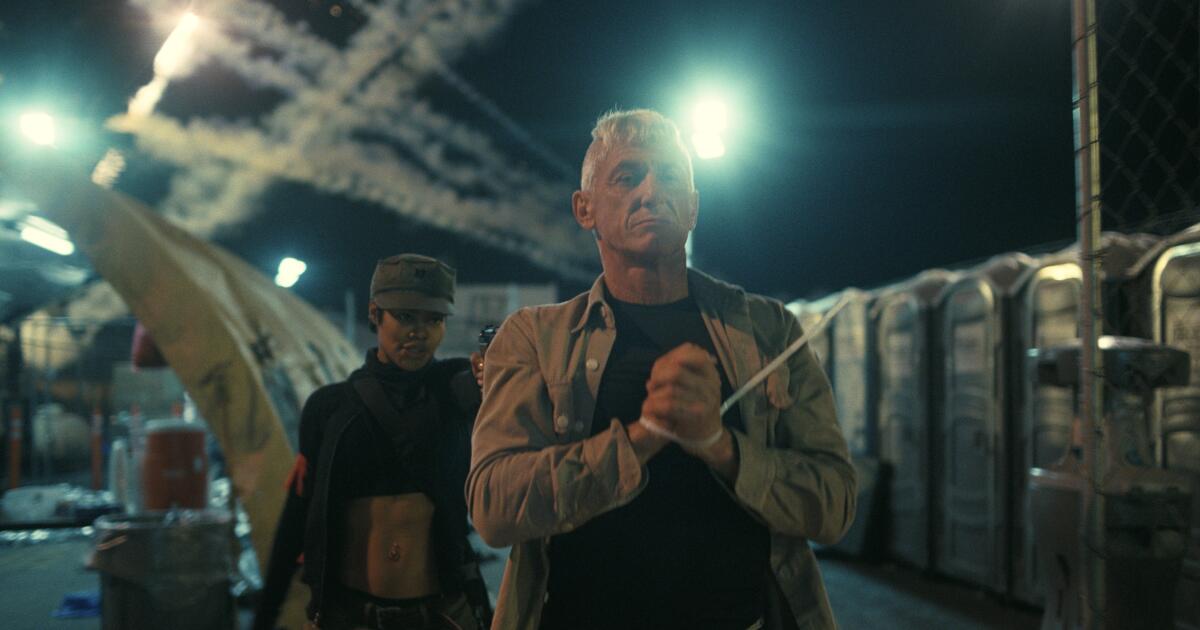
Sean Penn won the supporting actor Oscar on Sunday night for his performance as the ruthless, racist Col. Steven J. Lockjaw in Paul Thomas Anderson’s “One Battle After Another.”
The win marks the third Academy Award for the 65-year-old Penn and his first in the supporting category. He previously earned lead actor Oscars for “Mystic River” (2003) and “Milk” (2008), and had been nominated three other times in leading roles before this year. He beat out fellow nominees Benicio Del Toro for “One Battle After Another,” Jacob Elordi for “Frankenstein,” Delroy Lindo for “Sinners” and Stellan Skarsgård for “Sentimental Value.”
With his victory, Penn joins Meryl Streep, Jack Nicholson, Ingrid Bergman, Daniel Day-Lewis, Frances McDormand and Walter Brennan as three-time Oscar winners for acting. Katharine Hepburn is the only four-time acting winner.
Penn, who delivers a volatile, darkly comic performance in Anderson’s sprawling political thriller, emerged as the race’s front-runner after a surprise victory at the BAFTA Awards and the Actor Awards, whose voting body overlaps heavily with the motion picture academy.
Sean Penn did not attend the Oscars, so presenter Kiernan Culkin accepted the award on Penn’s behalf.
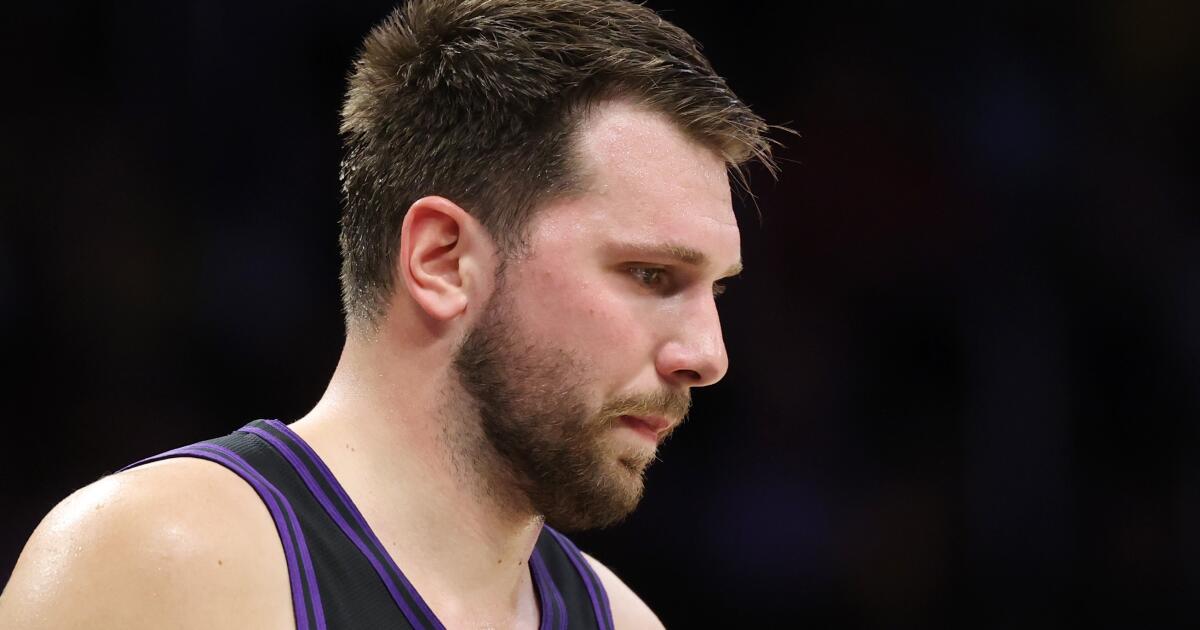
Luka Doncic is attempting to bring his daughters to the United States from his native Slovenia after separating from his fiancée, according to reports.
His former fiancée, Anamaria Goltes, 28, has filed a petition in California seeking child support and attorney fees from Doncic. One of Doncic’s daughters was with him for three months in 2025, and his other daughter has never been to California. Doncic, 27, told ESPN that he had “no idea” Goltes filed the petition.
“I love my daughters more than anything, and I’ve been doing everything I can for them to be with me in the U.S. during the season, but that hasn’t been possible, so I recently made the tough decision to end my engagement,” Doncic said in a statement. “Everything I do is for my daughters’ happiness, and I will always fight to be with them and give them the best life I can.”
Doncic and Goltes were engaged for nearly three years. Their oldest daughter, Gabriela, was born in November 2023, and Olivia was born in December. Doncic traveled to Slovenia for Olivia’s birth, missing games against the Toronto Raptors on Dec. 4 and Boston Celtics on Dec. 5.
During his visit, Doncic told Goltes he wanted to bring Gabriela to the United States when he returned to rejoin the Lakers, according to reports. Goltes objected, and Doncic departed without his daughter.
“I don’t even know how to describe it,” he told reporters of being present for Olivia’s birth. “It was a lot. I was there for the birth of my daughter, so that means everything to me. But it was definitely a roller coaster.
“I got to see my daughter again, my newborn. Coming back, it was kind of hard to leave them behind. But it’s a job, so I got to do it. So hopefully I’ll see them soon.”
Doncic posted a photo on social media of Olivia wearing a pink sweater with a heart emoji covering her face. In his first game back, he inscribed a G and O with a heart on his shoes.
“Two girls, they’re going to make my life hell for sure, I know that,” Doncic said, half-joking. “I’m going to be their security after I retire. All jokes aside, it’s the best thing in the world. I’m just blessed.”
Goltes deleted photos of her and Doncic from her Instagram account last week, and Doncic acknowledged that they had separated. Two weeks ago, he filed an injunction with a Slovenian court seeking immediate contact with his daughters, ESPN reported.
Doncic, who was traded to the Lakers from the Dallas Mavericks for Anthony Davis in February 2025, leads the NBA with a 32.5 points-per-game average. The guard also averages 8.4 assists and 7.8 rebounds.
The Legal Aid Foundation of Los Angeles routinely sues the city — and wins.
In the last two months, the nonprofit has notched victories in three lawsuits over the city’s handling of the homelessness crisis.
Legal Aid also defends tenants at risk of eviction as part of the city and Los Angeles County’s Stay Housed L.A. program.
Last Tuesday, the City Council was set to vote on a $177-million contract for Legal Aid to continue representing tenants for the next three years, with other groups providing related services.
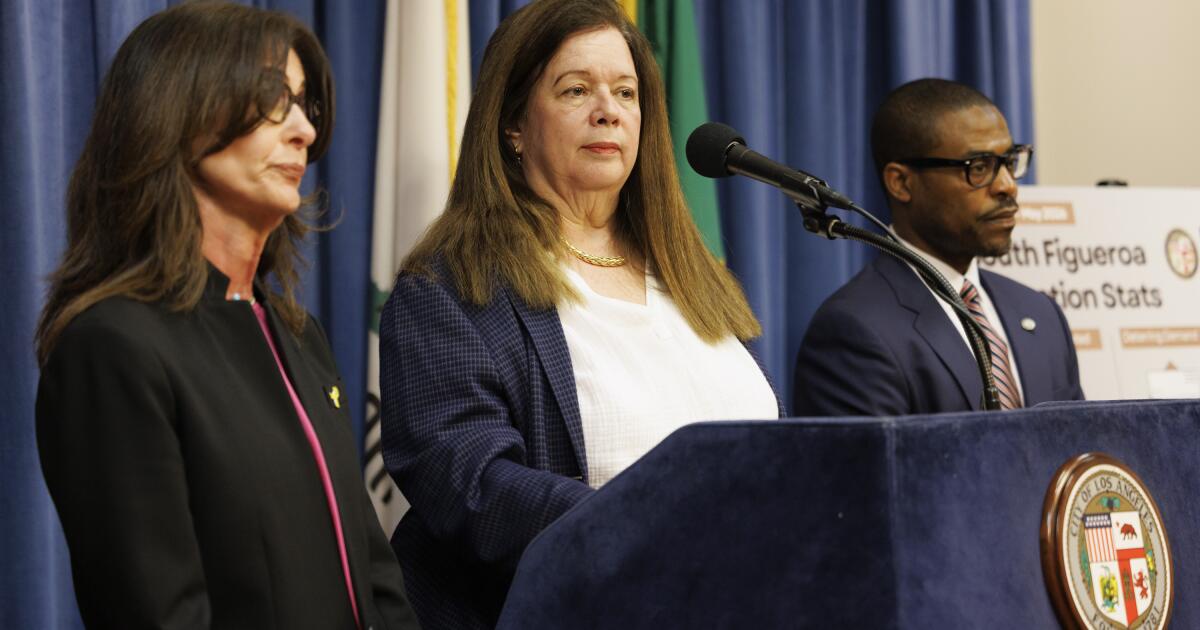
But the night before the vote, City Atty. Hydee Feldstein Soto sent a confidential memo to council offices recommending that council members “reconsider the award of such a large contract to a frequent litigant against the city,” according to a portion of the memo obtained by The Times.
On the day of the scheduled vote, the council delayed it for a week, until Tuesday.
“[Legal Aid’s] mission includes improving the lives of our client communities through systemic change, which sometimes means filing litigation against government entities engaging in illegal conduct,” Barbara Schultz, director of housing justice for Legal Aid, said in an interview.
Schultz said that Legal Aid’s litigation and eviction work “are entirely separate.”
Through a spokesperson, Feldstein Soto declined to comment. She is running for reelection this year.
The contract, which would last for three years, would award nearly $107 million to Legal Aid for eviction defense and prevention, $42 million to the Southern California Housing Rights Center for short-term emergency rental assistance, nearly $22 million to Liberty Hill Foundation for tenant outreach and close to $7 million to Strategic Actions for a Just Economy to protect tenants from harassment.
The battle over the contract has serious implications for Los Angeles tenants at risk of eviction, Schultz said.
Legal Aid, which has participated in the program since its inception in 2021, will have to stop accepting new clients if the contract does not pass on Tuesday. Each month, about 160 tenants will be without legal representation and about 575 more won’t get advice that could help them avoid eviction proceedings, Schultz said.
Schultz said that Legal Aid subcontracts some of the legal work in the program to groups such as Bet Tzedek and Inner City Law Center.
“We get 600 to 800 eviction filings each month in our district alone. If council doesn’t act, those families will have no help from the city,” City Councilmember Hugo Soto-Martínez said in a statement.
The Stay Housed L.A. program has opened about 26,000 cases overall, providing full representation for 6,150 cases and working on nearly 20,000 “limited scope” cases, according to data from Legal Aid. The original contract, which is set to lapse at the end of the month, was for about $90 million.
Measure ULA, the “mansion tax” passed by city voters in 2022, includes funding for the program.
Last June, Feldstein Soto tried to block the City Council from extending the contract without a competitive bidding process, a core tenet she has preached as the city’s elected legal counsel.
At the time, some City Council members grumbled, but still, they opened the contract to bidders.
Months later, the city Housing Department awarded the contract to Legal Aid and the other organizations before sending it to the City Council for approval.
“Our understanding of the city’s contracting process is that it is trying to get the best services it can at the best value and not using the process to influence the political or legal activities of nonprofit advocacy organizations,” Elizabeth Hamilton, deputy director of Strategic Actions for a Just Economy, which has also filed lawsuits against the city, said in a statement.
Feldstein Soto’s confidential memo cited other potential issues with the contract, calling for an audit of Stay Housed L.A. and asserting that a confidentiality clause in the original contract might violate state public records laws.
Recently, Legal Aid has scored several victories against the city.
In January, a judge ruled that the city violated the state’s open meeting law when council members made a plan behind closed doors to sweep 9,800 homeless encampments. Legal Aid represented the plaintiffs in that case.
In February, with Legal Aid also serving as plaintiffs’ counsel, a judge ruled that the city lacked the legal authority to carry out a state law allowing the dismantling of abandoned or inoperable RVs worth up to $4,000.
That same month, Legal Aid scored another victory when a federal judge found that the city violated homeless people’s constitutional rights by seizing and destroying their property during encampment cleanups.
“I know from above she’s looking down on all of us with her beautiful smile. Rest in peace our Jenn.”
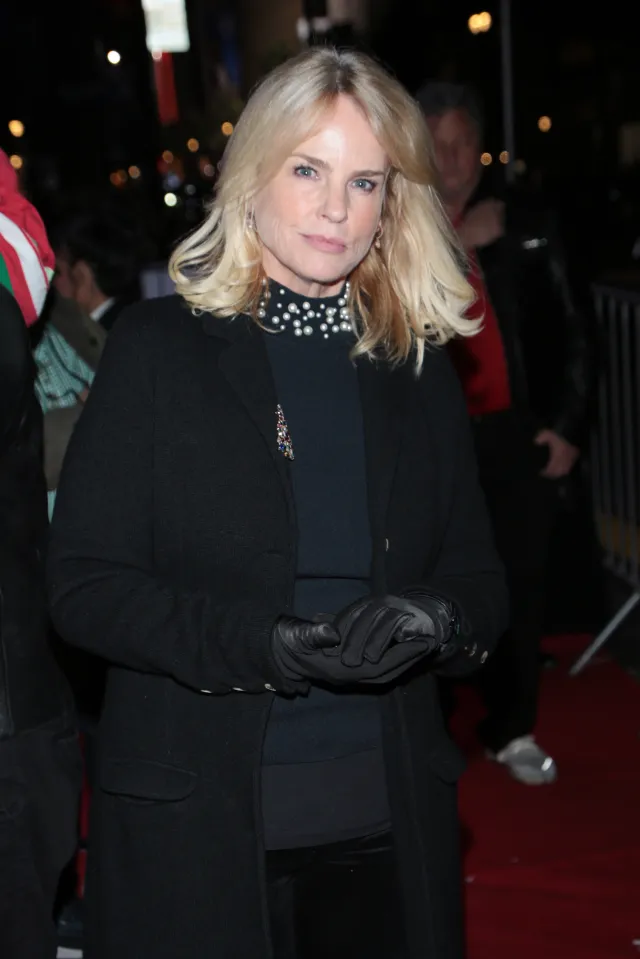
Erin Murphey wrote: “So sad to share that my friend Jennifer Runyon Corman has passed away after a brief battle with cancer.
“Some people you just know you’ll be friends with before you even meet. She was a special lady. I’ll miss you Jenn.
“My thoughts are with your family and beautiful children.”
Jennifer made her movie debut in the 1980 horrorfilm To All a Goodnight, taking on the lead role of Nancy.
She then took on a role as Sally Frame in the American soap Another World, acting in the series until 1982.
The beloved Ghostbusters film, which featured Bill Murray, Dan Aykroyd and Sigourney Weaver, Jennifer acted in the opening scene as a student involved in an ESP experiment.
Her television career included guest appearances in Murder, She Wrote as well as roles in Magnum PI and Beverly Hills.
Jennifer’s final role was in the 2017 comedy horror film Bloodsucka Jones vs. The Creeping Death.
During the 2019 documentary, Remembering Ghostbusters, Jennifer appeared to discuss her most notable role.
The actresses’ grieving family announced the heartbreaking news on social mediaCredit: Getty Images
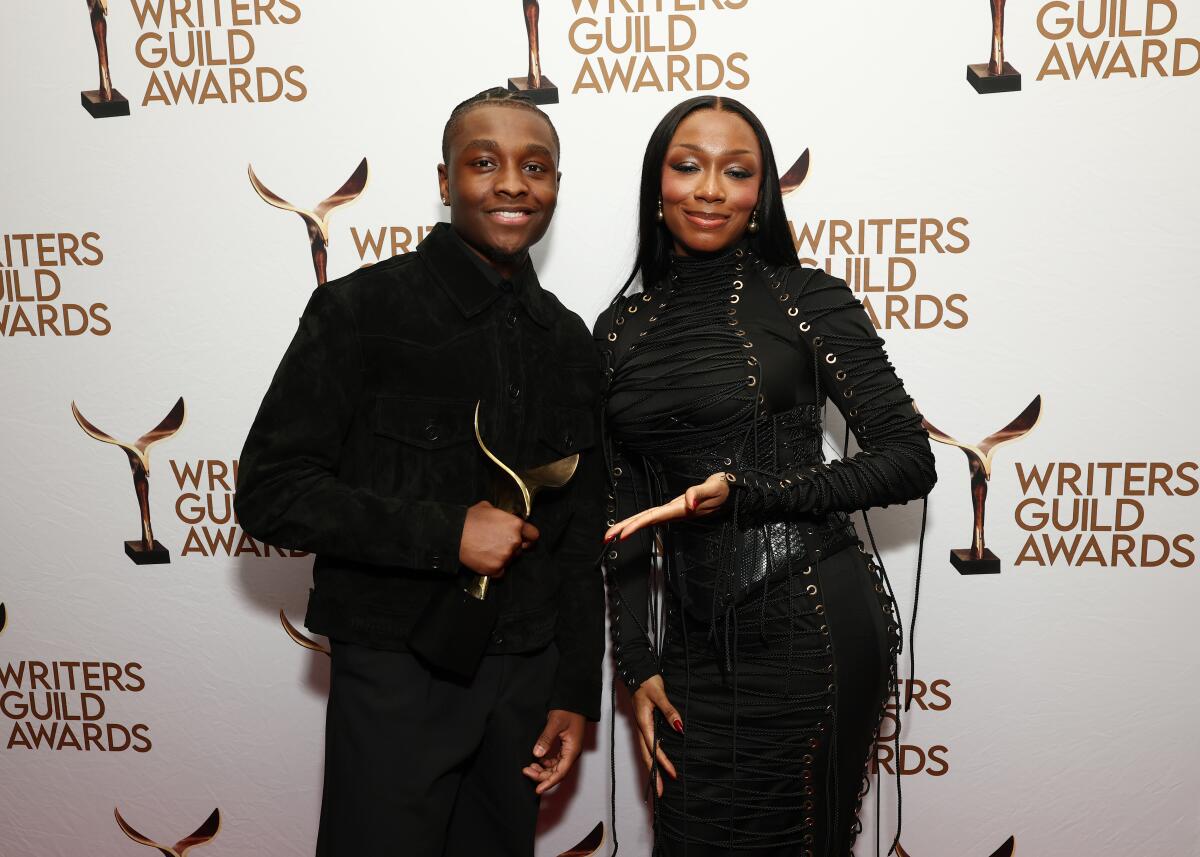
The already highly decorated “Sinners” was among the top winners at the 78th Writers Guild Awards on Sunday in New York City.
The Ryan Coogler-directed horror film won the award for original screenplay, and its primary Oscars best picture opponent, Paul Thomas Anderson’s “One Battle After Another,” clinched the win for adapted screenplay. “Sinners” star Miles Caton accepted the award for the former, and “One Battle” cast member Shayna McHayle for the latter.
“Sinners” star Miles Caton and “One Battle After Another” actor Shayna McHale accepted the awards for original and adapted screenplay, respectively.
(Cindy Ord / Getty Images for Writers Guild of America East)
In the TV realm, “The Pitt” made a splash with awards for drama series, new series and episodic drama.
As for lifetime achievement honors, Robert Smigel presented Stephen Colbert with the Walter Bernstein Award for critiquing the power elite on his late-night show, which will air its final episode in May. Terry George received the Ian McLellan Hunter Award for Career Achievement from Don Cheadle, and Diana Son the Richard B. Jablow Award for Devoted Service to the Guild from last year’s recipient, Kathy McGee.
Most years, the Writers Guild holds simultaneous ceremonies in New York and Los Angeles. But the East Coast edition became a solo affair after WGA West canceled its ceremony amid an ongoing strike by its own staff union, who claimed guild management had “surveilled workers for union activity, terminated union supporters, and engaged in bad faith surface bargaining.”
The L.A. ceremony was set to honor James Cameron with the Laurel Award for Screenwriting Achievement, Don Reo with the Paddy Chayefsky Laurel Award for Television Writing Achievement and Mstyslav Chernov with the Paul Selvin Award for “2,000 Meters to Andriivka,” which won the award for documentary screenplay Sunday evening.
While WGA West’s board of directors said the ceremony was postponed to give members “an uncomplicated celebration of their achievements,” the Writers Guild Staff Union characterized the cancellation as an attempt to sow division between management and unionized staff, which is ill-timed given upcoming contraction negotiations between the WGA and the Alliance of Motion Picture and Television Producers, which represents Hollywood studios and streamers. In 2023, the WGA went on its longest-ever strike, lasting 148 days.
Comedian and Emmy-nominated producer Roy Wood Jr., who this year hosted the WGA’s East Coast ceremony for the third time, during his opening monologue offered (in jest) his predictions for the negotiations, which begin later this month.
“First, I predict somebody’s gonna lose their s—,” the host said. “Cooler heads are gonna prevail, and then somebody else is gonna lose their s—.”
Here is the full list of Writers Guild Award winners:
Original screenplay: “Sinners,” written by Ryan Coogler; Warner Bro. Pictures
Adapted screenplay: “One Battle After Another,” screenplay by Paul Thomas Anderson, screen story by Paul Thomas Anderson, inspired by the novel “Vineland” by Thomas Pynchon; Warner Bros. Pictures
Documentary screenplay: “2,000 Meters to Andriivka,” written by Mstyslav Chernov; Frontline Features
Drama series: “The Pitt,” written by Cynthia Adarkwa, Simran Baidwan, Valerie Chu, R. Scott Gemmill, Elyssa Gershman, Joe Sachs, Noah Wyle; HBO Max
Comedy series: “The Studio,” written by Evan Goldberg, Alex Gregory, Peter Huyck, Frida Perez, Seth Rogen; Apple TV
New series: “The Pitt,” written by Cynthia Adarkwa, Simran Baidwan, Valerie Chu, R. Scott Gemmill, Elyssa Gershman, Joe Sachs, Noah Wyle; HBO Max
Limited series: “Dying for Sex,” written by Sheila Callaghan, Harris Danow, Madeleine George, Elizabeth Meriwether, Amelia Roper, Kim Rosenstock, Sasha Stewart, Sabrina Wu, Keisha Zollar; FX/Hulu
TV & Streaming Motion Pictures: “Deep Cover,” written by Derek Connolly and Colin Trevorrow; Prime Video
Animation: “Shira Can’t Cook” (“Long Story Short”), written by Mehar Sethi; Netflix
Episodic drama: “7:00 A.M.” (“The Pitt”), written by R. Scott Gemmill; HBO Max
Episodic comedy: “Prelude” (“The Righteous Gemstones”), written by John Carcieri, Jeff Fradley, Danny R. McBride; HBO Max
Comedy/variety series – talk or sketch: “Last Week Tonight with John Oliver,” senior writers: Daniel O’Brien, Owen Parsons, Charlie Redd, Joanna Rothkopf, Seena Vali; writers: Johnathan Appel, Ali Barthwell, Tim Carvell, Liz Hynes, Ryan Ken, Sofía Manfredi, John Oliver, Taylor Kay Phillips, Chrissy Shackelford; HBO Max
Comedy/variety specials: “Marc Maron: Panicked,” written by Marc Maron; HBO Max
Quiz and audience participation: “Celebrity Jeopardy!”, head writer: Bobby Patton; writers: Kyle Beakley, Michael Davies, Terence Gray, Amy Ozols, Tim Siedell, David Levinson-Wilk; ABC
Daytime drama: “The Young and the Restless,” associate head writers: Jeff Beldner, Marla Kanelos, Dave Ryan; writers: Susan Banks, Amanda L. Beall, Marin Gazzaniga, Rebecca McCarty, Madeleine Phillips; CBS/Paramount+
Children’s episodic, long form and specials: “When We Lose Someone” (“Tab Time”), written by Sean Presant; YouTube
Short form streaming: “The Rabbit Hole with Jimmy Kimmel,” writers: Jimmy Kimmel and Jesse Joyce; YouTube
Documentary script – current events: “Trump’s Power & the Rule of Law” (“Frontline”), written by Michael Kirk and Mike Wiser; PBS
Documentary script – other than current events: “Forgotten Hero: Walter White and the NAACP” (“American Experience”), written by Rob Rapley; PBS
News script – regularly scheduled, bulletin or breaking report: “Devastating Flooding in Texas” (“World News Tonight with David Muir”), written by David Muir, Karen Mooney and Dave Bloch; ABC News
News script – analysis, feature or commentary: “Remembering Palestinian Journalists Killed by Israeli Forces” (“Ayman”), written by Lisa Salinas; MSNBC
Digital news: “An Isolated Boarding School Promised to Help Troubled Girls. Former Students Say They Were Abused.,” written by Sebastian Murdock and Taiyler Mitchell; HuffPost
Radio/audio documentary: “Jerry Lewis’ Lost Holocaust Clown Movie” (“Decoder Ring”), written by Max Freedman; Slate
Radio/audio news script – regularly scheduled, bulletin or breaking report: “ABC News Radio Top of the Hour News”, written by Robert Hawley; ABC News Radio
Radio/audio news script – analysis, feature or commentary: “The Life and Legacy of Jimmy Carter,” written by Gail Lee; CBS News Radio
On air promotion: “CBS Comedy,” written by Dan Greenberger; CBS
Times staff writers Stacy Perman and Cerys Davies contributed to this report.