Dread is usually the first sensation Angelenos conjure when they hear “LAX.” It doesn’t have to be this way, L.A.
You might be preparing to check in toward a faraway destination, or doing what is often called the ultimate expression of love here: driving someone to or from one of the busiest airports in the world. Either way, if timed right, your journey can become a satisfying dip into the culinary scene surrounding our vice for the airborne, our awkward beauty, El Ay Ex.
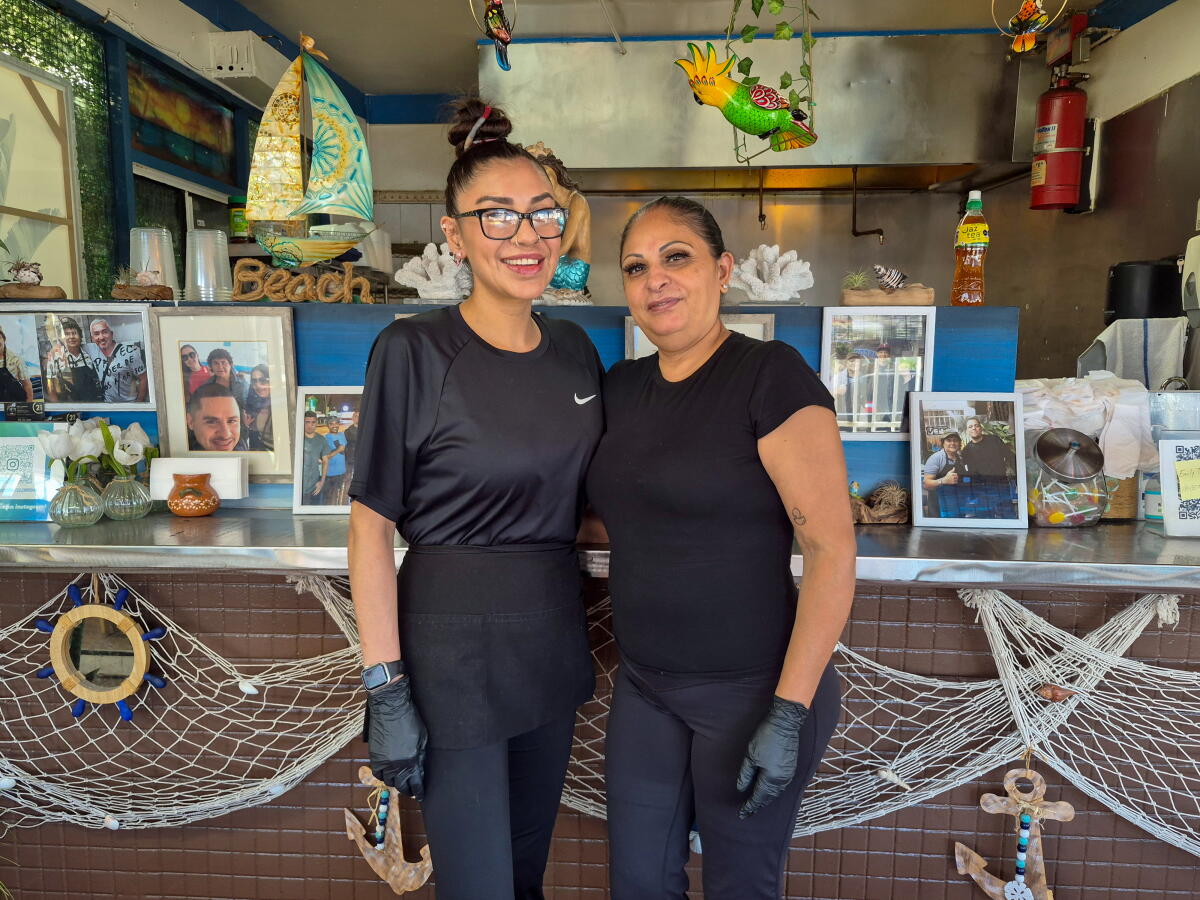
Mariscos El Chente staff members Denise Miranda and Maria Peñuelas.
(Daniel Hernandez / Los Angeles Times)
No, you don’t have to limit yourself to the touristy In-N-Out on Sepulveda Bouelvard. Skip Randy’s Donuts if you’ve done it before. For this guide, we’re zeroing in on local favorites in the quietly robust scene of dining and drinking within one mile of the airport’s perimeter. No hotel restaurants or lounges.
A tight proximity to the runways means you’re mostly surrounded by busy LAX workers and hardcore locals from the communities of Westchester, El Segundo, Lennox, Hawthorne and Inglewood. Sprinkle in people who’ve just landed from just about anywhere in the world, and the magic of the LAX cultural orbit comes alive. I’m no longer kidding or holding my secret: Because of the restaurants and bars, I actually love hanging out around the airport.
This makes me part of a low-key membrane of Angeleno who enjoys watching jetliners serenely glide their passengers through the sky, landing a kiss away from the gleaming Pacific, as we sip a nice lager or chomp into a mulita. I can trick my brain on any day into thinking I’m just about to take off myself.
It stopped me mid-scroll. In an Instagram reel, one DJ was mixing an upbeat track in a dark, packed room while another danced on a stage behind her, twerking perfectly on beat. Above them, a message flashed on a massive screen: “Love. Dance. And F— Ice.”
The crowd went wild, matching the energy of the two Los Angeles-based DJs who go by Mango and Ginger. The night looked so electric that I could feel the FOMO traveling through my body.
When I tapped the location tag, I assumed I was looking at an underground warehouse party in downtown L.A. or a venue in Hollywood. Instead, the party — known as If You See Me You See Me — was happening 120 miles south in San Diego. As a DJ and music lover, I knew I needed to get down there ASAP.
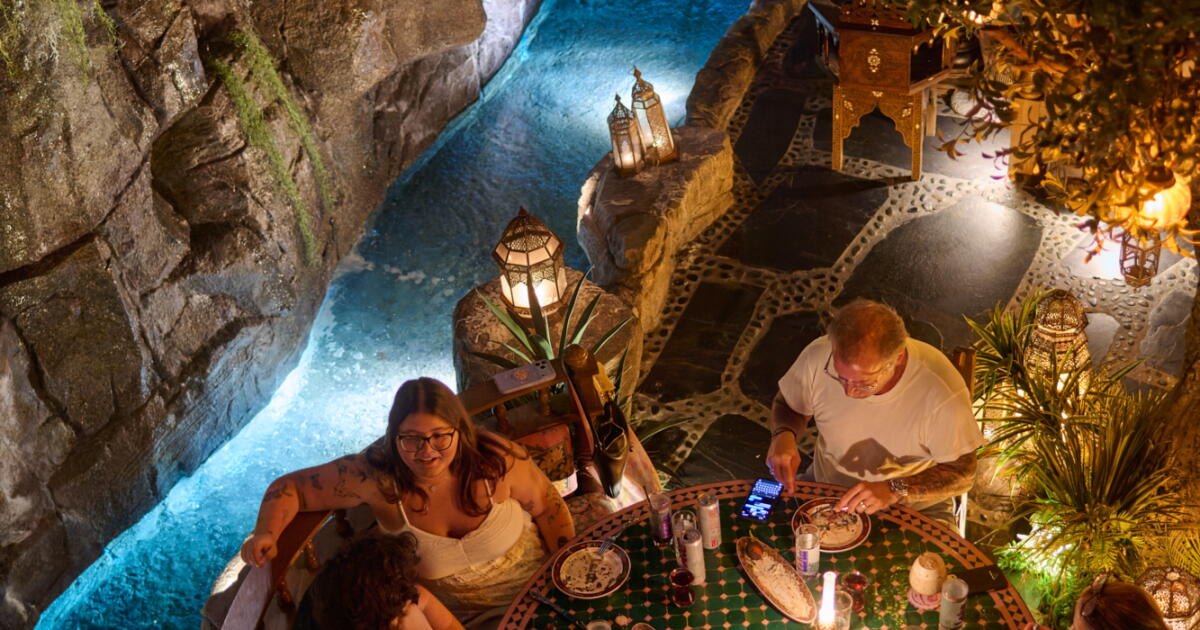
For many Angelenos, San Diego is the place to go for a peaceful weekend getaway — think scenic cliffs, serene beaches, fresh fish tacos and visits to Balboa Park and the San Diego Zoo. But it’s easy to sleep on its vibrant nightlife scene — and I don’t just mean the bars crowding the Gaslamp Quarter. The city is home to some of the most exciting late-night spaces, from hi-fi listening lounges to a cinematic Middle Eastern restaurant that feels straight out of Disneyland.
“People just aren’t aware,” says San Diego native Mo Perez, who as DJ Dopemo regularly packs out parties at North Park’s Bluefoot Bar and Lounge. “Then they come here and they’re like, ‘Wow, San Diego is really fun.’”
This is part of the reason why Sasha Marie, a longtime DJ and former member of the Soulection music collective, decided to continue hosting her event If You See Me You See Me, in partnership with Future Is Color, in her hometown of San Diego, even amid invitations to bring it to other cities. She invites DJs from around the globe, many of whom wouldn’t typically play in San Diego, to spin at the party.
“I feel like it’s important to show that something can be successful here,” she says.
Consider this your wake-up call to tap into San Diego’s nightlife scene, whether you want to go dancing or vibe to diverse sounds or have a cocktail in a one-of-a-kind atmosphere. These nine great spots are a sampling of how the city comes alive after dark.
A SMALL station in Manchester that first opened in the 1800s has been crowned the best in the country at the ‘World Cup of Stations’.
It has trackside seating, an Airbnb upstairsand beat 150 stations across the country for the title.
Irlam Station has been crowned the ‘World Cup of Stations’Credit: AlamyThe station house was restored in 2015 after being closed for many yearsCredit: Alamy
‘The World Cup Of Stations’ was launched in honour of 200 years of railways in Britain and brings attention to the stories behind the stations and how much they’ve changed and brought communities together.
This year there was 150 nominations from across the country, but Irlam in Salford took the title with 4786 votes.
Sign up for the Travel newsletter
Thank you!
Irlam Station first opened in 1873 and was used for many years although its station building fell into disrepair in the 1980s.
The station itself remained opened to passengers and now sees as many as 350,000 passengers each year.
11 years ago, the station house was restored as part of a £2million project and reopened in March 2015.
It’s much more than a simple station now, as inside is a railway-themed café-bar with train carriage booths.
The 142-year-old signal box has been restored and reopened.
There’s a heritage hub too which has railway artefacts including formerly used locomotives.
In The Station garden is an homage to Harry Potter‘s Platform 9 and three quarters, as well as James the Tank Engine.
Also outside in the Station Art Park are 3D sculptures which ‘reflect the area’s history‘ including a seating area and Hobbit-style cottage.
The Signal Box has been restored and is used as an afternoon tea venueCredit: Alamy
Back inside the station house is Irlam Café Bar which serves up breakfast, main meals from burgers to toasted sandwiches, salads and even Sunday roasts.
Afternoon tea can be booked from £18.95 and train enthusiasts will love that you can enjoy this in the Signal Box.
It’s also a bar so there are plenty of drinks to try too and seats outside for trainspotting.
Above the train station is an Airbnb – the apartment can sleep up to four people across two bedrooms and guests enter through the Station Master’s Door.
There’s a two bedroom Airbnb on the top floor of the Station HouseCredit: Airbnb The gardens pay homage to the likes of Platform nine and three quartersCredit: Airbnb
One guest wrote in their review: “The apartment is located in a train station which makes this very special place.”
Another called it a “unique space perfect for train enthusiasts.”
A three-night stay for four in November can be booked for £404 – or £33.67pppn.
Tricia Williams, Managing Director of Northern, said: “The station has a unique charm and is well worth a visit. You can enjoy a meal in the café, take a tour of the gardens to see some amazing 3D artwork and visit the heritage hub.”
The other final four stations in the running were Cardoss in Argyll & Bute, Brookwood in Surrey, Yatton in Somerset and Berney Arms in Norfolk.
MINI bars at your seat, fancy amenity kits and the ‘world’s biggest business class’ – British Airways’ latest announcement is transforming the way Brits will fly with the flag carrier.
The airline’s huge new upgrades are part of the A380 retrofit programme.
First look at British Airways’ huge new A380 retrofitCredit: British Airways
Set to cost millions, it will see new seats in every single cabin, including in World Traveller – economy – and its premium economy, World Traveller Plus.
It will also have what they are calling the world’s biggest business class as well, with 106 Club Suite seats which will be on the upper deck.
Sign up for the Travel newsletter
Thank you!
This is alongside 12 seats in First, 84 in World Traveller Plus and 215 in World Traveller.
The new amenity kits have been rolled out as well – First Class passengers will get bags designed by Swaine with Wildsmith toiletries, and Business Class will get unique patterned bags with anatome products.
First passengers will be getting a few other upgrades as well.
This includes new pyjamas with a bespoke tartan pattern design, along with slippers and blankets.
A built in mini bar will also mean First passengers can get their own snacks without having to go to the galley, with chocolates, mints and even electrolytes.
A new dining experience will include onboard Bollinger, and a wide cocktail menu. Even racks of lamb and grilled salmon will be on the menu.
A new food and snack menu is being rolled outCredit: British AirwaysIt will have the world’s biggest business class with the most seats onboardCredit: British AirwaysNew seats are being rolled out across all classesCredit: British AirwaysThere’s new amenity kits tooCredit: British Airways
British Airways boss Sean Doyle said: “This is a major milestone for British Airways and the future of our A380 fleet, marking one of the most significant transformations we’ve ever undertaken on any aircraft.
‘We’ve completely reimagined the customer experience, introducing new and updated seats in every cabin, all carefully considered to deliver greater comfort and an elevated customer experience.
“From redesigned interiors and upgraded dining to new amenities and service delivery, every detail has been thoughtfully designed with our customers front and centre, helping them to have a more seamless and memorable experience when they fly with us.”
Off the plane, new airport lounges are also being introduced.
First class passengers get an in-seat mini barThe airline has teamed up with Swaine and Wildsmith for First Class amenity kits
A new lounge at Heathrow Terminal 5 C will open by the end of 2028, while the Heathrow Arrivals lounge is being redesigned.
Lounges across the US including Boston, Newark and San Francisco are being updated, along with Geneva.
California Professional Firefighters, the California Federation of Teachers, the Nurse Alliance of SEIU California and the California School Employees Assn. all oppose the measure. They argue that it will make it harder to pass tax hikes to pay for police and fire departments, fix and repair local roads, staff local schools or backfill federal healthcare cuts.
They also argue that Proposition 43 skirts the California Supreme Court’s opinion on the threshold.
Gubnatorial candidate Xavier Becerra opposes Proposition 43. In a statement, he called corporations “special interests” that want the proposition to pass in order to block new taxes.
“Prop. 43 would hand special interests the power to block the resources our communities count on most: fire protection, safe roads, good schools,” Becerrra said.
Assemblymember Buffy Wicks (D-Oakland), who authored the legislation that became Proposition 43 — ACA 22 — opposes the measure and has urged Californians to vote against it. She said the only reason she crafted the bill was because it was a necessary bargaining chip to torpedo another ballot measure backed by the Jarvis taxpayers group that would have devastated revenues for local governments and retroactively rescinded some local tax increases.
“Tip Toe,” a fine new drama from Russell T Davies premiering Friday on Starz, begins at the end, with Leo Struther (Alan Cumming, phenomenally good), a gay Manchester bar owner, hanging dead from a streetlight outside his house, as a woman screams and his neighbor Clive Goss (David Morrissey) stands breathing heavily on his porch. Then, as so many series do nowadays, it goes back in time — 10 days here — to tell the tale that got them there.
And so you are prepared from the beginning for tragedy, though not everything that happens in its five episodes will be tragic — some of what we see will be sweet and even celebratory — and one might forget for a moment where this is all heading, and even believe that what we’ve already seen will turn out differently.
The series sets off in a comparatively light mood. Chasing a one-night stand who’s stolen his laptop, Leo finds he’s locked himself out of his house, and, dressed only in his underwear, goes next door to ask if he can borrow a phone to call his friend Stephanie (Elizabeth Berrington) to bring him a spare key; here we meet the Goss family, Clive, an out-of-work electrician; his wife, Marie (Pooky Quesnel), who doesn’t like Clive; 16-year-old son George (Jackson Connor), gay and closeted; and 25-year-old son Saul (Joseph Evans), an easygoing hunk who lives at home, secretly makes money on OnlyFans and accepts everyone for who they are. Leo and the Gosses have been living amicably at arm’s length for 14 years, though their lives are about to become closely entwined, with disastrous results.
In an act of something like willful, somewhat disturbing friendliness, or a desire not to have to deal with Leo the next time he’s locked out, Clive makes a copy of Leo’s key and installs a lock box by his door. (By the Chekov’s gun rule, a key copied in Episode 1 is bound to be turned in a lock in whatever later act Davies deems advantageous.) Then, Leo gives Clive work at his bar.
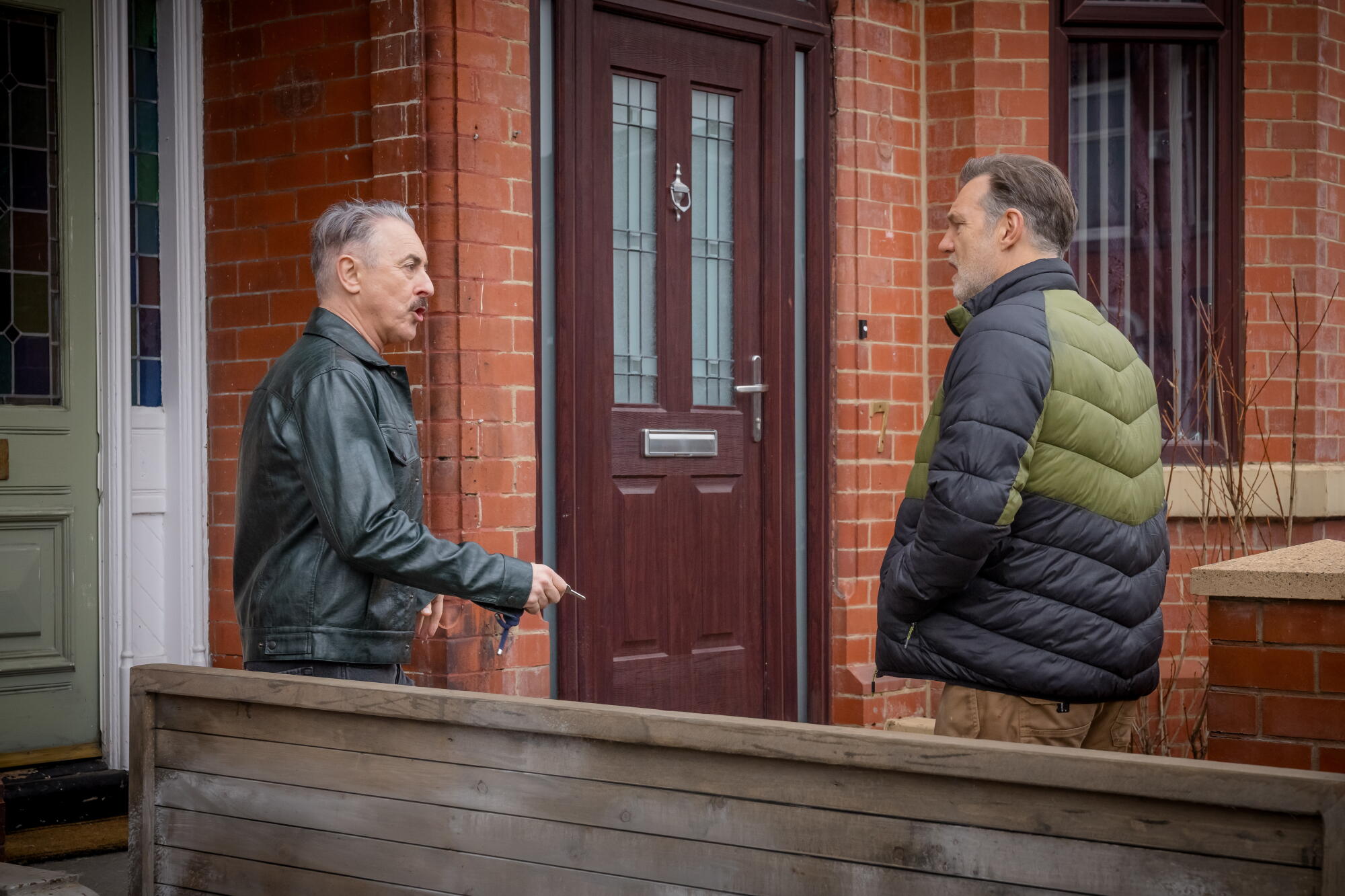
Alan Cumming and David Morrissey play neighbors whose relationship escalates to violence in “Tip Toe.”
(Ben Blackall / Starz)
Leo’s bar, Spit and Polish, sits on Canal Street in Manchester’s long-established “gay village.” It’s a safe space for his employees and regulars, including Zee (Iz Hesketh), who’s been sleeping hidden in the bar, frightened of new flatmates since coming out as a trans woman, and Melba (Paul Rhys, brilliant), a former drag performer who holds down the end of the bar like Norm from “Cheers” and carries a torch for Leo.
Things will go generally downhill from here, in a narrative of escalating misunderstanding — not in the sense of an innocent mistake, of simply getting the wrong end of the stick (though that’s part of it), but as a contemporary habit of mind, blinkered, closed to facts but open to conspiracies. (Clive, a consumer of social media disinformation, believes that AIDS and COVID are fake); he lives in fear.
Directed by Peter Hoar, it’s a rough watch, yet beautifully wrought and delicately performed, inspiring and depressing, hopeless and hopeful by turns Davies has points to make — hanging your protagonist is not subtle — but his dialogue carries a lot of weight lightly; long conversations ebb and flow and rise and fall like compressed playlets. If there is something schematic about the arc, the characters within it, Clive as much as Leo, are completely human. They stand for something bigger than themselves, but they also stand for themselves.
Davies brought gay life in its infinite variety to television with the 1999 series “Queer as Folk” (also set on Canal Street) and gender fluidity to “Doctor Who,” the series he revived in 2005 and returned to in 2023. (The Tardis is currently in limbo.) His “Cucumber,” about middle-age gay men, and “Banana,” about young LGBTQ+ people, are also set in Manchester, where Davies has lived since the late 1980s. “Tip Toe” has been crafted for an age of surging homophobia and anti-gay violence. “The president of America has given these men permission to attack us,” says Melba, as he sits with Leo late one night by the canal. The series’ dark prophet, he gives it its title.
“It’s a storm, it’s a tide, it’s a great big tsunami. We’re in the middle of it right now … If you’d asked me in 1996 what do you think 2026 will be like, I’d have said ‘glory days’ … But they tricked us didn’t they? They let us all come out, so now we’re standing in he open ready for them to shoot us down. I used to walk into a room and just go, ‘Ta-da!’ Now I tip toe, just in case.”
“Cartoon Network was better than Disney Channel and Nickelodeon.”
“Men should be required to get a vasectomy after a certain amount of baby mamas.”
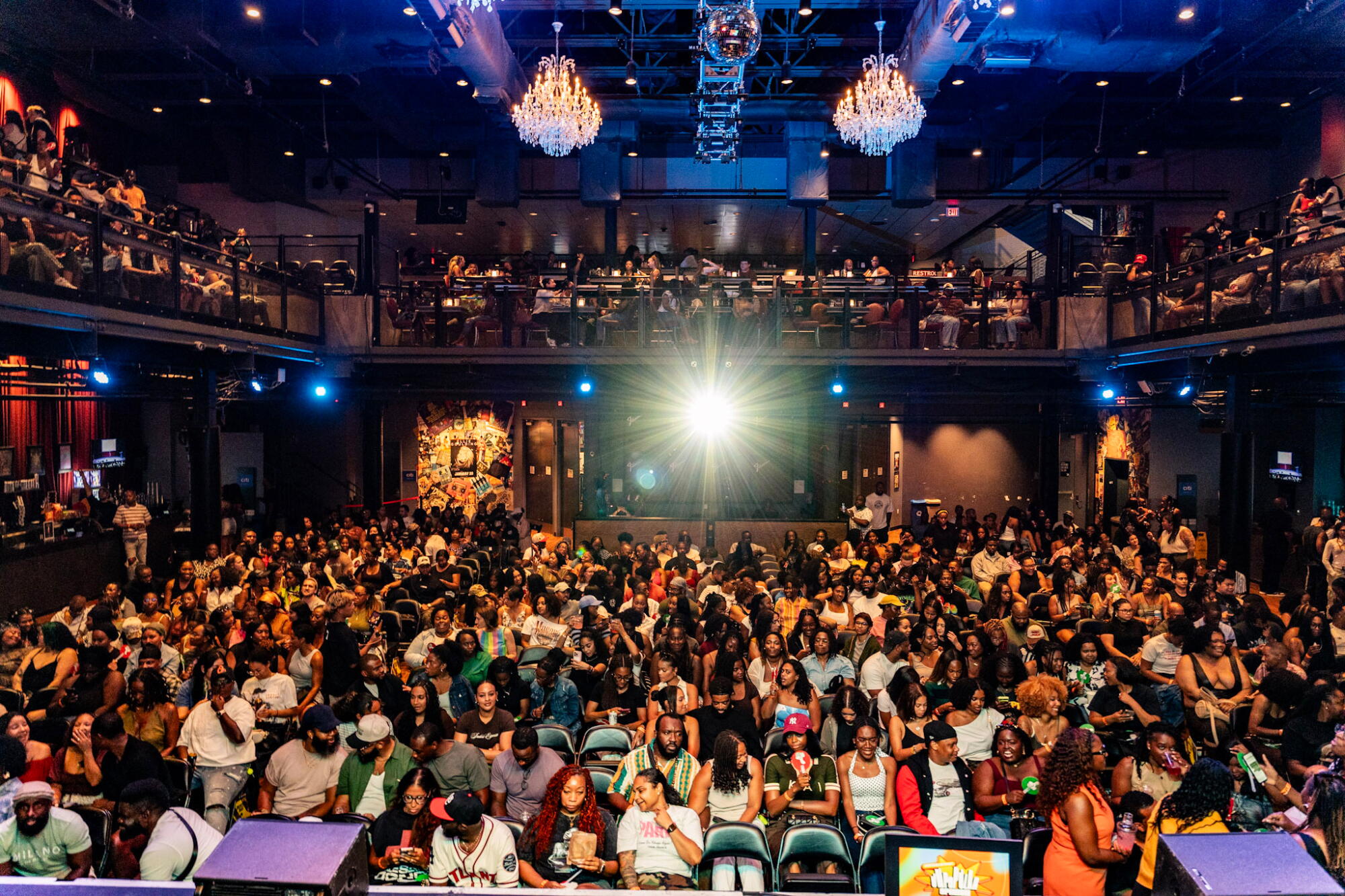
These are just some of the bold, controversial statements that have come up at “Unpopular Opinion,” a live, interactive event where people share and defend their hot takes in front of a spirited audience. To support their claims, they present slide decks filled with graphics and memes on a giant screen. Those in the crowd gasp, cheer and laugh.
The crowd from a past “Unpopular Opinion” event. The viral series is coming to the Regent Theater in L.A.
(Quest Hollis / SideQuest Visuals)
The event was created by Chance Albury and Sarah Prince, founders of the Washington, D.C.-based experiential production company Something Different. People were already having these types of impassioned conversations online, Albury says, and they simply wanted to provide that space in real life.
They debuted the series in February, and after recaps of events went viral, they decided to take it on tour. “Unpopular Opinion” makes a stop in Los Angeles on Thursday at the Regent Theater.
“Who knew rage-baiting could be such a unifier?” Albury says.
“Everyone loves to argue,” Prince adds.
Albury says that the success of the show relies on having different perspectives and opinions in the room. The slide decks are also a major draw. Unpopular Opinion is one of several events that takes PowerPoint-style presentations out of their traditional setting — the office or the classroom — and puts them front and center in a social scene. Over the last few years, slide decks have shown up at house parties, matchmaking events and even in bars at gatherings like Lectures on Tap.
Anyone who wants to present can submit their hot take through an application form. Albury and Prince receive roughly 50 submissions for each event, but only about seven to nine are selected.
Presenters defend their hottest takes on stage using slides and passion.
(Quest Hollis / SideQuest Visuals)
“There’s just so many topics that you can talk about so it can’t get old,” says Prince, adding that a lot of the speakers are funny and present like stand-up comedians.
Typically hosted at a live music venue, the vibe of “Unpopular Opinion” feels like a boisterous late-night game show. Drinks are available for purchase at the bar. A live DJ plays a mix of hip-hop, pop and other high-energy genres as a host hypes up the crowd. As an icebreaker, audience members are asked to submit their own unpopular opinions to be displayed on the screen for everyone to see.
Then the main event begins. Presenters are given 10 minutes to make their case. Unlike a traditional debate tournament, audience members are encouraged to get involved and make their thoughts known.
“There’s just so many topics that you can talk about so it can’t get old,” says co-founder Sarah Prince.
(Quest Hollis / SideQuest Visuals)
After each pitch, the host asks audience members to hold up their paddle, which has a green thumbs up and a red thumbs down to indicate whether they agree or disagree. Then a mic is passed around so attendees can share their thoughts or rebuttals.
Though the event is called “Unpopular Opinion,” there are times when the majority of the crowd agrees with the presenter. There are also times when the audience strongly disagrees. In either case, Albury and Prince ask that attendees are respectful to one another.
The presentation topics range drastically, from lighthearted social media discourse (“Women standing behind the DJ booth is more embarrassing than men”) to hot-button dating debates (“Splitting the bill on the first date is fine”) to deeper societal issues (“People hate everything about slavery but Christianity”).
Albury and Prince say they are exploring ways to bring “Unpopular Opinion” “beyond the show doors” for those who can’t make it to a live event. They already post man-on-the-street-style interviews on social media, in which they ask people to weigh in on hot button questions.
Albury says the beauty of “Unpopular Opinion” is that it shows people it’s OK to disagree. “Just because we have different opinions doesn’t mean we can’t talk about it,” she says. “We may not even come to terms on agreeing or disagreeing, but we’ve got that space.”
‘Unpopular Opinion,’ hosted by Something Different
When: Oct. 1. Doors open at 7 p.m. and showtime is at 8 p.m. Where: Regent Theater, 448 S. Main St., Los Angeles Info: Tickets start at $48.60 (including fees). Must be 21+ to enter.
It’s relatively easy to find USC and UCLA fans in Southern California, but where can proud Georgia, Michigan, Florida or Alabama fans go to watch games in the Los Angeles area with like-minded sports expats?
Look no further than the Los Angeles Times’ ultimate SoCal college football sports bar guide.
If you’re an alum or fan of teams from the Power Four conferences — the ACC and ally Notre Dame, Big Ten, Big 12 and SEC — this guide will lead you to your tribe. No longer will you be the only person cheering and clapping at the bar when Oklahoma scores a touchdown or walk into a bar wearing Michigan blue and only seeing others decked out in Ohio State gear.
Find your home away from home on game day.
Scroll down or filter through location to find where fan bases for most Power 4 schools hang out during the game.
Excluding Ra’am and the Joint List leaves Palestinian citizens in Israel without major Knesset representation options.
Published On 24 Sep 202624 Sep 2026
Israel’s Central Elections Committee has voted to bar both main Arab electoral lists from next month’s election, putting the political representation of Palestinian citizens of Israel before the Supreme Court weeks before voters go to the polls.
The committee voted on Wednesday to disqualify the United Arab List, or Ra’am, led by Mansour Abbas, and the Joint List, an alliance of the Arab-led Hadash, Ta’al and Balad parties. It also voted separately to bar Hadash legislator Ofer Cassif and Balad leader Sami Abu Shehadeh. The election is scheduled for October 27.
Recommended Stories
list of 4 itemsend of list
The bans are not final. Decisions against individual candidates require Supreme Court approval, while lists can appeal their exclusion. Adalah, the legal centre representing the parties and candidates, says it will challenge the votes when the court hears the cases next week.
Ra’am called its exclusion “political and unacceptable”, saying the decision was intended to prevent it from influencing the balance of power and changing the government.
The Joint List said Israeli Prime Minister Benjamin Netanyahu and far-right National Security Minister Itamar Ben-Gvir were trying to discourage Arab citizens from voting “because they fear our ability to bring down the government of genocide and racism”. Its leader, Yousef Jabareen, questioned how the committee could bar parties representing more than 1.25 million voters.
Abu Shehadeh told Al Jazeera that his exclusion was an attempt to silence criticism of government policy and said the decisions would be challenged in court and through public protest. Rejecting the allegation that he supports violence, he told The Times of Israel: “I have never called for violence or terrorism. I oppose armed struggle.”
The petitions invoke Section 7A of Basic Law: The Knesset, which allows a list or candidate to be excluded for denying Israel’s existence as a “Jewish and democratic state”, inciting racism or supporting armed struggle against Israel by an enemy state or an organisation designated as terrorist.
Netanyahu’s Likud party sought to disqualify the Joint List and Cassif, and was among the groups that filed against Ra’am. Ben-Gvir’s Otzma Yehudit party also sought to bar Abu Shehadeh. Adalah disputes the allegations. It says the case against Ra’am presents no evidence that the party supports armed struggle, while the Joint List petition relies heavily on old material, including bills proposed in previous Knessets.
Israel’s Minister of National Security Itamar Ben-Gvir speaks with Prime Minister Benjamin Netanyahu during a session at the Knesset, Israel’s parliament, in Jerusalem, July 16, 2026 [File: Ronen Zvulun/Reuters]
Abu Shehadeh’s case has drawn a different response. Attorney General Gali Baharav-Miara found no legal basis to exclude the other targeted parties and candidates but said an article he published on October 8, 2023, which she said may constitute support for armed struggle, warranted serious examination. The committee voted 31-4 to bar him. Adalah says the article contains no such call.
The push to bar Abu Shehadeh drew support from parties outside Netanyahu’s coalition. According to The Times of Israel, opposition parties voted to disqualify him, as did Supreme Court Justice Noam Sohlberg, who chairs the elections committee. The vote broke with decades of precedent in which committee chairs abstained from disqualification votes. Abu Shehadeh’s exclusion still requires approval from the full Supreme Court.
Why the Arab vote matters
Ra’am joined the coalition government formed by Naftali Bennett and Yair Lapid in 2021, helping end Netanyahu’s 12 consecutive years in office in 2021, although Abbas had previously discussed cooperation with Netanyahu as well. Now Likud itself has filed petitions against Arab representation, while Ben-Gvir’s party has pursued separate exclusions.
A Channel 12 poll published on Tuesday projected seven seats for the Joint List and five for Ra’am, against 50 for Netanyahu’s current coalition bloc. The 12 projected Arab seats would not automatically back Netanyahu’s opponents, as mainstream opposition parties remain divided over whether to govern with Arab support. But removing both lists would change the possible routes to the 61-seat majority needed to form a government.
The Supreme Court has overturned previous committee bans on Arab lists and candidates, including Balad’s exclusion in 2022. It must now decide whether the evidence meets the legal threshold for barring the two principal lists seeking to represent Palestinian citizens of Israel. The ruling will determine who can appear on the October ballot.
Normally when a telephone rings inside a bar, it’s the duty of the staff to pick it up. But when an old-timey rotary dial phone suddenly springs to life at the Last Canteen, it’s up to guests to decide what to do next.
Answer it — or attempt to make a call from it — and you’ll encounter one of dozens of pre-recorded messages. They’re calls from an imagined future, one when a war-torn America is on the mend from some sort of apocalyptic catastrophe. They’re messages, perhaps, for the bar’s fictional founder, a shotgun-carrying mysterious woman known for her mean bartering skills, or maybe if you’re lucky, you will dial into what sounds like an early 20th century party line and hear from those looking for a date in the Valley, now a neutral zone among warring factions.
You’re reading Mr. Todd’s Wild Ride newsletter
Todd Martens’ newsletter delivers news and commentary on the past, present and future of theme parks, right from the theme park capital of the world — Southern California.
By continuing, you agree to our Terms of Service, which include arbitration and a class action waiver. You agree that we and our third-party vendors may collect and use your information, including through cookies, pixels and similar technologies, for the purposes set forth in our Privacy Policy such as personalizing your experience and ads.
The Last Canteen, situated on a stretch of Ventura Boulevard that’s just a short walk from the Universal City metro and minutes from Universal Studios Hollywood, is a new restaurant and bar that looks lifted from a theme park. It also feels like a throwback to an earlier time, when Los Angeles was an epicenter of the themed restaurant.
Southern California has a storied history when it comes to themed establishments. There’s our penchant for food-shaped eateries, of course — see our giant doughnuts or the Tail o’ the Pup — but dinner with a side of story is a Los Angeles-area staple that predates any corporate chains such as Rainforest Cafe or Chuck E. Cheese. From the long-forgotten Jail Cafe in the 1920s to our region’s birth of the tiki bar to the themed restaurant explosion of the ‘80s and ‘90s, when even Steven Spielberg got into the action with the submarine-focused DIVE! in Century City, the themed restaurant has long found a receptive audience in Southern California.
And the Last Canteen feels especially built for our moment.
The Last Canteen’s three founders were going for a lived-in feel.
(Eric Thayer / Los Angeles Times)
Taking influence from the likes of “Mad Max,” “Fallout” and a host of other dystopian, postapocalyptic media, the Last Canteen is a bar for an era — and a city — when the future seems especially uncertain. Whether it’s AI, corporate consolidation, inflation or the struggles of Hollywood that’s got you down, the Last Canteen wants to be your “Cheers” of sorts.
“It’s not the brightest of times, I would say for most of the world, but certainly younger generations are feeling like we got the rug pulled over us — the state of the economy and corporate overreach,” says Jimmy Clements, 32, who founded the Last Canteen with two other friends from the hospitality industry.
“We always joke that the world is ending, but there’s some charm in fully embodying what that would mean, and realizing there’s something on the other side,” he adds. “That’s what attracts me to the genre. OK, the worst thing possible happened, but there’s still people on the other side. We still need community and a place to eat and drink.”
A grenade fashioned out of a baseball is one of the items hidden in the Last Canteen.
(Eric Thayer / Los Angeles Times)
Or as Clements’ partner TJ Lewis says, “Who doesn’t watch ‘Mad Max’ and dream of riding on top of a crazy car with a spike in your hand?”
Despite a potentially bleak concept, the Last Canteen is open and welcoming. The color palette is soft, leaning heavily on dust-like sandy vibes, the cocktail menu takes influence from the fruity, complex world of tiki bars, and a sense of humor permeates the main dining room.
Yes, a demolition bomb, which is actually a movie prop from Angelina Jolie’s “Unbroken,” hangs from the ceiling, but take a moment to explore the venue and you’ll find grenades colorfully fashioned out of baseballs, or rewritten maps of the Valley in its new “Wasteland” era. Universal Studios’ famed minion still stands, but the Ikea is now a “hall of justice.”
Newspapers dot the walls. They’re filled with fiction that tell of the bar’s new reality, giving the place a sense of history and lore. One article, for instance, speaks of a battle that broke out near the remnants of US-101 next to the old “sidewalk stars site.” Another tells of how the bar’s founder took over the land where the establishment now stands. By force, of course. And don’t miss the beer taps, fashioned out of bullets, guns and baseball bats.
The Last Canteen is a themed bar that feels ripe for our era, one in which the future is filled with uncertainty.
(Eric Thayer / Los Angeles Times)
“It’s the difference for us between immersive and themed,” says Lewis. “Like the Hard Rock Cafe is themed. It’s got music on the wall, but you don’t feel like you’re at a concert when you’re there. It’s not immersive. What we were really going for is a lived-in space. We didn’t cover this in ‘Max Max’ posters. It is in the world of. It’s really open-ended. All the details on the wall help paint a picture.”
Of course there were limits. The team jokes that if they really wanted to exploit the dystopian theme, then drinks should likely be served in red plastic cups. Instead, the Last Canteen has proper drinkware, but each type of glass does come from a different set, as the owners wanted to give it a found materials vibe. The menu doesn’t stray too heavily from bar fare, and there are bowls of bison chili ($18), a burger ($18), a charcuterie plate ($21) and, of course, a “Last Meal,” which is a half grilled cheese, a cup of chili and a glass of sarsaparilla ($25).
The cocktail program, however, is extensive. The blackberry-infused Blackthumb or the spiced A Torch or Rosemary feel like darker twists on brighter, lively tiki fare. For those craving the latter, there is currently a frozen version of a Zombie. Bar founders Clements, Lewis and Drew Aloe say the menu, both cocktails and food, will change seasonally.
The Last Canteen founders Jimmy Clements, from left, TJ Lewis and Drew Aloe.
(Eric Thayer / Los Angeles Times)
And the tiki influence is no accident. The three cite the Disneyland Hotel’s Trader Sam’s as the Last Canteen’s primary influence. Also an inspiration? Oga’s Cantina at Disneyland’s Star Wars: Galaxy’s Edge. Theme parks were on their mind as much as the apocalypse.
“What they do so well is they feel really lived in,” Clements says of Trader Sam’s and Oga’s. “It doesn’t feel like a cute homage. You walk in the door and you’re somewhere else.”
And guests are noticing.
“We had someone opening weekend tell me that this feels like an end-of-the-world Trader Sam’s. Thank you. That’s all we want,” Lewis says.
This week in SoCal theme parks
Fast & Furious: Hollywood Drift is now in daily operations at Universal Studios Hollywood.
(Ronaldo Bolaños / Los Angeles Times)
New coaster. New accolades. New noise complaints. Universal Studios Hollywood officially opened its Fast & Furious: Hollywood Drift last week after months of running the thrill ride in a soft open phase. Fans were happy, with some even calling it the “best” coaster in SoCal. But nearby neighbors in Toluca Lake still want change, arguing that the sound of rider screams from the coaster is disrupting their lives.
Calling all Disney film buffs. Starting this Sunday, Santa Ana’s Frida Cinema will begin hosting a weekly “Walt Disney Studios” film series hosted by historian/educator Jeff Kurtti. First up is “20,000 Leagues Under the Sea,” which will also feature a presentation from artist/designer Kevin Kidney, who over the years has contributed to many a Disney parks project. Other Sunday screenings will include “Alice in Wonderland,” “Disneyland Handcrafted,” “Swiss Family Robinson” and more. Check out the full series here.
And speaking of “Disneyland Handcrafted.” It’s the last call for tickets to a stellar Disneyland history and charity event at Santa Ana’s Bowers Museum, which on Sunday will screen the Leslie Iwerks documentary as well as host a reception and panel. Historian and author Tim O’Day will moderate a talk that includes the film’s producer, Mark Catalena, former Imagineer-turned-historian Tom Morris and current Imagineer Emily “Emo” O’Brien, who oversees creative at Disneyland and is leading the team behind the just-announced makeover of Tomorrowland. Tickets start at $125 and are on sale now.
Ride report
The concluding, trippy scene in Inked, a new maze from Knott’s Scary Farm.
(Todd Martens / Los Angeles Times)
As we get deeper into Halloween season, I wanted to highlight another haunted maze, this one being the best one at this year’s Knott’s Scary Farm event. Inked is the maze, and it’s set in a 1930s cartoon studio. While of course having the requisite number of scare actors who will pounce on guests after they turn any corner, the maze also charms as it features original animation in the style of Disney’s classic “Silly Symphony” cartoons. Nearly every room in the haunted house boasts a cartoon scene starring a cutesy ghost, a little cat and an often sad pumpkin man.
The story is the drawn figures have come to life and are now murderous, but you’ll wish you could stop and watch a graveyard short or hang with a jazzy skeleton band. Giant pumpkin heads are animated with cartoon eyes and a mirror-heavy psychedelic scene, pictured above, brings the maze to a fiery conclusion. Knott’s is perhaps relying too heavily on returning mazes of late, but Inked is a winner.
Tell us your stories. Ask us your questions.
Have a theme park tale to share? Whether it was a good day or less-than-perfect day, I would love to hear about it. Have a question? A tip? A fun photo from the parks to share? Email me at todd.martens@latimes.com. I may feature your note in an upcoming newsletter.
Ride on,
Todd Martens
P.S.
Magic Mountain’s currently shuttered X2 coaster has been in the news of late.
The X2 ride has for years been the Valencia park’s crown jewel, the first roller coaster in the world that spun riders 360 degrees in their seats. It even topped my ranking of thrill rides at the park. I wrote that it was a risky choice, as the coaster is not for the faint of heart. Its seats extend off the track, giving you a sensation of flight at its most chaotic, with an assortment of loops that suddenly shift direction and segue into drops. Due to the constantly changing direction of its seats, the path of the track can be hard to discern.
But X2 has come under close inspection after several lawsuits allege people were injured on the ride. Six Flags shut down X2 in July amid a state investigation into the coaster. The Times’ Fedor Zarkhin has the story.