ballot

Voter ID appears headed for California’s November ballot. What you should know

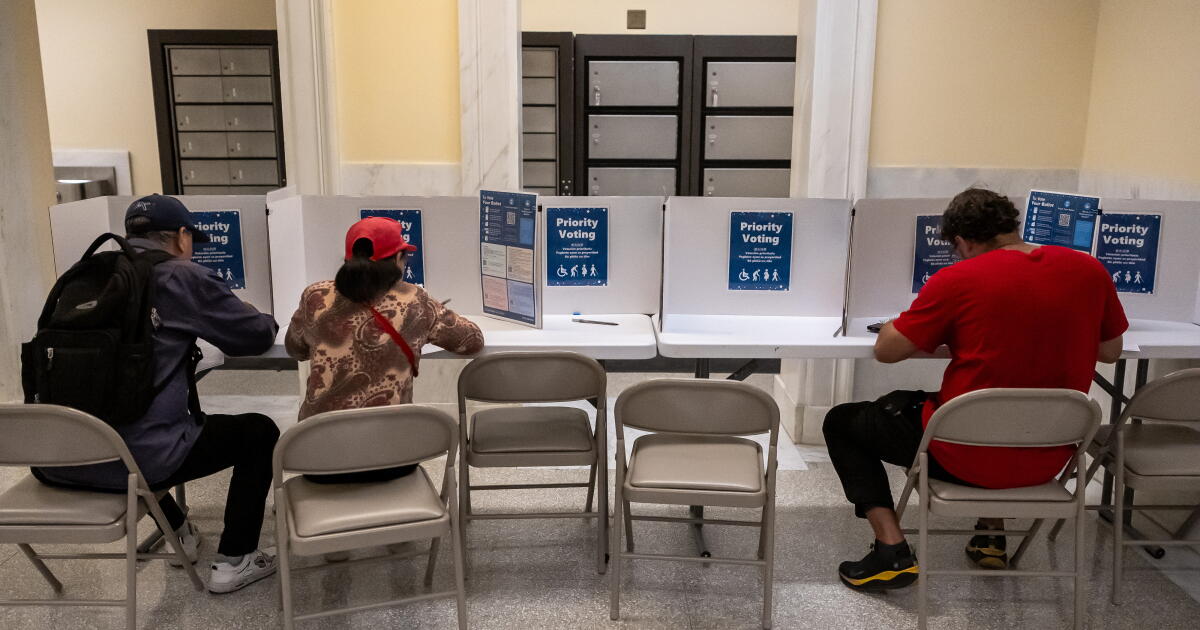
A proposed initiative to require Californians to show identification every time they vote, and election officials to verify registered voters are U.S. citizens, appears to have enough support to qualify for the November ballot.

Proponents say they have collected more than 1.3 million voter signatures on petitions supporting the ballot measure, far more than required under California law, and plan to submit them to county elections officials Monday for verification.

The Republican-led push for the voter ID initiative comes at a time of growing distrust in the integrity of the electoral process nationwide, a wariness intensified by President Trump’s baseless claims that the 2020 election was stolen from him and false assertions that droves of undocumented immigrants are swaying elections with illegal votes.

Proponents of voter ID contend that such laws prevent election fraud and, along with proof of citizenship mandates, prevent noncitizens from voting. Opponents say ID mandates threaten the fundamental constitutional rights of Americans who do not have the mandated documentation readily available, and that the restrictions are unnecessary given that voting by noncitizens is rare and already outlawed in the U.S.

The partisan divide over whether voters must provide proof of U.S. citizenship when registering to vote, one of Trump’s top priorities, continues to consume Washington. House Republicans passed the mandate in early February but the legislation — known as the SAVE Act — has bogged down in the Senate.

Democrats say that under the SAVE Act, many state driver’s licenses would not be adequate documentation to prove U.S. citizenship, forcing people to produce a passport or birth certificate — which many voters do not have. According to a 2023 survey by the Brennan Center for Justice and others, 9% of U.S. adult citizens do not have proof of their citizenship that’s readily available. The survey found that 11% of adult citizens of color were unable to readily access those documents, compared with 8% for white American adults. They accused Republicans of trying to prevent millions of Americans from voting in the next election in order to keep Congress under GOP control.

UC Berkeley Law School Dean Erwin Chemerinsky said that both the SAVE Act and proposed ballot measure in California are not only unnecessary, but harmful to democracy.

“Both are aimed at solving problems that don’t exist,” Chemerinsky said. “There is no evidence of a problem of non-citizens voting. Nor is there evidence of significant fraud with voters casting votes under false names. But both would limit who can vote. As for the SAVE Act, many people don’t have a birth certificate or passport.”

 U.S. House Speaker Mike Johnson (R-La.) speaks during a news conference.

U.S. House Speaker Mike Johnson (R-La.) speaks during a news conference on Feb. 11 at the U.S. Capitol. Johnson was joined by Republicans to speak about the passage of the SAVE America Act, an election bill backed by President Donald Trump that would require proof of citizenship to register to vote and require photo identification at the ballot box.

(Michael M. Santiago / Getty Images)

Rep. Ken Calvert (R-Corona), who supports and voted for the SAVE Act, said it is a simple way to restore voter confidence in elections. But he said the bill’s fate appears grim.

“I don’t think they have the votes,” Calvert said Friday.

Which is why, Calvert says, California must join other states and enact commonsense voter ID and citizenship requirements that can attract bipartisan support. The longtime Republican congressman said he does not believe there has been widespread voter fraud in the U.S., or a that a flood of noncitizens has been voting, but that does not mean those have not happened to some degree and would sway both tightly contested local elections and congressional races.

“I’ve always said it’s probably a small amount, but it’s enough to change an outcome of elections, and could change the numbers we have in Congress,” Calvert said.

The California ballot measure

The petitions being submitted for the California Voter ID Initiative will be reviewed by county election officials, who must verify that the people who signed are registered voters in the state and that the proponents collected at least the 874,641 valid signatures required to qualify for the November ballot.

The ballot measure will make significant changes to how Californians vote, and enact new mandates on county elections officials. Among the top changes being proposed:

  • Every time a voter casts a ballot in person in any election in California, they must present government-issued identification.
  • Californians voting by mail will be required to list on the ballot envelope the last four digits of a “unique identifying number from a government issued identification” — essentially a pin number like people use at an ATM — that matches the one the voter designated when they registered to vote.
  • The California secretary of state and county election officials will be required to verify that registered voters are U.S. citizens by “using government data,” which according to supporters could include information in the federal Social Security Administration database, jury summons information and other government records.
  • The secretary of state and county election officials must maintain accurate voter registration lists.
  • If requested, the state would be required to a provide eligible voters with free voter identification cards for use during elections.

“We’re creating the legal obligation that in California, when we do voting, we want our election officers to actually give a damn about whether someone’s a citizen,” said Assemblymember Carl DeMaio (R-San Diego), one of the main forces behind the proposed ballot measure. “That’s what we’re asking. That’s why voters support this, because it’s not a burden on the voter. It really is a burden on the election officers to do their job.”

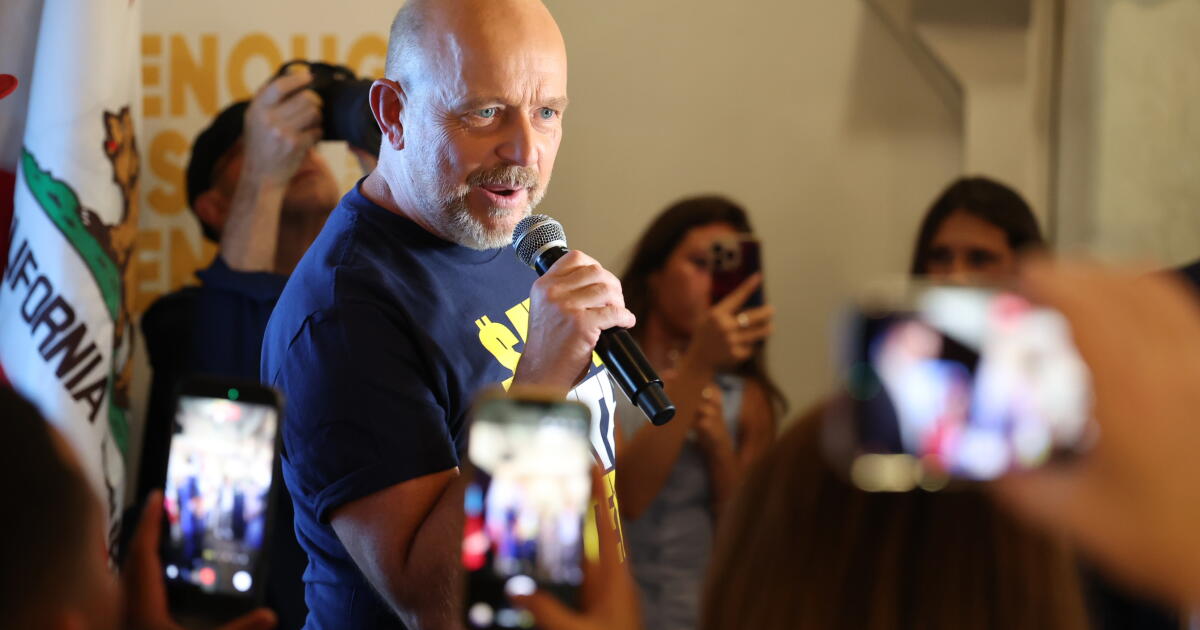
Republican Assemblymember Carl DeMaio speaks at a press conference.

Republican Assemblymember Carl DeMaio of San Diego speaks at a press conference in July to announce a campaign to require voter identification in California.

(Tran Nguyen / Associated Press)

But Jenny Farrell, executive director of the League of Women Voters of California, called the proposed ballot measure an underhanded attempt by Trump and Republicans to make it even harder for people in the state to vote — which they see as a political advantage. The Californians who will suffer the most are “communities of color, people with disabilities, elderly folks, folks who move around a lot, folks who have recently experienced a name change.”

“California elections are already secure. This initiative isn’t really about election integrity. It’s part of this broader national playbook from President Trump and the current federal administration to make voting harder and to create doubts in the minds of the public and to really sow chaos on election day,” Farrell said. “The measure would create new strict barriers for eligible voters. It could wrongfully flag naturalized citizens, and it will create new ways to challenge results.”

Noncitizens who vote in California risk being charged with a felony and deported, she said.

Farrell’s organization has joined with the ACLU of Northern and Southern California, Common Cause, Disability Rights California and other groups to oppose the proposed measure.

The nonpartisan Legislative Analysts Office estimates the new requirements under the proposed ballot measure could potentially cost state and local governments “tens of millions of dollars to the low hundreds of millions of dollars” annually.

What’s the law now in California?

Currently, 36 states require or request that voters provide identification at the time they cast a ballot, and 10 states have strict laws requiring people to produce government-issued photo IDs, according to the National Conference of State Legislatures.

Under current law, Californians are not required to show or provide identification when casting a ballot in person or by mail. They are required to provide identification when registering to vote, and must swear under penalty of perjury, a felony, that they are eligible to vote and a U.S. citizen.

To register to vote, Californians must provide their driver’s license number or state identification card number and the last four digits of their Social Security number, along with other information. The state is required to validate the information using relevant databases, including records at the state Department of Motor Vehicles and Social Security Administration.

Along with a driver’s license, U.S. passport or state identification card, acceptable identification also can include photo identification cards issued by a school, a credit card company, a gym, an insurance company, an employer or a public housing agency. Californians have the option of providing certain other documents, as long as they contain the person’s name and address, including: utility bills, bank statements, government checks, rental statements or government-issued bus passes.

First-time voters who did not present identification when they registered to vote must present ID the first time they cast a ballot in a federal election.

When ballots are sent by mail, election officials are required to verify a voter’s signature on the ballot by comparing it with the signature on the official voter registration records on file.

Source link

Ballot proposal may change pay for L.A. County deputies, firefighters

Los Angeles County leaders are pushing forward a measure for the November ballot that would remove their ability to have final say on one of the costliest decisions they make: How much to pay firefighters and sheriff’s deputies.

The supervisors voted 4 to 0 on Tuesday to have their lawyers draft a ballot measure that would give final decision-making power in contract disputes regarding pay and working conditions for public safety workers to a three-person panel, a practice known as binding arbitration.

Supporters say the proposal, which the supervisors are pushing to get on the November ballot, would offer a new tool to smooth over disputes and provide a “reset” after recent tumultuous contract negotiations.

“It incentivizes both parties to come to a fair agreement,” said Supervisor Lindsey Horvath, who introduced the measure along with Supervisor Hilda Solis.

The supervisors are expected to vote again on the proposal in the coming months before putting it on the ballot.

Currently, if contract talks hit an impasse, the five county supervisors can, after a complex mediation process, impose a final offer. Public safety workers, who are not allowed to strike, say they have no leverage with which to fight back, giving the county final word.

Under the new proposal, the power dynamics would shift. An arbitration panel would instead make the final decision on some contract disputes for public safety employees, including firefighters, sheriff’s deputies and county lifeguards. The panel would have one arbitrator chosen by the county, one chosen by the union and one agreed to by both sides.

It’s rare for labor negotiations to get to this point. The county said it has imposed contract terms after reaching impasse over negotiations twice since 2001, once with the Union of American Physicians and Dentists in 2001 and Supervising Deputy Probation Officers in 2024.

“The goal is to never have to get to that step,” Horvath said.

Unions say the measure would give them needed leverage and remove political pressure from the thorniest contract questions. Critics say it shifts financial control away from politicians and into the hands of unaccountable arbitrators, which could lead to bloated labor costs.

“Arbitrators aren’t elected, they’re not required to weigh countywide trade-offs like homeless services, healthcare, capital improvements, all of those things,” said Supervisor Holly Mitchell, the only supervisor to abstain from the vote.

Interim County Executive Officer Joseph M. Nicchitta said he viewed it as a potential “seismic change” in how the county handles labor negotiations.

“Because the arbitrators ‘pick a winner’ as between the parties’ final offers, the decision will no longer be a compromise. One side will win,” Nicchitta wrote in a Feb. 9 letter to the board.

Substantial raises mandated by arbitrators, he wrote, “could, among other things, materially and detrimentally increase the County’s day-to-day operating costs, lead to workforce reductions and program curtailments, balloon our unfunded pension liabilities, and damage the County’s credit ratings.”

The decision of who gets final say over wage increases will become increasingly important as county leaders try to steer the government through financial tumult brought on by federal cuts, booming labor costs and billions in sex abuse payouts. Last week, the supervisors unanimously approved $200 million in homeless service cuts to close the budget gap.

Horvath said more than 20 jurisdictions in California use binding arbitration for public safety workers, including the counties of San Francisco and Sacramento.

Public safety unions are simultaneously gathering signatures to get the proposal on the ballot in case the board decides against moving forward. A coalition of public safety unions has started a campaign arguing that binding arbitration would “remove politics from pay decisions” and leave “pay decisions in the hands of neutral experts.”

“They have every intention and probably all of the resources needed to collect signatures to put something on the ballot that gets them this,” Supervisor Janice Hahn said. “This makes sense to work on something that we can have some input in.”

Source link

How California is preparing to fend off federal interference in 2026 election

In recent weeks, Marin County Registrar Natalie Adona has been largely focused on the many mundane tasks of local elections administrators in the months before a midterm: finalizing voting locations, ordering supplies, facilitating candidate filings.

But in the wake of unprecedented efforts by the Trump administration to intervene in state-run elections, Adona said she has also been preparing her staff for far less ordinary scenarios — such as federal officials showing up and demanding ballots, as they recently did in Georgia, or immigration agents staging around polling stations on election day, as some in President Trump’s orbit have suggested.

“Part of my job is making sure that the plans are developed and then tested and then socialized with the staff so if those situations were to ever come up, we would not be figuring it out right then and there. We would know what to do,” Adona said. “Doing those sort of exercises and that level of planning in a way is kind of grounding, and makes things feel less chaotic.”

A woman with long black hair, black T-shirt and a shawl poses against a wall framed by shadows.

Natalie Adona faced harassment from election deniers and COVID anti-maskers when she served as the registrar of voters in Nevada County. She now serves Marin County and is preparing her staff for potential scenarios this upcoming election, including what to do if immigration agents are present.

(Jess Lynn Goss / For The Times)

Across California, local elections administrators say they have been running similar exercises to prepare for once unthinkable threats — not from local rabble-rousers, remote cyberattackers or foreign adversaries, but their own federal government.

State officials, too, are writing new contingency plans for unprecedented intrusions by Trump and other administration officials, who in recent days have repeated baseless 2020 election conspiracies, raided and taken ballots from a local election center in Fulton County, Ga., pushed both litigation and legislation that would radically alter local voting rules, and called for Republicans to seize control of elections nationwide.

California’s local and state officials — many of whom are Democrats — are walking a fine line, telling their constituents that elections remain fair and safe, but also that Trump’s talk of federal intervention must be taken seriously.

Their concerns are vastly different than the concerns voiced by Trump and other Republicans, who for years have alleged without evidence that U.S. elections are compromised by widespread fraud involving noncitizen voters, including in California.

But they have nonetheless added to a long-simmering sense of fear and doubt among voters — who this year have the potential to radically alter the nation’s political trajectory by flipping control of Congress to Democrats.

An election worker moves ballots to be sorted.

An election worker moves ballots to be sorted at the Orange County Registrar of Voters in Santa Ana on Nov. 5, 2024.

(Allen J. Schaben / Los Angeles Times)

Trump has said he will accept Republican losses only if the elections are “honest.” A White House spokesperson said Trump is pushing for stricter rules for voting and voter registration because he “cares deeply about the safety and security of our elections.”

Rick Hasen, an election law expert and director of the Safeguarding Democracy Project at UCLA Law, said some of what Trump says about elections “is nonsensical and some is bluster,” but recent actions — especially the election center raid in Georgia — have brought home the reality of his threats.

“Some worry that this is a test run for trying to seize ballot boxes in 2026 and prevent a fair count of the votes, and given Trump’s track record, I don’t think that is something we can dismiss out of hand,” Hasen said. “States need to be making contingency plans to make sure that those kinds of things don’t happen.”

The White House dismissed such concerns, pointing to isolated incidents of noncitizens being charged with illegally voting, and to examples of duplicate registrations, voters remaining on rolls after death and people stealing ballots to vote multiple times.

“These so-called experts are ignoring the plentiful examples of noncitizens charged with voter fraud and of ineligible voters on voter rolls,” said Abigail Jackson, the White House spokesperson.

Experts said fraudulent votes are rare, most registration and roll issues do not translate into fraudulent votes being cast, and there is no evidence such issues swing elections.

A swirl of activity

Early in his term, Trump issued an executive order calling for voters nationwide to be required to show proof of U.S. citizenship, and for states to be required to disregard mail ballots received after election day. California and other states sued, and courts have so far blocked the order.

This past week, Trump said outright that Republicans should “take over” elections nationwide.

The Justice Department has sued California Secretary of State Shirley Weber and her counterparts in other states for refusing to hand over state voter rolls — the lawsuit against Weber was tossed — and raided and seized ballots from the election office of Fulton County, long a target of right-wing conspiracy theories over Trump’s 2020 election loss.

President Trump walks behind former chairperson of the Republican National Committee Michael Whatley.

President Trump walks behind former chairperson of the Republican National Committee Michael Whatley as he prepares to speak during a political rally in Rocky Mount, N.C., on Dec. 19.

(Andrew Caballero-Reynolds / AFP via Getty Images)

Longtime Trump advisor and ally Stephen K. Bannon suggested U.S. Immigration and Customs Enforcement agents will be dispatched to polling locations in November, reprising old fears about voter intimidation. White House Press Secretary Karoline Leavitt said she couldn’t rule that out, despite it being illegal.

Democrats have raised concerns about the U.S. Postal Service mishandling mail ballots in the upcoming elections, following rule changes for how such mail is processed. Republicans have continued pushing the SAVE America Act, which would create new proof of citizenship requirements for voters. The U.S. Supreme Court is considering multiple voting rights cases, including one out of Louisiana that challenges Voting Rights Act protections for Black representation.

Charles H. Stewart, director of the MIT Election Data + Science Lab, said the series of events has created an “environment where chaos is being threatened,” and where “people who are concerned about the state of democracy are alarmed and very concerned,” and rightfully so.

But he said there are also “a number of guardrails” in place — what he called “the kind of mundane mechanics that are involved in running elections” — that will help prevent harm.

California prepares

California leaders have been vociferous in their defense of state elections, and said they’re prepared to fight any attempted takeover.

“The President regularly spews outright lies when it comes to elections in this country, particularly ones he and his party lose,” Gov. Gavin Newsom said in a statement. “We will continue to correct those lies, rebuild much-needed trust in our democratic institutions and civic duties, and defend the U.S. Constitution’s grant to the states authority over elections.”

California Atty. Gen. Rob Bonta and Secretary of State Shirley Weber.

California Atty. Gen. Rob Bonta and Secretary of State Shirley Weber take questions after announcing a lawsuit to protect voter rights in 2024.

(Damian Dovarganes / Associated Press)

California Atty. Gen. Rob Bonta said in an interview that his office “would go into court and we would get a restraining order within hours” if the Trump administration tries to intervene in California elections, “because the U.S. Constitution says that states predominantly determine the time, place and manner of elections, not the president.”

Weber told The Times that the state has “a cadre of attorneys” standing by to defend its election system, but also “absolutely amazing” county elections officials who “take their job very seriously” and serve as the first line of defense against any disruptions, from the Trump administration or otherwise.

Dean Logan, Los Angeles County’s chief elections official, said his office has been doing “contingency planning and tabletop exercises” for traditional disruptions, such as wildfires and earthquakes, and novel ones, such as federal immigration agents massing near voting locations and last-minute policy changes by the U.S. Postal Service or the courts.

“Those are the things that keep us up at night,” he said.

Los Angeles County Registrar-Recorder Dean Logan said the county no longer has ballots from the 2020 election.

Los Angeles County Registrar-Recorder Dean Logan said the county no longer has ballots from the 2020 election.

(Irfan Khan / Los Angeles Times)

Logan said he is not currently concerned about the FBI raiding L.A. County elections offices because, while Fulton County still had its 2020 ballots on hand due to ongoing litigation, that is not the case for L.A. County, which is “beyond the retention period” for holding, and no longer has, its 2020 ballots.

However, Logan said he does consider what happened in Georgia a warning that the Trump administration “will utilize the federal government to go in and be disruptive in an elections operation.”

“What we don’t know is, would they do that during the conduct of an election, before an election is certified?” Logan said.

Kristin Connelly, chief elections officer for Contra Costa County, said she’s been working hard to make sure voters have confidence in the election process, including by giving speeches to concerned voters, expanding the county’s certified election observer program, and, in the lead-up to the 2024 election, running a grant-funded awareness campaign around election security.

Connelly — who joined local elections officials nationwide in challenging Trump’s executive order on elections in court — said she also has been running tabletop exercises and coordinating with local law enforcement, all with the goal of ensuring her constituents can vote.

“How the federal government is behaving is different from how it used to behave, but at the end of the day, what we have to do is run a mistake-free, perfect election, and to open our offices and operation to everybody — especially the people who ask hard questions,” she said.

Lessons from the past

Several officials in California said that as they prepare, they have been buoyed by lessons from the past.

Before being hired by the deep-blue county of Marin in May, Adona was the elected voting chief in rural Nevada County in the Sierra foothills.

In 2022, Adona affirmed that Trump’s 2020 election loss to Democrat Joe Biden was legitimate and enforced a pandemic mask mandate in her office. That enraged a coalition of anti-mask, anti-vaccine, pro-Trump protesters, who pushed their way into the locked election office.

Protesters confronted Adona and her staffers, with one worker getting pushed down. They stationed themselves in the hallway, leaving Adona’s staff too terrified to leave their office to use the hallway bathroom, as local, state and federal authorities declined to step in.

“At this point, and for months afterwards, I felt isolated and depressed. I had panic attacks every few days. I felt that no one had our back. I focused all my attention on my staff’s safety, because they were clearly nervous about the unknown,” Adona said during subsequent testimony before the Senate Judiciary Committee.

In part because she knows what can go wrong, Adona said her focus now is on preparing her new staff for whatever may come, while following the news out of Georgia and trying to maintain a cool head.

“I would rather have a plan and not use it than need a plan and not have one,” she said.

Clint Curtis, the clerk and registrar of voters in Shasta County — which ditched its voting machines in 2023 amid unfounded fraud allegations by Trump — said his biggest task ahead of the midterms is to increase both ballot security and transparency.

Since being appointed to lead the county office last spring, the conservative Republican from Florida has added more cameras and more space for election observers — which, during the recent special election on Proposition 50, California’s redistricting measure, included observers from Bonta’s and Weber’s offices.

He has also reduced the number of ballot drop boxes in the vast county from more than a dozen to four. Curtis told The Times he did not trust the security of ballots in the hands of “these little old ladies running all over the county” to pick them up, and noted there are dozens of other county locations where they can be dropped off. He said he invited Justice Department officials to observe voting on Proposition 50, though they didn’t show, and welcomes them again for the midterms.

“If they can make voting safer for everybody, I’m perfectly fine with that,” he said. “It always makes me nervous when people don’t want to cooperate. Whatcha hiding? It should be: ‘Come on in.’”

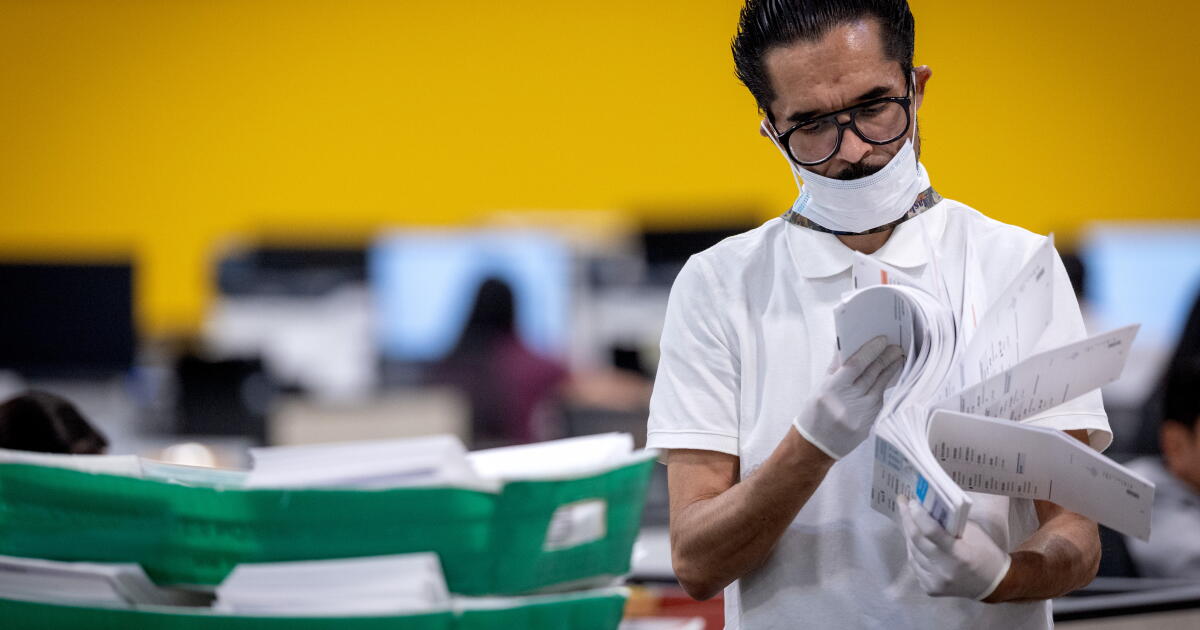
Election workers inspect ballots after extracting them from envelopes.

Election workers inspect ballots after extracting them from envelopes on election night at the Los Angeles County Ballot Processing Center on Nov. 5, 2024, in the City of Industry.

(Gina Ferazzi / Los Angeles Times)

Weber, 77 and the daughter of an Arkansas sharecropper whose family fled Southern racism and threats of violence to reach California, said that while many people in the U.S. are confronting intense fear and doubt about the election for the first time, and understandably so, that is simply not the case for her or many other Black people.

“African Americans have always been under attack for voting, and not allowed to vote, and had new rules created for them about literacy and poll taxes and all those other kinds of things, and many folks lost their lives just trying to register to vote,” Weber said.

Weber said she still recalls her mother, who had never voted in Arkansas, setting up a polling location in their home in South L.A. each election when Weber was young, and today draws courage from those memories.

“I tell folks there’s no alternative to it. You have to fight for this right to vote. And you have to be aware of the fact that all these strategies that people are trying to use [to suppress voting] are not new strategies. They’re old strategies,” Weber said. “And we just have to be smarter and fight harder.”

Source link

California leaders decry Trump call to ‘nationalize’ election, say they’re ready to resist

President Trump’s repeated calls to “nationalize” elections drew swift resistance from California officials this week, who said they are ready to fight should the federal government attempt to assert control over the state’s voting system.

“We would win that on Day One,” California Atty. Gen. Rob Bonta told The Times. “We would go into court and we would get a restraining order within hours, because the U.S. Constitution says that states predominantly determine the time, place and manner of elections, not the president.”

“We’re prepared to do whatever we have to do in California,” said California Secretary of State Shirley Weber, whose office recently fought off a Justice Department lawsuit demanding California’s voter rolls and other sensitive voter information.

Both Bonta and Weber said their offices are closely watching for any federal action that could affect voting in California, including efforts to seize election records, as the FBI recently did in Georgia, or target the counting of mailed ballots, which Trump has baselessly alleged are a major source of fraud.

Weber said California plays an outsized role in the nation and is “the place that people want to beat,” including through illegitimate court challenges to undermine the state’s vote after elections, but California has fought off such challenges in the past and is ready to do it again.

“There’s a cadre of attorneys that are already, that are always prepared during our elections to hit the courts to defend anything that we’re doing,” she said. “Our election teams, they do cross the T’s, dot the I’s. They are on it.”

“We have attorneys ready to be deployed wherever there’s an issue,” Bonta said, noting that his office is in touch with local election officials to ensure a rapid response if necessary.

The standoff reflects an extraordinary deterioration of trust and cooperation in elections that has existed between state and federal officials for generations — and follows a remarkable doubling down by Trump after his initial remarks about taking over the elections raised alarm.

Trump has long alleged, without evidence and despite multiple independent reviews concluding the opposite, that the 2020 election was stolen from him. He has alleged, again without evidence, that millions of fraudulent votes were cast, including by non-citizen voters, and that blue states looked the other way to gain political advantage.

Last week, the Justice Department acted on those claims by raiding the Fulton County, Ga., elections hub and seizing 2020 ballots. The department also has sued states, including California, for their voter rolls, and is defending a Trump executive order purporting to end mail voting and add new proof of citizenship requirements for registering to vote, which California and other states have sued to block.

On Monday, Trump further escalated his pressure campaign by saying on former FBI Deputy Director Dan Bongino’s podcast that Republicans should “take over the voting in at least 15 places,” alleging that voting irregularities in what he called “crooked states” are hurting his party. “The Republicans ought to nationalize the voting.”

On Tuesday morning, Karoline Leavitt, the White House press secretary, appeared to try to walk back Trump’s comments, saying he had been referring to the Save Act, a measure being pushed by Republicans in Congress to codify Trump’s proof-of-citizenship requirements. However, Trump doubled down later that day, telling reporters that if states “can’t count the votes legally and honestly, then somebody else should take over.”

Bonta said Trump’s comments were a serious escalation, not just bluster: “We always knew they were going to come after us on something, so this is just an affirmation of that — and maybe they are getting a step closer.”

Bonta said he will especially be monitoring races in the state’s swing congressional districts, which could play a role in determining control of Congress and therefore be a target of legal challenges.

“The strategy of going after California isn’t rational unless you’re going after a couple of congressional seats that you think will make a difference in the balance of power in the House,” Bonta said.

California Democrats in Congress have stressed that the state’s elections are safe and reliable, but also started to express unease about upcoming election interference by the administration.

Rep. Ro Khanna (D-Fremont) said on Meet the Press last week that he believes the administration will try to use “every tool in their toolbox to try and interfere,” but that the American people will “overcome it by having a battalion of lawyers at the polls.”

California Sen. Adam Schiff this week said recent actions by the Trump administration — including the Fulton County raid, where Director of National Intelligence Tulsi Gabbard put Trump on the phone with agents — were “wrong” and set off “alarm bells about their willingness to interfere in the next election.”

Democrats have called on their Republican colleagues to help push back against such interference.

“When he says that we should nationalize the elections and Republicans should take over, and you don’t make a peep? What is going on here?” Senate Minority Leader Chuck Schumer (D-N.Y.) said Tuesday. “This is the path that has ruined many a democracy, and our democracy is deep and strong, but it requires — and allows — resistance to these things. Verbal resistance, electoral resistance. Where are you?”

Some Republicans have voiced their disagreement with Trump. Senate Majority Leader John Thune (R-S.D.) said Tuesday that he is “supportive of only citizens voting and showing ID at polling places,” but is “not in favor of federalizing elections,” which he called “a constitutional issue.”

“I’m a big believer in decentralized and distributed power. And I think it’s harder to hack 50 election systems than it is to hack one,” he said.

However, other Republican leaders have commiserated with Trump over his qualms with state-run elections. House Majority Leader Mike Johnson (R-La.), for example, took aim at California’s system for counting mail-in ballots in the days following elections, questioning why such counting led to Republican leads in House races being “magically whittled away until their leads were lost.”

“It looks on its face to be fraudulent. Can I prove that? No, because it happened so far upstream,” Johnson said. “But we need more confidence in the American people in the election system.”

Elections experts expressed dismay over Johnson’s comments, calling them baseless and illogical. The fact that candidates who are leading in votes can fall behind as more votes are counted is not magic but math, they said — with Democrats agreeing.

“Speaker Johnson seems to be confused, so let me break it down. California’s elections are safe and secure. The point of an election is to make sure *every* eligible vote cast is counted, not to count fast,” Sen. Alex Padilla (D-Calif.) wrote on X. “We don’t just quit while we’re ahead. It’s called a democracy.”

Democrats have also expressed concern that the administration could use the U.S. Postal Service to interfere with counting mail-in ballots. They have specifically raised questions about a rule issued by the postal service last December that deems mail postmarked on the day it is processed by USPS, rather than the day it is received — which would impact mail-in ballots in places such as California, where ballots must be postmarked by Election Day to be counted.

“Election officials are already concerned and warning that this change could ultimately lead to higher mailed ballots being rejected,” Senate Democrats wrote to U.S. Postal Service Postmaster General David Steiner last month.

Some experts and state officials said voters should make a plan to vote early, and consider dropping their ballots in state ballot drop boxes or delivering them directly to voting centers.

Source link

Georgia’s Fulton County seeks the return of 2020 election ballots and documents seized by the FBI

Georgia’s Fulton County has gone to federal court seeking the return of all ballots and other documents from the 2020 election that were seized by the FBI last week from a warehouse near Atlanta.

Its motion also asks for the unsealing of a law enforcement agent’s sworn statement that was presented to the judge who approved the search warrant, the county chairman, Robb Pitts, said Wednesday. The filing on behalf of Pitts and the county election board is not being made public because the case is under seal, he said.

The Jan. 28 search at Fulton County’s main election facility in Union City sought records related to the 2020 election. Many Democrats have criticized what they see as the use of the FBI and the Justice Department to pursue President Trump’s political foes.

The Republican president and his allies have fixated on the heavily Democratic county, the state’s most populous, since the Republican narrowly lost the election in Georgia to Democrat Joe Biden that year. Trump has long insisted without evidence that widespread voter fraud in the county cost him victory in the state.

“The president himself and his allies, they refuse to accept the fact that they lost,” Pitts said. “And even if he had won Georgia, he would still have lost the presidency.”

Pitts defended the county’s election practices and said Fulton has conducted 17 elections since 2020 without any issues.

“This case is not only about Fulton County. This is about elections across Georgia and across the nation,” Pitts said, citing comments by Trump earlier this week on a podcast where he called for Republicans to “take over” and “nationalize” elections. White House spokesperson Karoline Leavitt has said the president was referring to legislative efforts.

A warrant cover sheet provided to the county includes a list of items that the agents were seeking related to the 2020 general election: all ballots, tabulator tapes from the scanners that tally the votes, electronic ballot images created when the ballots were counted and then recounted, and all voter rolls.

The FBI drove away with hundreds of boxes of ballots and other documents. County officials say they were not told why the federal government wanted the documents.

“What they’re doing with the ballots that they have now, we don’t know, but if they’re counted fairly and honestly, the results will be the same,” Pitts said.

Andrew Bailey, the FBI’s co-deputy director, and Tulsi Gabbard, the director of national intelligence, were seen on-site, at the time. Democrat in Congress have questioned the propriety of Gabbard’s presence because the search was a law enforcement, not intelligence, action.

In a letter to top Democrats on the House and Senate Intelligence committees Monday, she said Trump asked her to be there “under my broad statutory authority to coordinate, integrate, and analyze intelligence related to election security.”

Brumback writes for the Associated Press.

Source link