The actor will this time take the character to Miami for the chaos of the World Cup, involving 48 teams and 16 venues
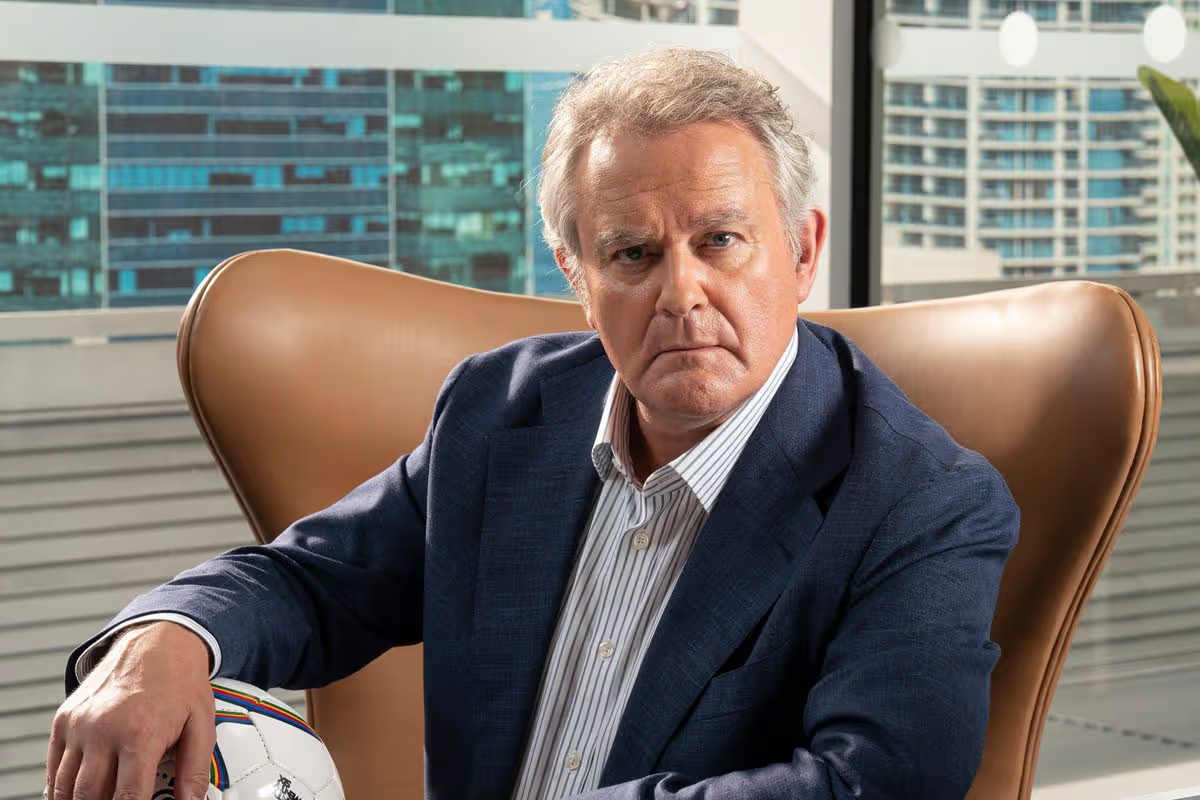
Ian Fletcher is going to have his work cut out as he and Will try to work with an international team on Trump’s World Cup(Image: BBC/Expectation Entertainment/Jack Barnes)
Hugh Bonneville is back as Ian Fletcher, and this time around the BBC’s former Head of Values is in America, dealing with the World Cup.
The Downton star, who first introduced Fletcher in the Olympics-spoofing series Twenty Twelve and then brought him back for W1A, said that playing Ian again was so painful it was akin to a nasty visit to the dentist. “It’s a bit like root canal in that you know there’s a massive well of poison in your mouth and it’s got to be dealt with. And after it’s finished, it’s rather nice,” he laughed. “But the process itself is agony.”
Hugh, 62, says that Ian Fletcher has “evolved” since the last time we saw him. “Although, ‘evolution’ is, of course, an interesting word, conjuring images of change. “If Ian was a lapel pin it would be enamelled with the words, Stay Calm. The seas may be tossed and blown but Ian will be neither tossed and certainly not blown.”
But he questions how much Ian has actually learned from the chaos of his past experiences. “The tragicomedy of life is that we may think we develop and change but actually most of us reset at the end of each day to catastrophically normal and – if we can afford one – a take-away.”
One new element in this series is a potential romance between Ian the terribly keen VP Sustainability Sarah Campbell (Chelsey Crisp).Writer John Morton says he “can’t remember” if the actually happens, while Hugh says cryptically: “During this series Ian’s eyes are opened a teeny bit to emotional opportunity. Then again, he’s also recovering from a detached retina.”
The actor admits his own football experience as the Under 11 B Team goalie at his junior school was an unhappy one. “I was fat and I was rubbish at running up and down. So I was put in goal. It was the days where you wore a padded top as a goalie, which was quite a warm garment, actually. So that was nice. I was quite cosy, toddling up and down in my little goal, pretending to stretch, in my green, figure-hugging little duvet. I don’t think I ever saved a ball.”
Morton said that none of the shows are actually about what they appear to be, and that they all work as standalone programmes. “Although W1A was about the BBC, this appears to be about football and 2012 was about the Olympics, none of them are really about those things,” he explained. “That’s what they’re tussling with on the surface, but underneath is where the real stuff is happening. Anybody that’s trying to organise anything with a group of people will, I hope, recognise this. Those dynamics I think are pretty much universal.”
He said that the BBC was the show’s natural home. “There’s a sort of BBCness about Ian Fletcher, a guy who’s kind of hamstrung by trying to do the right thing all the time. And I have, just personally, a huge amount of respect and affection for the BBC. I think they’re one of the best things we do. I think they’re very, very precious. And W1A was never intended to be a takedown, just as this isn’t, of anybody or anything.”
– Twenty Twenty Six, BBC Two, 10pm, Wednesday 8 April
You might expect a screenwriter working in the horror genre to be relatively difficult to scare, but Haley Z. Boston, the creator and executive producer of Netflix’s harrowing new limited series “Something Very Bad Is Going to Happen,” insists that is not the case.
“I’m afraid of everything,” Boston, 31, said during a recent Zoom conversation. “I’m afraid of horror movies, but that’s why I love them so much, because they scare me. A lot of horror people are desensitized and looking for something to shake them. I am the opposite. I am easily afraid.”
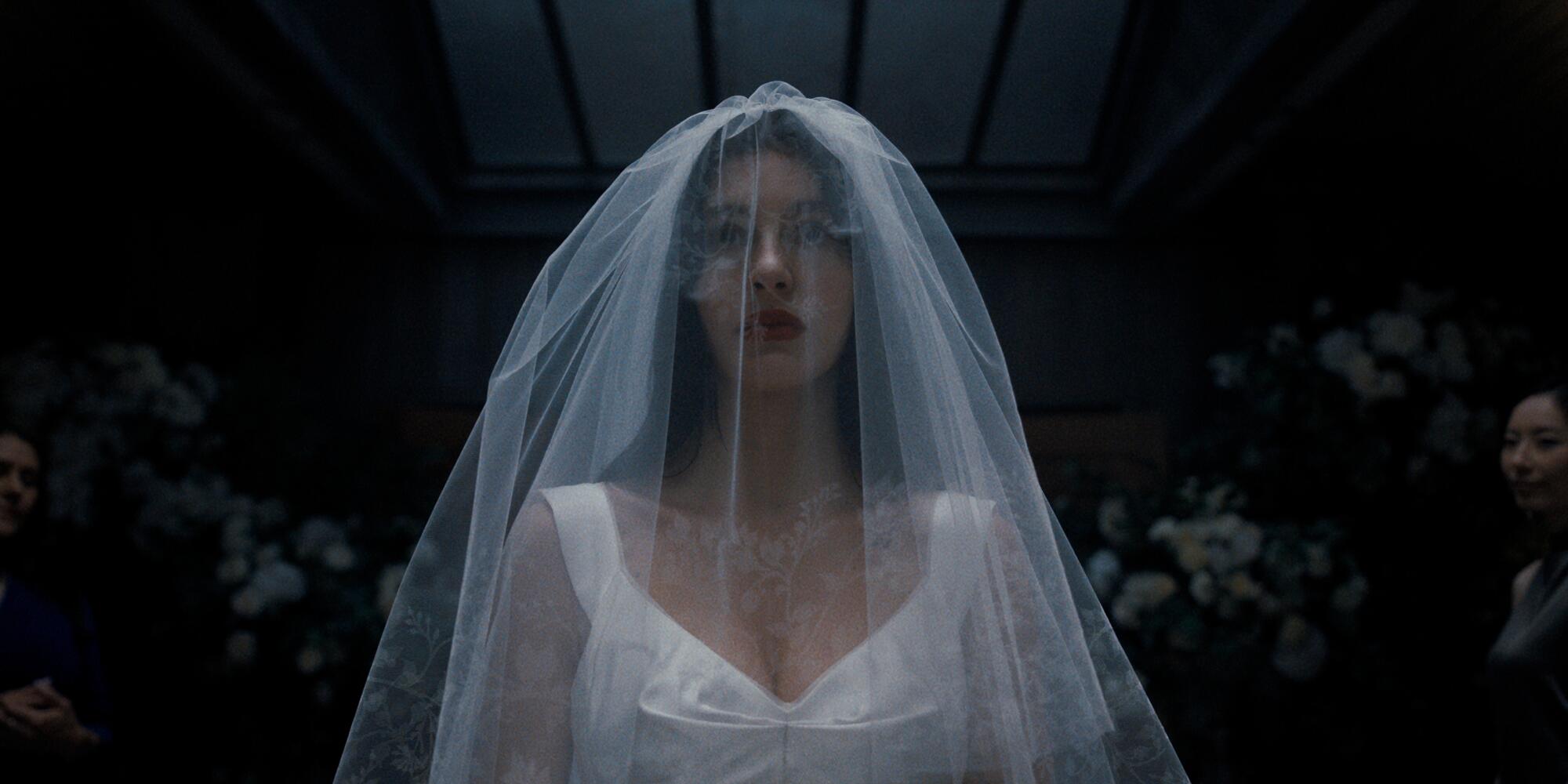
The easily frightened — and the recently engaged — might be advised to approach Boston’s new series, which premiered Thursday, with caution. A haunting fusion of David Lynch surrealism and “Rosemary’s Baby” paranoia, “Something Very Bad Is Going to Happen” traces the peculiar and ominous events that unfold in the week leading up to the nuptials between wary Rachel (Camila Morrone) and trusting fiancé Nicky (Adam DiMarco), as overseen by Nicky’s mother Victoria (Jennifer Jason Leigh).
Faced with inexplicable truths about Nicky’s family and her own past, Rachel becomes convinced that saying “I do” has the potential to prove deadly, and she comes to fear what might take place when she walks down the aisle.
Camila Morrone as Rachel Harkin in Netflix’s “Something Very Bad Is Going to Happen.”
(Netflix)
“I’d seen people in their wedding, in their vows, say, ‘I never once had a doubt,’” Boston said. “I’m like, ‘How could you not constantly question everything?’ It felt very natural to me to explore that idea in a horror show where the doubt is the horror.”
Horror has long been a preoccupation for Boston. The Oregon native has a tattoo of the phrase “Carrie White burns in hell” to commemorate her favorite film, Brian DePalma’s landmark Stephen King adaptation, “Carrie.” She distinguished herself writing episodes of weird, atmospheric series including Netflix’s “Brand New Cherry Flavor,” a nightmarish exploration of witchcraft and filmmaking in 1990s L.A., and “Guillermo del Toro’s Cabinet of Curiosities,” also for Netflix.
Her installment in the Oscar-winning director’s anthology series, “The Outside,” was inspired by a comic titled “Some Other Animal’s Meat” and followed the unnerving transformation one woman undergoes after purchasing a beauty cream advertised on a late-night infomercial. “It’s all about being an outsider and feeling different, and I related to that,” Boston said.
Boston began writing at the age of 11, and after seeing Quentin Tarantino’s “Kill Bill” in her early teens, she became interested in filmmaking. “I was so taken by the way that the story is told, and I love a revenge story,” she said. “That’s when I started to think, ‘Is this something? Who wrote that? How does any of this work?’”
She had considered following her parents’ path and choosing a career in medicine, but during her first formal writing class at Northwestern University, she felt that she’d found her calling. “I was like, ‘No, this is it. This is what I want to do,’” Boston said.
“I’m like, ‘How could you not constantly question everything?’” Haley Z. Boston says about marriage. “It felt very natural to me to explore that idea in a horror show where the doubt is the horror.”
(Christina House / Los Angeles Times)
After graduation, she moved to L.A., taking a job in the William Morris Endeavor mailroom and writing scripts on her own time. A high school slasher movie she’d penned in college landed her an agent. Soon after, her pilot for a “sapphic murder story” inspired by “Killing Eve” netted her 22 pitch meetings — the first was with director Sam Raimi, whose early-career “Evil Dead” movies are beloved cult classics. “I was 24, and I did the scariest thing at the time possible,” Boston said. “Sometimes I think if you don’t think too much about how terrifying it is, and you’re just thrown into it, that’s better.”
With “Something Very Bad Is Going to Happen,” Boston found herself thrown into the position of showrunner without ever having spent any real time on a set. Yet Morrone says Boston was the picture of confident professionalism throughout the shoot. “There’s just a grace to her,” Morrone said. “Even if she was overwhelmed, you would just never see it. These are her words and her world, and she inherently knows the character and the story so well that she could really navigate any questions thrown at her because it lives in her.”
The series is something profoundly personal for Boston. Growing up with parents whose marriage seemed idyllic had left her struggling once she began dating, and she channeled many of her own anxieties into the show. “They’ve been together for 37 years or something,” Boston said of her parents. “I felt all this pressure knowing that that exists. It always felt like a curse. You have this great example of what a marriage is, and I always found myself weighing every little romantic tryst against this 30-year marriage — which was unhelpful.”
She hit upon the premise for the series right around her 27th birthday, a time when more and more of her friends began to get married, and developed the idea while working on other projects. By the time Boston sat down to write the pilot episode, she knew the narrative and the characters so well that it took her just two weeks to finish.
Pitching the series, she met with “Stranger Things” creators Matt and Ross Duffer, who were so impressed by her vision that they signed on to executive produce “Something Very Bad Is Going to Happen” through their Upside Down Pictures banner.
“From reading one page of her script, it became very clear that this is someone who has a very unique voice,” Ross said. “It was unlike anything we’d ever read before. Immediately, we were like, ‘We have to be involved with this. We have to help bring her vision to life.’”
Rachel (Camila Morrone) and Nicky (Adam DiMarco) experience peculiar and ominous events leading up to their wedding.
(Netflix)
Matt added, “Haley has such a specific sense of humor. It’s very dark, very dry, but it also feels incredibly real. Her characters talk very much in the same way that real people talk. I find that sadly rare in the scripts that you read.”
The series was filmed in Toronto in January 2025 with directors Weronika Tofilska (“Baby Reindeer”), Lisa Brühlmann (“Killing Eve”) and Axelle Carolyn (“American Horror Story”) behind the camera. Boston said she and her collaborators would often reference specific films — everything from “The Celebration” to “Uncut Gems” — as a shorthand for the tone they were hoping to strike in a given episode. “I really love a story that takes something normal and grounded and gives one twist on it that throws you into a different world and makes you see things in a different way,” Boston said.
With “Something Very Bad Is Going to Happen” poised to elevate Boston’s Hollywood profile, establishing her as one of the most exciting voices in horror, she’s already planning for her future, writing a film that she intends to direct. “I love the horror community, but it is still such a boy’s club, and I really want to infiltrate it,” Boston said.
“The genre has been so much about women, and in studying feminist theory in horror, especially back in the ’70s, the genre forced men to relate to women — you’re watching a woman survive, which is ultimately very powerful,” she added. “I find it interesting how many men are making horror movies about women. I talked about ‘Carrie.’ I love that movie, but it’s missing something. Same with ‘Rosemary’s Baby.’
“This show is such a great opportunity to begin my career in this genre — now, I want to continue my reign of terror.”
On a night of bizarre incidents, two of them centred around the goals.
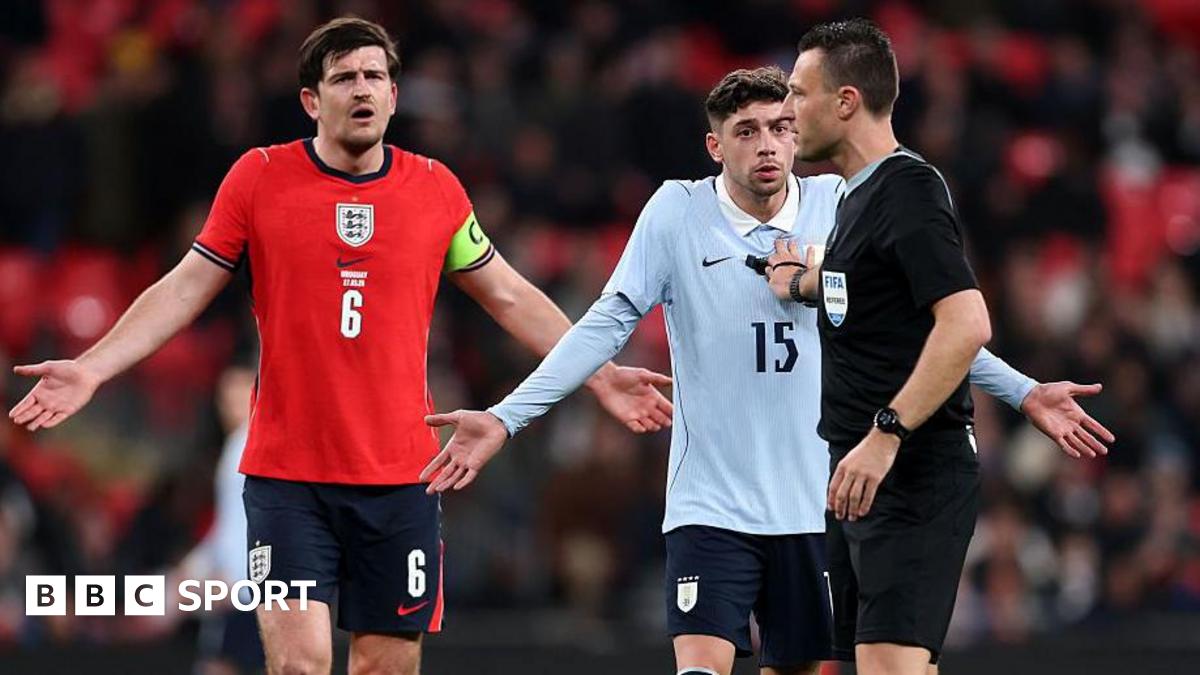
White bundled home England’s opener from a corner, but there was a check by the video assistant referee (VAR) with Adam Wharton appearing to block Gimenez in the build-up.
Former Arsenal striker Ian Wright said on ITV: “Come the World Cup, they’d probably look at that and give it as a foul.”
USA Women head coach Emma Hayes added: “VAR was on and off tonight. I think nine times out of 10 blocking someone off like that is a foul and I was surprised it wasn’t given.”
Then came Uruguay’s equaliser.
White and Federico Vinas came together inside the box – and the referee originally allowed play to continue. But he was asked to go to the monitor by VAR after which he awarded a penalty that Valverde scored.
“I think the referee was in a very good position when he gave the initial decision,” former Tottenham goalkeeper Paul Robinson said on BBC Radio 5 live.
“That’s nothing more than clumsy from White. There is connection but he got the ball first. One of those decisions where if it’s not given on field you don’t interfere.”
Last May, a strange thing happened on the U.S. album charts. Two metal bands (or at least metal-adjacent hard rock acts) scored No. 1 albums in the same month. The genre hadn’t seen multiple bestsellers in the same year since 2019 — and those were from veteran acts. So it was notable when the young U.K. group Sleep Token crushed on streaming and Ghost topped charts with a Taylor Swift-sized vinyl rollout. Meanwhile, avant-garde heavy rockers Deftones became unexpected TikTok darlings and arena stars.
Metal had not-so-quietly reemerged as a commercial force, and not just in the live sphere, where it’s always thrived and continues to grow. Pop culture seemed ready to welcome back a breed of hitmaker thought lost to time — the sleeve-tatted, throat-shredding hard rock star.
So the wider pop world should acquaint itself with the Virginia-born group Bad Omens, whose slam-packed Thursday night show at the Forum in Inglewood reaffirmed that they’re one of the most ambitious and skilled young bands in heavy rock, and have the star wattage and ravenous fan culture to get even bigger.
Bad Omens — with singer Noah Sebastian, bassist Nicholas Ruffilo, guitarist Joakim Karlsson and drummer Nick Folio — are not brand new. They’ve slugged it out on the metalcore and heavy rock circuit for a decade, signed to the small-ish but influential imprint Sumerian Records. But they hit their stride with 2022’s “The Death of Peace of Mind,” which melded a Weeknd-worthy R&B falsetto with rotted, churning guitars and tasteful electronics.
The band became festival headliners and racked up billions of streams, surely aided by Sebastian’s dreamboat-goth-BF good looks and striking range as a vocalist, where he veers from an ear-tickling whisper to an operatic howl and a shriek worthy of Norway in the ‘90s (sometimes on the same song, as he did on “Like a Villain”).
The band has tipped a new album for some time, though for this career-peak arena tour, it had only a handful of new singles in tow. No matter. At the Forum, the band cohered its catalog with an eye-popping stage production, one that made its case as an ultra-modern heavy rock act with the reach to be huge stars, even if they take genuine fame with some ambivalence.
That force-of-gravity was evident in the days leading up to the Forum show, where fans debated how many hours early they needed to be at the Forum to be on the barricades (the consensus — get there by breakfast). Mid-set, Sebastian pointed out one fan whom he recognized from years on the road. “You’ve been coming to see us since we sucked,” he said, laughing.
That commitment wouldn’t be possible if the music didn’t have a preternatural force to speak to current anxieties. From the first notes of its new single “Specter” — a brooding vocal workout for Sebastian that ended on pulverizing riffs — Bad Omens used cutting-edge tools and underground influence to elicit arena-rock catharsis.
One early peak of the set came when Jake Duzsik of the L.A. industrial-rock trio Health came out to duet on “The Drain,” a lurching, menacing collaborative single and a standout for both bands. Heavy-rock veterans see something compelling in Bad Omens, which helps situate the band’s pop-savvy tracks like “Left for Good” and “Just Pretend” (a platinum-selling single that wrapped up the main set) with earned feeling rather than calculation.
After the Forum show, I understood why it’s taking them so long to finish a new LP. Sebastian has been open about his mental health struggles. The band is pitched right at a difficult juncture at which their artistic ambitions abut real, life-altering attention.
They can make songs like “What It Cost” (a hooky, lecherous electro track that I’d totally believe was co-written with Max Martin if you told me) and the serrated metal that them earned them their fanbase and would cause a revolt without. It’s not easy to pair the two in a natural way. (Just ask Code Orange, once pitched as metal’s breakout stars who got bogged down in electronic experiments.) Having a K-pop-caliber devoted fanbase is great on the way up, but it’s a tense relationship.
But first and foremost, Bad Omens are gifted musicians, and whatever eldritch magic Sebastian wields onstage will always be bolstered by a serious band contorting metal, dark pop and electronic music. I saw nothing that would stop that one fan from coming back for 10 more years of Bad Omens shows, and plenty to suggest others are going to follow him.
The mysterious character is introduced early on in the Netflix series
Samantha King Content Editor
15:00, 26 Mar 2026
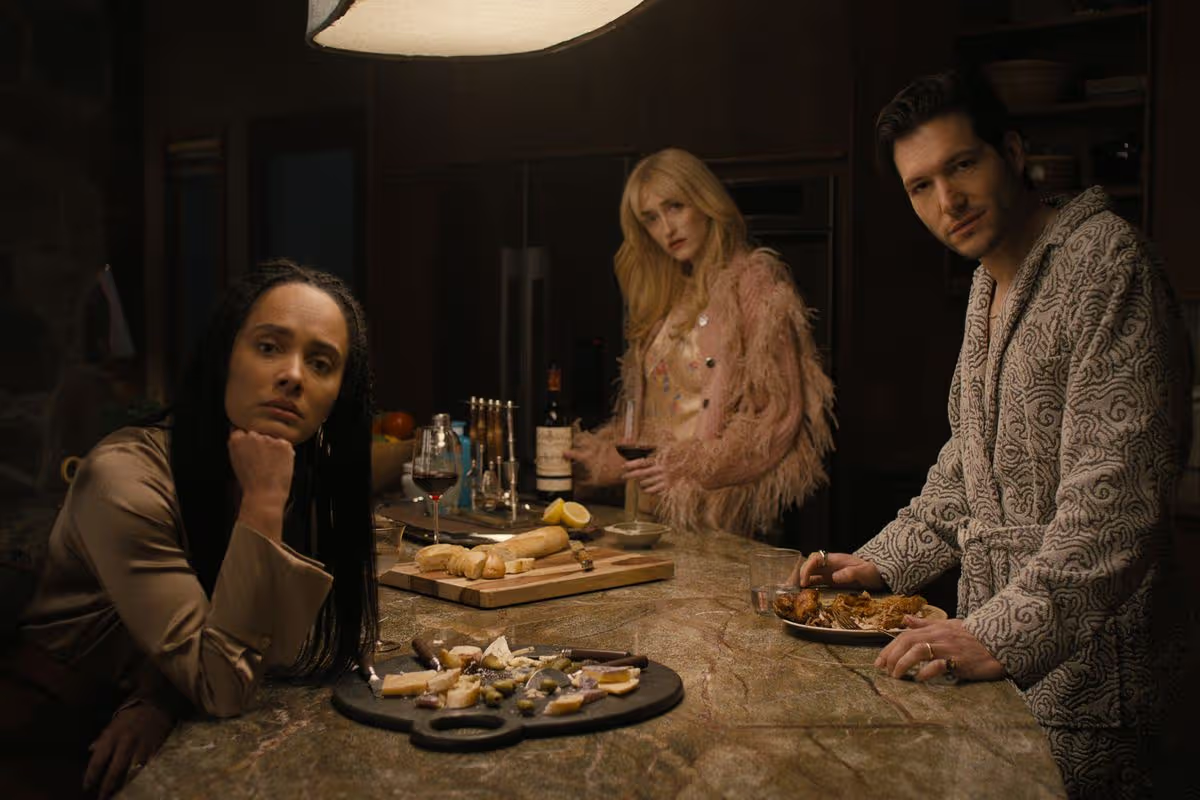
Nicky’s siblings inform Rachel about a family legend known as the Sorry Man(Image: Netflix)
*Warning: Contains major spoilers for Something Very Bad Is Going To Happen*
Netflix today released (March 26) all episodes of its highly-anticipated horror series Something Very Bad Is Going To Happen which explores the dark side of wedded bliss.
The eight-part show is created by Haley Z. Boston (Brand New Cherry Flavor) and executive produced by the Duffer Brothers (Stranger Things), and centres around a young couple, Rachel Harkin and Nicky Cunningham, in the week leading up to their wedding.
While the duo initially seem a match made in heaven, things start to unravel as Rachel (Camila Morrone) meets her soon-to-be-spouse’s family for the first time while they prepare for their big day at the sprawling, remote cabin owned by Nicky’s (Adam DiMarco) parents.
During her first encounter with Nicky’s siblings at the cabin, Rachel is told the story of the Sorry Man, a mysterious presence who allegedly roams the woods outside looking for women to murder.
Nicky’s sister Portia (Gus Birney) takes great pleasure in revealing that the Sorry Man believes his long-lost love is hiding inside another woman. She says that if he gets the scent of blood, he wastes no time in tracking down and ripping open the woman who is bleeding.
The tale originates from Nicky’s older brother Jules, who claimed to have seen the Sorry Man for himself when he was a child. The whole family are aware of the story, including Jules’ own son who lives in fear of the creature.
The Sorry Man and whether or not he will appear is one of the show’s enduring mysteries – especially after Rachel gets a nose bleed – until a major reveal explains what is really going on.
Get Netflix free with Sky
This article contains affiliate links, we will receive a commission on any sales we generate from it. Learn more
Sky is giving away a free Netflix subscription with its new Sky Stream TV bundles, including the £15 Essential TV plan.
This lets members watch live and on-demand TV content without a satellite dish or aerial and includes hit shows like Stranger Things and The Last of Us.
As viewers know, Rachel is battling a curse that kills anyone in her family line who marries someone who is not their soulmate. That curse affected her own mother (portrayed by Victoria Pedretti) who shortly after wedding Rachel’s dad, collapsed while bleeding from her eyes.
As his new bride was pregnant, Rachel’s dad was forced to tear open his dead wife’s belly to save his unborn child all the while repeating “I’m sorry” as the tragic moment unfolds.
Viewers learn that Jules was actually present that day as the newlyweds had been staying at a cabin nearby to his family home. He had been hiding under the bed in their holiday cabin after leaving home and so witnessed Rachel’s mother die, and her father then tear her open, leaving him with the idea of the Sorry Man.
The moment of Rachel’s mother’s death was caught on a home video tape which is later shown to Rachel after the Sorry Man – a.k.a her actual dad – invades the Cunningham home and kidnaps Rachel in the dead of night to stop her from suffering the same fate as her mother after hearing about her impending wedding to Nicky.
Jules’ son sees Rachel being kidnapped and informs his dad, who tracks down where Rachel is being held. When he finds her, he recognises who he believes to be the Sorry Man, before Rachel informs him that is actually her dad.
Jules then realises what he witnessed that day as a child was the Harkin family curse unfolding, not a murder, and that he was actually present at Rachel’s birth.
Something Very Bad Is Going To Happen is now streaming on Netflix.
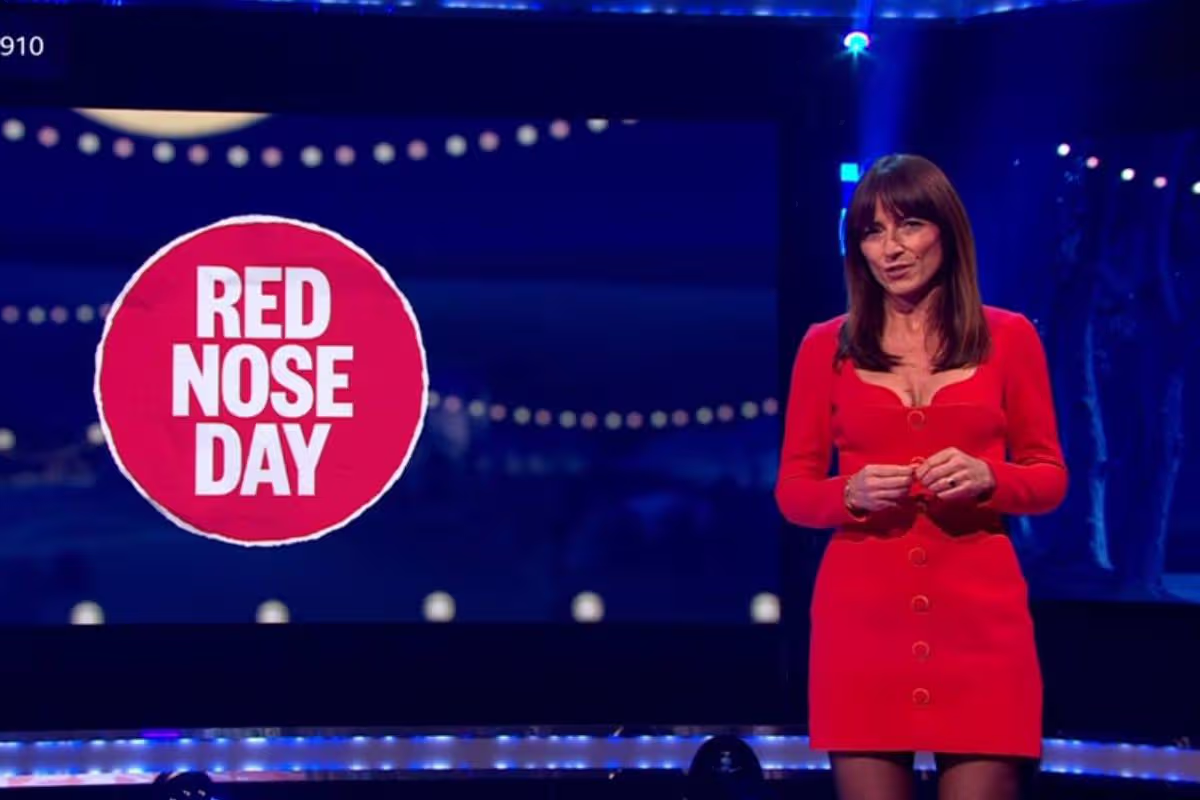
BBC’s Comic Relief saw host Davina McCall issue an apology during the live show after Nick Mohammed used explicit language during a Rubik’s Cube challenge on Friday night
Davina was quick to apologise to BBC viewers(Image: BBC)
Presenter Davina McCall addressed viewers watching Comic Relief on Friday night (March 20) following Nick Mohammed’s strong language.
During the BBC programme, which featured Catherine Tate reprising her role as Nan, Celebrity Traitors star Nick was tasked with completing eight Rubik’s Cubes in one minute.
Supporting him on stage was his mate and former Celebrity Traitors co-star Joe Marler, who was dressed up in drag.
When the clock started, it was obvious the comedian was flustered as at one point he was heard saying: “F**k” before later adding “s**t”.
However, Nick didn’t manage to successfully complete any Rubik’s Cube at all before revealing he had been creating a pattern instead, reports Wales Online.
He said: “Ok, right. I was a little bit distracted. But, in all honesty, I was still feeling a little bit guilty for betraying Joe all those months ago.
“So, instead of actually solving the Rubik’s Cubes, I actually just had something that I did want to say to Joe.”
As he turned the items over, the red colours on the blocks spelled out the word ‘sorry’, which earned a huge round of applause from the audience, along with a hug from Joe.
However, Davina quickly addressed the explicit swear words Nick had uttered during his 60 seconds. She commented: “Before we go any further, we just want to apologise if anybody heard any bad language there. It was a very high-stress situation.”
Nick appeared oblivious to the fact he’d sworn on live television as he questioned whether the ‘bad language’ Davina mentioned was his doing. The BBC presenter added: “I’m not sure, let’s not go over it again!”
Throughout the fundraising evening, Davina was accompanied by several guests to assist with co-hosting duties. Initially, viewers were treated to Joel Dommett and Catherine Tate as Nan.
Nick subsequently joined her for the programme’s second segment before Katherine Ryan finally came aboard to conclude the event.
During the broadcast, Davina welcomed Greg James to announce the final sum he’d accumulated over eight gruelling days completing a mammoth cycling challenge.
She informed the radio presenter he’d raised an impressive £4,225,939 as the audience burst into applause.
He responded: “Wow! Thank you to everyone who donated, wow.” Left momentarily lost for words, the crowd began chanting his name in appreciation.
Comic Relief: Funny For Money is available to watch on BBC iPlayer.
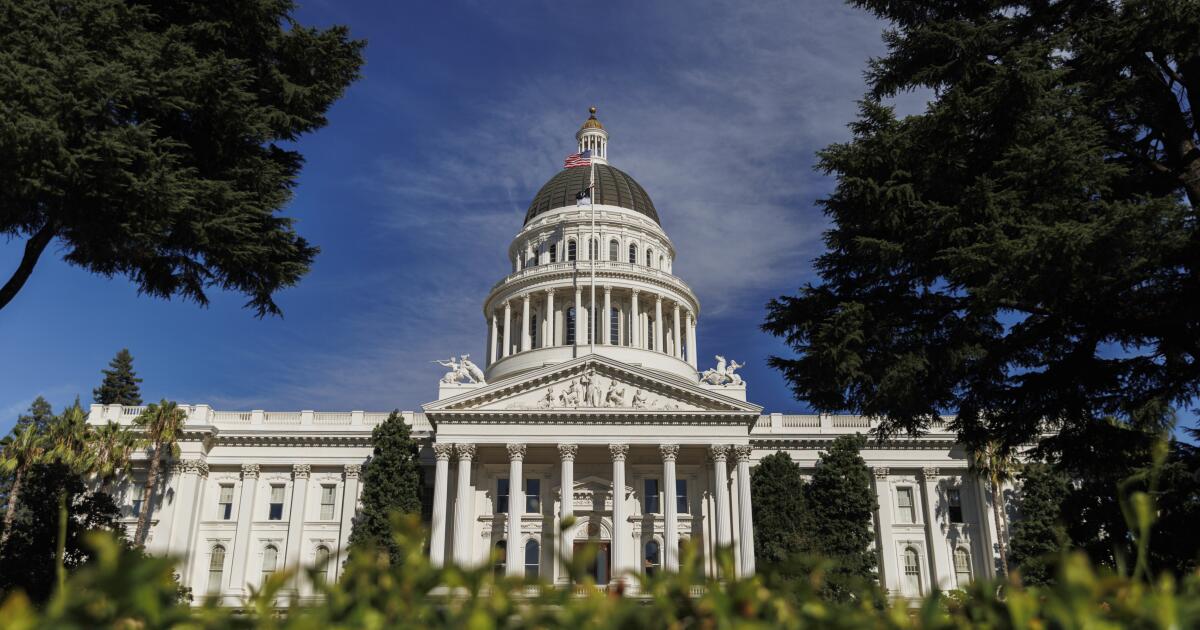
A group of California trial lawyers is backing a package of bills aimed at policing their industry by ramping up the penalties for attorneys who recruit clients illegally or prioritize the desires of hedge fund investors.
The Consumer Attorneys of California, a prominent trade group, said it is supporting two bills this session meant to crack down on the “small number of bad actors engaged in illegal conduct that threatens to undermine public trust” in the state’s legal bar.
The group said the bills, introduced Monday by Assemblymembers Ash Kalra (D-San José) and Rick Chavez Zbur (D-Los Angeles), were a response to recent Times investigations involving California lawyers. The Times found nine clients within L.A. County’s $4-billion sex-abuse settlement who said they were paid to sue and, in some cases, fabricate claims that became part of the historic payout. Another story examined opaque investor financing arrangements used by some firms.
“We’re not trying to insulate ourselves from accountability,” said Douglas Saeltzer, president of the attorney group, in an interview. “There needs to be consequences.”
The bill introduced by Zbur would disbar any attorney who is convicted of illegally soliciting clients. Kalra’s bill would ban private equity firms and hedge funds from dictating case strategy after giving money to a law firm.
Plaintiff’s attorneys say the legislative push is an attempt to clean up their profession’s image. It comes amid efforts by companies and governments frequently targeted by lawsuits to rein in a barrage of litigation.
Uber is pushing a measure for the November ballot that would limit how much lawyers can collect in fees for car crash cases, encouraging Californians to “stop the billboard lawyer scam.” A coalition of California counties has simultaneously begun circulating language to lawmakers that would limit attorneys’ ability to sue over older sex-abuse cases, pointing to recent allegations of fraud.
Zbur’s legislation, Assembly Bill 2039, would require the State Bar strip the license of any attorney with a felony conviction for a practice known as capping, in which law firms directly solicit or procure clients to sign up for lawsuits. Currently, attorneys convicted of capping can face suspension or probation, but are eligible to keep their license.
Under the bill, the attorney also would be disbarred for a misdemeanor capping conviction if the lawyer “acted knowingly and for financial gain.”
“It really is making very clear that if you’re engaging in this kind of capping, then there’s going to be a consequence,” Zbur said.
All clients who said they were paid to sue L.A. County over sex abuse were represented by Downtown LA Law Group, one of Southern California’s largest personal injury firms. The firm, also known as DTLA, is under investigation by the district attorney, the State Bar and L.A. County.
DTLA has denied any wrongdoing and said its lawyers “operate with unwavering integrity, prioritizing client welfare.”
Zbur’s bill also would provide whistleblower protections to people who report on attorney misconduct and tighten the rules around client loans. California is one of the few states where lawyers can lend money directly to clients.
Other states have barred the practice, concerned that direct loans give an attorney too much leverage over their clients.
The second bill introduced Monday, AB 2305, is aimed at the rising trend of private equity firms and hedge funds lending money to law firms and profiting from the payouts. The Times reported in December that investors were financing some of the flood of sex-abuse litigation against L.A. County.
Supporters of litigation finance say it gives attorneys the funding they need to take on deep-pocketed corporations and represent victims who can’t afford to sue on their own. Critics say investors can secretly sway case strategy, putting their profit before the best interests of a client.
“These Wall Street investors are salivating,” Kalra said. “This is just gonna clearly say, ‘No, no more. We’re not gonna allow these types of investments to influence the practice of law.’”
Kalra’s bill would bar investors from weighing in on litigation, such as who the firm should take on as a client and when they should settle a case. Any contracts that allow investor influence would be void under the law.
It’s unclear how the restrictions would be enforced. It’s often difficult to tell when an investor is financing a firm’s caseload, much less whether they’re exerting influence on a case.
Lawyers already are barred under the State Bar’s rules from allowing a third party to dictate case strategy and are barred in many cases from sharing legal fees with a nonlawyer.
“We’re finding that’s not enough,” Kalra said. “We actually need clear statutory safeguards.”