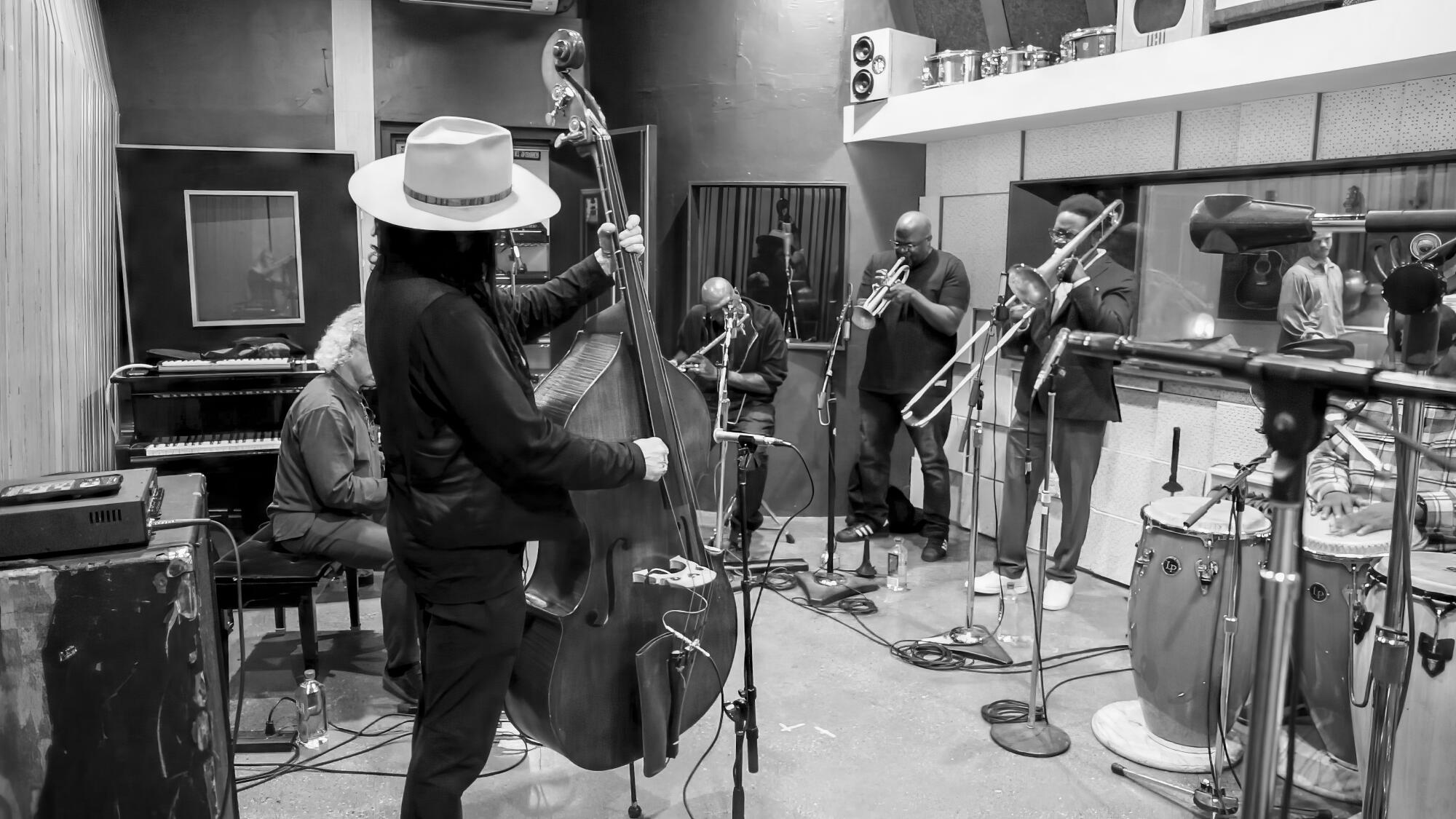
backing band

Don Was finds his voice in Detroit — and the Dead

The bass legend and superproducer Don Was didn’t expect to be covering Curtis Mayfield’s Civil Rights-era anthem “This Is My Country” on the road in 2026. But lately, the chaos in the United States made the song seem regrettably apropos.

“It wasn’t supposed to still feel potent. It was supposed to be something that served a moment,” said Was, who included the defiant single on his 2025 album “Groove In the Face of Adversity.”

“It’s shocking to be here in 2026 and, whatever distance we traveled from 1966 until now, to see it all get reset,” Was said. “That song’s a more powerful statement now than it was then. It was inconceivable that it would still be relevant — this is supposed to be the utopian age of Aquarius. This is not the way it was supposed to turn out.”

Was remembers the tumult, violence and hope that came out of that era in his hometown of Detroit. The city’s music, famed for rough-hewn virtuosity from blues to soul to techno, is the spring that waters “Adversity.” It is, remarkably, the 73-year-old’s first solo album after a career spanning the pioneering electro-pop band Was (Not Was) and deep producer relationships with the Rolling Stones, Bob Dylan and Bonnie Raitt.

He also spent years in Bob Weir & Wolf Bros with the late Grateful Dead founder, and will play from the Dead’s landmark “Blues for Allah” on his tour that stops at Lodge Room on July 7.

With a backing band of studio killers dubbed the Pan-Detroit Ensemble, “Adversity” has an expansive modern atmosphere, yet a lived-in, filament-bulb quality in the playing that carries through funk, jazz, rock and R&B. It’s largely a covers record, but you wouldn’t know it from the depth of the revisions — veering from the Yusef Lateef standard “Nubian Lady” to Hank Williams’ “I Ain’t Got Nothin’ But Time,” closing with funk group Cameo’s “Insane.”

“I’ve been carrying it around in my head for 30 years,” Was said. “This first album to me is really a handshake, a ‘nice to meet you,’ this jambalaya of Detroit sounds.” While much of the source material comes from elsewhere, the cumulative mood is extremely personal to an artist who has spent his life helping the greats find true expression.

“I’ve come to admire artists who are willing to go in deep inside their most personal thoughts for the sake of helping the listener understand their own lives,” he said. “To help them deal with the trauma of being human — especially in these times, man.”

Tops on that list is the late Grateful Dead founder Bob Weir — who died in January at 78 — as a model for a band staying fearless and uncompromising. Was, still heartbroken about the loss of his friend and bandmate, recalled their first time on tour.

“When Bobby called asking me to play bass with the Wolf Bros, I thought at the very least, this is going to be a master class in losing self-consciousness and forgetting about fear,” Was said. “If the band stumbled, the audience wouldn’t walk out. They appreciated the fact that you were trying to do something new for them. Then there’d be a couple moments every night with an incredible exchange between the musicians and you can feel the audience becoming a member of the band.”

Playing the Dead’s “Blues for Allah” on this tour — an LP rooted in Middle Eastern scales, pirouetting time signatures and improvisational telepathy — put him in communion with his old friend.

“I used to think that songs like ‘King Solomon’s Marbles’ were just jams and conversations on the spot. But when we really got into it, there’s a form underneath and you can take tremendous liberty with that form,” Was said.

Was’ production career was built on a similar principle.

His early band Was (Not Was) remains a visionary electro-pop act with subtle, salient politics. “Out Come the Freaks” is a favorite on Pride month dance floors — “If you just wanted to do poppers and dance all night, it worked, and if you wanted to think about the government careening out of control, it worked too,” Was said of the band’s club material.

The late Ozzy Osbourne sang on the band’s international hit “Shake Your Head,” alongside a winking, very game Kim Basinger. The actor was a replacement after Madonna backed out, leaving the proto-rave tune one of the era’s most unlikely collaborations.

He recalled Ozzy fondly. “In 1975, this folk group I was in booked us to open for Black Sabbath at the Toledo Sports Arena, playing for a bunch of 14-year-old white boys on amphetamines,” Was said. “They weren’t having it. I’ve heard the tape of that show, and the drummer was bleeding from being hit by so many bottles that we had to stop playing. That was my first exposure to Ozzy, so I was a little afraid to do the session, but he was up for an adventure.”

Don Was and the Pan-Detroit Ensemble

Don Was and the Pan-Detroit Ensemble

(Gemma Corfield)

A Stones confidant and producer from 1994’s “Voodoo Lounge” up until 2023’s “Hackney Diamonds” (where Andrew Watt took the helm), Was had nothing but praise for the band, and still admits to a twinge of fandom in their presence.

“There’s never been a day in the studio with the Rolling Stones where I didn’t look around the room and go, ‘Oh my God,’” he said. “I’ve known Mick for over 30 years, but the last time they played L.A. at SoFi Stadium, Mick came walking down that stage and I was like, ‘Wow, there he is, it’s 1965 again.’”

With Dylan, he recalled the mercurial genius’ impish side. “I was producing Dylan, and George Harrison came in to play guitar. Bob was messing with him, Bob pushed the engineer aside and he ran the tape machine. George had never heard the song before, didn’t know what key it was in, and Bob just starts the tape. George played a respectable solo, but clearly it was rough. Bob, just to be funny, stopped the machine and said ‘That’s it, perfect.’ George turns to me and said, ‘What do you think, Don?’ And Bob goes, “Yeah, what do you think, Don?’ I’m looking at these two guys and time slowed down. I remembered trying to sell my car to get a ticket to go to New York to see the Concert for Bangladesh. Now they’re asking me what I think. I was paralyzed.”

“A voice appeared in my head,” he said, “Telling me, ‘He’s not paying you to be a fan.‘ So I said to George, ‘It was good, man. Let’s see if we can beat it.’ You can’t allow the iconography to dictate the outcome in the studio. You have to put that aside.”

As president of Blue Note Records, the estimable jazz label he’s led for more than a decade, Was relentlessly looks forward. He’s released restless modern records by Domi & JD Beck, Fathers, Makaya McCraven and Julian Lage (the hotshot jazz guitarist now playing with Dylan). He’s refreshingly optimistic about challenging music in streaming’s ruthless economy.

“Don’t make music for the delivery system,” Was said. “I don’t think about streaming, I think about touching people. If you do that, nothing has changed fundamentally in the music business. If your purpose is to get under people’s skin and make them feel something, that’s the same job it was for Mozart. How people listen can keep changing, but I don’t think the palette of human emotion changes, and that’s who you’re addressing.”

Was came from a working-class industrial city, making music reflective of Detroit’s technological upheaval and economic neglect. “Adversity” is a beacon to keep playing in spite of everything.

“I think that the salvation of musicians is that no matter what happens, what technological advancements come along, there’s still nothing like the experience of being in the same room as people who are playing together,” Was said. “It’s always been tough, man. It’s harder these days to buy a Ferrari as a musician, but I don’t know that that’s necessary. I have total confidence that the opportunity is there for anybody who is willing to give the audience a meaningful experience.”
Source link

Violet Grohl steps out of her famous father’s shadow with a haunted, alt-rock debut

The title of Violet Grohl’s debut album, “Be Sweet to Me,” started as an inside joke.

“‘Be Sweet to Me’ is a phrase that my best friend and I say to each other when we’re play-fighting,” says the rising singer. “It’s what we do to put an end to it. Like, ‘Oh, be sweet to me!’”

The phrase might also carry a double meaning, one Grohl is still parsing. At some point in the naming process, someone in her circle asked Grohl if she was making a plea. Remembering that moment, Grohl pauses to consider.

“I guess it can be seen as a pretext for the album. Just … be sweet,” she says. “But at the same time, it’s literally just what my best friend and I say to each other when we’re calling each other idiots.”

Intentional or not, no one could blame the 20-year-old for inserting an earnest request for audiences to proceed with kindness as she readies her debut album, which finally landed Friday.

The reasons are pretty self-explanatory: Grohl is the eldest child of modern rock icon Dave Grohl, the highly decorated founder and centerpiece of Foo Fighters and onetime drummer of Nirvana, and his wife, former model and TV producer Jordyn Blum. In an age of “nepo” accusations and internet dogpiles, it would be completely understandable for Grohl to feel anxious about her album’s reception.

But if she is, it doesn’t show. On a warm day in mid-May, Grohl appears relaxed and self-assured — but not arrogant — as she idles on a sofa in a cozy Studio City ADU owned by her publicist. Encased in a long, black sleeveless dress, she’s giving a mixture of off-duty rock star and summer goth. Her arms host an array of intricate tattoos; I spot a raven, a skull and a vintage lace fan. Next to her is a bulging Balenciaga mini bag, and a pair of oversized sunglasses on her head are perched atop a mop of jet black curls. The high contrast of her pale, makeup-less skin and swept back hair makes her round, gray-blue eyes appear even more pronounced.

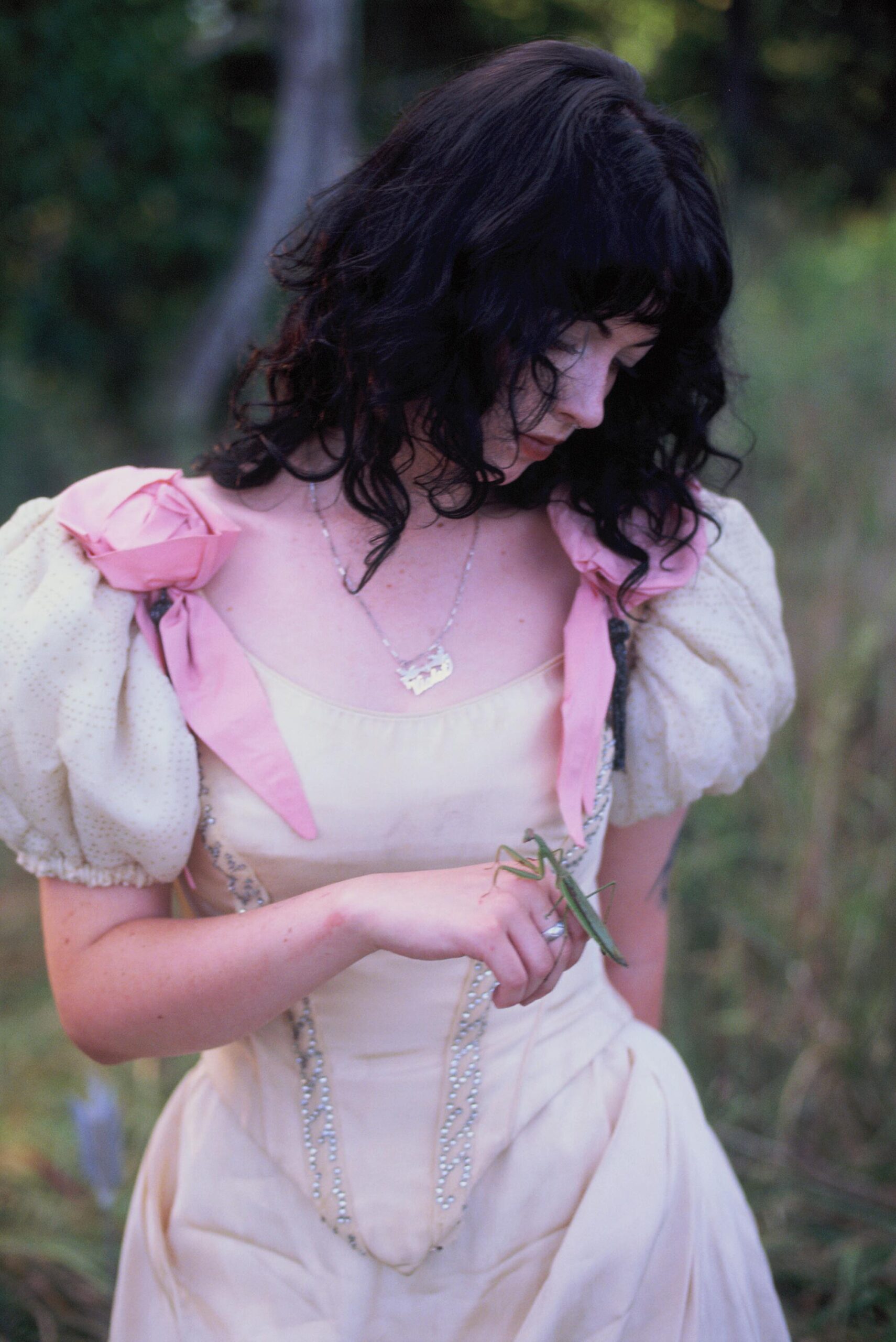
Young woman in a pink and white dress.

“Everyone wants you to be an idealized version of … not even yourself, but of what they want you to be,” she says. “Sorry, that’s just not gonna happen with me.”

(Bella Newman)

Any time spent with her reveals that Grohl is the sort of person who is ultra-sensitive to the energy of places, people and even the long-deceased. In her free time, Grohl is an avid lover of anything paranormal. “The same time I got into horror movies, I started watching ‘Ghost Adventures’ on Travel Channel,” she says. “It totally sent me down this rabbit hole of the supernatural.”

When I ask if she’d ever made contact with any ghosts, Grohl nods emphatically before describing a trip to a hunting estate near the Scottish Highlands. “It is the most haunted place I’ve ever been in my whole life,” she says. “I walked into the house, and it was like a blast of cold air, chills everywhere. It’s this instinctual feeling of, I’m not alone here … I heard footsteps and disembodied voices, I saw shadows, I had crazy f–ing dreams. It’s so eye-opening, but it’s not evil or negative.”

Chilling films and Lynchian surrealism pervade the tracklist of “Be Sweet to Me,” which relies on symbolic lyricism to illustrate coming-of-age stories. From a sonic perspective, listeners will be thrilled to know that her debut does not just make for an entertaining listen — it’s a dedicated towpath to the very squealing heart of alternative rock, built by an artist who understands her music history on a granular level. Across a tight 11 tracks, “Be Sweet to Me” careens across late-’80s and ‘90s experimental genres, from ripping alt-rock on “Bug in the Cake” to hazy dream pop on “Mobile Star” to aggro Clinton-era alt metal on “Often Others,” and even a bit of chugging hardcore on “Cool Buzz.”

As many references as she brought to the recording process, led by producer Justin Raisen (a known collaborator of Charli XCX and Kim Gordon, who made the introduction), Grohl is not attempting to cosplay the grunge era. Instead of simply mirroring influences, she deftly puts her own spin on each arrangement with inventive, grabby arrangements, razor-sharp production and her versatile vocals, which can bellow like Courtney Love, murmur like PJ Harvey or turn ethereal like Elizabeth Fraser.

“Justin has a crew of musicians that he works with, and they’re all close friends of his,” Grohl explains of the album’s backing band, which Raisen assembled to mimic the Wrecking Crew, a loose collective of session players who appeared on some of the most beloved albums of the 1960s and ‘70s. “They’re the coolest, most talented, genuine music lovers, and seriously talented musicians … I’d never been in that kind of recording environment before. Everyone would throw out ideas or I would share a reference, and whatever it was about the song, [we’d ask] how we can build and make it a completely new, different thing.”

Growing up in Tarzana/Woodland Hills, Grohl says she’s been singing ever since she could speak. In a baby book, her mother wrote how Grohl, at 8 or 9 months, was “babbling and singing.” She took piano lessons with a teacher who taught her any Beatles song she wanted to learn. She later picked up the ukulele, and then a guitar. Now, it’s any piece of gear, from bass to drums to a lap dulcimer. “I just love messing around with different instruments and seeing all the different sounds I can make,” she says.

Grohl also had an ideal music-taste mentor in her father, who told his eldest all about Björk and acquiesced to playing Amy Winehouse’s “Rehab” on repeat. “I think I was 4 or 5, and I remember sitting in front of his computer, and he was talking about how she was from Iceland,” Grohl says of those days. “And I was like, ‘Oh, she’s the princess of Iceland. That was my idea of Björk from a young age. Björk’s ‘Hunter’ music video was a turning point for me.”

By adolescence, while on the road with the Foo Fighters, Grohl would make herself useful by assisting the band’s tour manager. She remembers: “I had a walkie-talkie, I would hand per diems out to people, I would run the envelopes around, and bring my dad a towel after the show, stuff like that.” The live-music atmosphere may have also sparked Grohl’s curiosity in songwriting, which she says began as a way of journaling. “I have cassette demos that I made with a tiny one-track recorder,” she remembers. “Then I started learning how to use Logic right before I turned 13, and that opened up this whole new world.”

One night in May 2018, on a break from the East Coast leg of the Foos’ Concrete and Gold tour, the elder Grohl headlined a benefit concert for the UCSF Benioff Children’s Hospital, where he encouraged his daughter, then only 12, to join him onstage to sing Adele’s “When We Were Young.” A few weeks later, back on tour, Grohl jumped onstage to help sing backup on a few tracks. “It wasn’t my first time singing on a stage, but it was my first time singing on a stage with that many people in [the audience],” she says of the second experience. “I was really scared, but once it was happening, and once it was over, I was like, ‘Oh, this is what I want to do. This is my purpose.’”

Woman with black hair in back dress

Chilling films and Lynchian surrealism pervade the tracklist of “Be Sweet to Me,” which relies on symbolic lyricism to illustrate coming-of-age stories.

(Bella Newman)

From there, Grohl became something of a live fixture — a beloved Foos adjunct performer. But clearly one with her own trajectory. In pre-pandemic 2020, Grohl joined the surviving members of Nirvana at the Art of Elysium Gala, where she sang “Heart-Shaped Box.” The next year, father and daughter recorded a duet of “Nausea” by L.A. classic punk favorites X. In 2022, Grohl opened the second tribute to late Foos drummer, Taylor Hawkins, with an aching rendition of Leonard Cohen’s “Hallelujah.”

It should definitely be said that Grohl is hardly pulling a Jakob Dylan as it relates to her parentage — a detail that actually makes her appear that much more self-actualized and approachable, simply because she isn’t trying to circumvent reality or engage in a furious round of name-dropping. She freely discusses the long evening car rides around Los Angeles she’d take with her dad and two younger sisters during the pandemic, the car becoming a music-recommendation feedback loop, with older and younger generations trading off DJ duties. “My sister and I introduced him to Jockstrap,” Grohl chuckles when I ask what bands she introduced her dad to during those rides. “I’d play him old jazz standards, hip-hop. It was a constant thing.”

During those evening rides, Grohl also drank up the city’s otherworldly, vaguely haunted visage. “There’s something special about L.A. that I can’t fully describe,” she says. “There’s inspiration everywhere, so many beautiful people and historic buildings. I love art about L.A. — when people reference L.A. in their music, movies, or books. I grew up here, and I’ve lived here my whole life. I just feel that deep connection to it all.”

Like any great artist, Grohl is a product of her surroundings, and that can’t help but include a very specific, unlikely upbringing. In her own matter-of-fact way, Grohl shrugs as she acknowledges the inescapable pressure of her last name. “Everyone wants you to be an idealized version of … not even yourself, but of what they want you to be,” she says. “Sorry, that’s just not gonna happen with me. You’re not gonna convince me to change. I’m doing this because I love music, and that’s all I’ve ever known. Everyone’s gonna want me to be something, and I’m not the person that will give in to that.”

Source link