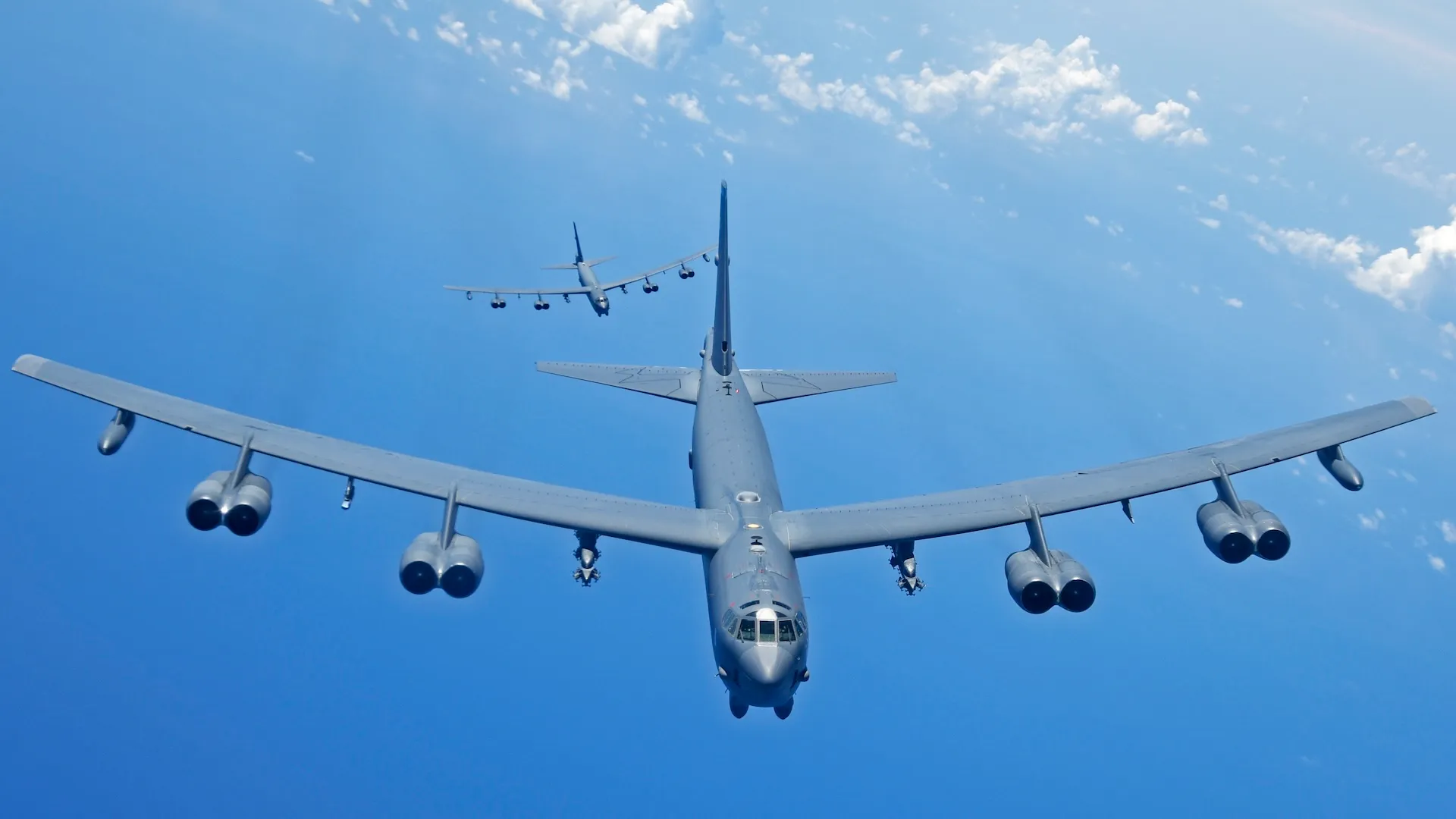
B52

B-52 Involved In Tragic Crash Was Heading Out On Radar Test Sortie

There are so many questions to be answered about what led to yesterday’s fatal mishap involving a B-52H bomber at Edwards Air Force Base. The crash was tragic on a level the base, which sits at the center of America’s flight testing ecosystem, has not experienced, at least to our knowledge, for 75 years. The human impact here is just hard to quantify at this time. At the same time, there will be a major developmental impact, too, especially when it comes to work that is being done to modernize the B-52. This is a constellation of programs that are seen as vital to U.S. national security, and are also already running far behind schedule and over budget.

At this time, we do know that the aircraft in question was being used to support the Radar Modernization Program (RMP), and its loss will have ramifications for that effort. The RMP has already suffered years of delays and major cost growth, the latter of which triggered a deep, legally mandated review. However, in the past year, the U.S. Air Force has been talking more positively about progress on this critical upgrade, as well as other parts of a larger B-52 modernization effort that have faced their own hurdles.

“It was a B-52 that was on initial takeoff, supporting the Radar Modernization Program,” Air Force Col. James Hayes, Deputy Commander of the 412th Test Wing at Edwards, said at a brief press conference yesterday. “It was a local test sortie. It took off, and immediately after takeoff, crashed and burst into flames.”

The 412th is the main unit at Edwards. As noted, the base serves as the Air Force’s main test and evaluation hub.

“After reviewing the footage of the crash, it was deemed that this was an unrecoverable crash and unsurvivable,” Col. Hayes added. The B-52 had “a mixed crew of military, government civilians, and government contractors supporting this test mission.”

“Right now, our thoughts and prayers are with the families of those that lost their loved ones,” he also stressed. “This is a tragedy.”

When reached by TWZ for comment today, Boeing reiterated a brief statement it made yesterday that confirmed two of its employees died in the crash. The company’s full statement is as follows:

“We extend our deepest condolences to the loved ones of the eight crew members who lost their lives in the B-52 crash at Edwards Air Force Base, California. It is with great sadness that we confirm two Boeing employees were among those on board. We are in contact with their families and are offering support.”

Boeing, the original manufacturer of the B-52, is serving as the prime integrator for the RMP. Raytheon is supplying the new AN/APQ-188 active electronically-scanned array (AESA) radar, which is derived primarily from the AN/APG-79. In the United States, versions of the AN/APG-79 are in service today on U.S. Navy F/A-18E/F Super Hornets and all EA-18G Growlers, as well as U.S. Marine Corps F/A-18A-D Hornets. The AN/APG-82 used on Air Force F-15E Strike Eagles and F-15EX Eagle IIs also builds on the AN/APG-79. The AN/APQ-188 will replace the mechanically-scanned AN/APQ-166 found on B-52s today.

A side-by-side look at the existing AN/APQ-166 radar on a B-52, at left, and the new AN/APQ-188 integrated onto one of the bombers, at right. USAF

The RMP is one of many major upgrades planned for the Air Force’s entire fleet of 76 B-52s in the coming years. The bombers are also set to get all-new engines, improved communication suites, and more. The changes will be so substantial inside and out that the designation of the bombers will switch from B-52H to B-52J in the process.

B-52 Future Stratofortress: The Upgrades That Will Transform The B-52H Into The B-52J thumbnail

B-52 Future Stratofortress: The Upgrades That Will Transform The B-52H Into The B-52J


“It is too early to tell,” a U.S. Air Force official told TWZ today when asked about potential impacts to the RMP.

We have also reached out to Raytheon.

The publicly stated plan for the RMP has called for the integration of the AN/APQ-188 radar onto two B-52s to support initial testing. Modification of those bombers began in Fiscal Year 2023, and the first example with the new radar touched down at Edwards in December 2025. Air Force budget documents say the second radar test B-52 is expected to be ready some time in Fiscal Year 2026, which began on October 1, 2025. Whether that milestone has already been reached is unclear.

The first B-52 equipped with the new AN/APQ-188 radar arrives at Edwards in December 2025. USAF

It is also not known how many AN/APQ-188s may be available at all at present. “The remaining test-phase radars are expected to be delivered through the summer of 2024,” Raytheon said in a press release back in 2023.

As noted, the RMP has already suffered significant delays. Under the original program schedule, flight testing was expected to start in 2024. The initial goal was for AN/APQ-188-equipped B-52s to begin flying operational sorties in 2027. As it stands now, the Engineering and Manufacturing Development (EMD) phase of the program is expected to run into the middle of 2029, with initial operational capability then coming in 2030.

These delays have also come along with substantial cost growth. In 2021, the estimated price tag for development of the AN/APQ-188 and integration of those radars onto the Air Force’s full fleet of 76 B-52s was pegged at nearly $2.4 billion, according to the Government Accountability Office (GAO). By 2023, the RMP’s costs had risen by 12.6 percent, per GAO. The program was eventually subjected to an extensive legally required review of its requirements and cost targets, which led to a scaling back of planned capabilities, at least initially.

“Part of what we did to control cost is to work at what are the main things that we need on this radar? As you may recall, we’re buying a radar that is largely a F-18 Hornet radar with some small modifications. We did that intentionally because that is what was on the market at the time,” Air Force Lt. Gen. Andrew Gebara, Deputy Chief of Staff for Strategic Deterrence and Nuclear Integration, explained in August 2025. “It would actually cost us more if we asked [a contractor] to design the new radar.”

An AN/APG-79 radar installed on an F/A-18 Hornet. Raytheon

Gebara’s remarks came during a virtual talk hosted by the Air & Space Forces Association’s Mitchell Institute for Aerospace Studies.

“Having said that, it doesn’t mean that we need everything on that radar that the Hornet had on it,” he continued. “We have a certain number of minimum things that we need to do to be able to do our B-52 mission. And so part of the cost saving [review] was looking at what are those things, to make sure that we’re prioritizing precious dollars on things that we need.”

Gebara said at that time that the revised RMP plan still kept the door open for “opportunities for growth in the future, if it comes to that.”

The AN/APQ-188 is still set to provide essential new capabilities, in part just by being a more modern AESA design. As TWZ has written in the past:

“In general, AESA radars offer greater range, fidelity, and resistance to countermeasures, as well as the ability to provide better overall general situational awareness, compared to mechanically scanned types. Increasingly advanced AESAs bring additional capabilities, including electronic warfare and communications support.”

“For the B-52, any new multi-mode AESA will improve the bomber’s target acquisition and identification capabilities, including when used together with targeting pods available for the bombers now. New radars for the bombers will also be helpful when it comes to guiding networked weapons over long distances to their targets and could provide a secondary ground moving target indicator (GMTI) and synthetic aperture radar surveillance capabilities. The radar upgrade could help defend B-52s from air-to-air threats, including through improved detection of incoming hostile aircraft.”

A B-52 bomber with its nose open for maintenance. USAF

“Boeing has already looked at some schedule improvement that we’ve seen,” Air Force Gen. Dale White, the service’s Direct Reporting Portfolio Manager for Critical Major Weapon Systems, also told TWZ and others more recently at a roundtable at the Air & Space Forces Association’s (AFA) annual Warfare Symposium in February. White was speaking at the time collectively about progress on the RMP and the Commercial Engine Replacement Program (CERP) for the B-52 fleet.

At that time, Gen. White also highlighted how the relatively small size of the B-52 fleet, combined with the operational demands placed on it, had created additional challenges for modernizing the bombers. The B-52s are in high demand to support conventional combat operations, as underscored by their heavy use in the recent conflict with Iran. A portion of the fleet is also a key element of the air leg of America’s nuclear deterrent triad, which imposes additional hard operational requirements for available aircraft.

“The challenge with B-52 that I think everybody forgets, it’s such a small fleet that has such a tremendous requirement in terms of readiness,” White said. “You’ve got to have a certain number on the ramp. That’s a requirement.”

With the B-52 fleet expected to fly into the 2050s, it is extremely likely that the Air Force will move to regenerate a bomber from storage to replace the one lost yesterday, just to meet general operational demands. That is typically a weeks-long process, at best, for an aircraft of this type and size.

Since 2015, the Air Force has returned two other B-52s to service to make up for losses. One of these aircraft replaced a B-52 that crashed and burned at Andersen Air Force Base on Guam in 2016. The other one took the place of a bomber that was totaled on the ground when an electrical fire broke out during routine maintenance at Barksdale Air Force Base in Louisiana in 2015. Thankfully, there were no fatalities in either of those mishaps.

A B-52H bomber nicknamed “Wise Guy” seen at Tinker Air Force Base in Oklahoma in the process of being regenerated to service back in 2020. USAF

With CERP and the other modernization efforts underway, there is high demand for resources to support B-52 test and evaluation work overall. This is reflected in a nearly tenfold year-over-year increase in the planned budgeting for B-52 test aircraft asset support at Edwards. The Air Force received just over $1.5 million to help pay for “the test aircraft, manpower, Bomber Modular Data Acquisition System (BMDAS), and facilities at the Air Force Test Center” in Fiscal Year 2026, according to official budget documents. The service is now seeking nearly $11 million in this same line item for the next fiscal cycle.

In the meantime, as mentioned, the Air Force has rightfully made clear that its immediate priorities following yesterday’s B-52 crash are engaging with the families of those who perished and working on the investigation, which could take months to complete. Edwards has also at least shut down flight operations today, primarily due to the state of the runway following the mishap.

The full scale and scope of the impacts to the RMP from yesterday’s loss remain to be seen.

Contact the author: joe@twz.com

Joseph is TWZ’s Deputy Editor, helping to oversee the site’s highly experienced and dedicated team, while also writing informative and impactful defense and national security content. He lives right in the thick of it in the Washington, D.C. area.


Source link

Eight believed dead in B-52 crash at Edwards Air Force Base

A B-52 Stratofortress assigned to the 419th Flight Test Squadron undergoes pre-flight procedures at Edwards Air Force Base in California in 2020. A B-52 Stratofortress crashed shortly after taking off from the base on Monday. Air Force File Photo by Giancarlo Casem

June 15 (UPI) — California’s Edwards Air Force Base said eight crew members are believed dead following the Monday crash of a B-52 Stratofortress.

The base confirmed the B-52 Stratofortress, which was carrying a crew of eight, crashed shortly after takeoff at 11:20 a.m. Monday morning.

“Initial indications are that the crash was not survivable,” the base said in a release posted to X.

Emergency response personnel were on scene working to account for all eight crew members.

“Our thoughts and prayers are with the families and unit members at this time,” the post said.

The airfield was closed following the crash and all incoming aircraft were diverted.

“All non-commercial visitor passes have been suspended until further notice to allow the installation to focus entirely on emergency response operations,” the base said in an earlier post.

Video captured nearby the base shows a plume of black smoke rising over the Mohave Desert.

Edwards Air Force Base, located about 100 miles north of Los Angeles, frequently hosts test flights for new and experimental Air Force and NASA aircraft.

The base said more information on the crash will be provided as it becomes available.


Source link

B-52 Bomber Crashes At Edwards Air Force Base In California (Updated)

Details are still coming in, but a B-52 bomber has crashed at Edwards Air Force Base in California.

The base’s official Facebook and X pages have posted the following statement:

“A United States Air Force B-52 Stratofortress crashed shortly after takeoff on the Edwards airfield at 11:20 a.m. Emergency crews immediately responded to the scene and the situation is ongoing. More information will be provided as it becomes available.”

From what we can see, the B-52 appears to have crashed on or at least very near the base’s main runway. Still images and video emerging now show a large fire with black smoke that can be seen from miles away.

News of the crash first emerged in a post on the unofficial Air Force amn/nco/snco Facebook group. That post said the aircraft in question was tail number 061, but this is currently unconfirmed. While its status is unclear, this particular B-52 was the first to receive a new AN/APQ-188 active electronically-scanned array (AESA) radar, which is one part of a much larger modernization effort for the entire fleet of these bombers.

How many individuals were on board the B-52 when it went down, and their fate, are currently unknown. However, the bomber ejection seat configuration could have presented complications for escape depending on how soon after takeoff the incident occurred. The B-52 has crew positions that eject downward.

Prior to this crash, the Air Force had 76 B-52s in service.

A stock picture of a B-52 bomber at Edwards. USAF

Though the two incidents are unrelated, this is also the second crash of a U.S. military aircraft in three days. A U.S. Marine Corps F/A-18D Hornet assigned to Marine Fighter Attack Squadron 323 (VMFA-323) went down near Mount Rainier in Washington State on June 13. The two individuals in that jet were able to eject safely. The Hornet did start a wildfire after hitting the ground.

Update: 4:00 PM ET –

Fox News has now shared a video it says is of the aftermath of the crash, which shows a very large scorched area along the side of one of the runways at Edwards. There is no readily discernible wreckage, pointing to a total loss of the aircraft.

Update: 4:18 PM ET –

Edwards Air Force Base has shared a new update as of 12:48 PM PDT via its social media accounts. The full statement reads:

“The airfield has been closed, and all inbound aircraft are being diverted. All non-commercial visitor passes have been suspended until further notice to allow the installation to focus entirely on emergency response operations.”

We will continue to update this story as more information becomes available.

Contact the author: joe@twz.com

Joseph is TWZ’s Deputy Editor, helping to oversee the site’s highly experienced and dedicated team, while also writing informative and impactful defense and national security content. He lives right in the thick of it in the Washington, D.C. area.


Source link

USAF Is Going To Explore What Will Finally Replace The B-52

With the U.S. Air Force set to still be flying B-52s at least into 2050, at which point the youngest examples will be some 88 years old, it has become common to quip about the bombers staying in service forever. However, the Air Force is now looking to conduct a formal review of its requirements to see whether the development of a successor might be warranted, and potentially sooner rather than later.

The Air Force is asking for $1 million in its budget request for the 2027 Fiscal Year to conduct a New Heavy Bomber Analysis of Alternatives (AoA). Aviation Week was the first to report on the appearance of this AoA in the service’s budget documents. All branches of the U.S. military routinely use the AoA process to assess available options and further refine requirements for new weapon systems and other capabilities.

The Air Force currently has 76 B-52Hs in service. The last of these aircraft rolled off Boeing’s production line in 1962, though they have received numerous upgrades in the decades since then. These bombers continue to be in high demand as conventional long-range strike platforms, as evidenced by their heavy use in the latest conflict with Iran. They also play a key role in the air leg of America’s nuclear triad.

A B-52 bomber heads out to conduct strikes on targets in Iran in March 2026. USAF

“A Heavy Bomber Analysis of Alternatives will begin in FY27 [Fiscal Year 2027] to analyze the future long range strike requirements to determine future B-52 requirements and costs and/or a new heavy bomber aircraft configuration and costs,” the Air Force’s latest proposed budget explains.

More specifically, the newly requested funding will support “initial planning activities to develop key performance parameters, key system attributes, and additional performance attributes for a follow-on heavy bomber in the USAF,” per the service’s budget documents. “The FY27 work scope will include key planning activities for programmatic, requirements, capabilities, and vendor options that could field [sic] in the future.”

The $1 million in funding for the AoA would come through a line item titled “Advanced Concept Demonstration” contained within the section of the Air Force’s budget for “B-52 System Improvements.” The service did not ask for or receive any money for this particular line item in Fiscal Year 2026, but did get nearly $4 million in funding for it in the preceding fiscal cycle.

The Fiscal Year 2025 funding supported a “classified Proof of Concept demonstration on the B-52,” according to the budget documents.

The Air Force is already in the midst of a massive, multi-billion-dollar modernization effort for the B-52 fleet. In the coming years, the bombers are set to get new engines, radars, communications capabilities, and more, as you can learn about in more detail here. The upgrades are so substantial that the aircraft will be redesignated B-52Js in the process. A host of new ordnance, including advanced hypersonic missiles and new nuclear weapons, is set to be integrated onto the B-52 fleet, as well.

B-52 Future Stratofortress: The Upgrades That Will Transform The B-52H Into The B-52J thumbnail

B-52 Future Stratofortress: The Upgrades That Will Transform The B-52H Into The B-52J


A rendering of what the future B-52J configuration will look like. Boeing

Based on the Air Force’s current force structure plans, the B-52 is set to outlast both the B-1 and B-2 bombers, and serve alongside the forthcoming B-21. Despite its age, the B-52’s design has certain unique benefits, especially the space underneath its wings for the carriage of outsized payloads, including very large munitions. This has also led the bombers to play important roles in research and development and test and evaluation efforts in the past, including air-launching large crewed and uncrewed aircraft.

An AGM-183 Air-Launched Rapid Response Weapon (ARRW) hypersonic missile under the wing of a B-52H bomber. USAF A live AGM-183A Air-Launched Rapid Response Weapon (ARRW) hypersonic missile under the wing of a B-52 bomber at Andersen Air Force Base on Guam in February 2024. This picture was taken ahead of the last publicly known planned live-fire test, which occcured the following month. USAF
A modified NB-52B bomber releases an X-15 experimental rocket-powered aircraft during flight testing in the 1960s. USAF

There is really nothing like the B-52 in production today anywhere globally, which has further contributed to its long service life. There is only one company in the United States currently building heavy bombers of any type, Northrop Grumman, with the B-21. The stealthy Raider is a very different aircraft designed to meet a very different set of requirements from the B-52, hence the Air Force’s stated plan to operate the two aircraft together for decades to come.

Two pre-production B-21 Raider bombers. USAF

The Air Force’s budget documents do not specify any particular design or other requirements for a follow-on heavy bomber. One possibility could be an aircraft with a blended wing body (BWB) planform, something the service has already been exploring for other mission sets. A BWB aircraft could offer a limited degree of low-observability (stealthiness), as well as significant internal payload capacity, including the ability to carry outsized stores. This could also be paired with Air Force plans for a next-generation aerial refueling tanker, which we will come back to in a moment.

A rendering of a blended wing body demonstrator aircraft already in development for the Air Force. USAF A rendering of the blended wing body demonstrator aircraft now in development for the Air Force. USAF

Whatever design requirements might emerge, a new heavy bomber to supplant the B-52 would not need to be as complex as the B-21. Still, it could involve a costly development cycle and risk, with few, if any, additional customers beyond the Air Force on the horizon. Today, only the United States, Russia, and China fly heavy bombers of any kind. Other countries, such as Australia, could be interested if the aircraft was uniquely cost-effective and could be exported.

The US Air Force’s current bomber force, left to right, the B-1, B-2, and B-52. USAF

The New Heavy Bomber AoA might also consider more radically different options for meeting even just some of the requirements that the B-52 fulfills today. As a tangential example, the Air Force has looked at a very wide array of concepts for next-generation aerial refueling capabilities, including stealthy, BWB, and business jet-based tankers, as well as packaging an aerial refueling boom in a ‘buddy store’ type pod that a fighter could carry.

The Air Force’s desire to conduct this AoA now also raises questions about the future of its existing B-52 modernization plans and the expected service life of the bombers. From what has been publicly disclosed to date, a fully upgraded force of B-52Js is still a decade away, at least, from becoming a reality. The re-engining effort and work on the new radars, the two biggest ticket items in the upgrade package, have also been beset by delays and cost growth.

Deciding to conduct an AoA does not commit the Air Force to pursue any particular course of action. As the budget documents note, the new heavy bomber review is also set to explore “future long range strike requirements to determine future B-52 requirements” that do not necessarily lead directly to a full follow-on program. We do not know what the service may have already concluded in this regard from the results of the classified demonstration in Fiscal Year 2025, either.

Regardless, despite the jokes, the B-52 cannot fly forever. At some point, the airframes will simply age out. The service is now clearly looking to put serious thought into what might come next.

Contact the author: joe@twz.com

Joseph has been a member of The War Zone team since early 2017. Prior to that, he was an Associate Editor at War Is Boring, and his byline has appeared in other publications, including Small Arms Review, Small Arms Defense Journal, Reuters, We Are the Mighty, and Task & Purpose.


Source link