B1B

B-1B “Apocalypse II” Out Of The Boneyard And Back In Service

The U.S. Air Force may once have eyed the B-1B Lancer for retirement, but the swing-wing bomber is now set to remain in service longer, and the fleet is even regaining a jet it had previously retired. The B-1B in question was once parked in the “boneyard” in the Arizona desert, but is now back in service after an intensive regeneration and depot maintenance effort.

The Air Force announced today that the B-1B, serial 86-0115, formerly named Rage, had departed Tinker Air Force Base, Oklahoma, after nearly two years of depot maintenance work to return it to operational status. Work was led by the Oklahoma City Air Logistics Complex, and the bomber left Tinker on April 22 of this year.

The B-1B taxis to the runway at Tinker Air Force Base, Oklahoma, Feb. 26, 2026, while undergoing depot maintenance. (U.S. Air Force photo by Courtney Landsberger)
The B-1B in a bare-metal configuration takes off to conduct a test flight at Tinker Air Force Base, Oklahoma, Feb. 26, 2026. (U.S. Air Force photo by Courtney Landsberger)

The Lancer was returned to combat-capable status after spending time in Type 2000 storage at the 309th Aerospace Maintenance and Regeneration Group (AMARG) at Davis-Monthan Air Force Base, Arizona. The jet originally arrived at the boneyard in 2021, as one of 17 B-1Bs retired in 2021 that were sent there to consolidate the fleet from 62 to 45 aircraft to help improve overall readiness rates and help redirect funds toward the type’s replacement, the B-21 Raider

In 2024, we reported on the aircraft’s return to flight at Davis-Monthan.

The B-1B takes off to conduct a test flight at Tinker Air Force Base, Oklahoma, Feb. 26, 2026. (U.S. Air Force photo by Courtney Landsberger)
The B-1B conducts a functional check flight at Tinker Air Force Base, Oklahoma, Feb. 26, 2026, in a stripped, bare-metal configuration. (U.S. Air Force photo by Courtney Landsberger)

As you can read about here, Type 2000 involves the aircraft being maintained in a way that makes it easier to return it to service should that be necessary, especially to fill in for any potential future combat losses or accidents. 86-0115 was one of four B-1Bs placed into this (reclaimable) storage.

According to the Air Force, the work involved more than 200 airmen and civilians from the 567th Aircraft Maintenance Squadron, who worked extended shifts. More than 500 components were replaced on the jet as part of system overhauls and structural repairs.

The B-1B is positioned inside a paint facility at Tinker Air Force Base, Oklahoma, April 15, 2026, during depot-level maintenance. The repainting process followed system validation flights and prepared the aircraft for return to operational use. (U.S. Air Force photo by Courtney Landsberger)
A technician with the Oklahoma City Air Logistics Complex moves a scaffold near the B-1B inside a paint facility at Tinker Air Force Base, Oklahoma, April 15, 2026.(U.S. Air Force photo by Courtney Landsberger)

Prior to being returned to active duty, pilots from Tinker’s 10th Flight Test Squadron flew the aircraft in a stripped, bare-metal configuration over Oklahoma, as seen in the photo at the top of this story. These functional check flights were used to validate systems and performance, after which the B-1B was declared fully mission capable and was then repainted, a process that was underway as of mid-April this year.

The B-1B is now at Dyess Air Force Base, Texas, where it has rejoined the 7th Bomb Wing with a new name — Apocalypse II — and nose art marking its restoration. The jet is also the flagship for the wing, so it bears the markings of its 9th and 28th Bomb Squadrons.

The Apocalypse II nose art honors the World War II crew of the B-24J Liberator Apocalypse and was the final step in regenerating tail number 86-0115 for its return to the operational bomber fleet. (U.S. Air Force photo by Airman 1st Class William Neal)

The arrival of the reactivated bomber means the Air Force once again meets strict legal requirements set by Congress for the service to maintain a fleet of 45 B-1Bs. The service told TWZ that 86-0115 was regenerated to replace aircraft 86-0126, which was undergoing heavy structures repair development with Boeing at Palmdale, California.   

“Analysis determined regenerating an aircraft in AMARG storage could be accomplished faster, at lower cost and risk, than continuing the Boeing repair project,” the Air Force said at the time.

The B-1B Lancer rests inside a paint facility at Tinker Air Force Base, Oklahoma, April 15, 2026, following final paint application. (U.S. Air Force photo by Courtney Landsberger)
The freshly painted B-1B is positioned inside a paint facility at Tinker Air Force Base, Oklahoma, April 15, 2026, during depot-level maintenance. (U.S. Air Force photo by Courtney Landsberger)

In 2024, a B-1B nicknamed Lancelot — also previously retired in Type 2000 storage — was flown to Tinker Air Force Base to undergo final regeneration work before rejoining the operational fleet. This replaced another aircraft that was written off following a catastrophic engine fire during routine maintenance at Dyess Air Force Base two years earlier.

Other bombers have also been pulled from the boneyard and returned to active duty. In 2019, the B-52 Wise Guy touched down at Barksdale Air Force Base in Louisiana to take the place of a bomber that had crashed and burned at Andersen Air Force Base in Guam three years earlier. Prior to that, the B-52 Ghost Rider was brought back into service at Minot Air Force Base in North Dakota in 2015, replacing a B-52 that had been written off after an electrical fire during routine maintenance in 2014.

The 567th Aircraft Maintenance Squadron poses with the B-1B at Tinker Air Force Base, Oklahoma, April 20, 2026, marking the completion of a depot maintenance effort to return the aircraft to operational status. (U.S. Air Force photo by Courtney Landsberger)

The return to service of 86-0115 is especially relevant now that the B-1B is officially slated to serve for another decade. Although earlier plans called for retiring the Lancer by 2030, its unmatched capacity to haul especially large payloads has helped secure an extended service life now projected to run to at least 2037.

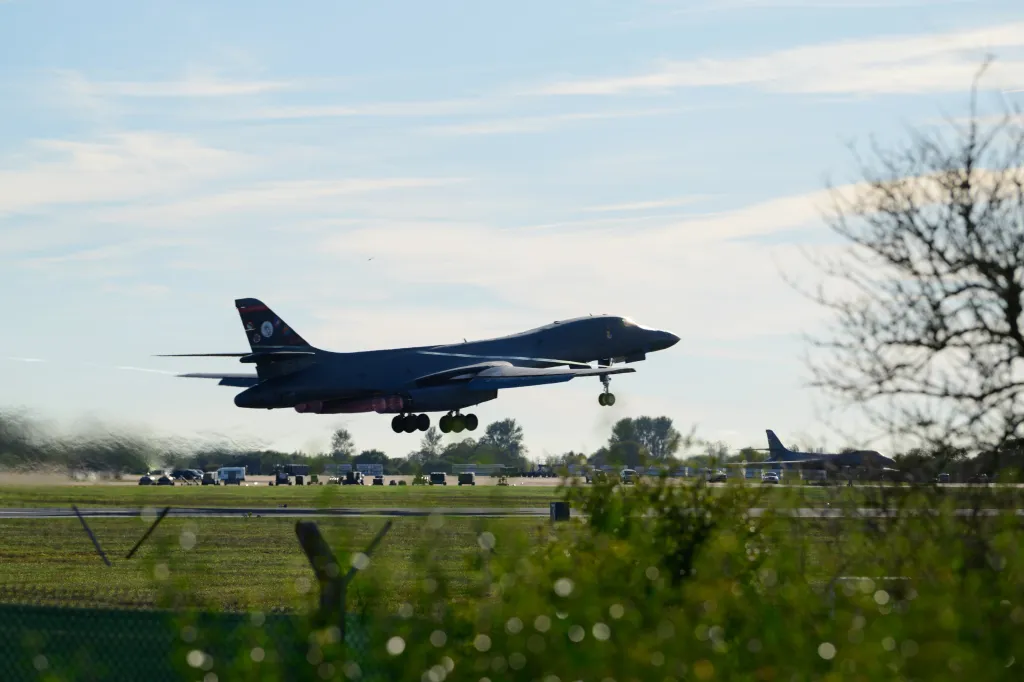
The B-1B takes off from Tinker Air Force Base, Oklahoma, April 22, 2026, following completion of depot maintenance to return the aircraft to operational status. (U.S. Air Force photo by Courtney Landsberger)
The B-1B lifts off from Tinker Air Force Base, Oklahoma, April 22, 2026, marking the completion of a depot maintenance effort to restore the aircraft’s capabilities. (U.S. Air Force photo by Courtney Landsberger)

At the same time, the relevance of the bomber continues to grow, including adding more new weapons. Earlier this week, we looked at the first imagery of the a B-1B carrying an AGM-183 Air-launched Rapid Response Weapon hypersonic missile, or ARRW.

For the first time, as far as we know, the U.S. Air Force has publicly released imagery showing a B-1B Lancer bomber carrying an AGM-183 Air-launched Rapid Response Weapon hypersonic missile, or ARRW.
A still from the first publicly released imagery showing a B-1B carrying an AGM-183 Air-launched Rapid Response Weapon hypersonic missile, or ARRW. (U.S. Air Force screencap) U.S. Air Force/screencap

The Air Force now also wants to develop an improved version of the ARRW, as well as a separate air-launched ballistic missile (ALBM). Once again, the B-1B is likely to be closely involved with these efforts.

The B-1B takes off from Tinker Air Force Base, Oklahoma, on April 22, 2026. (U.S. Air Force photo by Courtney Landsberger)
U.S. Air Force Airman 1st Class Trevor Francisco, 28th Bomber Generation Squadron assistant dedicated crew chief, taxis in a B-1B tail number 86-0115, at Dyess Air Force Base, Texas, April 22, 2026. Francisco was part of the maintenance team responsible for keeping the newly regenerated bomber mission-ready after it was recalled from retirement to support the active bomber fleet. (U.S. Air Force photo by Airman 1st Class William Neal)

Fiscal Year 2027 budget documents show the Air Force intends to invest $342 million to upgrade its remaining 44 B-1Bs between 2027 and 2031. “This request provides the necessary funding to modernize the platform, ensuring its lethality and relevance through 2037,” the document states.

With the B-1B now set to fly beyond its once-expected sunset, demand for the bomber shows no sign of easing, including recent heavy tasking for Operation Epic Fury. With that in mind, bringing the refurbished Apocalypse II back into the fleet will help keep it ready for the missions yet to come.

Contact the author: thomas@thewarzone.com

Thomas is a defense writer and editor with over 20 years of experience covering military aerospace topics and conflicts. He’s written a number of books, edited many more, and has contributed to many of the world’s leading aviation publications. Before joining The War Zone in 2020, he was the editor of AirForces Monthly.


Source link

B-1B Seen Carrying ARRW Hypersonic Missile For The First Time

For the first time, the U.S. Air Force has publicly released imagery showing a B-1B Lancer bomber carrying an AGM-183 Air-launched Rapid Response Weapon hypersonic missile, or ARRW. The development comes with the B-1B now officially slated to serve for another decade, while it has been earmarked as a hypersonic weapons test platform. For its part, the ARRW, at one point expected to be the U.S. military’s first operational hypersonic weapon, is also back from purgatory, after continued questions about its future. The Air Force now wants to develop an improved version, as well as a separate air-launched ballistic missile (ALBM).

A brief clip showing a B-1B flying with an ARRW carried on an external hardpoint was released on Edwards Air Force Base’s Instagram page recently. The emergence of the video was first brought to our attention by The Aviationist.

It is unclear when the test-flight footage was taken, and it is not directly referenced in the video, which is otherwise dedicated to the work of maintainers on different aircraft platforms at Edwards.

The B-1B over a test range, with the ARRW installed. U.S. Air Force screencap

The B-1B was originally designed to carry external stores on up to eight external hardpoints. The Air Force had also developed special pylons that would have allowed the bombers to carry two nuclear-tipped AGM-86B Air-Launched Cruise Missiles (ALCM) on each one. Following the end of the Cold War, the B-1Bs lost their nuclear mission and, as a result, the external pylons fell into disuse, at least as far as weapons are concerned.

B-1B with cruise missile mounting racks attached to external hardpoints during testing back in the 1980s. U.S. Air Force

However, as long ago as 2020, the Air Force detailed plans to add the ARRW to the B-1B, after the service highlighted work to expand the bomber’s ability to carry hypersonic weapons and other new stores, both internally and externally.

“My goal would be to bring on at least a squadron’s worth of airplanes modified with external pylons on the B-1, to carry the ARRW [Air-launched Rapid Response Weapon],” Gen. Timothy Ray, then head of Air Force Global Strike Command, told Air Force Magazine. He added that the service had contemplated several options for integrating the missile onto the bombers, “but we believe the easiest, fastest, and probably most effective in the short term will be to go with the external pylons.”

In the meantime, we have seen examples of the ARRW carried under the wing of the B-52H bomber during multiple test sorties, and a live version also notably appeared on a Stratofortress during a training event at Andersen Air Force Base on Guam.

A live AGM-183A ARRW under the wing of a B-52 bomber at Andersen Air Force Base on Guam ahead of a test over the Western Pacific in 2024. U.S. Air Force

The Fiscal Year 2026 budget request confirmed that the Air Force plans to use the B-1B as a testbed for the Load Adaptable Modular (LAM) pylon, intended for hypersonic weapons and other outsize loads. The B-1B can accommodate six of these pylons, each capable of carrying two 2,000-pound-class weapons or a single 5,000-pound-plus-class weapon. The ARRW would fall into the latter category.

Boeing concept art showing a B-1B fitted with LAM pylons carrying air-breathing hypersonic missiles. Boeing

The budget documents noted: “The Hypersonic Integration Program successfully demonstrated the B-1’s ability to execute a captive carry of a 5,000-pound-class store and the release of a proven weapon shape from a Load Adaptable Modular (LAM) pylon.” This suggests that the video we are now seeing could have been taken during this demonstration, but it might also refer to external load tests involving the Air Force’s new bunker-buster bomb, the 5,000-pound class GBU-72/B.

A model of the LAM pylon, which Atlantic Models in Miami built for Boeing, loaded with two mock-up hypersonic cruise missiles. Atlantic Models

In the same position as seen in the ARRW video, the LAM has also been used for external carriage tests of the Joint Direct Attack Munition (JDAM). More routinely, this same position mounts an external pylon that accommodates a Sniper targeting pod. The same location has previously been used in external carriage tests of the AGM-158 Joint Air-to-Surface Standoff Missile (JASSM) cruise missile, too.

A B-1B Lancer assigned to the 419th Flight Test Squadron conducts flight tests with a JDAM on the Load Adaptable Modular pylon in early 2024. Air Force photo by Richard Gonzales
A 419th Flight Test Squadron B-1B carrying an inert AGM-158 JASSM during a demonstration flight. U.S. Air Force
A close-up look at a Sniper Advanced Targeting Pod on a B-1B. U.S. Air Force

As for ARRW, it carries an unpowered hypersonic boost-glide vehicle as its warhead. A rocket booster accelerates and lifts the vehicle to the required speed and altitude, after which it separates and glides through the atmosphere on a relatively shallow path toward its target. The weapon’s high speed and unpredictable flight path make it difficult for opponents to intercept and engage it, and give very little response time.

B52 ARRW Hypersonic evaluation test at Edwards Air Force Base 12 JUN 2019 thumbnail

B52 ARRW Hypersonic evaluation test at Edwards Air Force Base 12 JUN 2019


The Air Force’s plans to move ahead with purchases of ARRWs notably re-emerged in the Fiscal Year 2026 budget proposal. The service had moved to cancel the AGM-183A in 2023, and refocus resources on the development of the air-breathing Hypersonic Attack Cruise Missile (HACM), but there were steady signs afterward that there was still life left in the ARRW program.

Meanwhile, in its Fiscal Year 2027 budget request, the Air Force seeks funds for the development of what it calls ARRW Increment 2, as well as to kick-start a new air-launched ballistic missile (ALBM) program. The service wants almost $350 million to fund these two efforts. ARRW Increment 2 involves adding undisclosed enhanced capabilities onto the baseline weapon, while the ALBM effort would seek to field a new air-launched, long-range strike capability to complement the ARRW and HACM.

The US Air Force plans to kick off Air Launched Rapid Response Weapon (ARRW) Increment 2 development and stand up a new Air Launched Ballistic Missile (ALBM) program in Fiscal Year 2027. The service has set aside nearly $350 Million combined for these two efforts. ARRW Inc 2… pic.twitter.com/pe0SKPlrDO

— Air-Power | MIL-STD (@AirPowerNEW1) April 27, 2026

In its Fiscal Year 2027 budget documents, the Air Force further notes:

“We are doubling production rates for our two developmental hypersonic weapons, the Air-Launched Rapid Response Weapon (ARRW) and the Hypersonic Attack Cruise Missile (HACM), with a planned investment of $1.8 billion across the FYDP to accelerate delivery of these critical strike capabilities into the hands of the warfighter.”

The documents don’t give any details on how many ARRWs they want to order.

Regardless, these developments are especially notable as China continues to push ahead in the development and fielding of these capabilities, and especially ALBMs.

Mockups of the Chinese JL-1 ALBM on parade in Beijing on September 3, 2025. Central Military Commission of China

Despite previous plans to retire the B-1B by 2030, the bomber’s ability to carry outsize loads, in particular, has helped ensure that it’s now expected to remain in service until at least 2037.

Fiscal Year 2027 budget documents indicate that the Air Force plans to spend $342 million on modernizing its 44 remaining B-1Bs from 2027 to 2031. “This request provides the necessary funding to modernize the platform, ensuring its lethality and relevance through 2037,” the budget said.

The B-2 stealth bomber will also be modernized, as the Air Force seeks to address growing demand for bomber capacity, pending the arrival of the new B-21. The intensity of recent operations against Iran, combined with day-to-day bomber task force operations around the globe, and the growing specter of a conflict with China, underscores just how important the bomber fleet is to the Pentagon at large.

B-1s first mission to Iran out of RAF Fairford UK thumbnail

B-1s first mission to Iran out of RAF Fairford UK


With a capacity to carry more conventional weapons than any other aircraft in the Air Force’s inventory, we will surely see the B-1B carrying additional external weapons and larger numbers of them, as it continues its service career.

Contact the author: thomas@thewarzone.com

Thomas is a defense writer and editor with over 20 years of experience covering military aerospace topics and conflicts. He’s written a number of books, edited many more, and has contributed to many of the world’s leading aviation publications. Before joining The War Zone in 2020, he was the editor of AirForces Monthly.


Source link