
Ayatollah Ali Khamenei

U.S. gas prices up 27% since start of Iran attacks

March 17 (UPI) — U.S. gasoline prices have surged by 27% and diesel by 34% since the start of U.S. attacks on Iran last month, fuel costs reported Tuesday indicate.

AAA reported that the national average cost for a gallon of gas in the United States was $3.79 Tuesday morning. Diesel was $5.044 per gallon, topping the $5 threshold for the first time in three years, CNBC reported.

A year ago, those prices were $3.078 and $3.592, respectively. A month ago, they were $2.917 and $3.651.

Fuel prices have been on the rise globally since the United States and Israel launched attacks on Iran on Feb. 28 amid negotiations over Iran’s nuclear program. The attacks, which killed Iran’s supreme leader, Ayatollah Ali Khamenei, prompted Tehran to effectively close down the Strait of Hormuz by banning ships linked to the United States or Israel. About 20% of the world’s oil runs through the waterway that separates Iran and Oman.

Brent Crude, the benchmark price for oil worldwide, rose about 2% to $102 a barrel Tuesday, The New York Times reported. The West Texas Intermediate, the U.S. benchmark, rose to $95 a barrel.

Diesel prices are particularly tied to the U.S. economy, which depends on it for the transportation of goods via trucks, trains and barges. Recent surges in prices could have a cascading effect.

Andy Lipow, president of Lipow Oil Associates, said Tuesday that trucking and rail companies have begun increasing their fuel surcharges in response to the fuel hikes.

“One should really be worried about higher diesel prices,” he said in a note published by CNBC.

President Donald Trump this week put pressure on other nations that rely on oil shipped through the Strait of Hormuz to join a coalition to police the transit route and reopen traffic.

Speaking aboard Air Force One on Sunday, Trump said the United States doesn’t need to be involved in reopening the Strait of Hormuz because little of its oil passes through the waterway. About 7% of the United States’ crude oil and condensate imports passed through the strait in the first half of last year, the U.S. Energy Information Administration said.

He said the United States was protecting it “almost like we do it for habit” and to help “some very good allies that we have in the Middle East.”

Patrick De Haan, head of petroleum analysis at GasBuddy, said Monday, “until we see a meaningful resumption of oil flows through the Strait of Hormuz, upward pressure on fuel prices is likely to persist.”

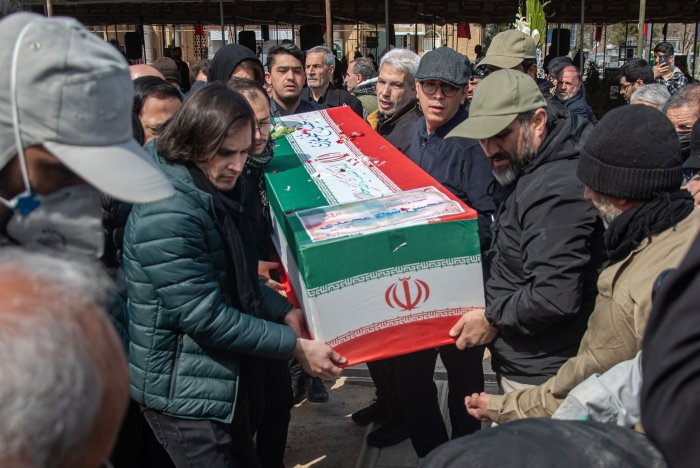
Iranians attend a funeral for a person killed in recent U.S.-Israel airstrikes at Behesht-e Zahra cemetery on the southern outskirts of Tehran in Iran on March 9, 2026. Photo by Hossein Esmaeili/UPI | License Photo

Source link

Oslo police release images of suspect in U.S. embassy attack

1 of 2 | Glass doors were damaged at the site of incident at the U.S. embassy in Oslo, Norway, Sunday, after a loud bang was reported at the site. No injuries were reported and the police have launched an investigation. Photo by Fredrik Varfjell/EPA

March 9 (UPI) — Oslo, Norway, police have released images of a person suspected in the bombing outside the U.S. embassy in the city on Sunday.

Two images from surveillance video were released showing a person wearing all black with their face covered and carrying a backpack.

Police said the explosion, which shattered a glass door, was from an improvised device set at the entrance to the building. It caused minor damage and no injuries. Police said there are no developments on the person’s motive.

Police are also looking at a video posted on Google Maps around the time of the explosion. It showed the former Supreme Leader Ayatollah Ali Khamenei, who was killed by the U.S. and Israeli military action on Feb. 28.

Police are asking for anyone with information about the suspect or who noticed anything unusual between midnight and 2 a.m. CET to contact them. They said they have used dogs, drones and helicopters to investigate the scene.

On Sunday, police weren’t sure if the explosion was an attack.

Frode Larsen, head of the joint investigation and intelligence unit, told a press conference that it’s “natural to view this in the context of the current security situation, and that it is a targeted attack against the American embassy. But we have not locked ourselves into just that one hypothesis.”

Police searched the surrounding area, but didn’t find any other explosive devices.

Source link

People stuck in Middle East told ‘have these essentials ready to go in grab bag’

Travel expert Ash Bhardwaj said people who are still in the country should ‘prepare’

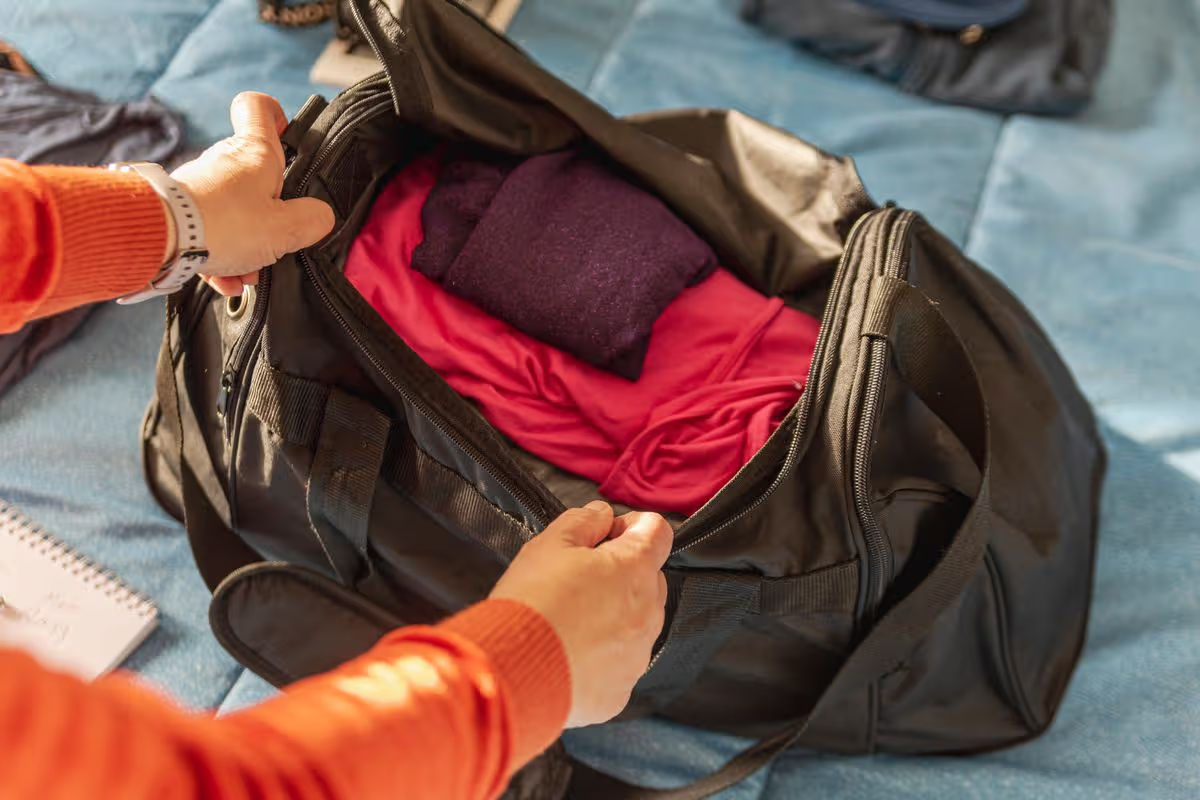
People affected by the Middle East conflict have been urged to gather a few essential items and keep them “ready to go” amid the ongoing war in Iran. Having these on hand will make sudden changes a lot less scary and chaotic, an expert has claimed.

Speaking on a recent episode of BBC Morning Live, travel expert Ash Bhardwaj said: “One of the best things you can always do is just make sure you have a grab bag. So, if you have to move quickly, you’ve got your essentials with you.”

Although it may look different for everyone, some things will likely be part of anyone’s emergency bag. Ash suggested that packing a ‘grab bag’ in advance could help during any panic that might set in during an emergency.

He said: “[That includes things like] passports, essential medicines and maybe any documents for travel insurance if you’ve got them printed out. If you’ve got kids, a change of underwear, a couple of t-shirts and some snacks.

“If you’ve got babies, and you’re no longer breastfeeding but still feeding them with formula or milk, get enough for 48 to 72 hours. This isn’t to scare you, it’s just so that you have actually thought everything through and it relaxes you.”

Content cannot be displayed without consent

The broadcaster said that people should prepare and “plan for when the worst might happen”. Speaking to hotel staff can help point out emergency exits, procedures, and other important safety measures.

As of March 5, 2026, the Foreign Office advises against all but essential travel to the United Arab Emirates. There are other parts of the Middle East and surrounding areas that have also been listed as completely or partially unsafe for travel – read that latest round-up here.

The current situation in Iran caused tensions to erupt last week, on February 28, when the US and Israel launched extensive strikes. Iran’s Supreme Leader, Ayatollah Ali Khamenei, who had been in power since 1989, was killed during the initial wave of attacks.

The conflict has sparked travel chaos throughout parts of the Gulf region, including Dubai. For the most recent developments, click here for updates on travel and news.

In an update from March 5, Dubai’s Emirates Airline has announced it will operate over 100 flights on March 5 and 6 from Dubai. The airline said it will “continue to gradually build back its flying schedule, subject to airspace availability and all operational requirements being met”, adding that “safety is always our top priority”.
Source link

Israeli military attacks Hezbollah in Lebanon

A damaged apartment in a building following an Israeli airstrike in Al Jamous, in Dahieh, southern suburbs of Beirut, Lebanon, on Monday, March 2, 2026. Photo by Wael Hamzeh/EPA

March 1 (UPI) — The Israeli military was attacking Hezbollah targets in neighboring Lebanon, amid worries that its war with the United States against Iran may escalate and spill across the region.

The Israel Defense Forces announced its military offensive hours after sirens triggered by projectiles launched from Lebanon sounded throughout northern Israel.

The Israeli strikes were retaliatory, the IDF said in a statement.

Strikes targeted senior Hezbollah operatives in the capital, Beirut, according to the Israeli Air Force, which said it also struck “a key terrorist” in southern Lebanon.

“Hezbollah opened a campaign against Israel overnight, and is fully responsible for any escalation,” IDF Chief of General Staff Lt. Gen. Eyal Zamir said in a statement.

“Any enemy that threatens our security will pay a heavy price — we will not allow any harm to come to the people of Israel and our northern border.”

In an update, the IDF said targets included command and control centers, launch sites and senior Hezbollah operatives.

In the recorded statement, an IDF spokesperson said they were prepared for a Hezbollah response prior to attacking Iran on Saturday.

The spokesperson said Israeli fighter jets were continuing to strike Iran.

According to Lebanon’s Health Ministry, at least 31 people were killed and 149 wounded in the overnight attacks in the country’s south and Beirut’s Dahiyeh district, the state-run National News Agency reported.

It said 11 were killed and 58 injured in south Lebanon and 20 killed and 91 injured in the southern suburbs.

The strikes come less than 48 hours after the United States and Israel began their military operation to force regime change in Iran. Iran’s spiritual leader, Ayatollah Ali Khamenei, was killed in the strikes, along with other senior officials. Iran will form a three-member interim council until a new leader is chosen, according to the semi-official Tasnim News Agency.

Iran has responded by attacking U.S. bases throughout the Middle East. Tehran’s proxy militias have also launched attacks, including Hezbollah.

Three U.S. service members were killed and five seriously injured in Kuwait. At least nine Israelis were killed in strikes in Beit Shemesh, located about 20 miles west of Jerusalem, Israel’s Magen David Adom emergency service said in a statement. More than 20 were injured in the strike.

In Iran, more than 200 people have been killed, according to state media citing the Red Crescent. The Iran Mission to the United Nations said more than 150 school children were killed in a strike on a school in the southern city of Minab.

Lebanese Prime Minister Nawaf Salam condemned the launching of rockets from southern Lebanon toward Israel.

He described the Hezbollah strikes as “an irresponsible and suspicious act that endangers Lebanon’s security and safety and provides Israel with pretexts to continue its attacks.”

“We will not allow the country to be dragged into new adventures, and we will take all necessary measures to stop the perpetrators and protect the Lebanese.”

Source link

At least 22 people killed in anti-U.S. protests in Pakistan

Plumes of smoke rise above the skyline of Tehran, Iran’s capitol, after explosions in the city on Sunday. Protests have occurred across the Middle East, including one in Pakistan where more than 20 people died. Photo by Hossein Esmaeili/UPI | License Photo

March 1 (UPI) — Some 22 people were killed amid anti-U.S. protests in Pakistan Sunday, following the U.S.-Israeli offensive Saturday that left 200 people dead.

In Karachi, at least 10 people were killed as they attempted to storm the U.S. Consulate, while two were killed in Islamabad and another 10 killed in Gilgit-Baltistan, the New York Times reported.

“When Iran is attacked, we feel our faith, our identity and our very existence are being targeted,” a student protestor in Karachi said, The Times reported.

The country’s supreme leader, Ayatollah Ali Khamenei was among the dead following the U.S. and Israeli attacks.

In response, protests are swelling across the region, including in Iraq and India.

“We must also ensure that those who are mourning in Jammu and Kashmir are allowed to grieve peacefully,” said the area’s chief minister Omar Abdullah, NDTV World reported. “The police and administration should exercise utmost restrain and refrain from using force or restrictive measures.”

Barron’s reported that protests against the U.S. are anticipated in North Africa, South Asia and across the Middle East.

The U.S.-Israeli airstrikes followed indirect negotiations between the United States and Iran regarding nuclear weapons on Thursday.

Iranian officials had said that additional talks were planned.

President Trump had previously increased military presence in the region and threatened escalation if no deal was reached.

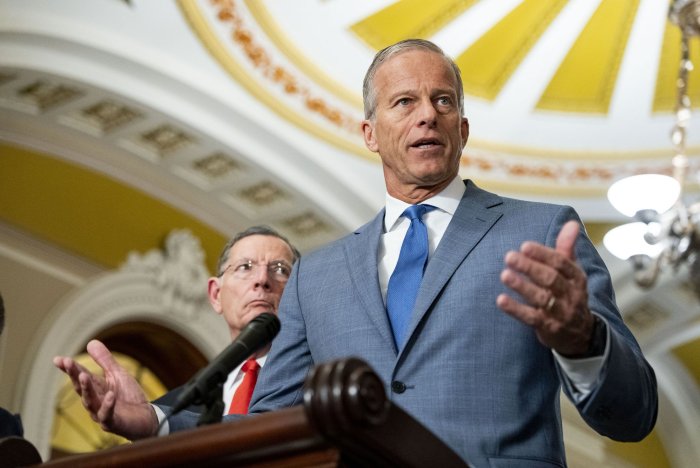
Senate Majority Leader John Thune, R-S.D., speaks during a press conference after the weekly Republican Senate caucus luncheon at the U.S. Capitol on Wednesday. Photo by Bonnie Cash/UPI | License Photo

Source link

Travel expert Simon Calder issues three-word advice for Brits caught up in Iran attacks

Thousands of Brits are thought to be stranded in the Middle East after US and Israeli airstrikes on Iran

A travel expert has issued three words of crucial advice for people stranded in the Middle East following US and Israeli air strikes on Iran. Simon Calder made the remarks after hundreds of thousands of travellers found themselves stuck in destinations such as Qatar and Abu Dhabi in the wake of the attacks.

Numerous airlines, including British Airways, Emirates, and Qatar Airways, grounded flights following Iranian retaliatory strikes throughout the region. When flights will resume normal service remains unclear, with thousands of Britons believed to be stranded.

Speaking on Radio 5 Live, Mr Calder had three key words he urged travellers to follow: “At the moment, the best advice I have for anyone who is stuck in various parts of the world is: just be patient.”

The situation will be resolved – I hope, very much sooner rather than later,” he added. “What we have seen is the extraordinary sight of the big three of Middle Eastern hubs – Dubai International, Doha, and Abu Dhabi – all closing because of the retaliatory strikes from Iran. We have never seen that. The last thing of this scale we saw in this area like that here was the Covid pandemic.

READ MORE: Travel expert Simon Calder predicts when BA, Etihad and Emirates flights will resume after Iran attackREAD MORE: Nationwide customers’ three steps needed to qualify for free £100 payout

“Consider this. More than a quarter of a million passengers were due (on Saturday) to fly to and through Dubai International Airport alone. It is bigger than Heathrow Airport, handles more passengers, and everyone is desperate to get where they need to be.

“I have been speaking to people who were about to take off, they had the ‘boarding complete’ announcement, and suddenly the captain said, ‘Sorry, airspace closed, we are staying here’. It took them three hours to get off the aircraft because they all had to be processed through immigration, leaving them in a place where they really didn’t want to be. Many of them were just off a previous flight a few hours before and were waiting to travel on to their final destination of London Heathrow.”

It was subsequently confirmed that Iranian Supreme Leader Ayatollah Ali Khamenei was killed in the strikes, casting serious doubt over the future of the Islamic Republic. The death of Mr Khamenei, following decades in power, has triggered furious scenes across other parts of the Middle East and beyond, heightening the threat of potential regional instability.

Dubai International ranks as the world’s busiest airport, processing roughly 250,000 passengers daily. Doha Airport in Qatar handles approximately 150,000 travellers each day, meaning enormous travel chaos as both airports continue to be affected.

Doha holds particular significance for British passengers flying to and from the Middle East, Asia and the UK. Mr Calder went on to say: “Some people are in the difficult position of being stranded on the wrong side, and they are trying to get back to the UK but finding that air passenger rights rules – which are great when you are flying from Europe – don’t work the same way when you are flying to Europe on a non-UK or non-EU airline.

“They can basically just say, ‘well, good luck, we’ll try and get you there in a week or you can take a refund’. It’s really, really difficult Airlines like Emirates, Etihad, Qatar Airways, they are not legally obliged to find hotel accommodation for all these stranded passengers and get them back as soon as possible but hopefully they will do so.

“The other problem for people whose flights have been cancelled, when flights resume, they go to the back of the queue. If flights resume on Monday, anybody who has a flight booked on Monday will fly on Monday, and people whose flights were cancelled over the weekend – and we are talking hundreds of thousands now – they are going to be finding that they are at the back of the queue, scrabbling for whatever available seats there are.”

Source link

BBC Breakfast shares ‘devastating’ deaths announcement minutes into show

BBC Breakfast’s Roger Johnson and Rachel Burden returned to our TV screens on Sunday’s (March 1) morning to deliver the day’s headlines

BBC Breakfast’s latest broadcast started with a distressing news update on the “most devastating offensive operation in history”.

During Sunday’s (March 1) episode of the BBC hit show, Roger Johnson and Rachel Burden returned to our screens as they delivered the day’s top headline stories from the UK and around the globe.

However, just moments into the live broadcast, Roger shared the news that Iran’s supreme leader Ayatollah Ali Khamenei has been killed following US-Israeli strikes on Tehran.

Rachel also revealed: “The Red Crescent says more than 200 people have been killed in the strikes with state media reporting at least 85 deaths following one air strike on a school in Iran.

“Overnight the Islamic Revolutionary Guard Corps warned it would attack US bases and Israel in retaliation for Khamenei’s death with what it called ‘the most devastating offensive operation in history of the Islamic Republic.”

This is a breaking showbiz story and is being constantly updated. Please refresh the page regularly to get the latest news, pictures and videos. You can also get email updates on the day’s biggest stories straight to your inbox by signing up for our newsletters.

Source link

Lebanon warns of ‘adventures’ dragging it into U.S.-led war on Iran

Lebanese Prime Minister Nawaf Salam, pictured at Lebanon’s presidential palace in Baabda in 2025, said that his country will not be dragged into “adventures” that threaten it’s security and unity. File Photo by Wael Hamzeh/EPA-EFE

Feb. 28 (UPI) — BERUIT — Lebanese Prime Minister Nawaf Salam said on Saturday that he rejects any attempt to drag his country into “adventures” that threaten its security and unity, indirectly calling on Iran-backed Hezbollah to refrain from involving Lebanon in the ongoing U.S.-led war on Iran.

Salam’s warning coincided with a statement from the U.S. Embassy in Lebanon urging U.S. citizens still in the country to leave “now, while commercial options remain available.”

In a post on X, the prime minister appealed to all Lebanese “to act with wisdom and patriotism” in light of the “dangerous developments in the region,” urging them to place Lebanon’s interests “above any other consideration.”

“I reiterate that we will not accept anyone dragging the country into adventures that threaten its security and unity,” he said, referring to Hezbollah, which previously announced that it would not remain neutral if Iran were attacked and its leader, Ayatollah Ali Khamenei, were targeted.

Salam, who also held a meeting with several ministers and relief officials, urged sparing the country the “repercussions” of the war on Iran, which broke out Saturday morning with joint U.S.-Israel attacks and prompted Iranian retaliatory strikes on Israel and U.S. targets across the Gulf Arab states.

When asked whether Hezbollah had reassured the Lebanese state that it would not participate in the war, he reiterated his call to spare Lebanon another war that “would bring even more suffering upon the Lebanese people.”

He was referring to the war with Israel that broke out on October 8, 2023, when Hezbollah opened a front in support of Gaza, during which top Hezbollah leaders, military commanders, and Lebanese civilians were killed, and substantial damage was inflicted, with border villages in southern Lebanon completely destroyed.

Despite a cease-fire agreement reached on Nov. 27, 2024, Israel continued to operate with near-total freedom, striking suspected Hezbollah operatives and positions almost daily, causing further destruction and casualties, including among civilians.

Salam and President Joseph Aoun also conducted diplomatic contacts in an effort to keep Lebanon “neutral and spare it from the repercussions” of the ongoing war in the region.

Aoun, for his part, affirmed that sparing Lebanon from “the disasters and horrors of external conflicts” and preserving its sovereignty, security, and stability are “absolute priorities.” Later, he was informed by U.S. Ambassador to Lebanon Michel Issa that Israel has “no intention of escalating” against Lebanon, as long as there are no hostile actions from the Lebanese side, according to a presidential statement.

Hezbollah, for its part, announced the postponement of a Saturday event during which its Secretary-General, Sheikh Naim Qassem, was scheduled to speak. Instead, it released a statement condemning “the treacherous U.S.-Israeli aggression” that targeted Iran after months of threats aimed at forcing it to “surrender.”

Hezbollah also expressed “full solidarity” with Tehran and urged the countries of the region to “stand against this aggressive scheme and recognize its dangers,” warning that “its dire consequences will affect everyone without exception if left unchallenged.”

It refrained from hinting to the possibility of supporting Iran militarily.

The Prime Minister condemned Iran’s strikes targeting Qatar, Bahrain, Jordan, the United Arab Emirates, Kuwait, and Saudi Arabia, during calls with their top officials to reaffirm Lebanon’s solidarity against such “aggressions.”

Asked whether the U.S. Embassy in Lebanon and the Hamat military base, which hosts U.S. training teams, might be targeted by Iran, Salam said he could not rule it out but noted that all necessary security measures had been taken to prevent such attacks.

He also confirmed that his government was prepared for “any emergency,” having adopted “proactive measures” in anticipation of war, and assured that food, medicine, and fuel were available in quantities sufficient to meet citizens’ needs for at least two months.

He noted that Beirut’s Rafik Hariri International Airport remains open, with the country’s national carrier, Middle East Airlines, operating as usual — except for countries in the region that have closed their airspace. He added that some airlines have canceled their flights to Lebanon.

His comments came at a time U.S. citizens were urged by the U.S. State department not to travel to Lebanon and those who are already in the country to leave “now while commercial options remain available.”

Senate Majority Leader John Thune, R-S.D., speaks during a press conference after the weekly Republican Senate caucus luncheon at the U.S. Capitol on Wednesday. Photo by Bonnie Cash/UPI | License Photo

Source link