Oscars are too political? Speeches have been less political over time
Twenty-three years ago, the Oscars were in turmoil. President George W. Bush had just begun an invasion of Iraq after the Sept. 11 attacks, and as the nation’s TV screens filled with the “shock and awe” campaign, many did not know quite how to proceed with Hollywood’s biggest night.
ABC wanted to postpone, presenters begged off, Jack Nicholson urged his fellow actor nominees to boycott (animated feature winner Hayao Miyazaki did), documentary winner Michael Moore attempted to directly shame Bush from the stage (to loud boos) and many of the acceptance speeches acknowledged the war and included pleas for peace.
President Trump’s recent decision to attack Iran is not precisely the same — American troops have thus far not invaded and the Bush administration’s media blitz of rockets lighting up the sky is absent. No one expected the Oscars to be canceled or delayed and there has been no talk of boycotts; whether the war and (if polls are to be believed) its general unpopularity are noted, either by host Conan O’Brien (who has already said he will not be mentioning Trump) or the winners, remains to be seen.
But if recent history is any indication, it could go unmentioned. Which would be something of a political statement in itself: It would be terrible if the false notion that awards shows have become too political had a chilling effect on anyone who wanted to use their platform to speak about something important they care about.
Thus far, film and television awards winners have stayed away from the issues that have prompted widespread public outrage and protests this year — including the often brutal methods of Immigration and Customs Enforcement, the ongoing concern over the war in Gaza and the endless revelations of the Epstein files.
Despite complaints from certain quarters, awards shows, particularly the Oscars, rarely have more than one or two truly political moments. But this year, the absence has been notable.
Compared with the Grammy Awards, where Trevor Noah, in his final stint as host, roasted Trump and anti-ICE sentiment reigned in speeches and on pins, this year’s Golden Globes (which aired three weeks before the Grammys) appeared to exist in another world. A few stars wore similar pins and spoke on the red carpet, but aside from a few digs about Epstein and CBS News from host Nikki Glaser, there was no mention of the many issues roiling the nation. (As he was beginning to make late-in-speech remarks about this being an important time to make films, Kleber Mendonça Filho, Brazilian director of the non-English language film winner “The Secret Agent,” ran over time and was played off.)
Has Hollywood lost its spine? Or, having been beset for years by grievances that the Oscars have become “too political” and “too woke,” are filmmakers and actors saving their outrage and passion for social media and bowing to pressure to keep their acceptance speeches grateful and celebratory?
“I know that there are people who find it annoying when actors take opportunities like this to talk about social and political things,” said Jean Smart on the Golden Globes red carpet, adding, when she won for actress in a TV comedy: “There’s just a lot that could be said tonight. I said my rant on the red carpet, so I won’t do it here.”
It was an echo of Jane Fonda’s famous 1972 Oscar speech: “There’s a great deal to say, and I’m not going to say it tonight.” And, perhaps, a response to more recent “shut up and dribble” criticism, as distilled by 2020 Golden Globes host Ricky Gervais, who cautioned the audience: “If you do win an award tonight, don’t use it as a platform to make a political speech. You’re in no position to lecture the public about anything. You know nothing about the real world.”
Indeed, as Oscars ratings have plummeted over the last 20 years, some have suggested that political speechifying is to blame. This is patently absurd. Viewership for just about everything except the Super Bowl has dropped dramatically, and the Oscars ratings do not take into account the millions who watch portions of the show on social media. (We’ll see what happens when the Oscars move to YouTube in 2029.)
And the Oscars have never been particularly political.
Speeches that deviate from the ubiquitous laundry list of thank yous always get more attention, whether they’re political or not, for the simple reason that they’re so dang unusual. But taken as a whole, either by decade or particular telecast, the Oscars is mostly, and consistently, apolitical. As in, almost every minute of a three-hour-plus show, year after year after year.
Unless, of course, you consider thanking God to be political. Which I do not. Nor do I categorize as such any speech that underlines the fact of a historic win (as Halle Berry did in 2002), encourages Hollywood to tell more diverse stories (as Cate Blanchett did in 2014) or reminds audiences in a general way that systemic oppression and war are bad (as Adrian Brody did amid his ramblings in 2025).
Many of the speeches that have been branded as “political” are simply underscoring the themes of the films being honored — in 2009, both Dustin Lance Black and Sean Penn advocated for gay rights when accepting Oscars for “Milk,” which chronicled the life of assassinated gay rights activist Harvey Milk. Likewise, John Irving supporting abortion rights and Planned Parenthood after winning for “The Cider House Rules” in 2000 and John Legend and Common speaking passionately about civil rights, past and present, after winning for “Glory,” a song from the civil rights drama “Selma,” in 2015 was only natural.

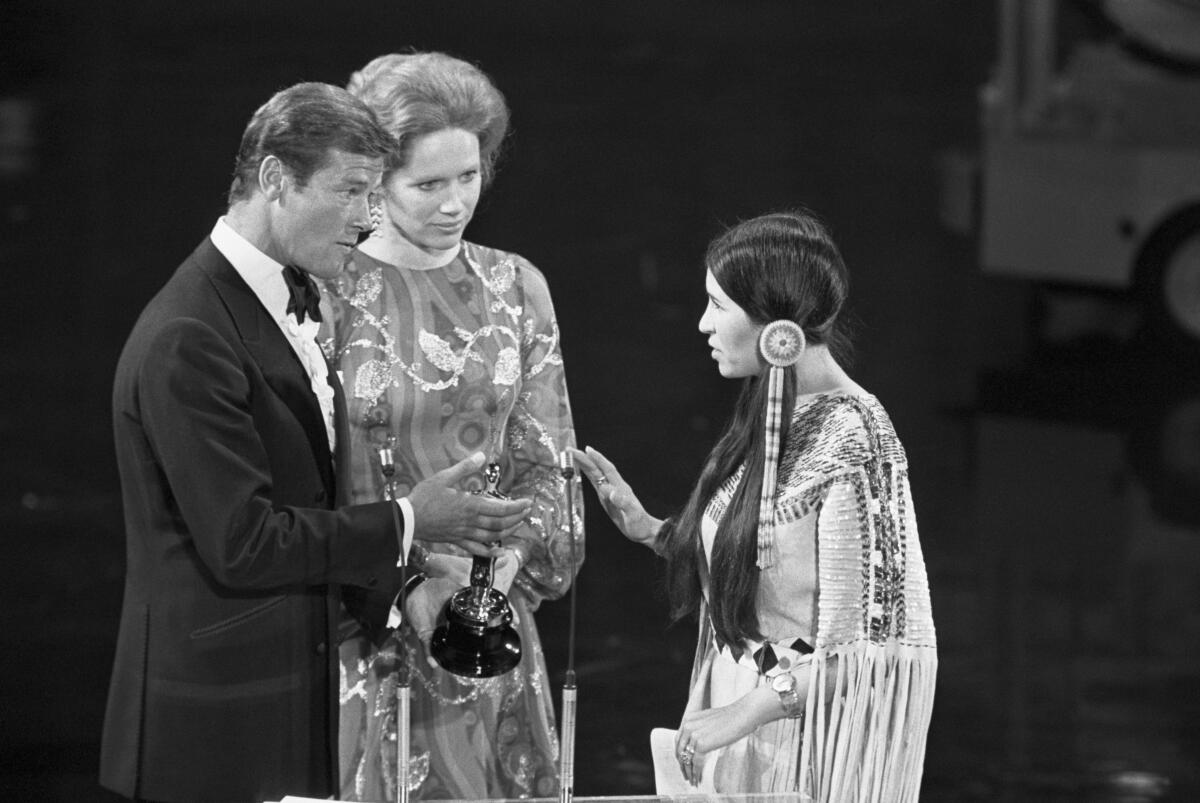
Sacheen Littlefeather refuses the lead actor Academy Award on behalf of Marlon Brando in 1973.
(Bettmann Archive)
A purely political speech, to my mind, directly calls out specific leaders, policies or crises, which may or may not have anything to do with the film being awarded. The most famous are, of course, Marlon Brando’s decision to send Sacheen Littlefeather to accept his Oscar for “The Godfather” and protest the treatment of Native Americans, and Vanessa Redgrave’s 1978 denunciation of “Zionist hoodlums” who were demonstrating against her involvement in a pro-Palestinian documentary even as she accepted for supporting actress in “Julia.”
In 1993, while many Oscars attendees wore red ribbons to honor those living with HIV/AIDS and call for government assistance, then-couple Susan Sarandon and Tim Robbins took it further, using their time as presenters to ask the U.S. government to allow HIV-positive Haitians being held at Guantanamo Bay to be let into the country. That same year, presenter Richard Gere used the fact that “1 billion people” were watching to send “sanity” to Chinese leader Deng Xiaoping in the hopes that he would allow the people of Tibet to “live free.” (Then-Oscars producer Gil Cates quickly denounced the three presenters; Gere did not return to the Oscars until 2013.)
A year after Moore blasted Bush over Iraq, Errol Morris, winning for “The Fog of War,” briefly compared the war in Iraq to the “rabbit hole” of Vietnam (which was the subject of his film). In 2015, “Boyhood” star Patricia Arquette used most of her supporting actress speech to demand equal wages for women. That same year, “Birdman” director Alejandro G. Iñárritu dedicated his award to his fellow Mexicans, with the hope that they would be treated by Americans “with dignity and respect” so that together, they could build a “great immigrant nation.” (Which frankly plays more purely political now than it did at the time.) A year later, Leonardo DiCaprio spoke about climate change after winning for “The Revenant.”
In 2019, Spike Lee, accepting for adapted screenplay (“BlacKkKlansman”), called on voters in the upcoming election to mobilize and “be on the right side of history” and in 2024, “Zone of Interest” director Jonathan Glazer, accepting for international film, riled many by comparing the dehumanization required for the Holocaust to occur with events in Gaza.
Even now, the most notable examples of political speeches, the ones that are always mentioned, are from the freaking ‘70s. Which certainly obliterates the idea that the Oscars have grown more political and undermines the argument that it is a Big Problem.
Put these relatively few moments next to the endless hours of acceptance speeches that, with varying degrees of emotion, honor the art of movie-making and the legions that support those who are doing it (including God, parents, spouses, children, some random but heaven-sent teacher) and it’s difficult to see much “wokeness.”
The people who gather at the Oscars are storytellers, and many of the stories they tell deal with uncomfortable truths about our collective past, present and future (including best picture front-runners “One Battle After Another” and “Sinners”). Of course nominees and winners have opinions about politics, science, social issues, international conflict and those suffering without recourse or voice — that’s why they make movies. So if a few of them decide to skip thanking their manager or the studio head and say a few words about climate change or whatever current law/policy/presidential action they believe is making lives worse for a lot of people, that’s their choice. They just won an Oscar!
For those uncomfortable watching it, just use the 45 seconds to grab a snack and by the time you’re back, the host will be moaning about how long the show is and the next five winners will inevitably cry and smile; praise their fellow nominees; thank the producers; say something sweet about their cast, crew and mamas; before telling their kids they love them and it’s time to go to bed.
And that’s OK too.