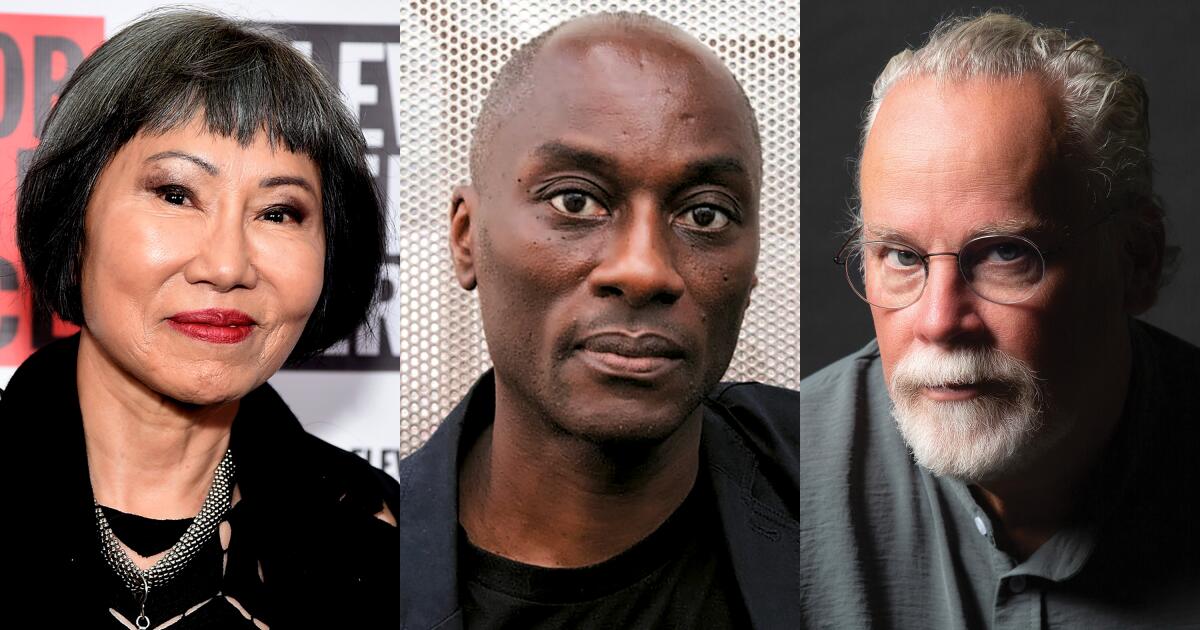
Finalists and honorees for the 46th Los Angeles Times Book Prizes were announced Wednesday.
Writer-curator Ekow Eshun is among the biography finalists for “The Strangers: Five Extraordinary Black Men and the Worlds That Made Them,” which parses Black masculinity as embodied by various civil rights activists, philosophers and other visionaries. Contenders in the fiction categories ranged from seasoned novelists like Michael Connelly to breakouts including Saou Ichikawa, whose debut novel, “Hunchback,” was longlisted for the 2025 International Booker Prize.
Many selected books evoke the greatest anxieties of our time, from government-sanctioned historical revisionism to the ongoing proliferation of AI.
“The Joy Luck Club” author Amy Tan will be honored with this year’s Robert Kirsch Award for lifetime achievement. Nonprofit We Need Diverse Books and novelist Adam Ross will receive the Innovator’s Award and Christopher Isherwood Prize for Autobiographical Prose, respectively.
Winners in the remaining categories will be revealed at the 46th L.A. Times Book Prizes on April 17 at USC’s Bovard Auditorium. The ceremony is a prelude to the annual L.A. Times Festival of Books, which this year runs April 18-19.
The Oakland-born Tan will be given the marquee Robert Kirsch Award, which celebrates literature with regional and thematic connections to the Western United States, for her highly awarded body of work exploring multicultural identity and its complex effects on familial bonds.
“Throughout her extraordinary career, Amy Tan has transformed American literature by shining a light on the emotional complexities of family, identity and cultural inheritance,” said Times senior editor for Books Sophia Kercher. “Her work confronts the social and cultural legacies of the American West with rich details of the immigrant experience.”
Tan’s 1989 debut novel, “The Joy Luck Club,” which interweaves the stories of four Chinese immigrant mothers and their American-born daughters in San Francisco, is a staple of the modern literary canon and was previously a finalist for the National Book Award and the National Book Critics Circle Award. “The Joy Luck Club,” along with the essays, memoirs and novels Tan has since penned — most recently 2024’s “The Backyard Bird Chronicles” — have also led her to be inducted into the American Academy of Arts and Letters and earned her a National Humanities Medal from President Biden.
We Need Diverse Books, a viral 2014 Twitter campaign turned nonprofit, is being honored with the Innovator’s Award for its efforts toward promoting diversity and inclusion in children’s and young adult publishing.
According to the WNDB website, upon the nonprofit’s launch more than a decade ago, only 8% of children’s books published in the U.S. were written by authors of color. In 2023, that figure rose to 47%, in no small part due to WNDB’s grants, library partnerships and other advocacy work, per the Cooperative Children’s Book Center at the University of Wisconsin-Madison.
“We Need Diverse Books has played an important role in publishing by championing stories that reflect our world, and opening doors for writers and readers,” said Times Executive Editor Terry Tang. “We are thrilled to recognize them with this year’s Innovator’s Award, honoring their unwavering commitment to access and representation in literature.”
Ross rounds out the L.A. Times Book Prize honorees as the winner of the Christopher Isherwood Prize for “Playworld,” a semi-autobiographical novel about a teen growing up in 1980s New York that is described as “less a bildungsroman than a story of miseducation.”
In addition to the achievement awards, the Book Prizes recognize titles in 13 categories: audiobooks, autobiographical prose (the Christopher Isherwood Prize), biography, current interest, fiction, first fiction (the Art Seidenbaum Award), graphic novel/comics, history, mystery/thriller, poetry, science fiction, science and technology and young adult literature. Each category’s finalists and winners are chosen by panels of writers specializing in that genre.
For more information about the Book Prizes, including the complete list of finalists, visit latimes.com/BookPrizes.
Robert Kirsch Award
Amy Tan
Innovator’s Award
We Need Diverse Books
The Christopher Isherwood Prize for Autobiographical Prose
Adam Ross, “Playworld: A Novel”
The Art Seidenbaum Award for First Fiction
Andy Anderegg, “Plum”
Krystelle Bamford, “Idle Grounds: A Novel”
Addie E. Citchens, “Dominion: A Novel”
Justin Haynes, “Ibis: A Novel”
Saou Ichikawa translated by Polly Barton, “Hunchback: A Novel”
Achievement in Audiobook Production, presented by Audible
Molly Jong-Fast (narrator), Matie Argiropoulos (producer); “How to Lose Your Mother”
Jason Mott, Ronald Peet, and JD Jackson (narrators), Diane McKiernan (producer); “People Like Us: A Novel”
James Aaron Oh (narrator), Linda Korn (producer); “The Emperor of Gladness: A Novel”
Imani Perry (narrator), Suzanne Mitchell (producer); “Black in Blues”
Maggi-Meg Reed, Jane Oppenheimer, Carly Robins, Jeff Ebner, David Pittu, Chris Andrew Ciulla, Mark Bramhall, Petrea Burchard, Robert Petkoff, Kimberly Farr, Cerris Morgan-Moyer, Peter Ganim, Jade Wheeler, Steve West, and Jim Seybert (narrators), Kelly Gildea (producer); “The Correspondent: A Novel”
Biography
Joe Dunthorne, “Children of Radium: A Buried Inheritance”
Ekow Eshun, “The Strangers: Five Extraordinary Black Men and the Worlds That Made Them”
Ruth Franklin, “The Many Lives of Anne Frank”
Beth Macy, “Paper Girl: A Memoir of Home and Family in a Fractured America”
Amanda Vaill, “Pride and Pleasure: The Schuyler Sisters in an Age of Revolution”
Current Interest
Jeanne Carstensen, “A Greek Tragedy: One Day, a Deadly Shipwreck, and the Human Cost of the Refugee Crisis”
Stefan Fatsis, “Unabridged: The Thrill of (and Threat to) the Modern Dictionary”
Brian Goldstone, “There Is No Place for Us: Working and Homeless in America”
Gardiner Harris, “No More Tears: The Dark Secrets of Johnson & Johnson”
Jordan Thomas, “When It All Burns: Fighting Fire in a Transformed World”
Fiction
Tod Goldberg, “Only Way Out: A Novel”
Stephen Graham Jones, “The Buffalo Hunter Hunter”
Mia McKenzie, “These Heathens: A Novel”
Andrés Felipe Solano translated by Will Vanderhyden, “Gloria: A Novel”
Bryan Washington, “Palaver: A Novel”
Graphic Novel/Comics
Eagle Valiant Brosi, “Black Cohosh”
Jaime Hernandez, “Life Drawing: A Love and Rockets Collection”
Michael D. Kennedy, “Milk White Steed”
Lee Lai, “Cannon”
Carol Tyler, “The Ephemerata: Shaping the Exquisite Nature of Grief”
History
Char Adams, “Black-Owned: The Revolutionary Life of the Black Bookstore”
Bench Ansfield, “Born in Flames: The Business of Arson and the Remaking of the American City”
Jennifer Clapp, “Titans of Industrial Agriculture: How a Few Giant Corporations Came to Dominate the Farm Sector and Why It Matters”
Eli Erlick, “Before Gender: Lost Stories from Trans History, 1850-1950”
Aaron G. Fountain Jr., “High School Students Unite!: Teen Activism, Education Reform, and FBI Surveillance in Postwar America”
Mystery/Thriller
Megan Abbott, “El Dorado Drive”
Ace Atkins, “Everybody Wants to Rule the World: A Novel”
Lou Berney, “Crooks: A Novel About Crime and Family”
Michael Connelly, “The Proving Ground: A Lincoln Lawyer Novel”
S.A. Cosby, “King of Ashes: A Novel”
Poetry
Gabrielle Calvocoressi, “The New Economy”
Chet’la Sebree, “Blue Opening: Poems”
Richard Siken, “I Do Know Some Things”
Devon Walker-Figueroa, “Lazarus Species: Poems”
Allison Benis White, “A Magnificent Loneliness”
Science Fiction, Fantasy & Speculative Fiction
Stephen Graham Jones, “The Buffalo Hunter Hunter”
Jordan Kurella, “The Death of Mountains”
Nnedi Okorafor, “Death of the Author: A Novel”
Adam Oyebanji, “Esperance”
Silvia Park, “Luminous: A Novel”
Science & Technology
Mariah Blake, “They Poisoned the World: Life and Death in the Age of Forever Chemicals”
Peter Brannen, “The Story of CO2 Is the Story of Everything: How Carbon Dioxide Made Our World”
Karen Hao, “Empire of AI: Dreams and Nightmares in Sam Altman’s OpenAI”
Laura Poppick, “Strata: Stories from Deep Time”
Jordan Thomas, “When It All Burns: Fighting Fire in a Transformed World”
Young Adult Literature
K. Ancrum, “The Corruption of Hollis Brown”
Idris Goodwin, “King of the Neuro Verse”
Jamie Jo Hoang, “My Mother, the Mermaid Chaser”
Trung Le Nguyen, “Angelica and the Bear Prince”
Hannah V. Sawyerr, “Truth Is: A Novel in Verse”