Hunt For “AWACS Killer” Anti-Radiation Missile Kicked-Off By Navy
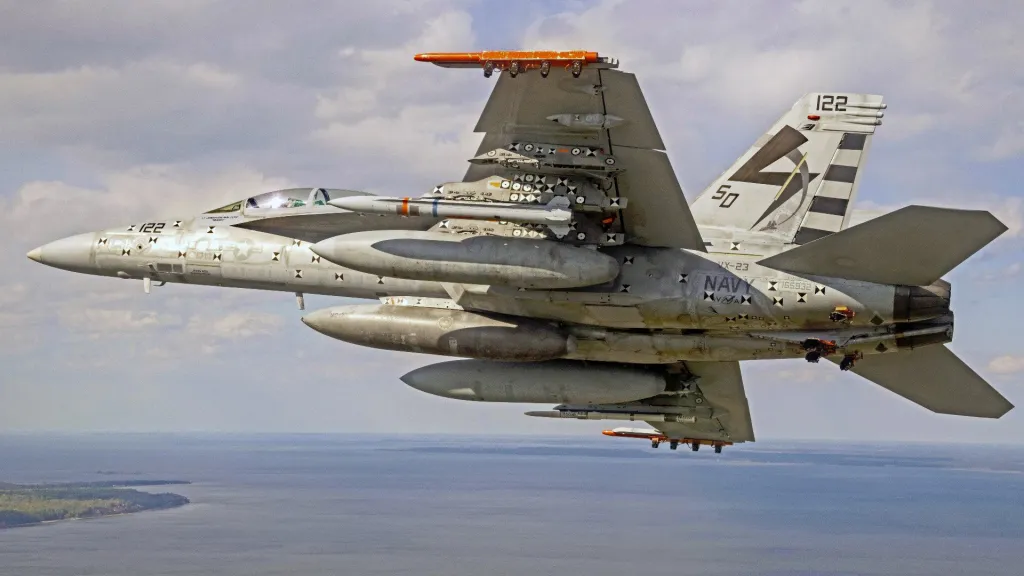
The U.S. Navy is exploring options for a new long-range anti-radiation missile designed to home in on radars to help neutralize enemy air defense networks. The capabilities the service wants for this Advanced Emission Suppression Missile (AESM) sound curiously similar to the ones it is already working to acquire through the AGM-88G Advanced Anti-Radiation Guided Missile-Extended Range (AARGM-ER). There is one crucial difference: the AESM needs to be able to engage targets in the air, as well as on the ground. This would give the Navy a single missile it could use to attack critical airborne early warning and control planes, as well as potentially other aerial targets, and air defenses down below.
Naval Air Systems Command’s (NAVAIR) Program Executive Office for Unmanned Aviation and Strike Weapons (PEO U&W) recently put out a contracting notice regarding the AESM.

NAVAIR is “conducting market research to identify potential sources capable of providing an advanced, anti-radiation guided missile weapon system, or key subsystems thereof, with a longer range than existing in the Navy’s current inventory, including associated engineering, manufacturing, testing, and logistics support,” the notice explains. “This All Up Round (AUR) must be compatible with existing launch platforms (e.g. F-18, F-35) and infrastructure currently supporting the Navy and Air Force’s existing inventory of anti-radiation guided missiles.”
The notice later elaborates that AESM needs to be compatible, at least, with the F/A-18E/F Super Hornet, EA-18G Growler, and F-35 Joint Strike Fighter. It is unclear whether “existing inventory of anti-radiation guided missiles” includes the AARGM-ER, which is a substantial new evolution of the AGM-88 design and is still under development. TWZ has reached out to NAVAIR for more information.

“NAVAIR is seeking to enhance its capabilities to suppress and neutralize enemy air defenses in contested environments,” the AESM notice adds. “This effort aims to identify and potentially acquire a weapon system that provides similar or improved capabilities compared to its current weapons inventory, focusing on extended range, advanced targeting, counter-countermeasures, and integration with existing and future platforms.”
No specific range requirement is included in the notice beyond that AESM needs to be capable of “engaging targets at significant standoff distances.” The missile also needs to have an “advanced anti-radiation seeker with broad frequency coverage,” the “ability to target modern and advanced radar systems,” a “precision navigation and guidance system (e.g., GPS/INS with anti-jamming capabilities),” and the “potential for pre-emptive targeting capabilities.”
Much of this sounds, at least in broad strokes, like the requirements for the AGM-88G. “The AARGM-ER incorporates hardware and software modifications to improve AGM-88E AARGM capabilities to include extended range, survivability and effectiveness against future threats,” according to NAVAIR’s own website.

However, as noted, the requirements laid out in the AESM notice notably differ from those for AARGM-ER in one key respect: the explicit call for anti-air engagement capability. Prospective offers are required to “describe ability to engage air-to-air and air-to-ground targets.”
AESM also needs to have “robust ECCM [electronic counter-countermeasures] capabilities to defeat enemy countermeasures, including chaff, flares, jamming and anti-ARM [anti-radiation missile] techniques.” This might also point further to emphasis on the air-to-air role. Radar blinding chaff and infrared decoy flares are countermeasures typically associated with the air and naval domains.
U.S. military interest in very-long-range air-to-air capable anti-radiation missiles traces all the way back to the Cold War, primarily as a means for engaging enemy airborne early warning and control (AEW&C) planes. Anti-air weapons designed around this role are often colloquially referred to as ‘AWACS killers,’ a reference to the U.S. E-3 Sentry Airborne Warning and Control System (AWACS) aircraft. A very-long-range air-to-air missile could be used against other aerial targets, as well.
This is also not the first time the Navy, as well as the U.S. Air Force, has pursued an air-launched weapon that would blend together traditional anti-radiation and air-to-air capabilities. Starting in the mid-2000s, the two services worked together on a single missile to replace the AGM-88 and the AIM-120 Advanced Medium Range Air-to-Air Missile (AMRAAM) dubbed the Joint Dual-Role Air Dominance Missile (JDRADM), which then evolved into the Next Generation Missile (NGM). The NGM effort came to an end, at least publicly, in 2013, ostensibly over high costs. A more secretive parallel development effort, called the Triple Target Terminator (T-3), continued for at least some time afterward. A possible successor to T-3, called the Long Range Engagement Weapon (LREW), emerged in 2017. How far the LREW effort subsequently progressed, and what its current status might be, are unclear.

All that being said, the value of an ‘AWACS killer’ missile is clear-cut. AEW&C are critical surveillance and battle management assets. Shooting them down deprives an opponent of those capabilities, inherently reducing their ability to effectively maneuver air assets and share important information, including with other nodes on the ground or at sea, as well as in the air. Knocking out these flying radar stations, which can be especially well-suited to spotting lower flying threats from their high perches, just hampers an enemy’s overall situational awareness.
The issue, of course, is that AEW&C planes typically orbit well behind the front edges of a conflict, creating additional challenges for targeting them. This is where something like AESM could come into play. A weapon of this type could engage other aerial targets by zeroing in on the radiofrequency emissions they pump out. This could include electronic warfare aircraft, and potentially other aerial targets. AESM might be able to take on a more general anti-air role with the addition of an active radar and/or imaging infrared seeker, as well as datalinks allowing for the use of networked targeting data. AARGM and AARGM-ER both feature an active millimeter-wave radar seeker to enable them to hit fleeing ground targets, but a similar concept could be adapted for air-to-air use.

AARGM F-18
For the Navy, as well as other branches of the U.S. military, this is all particularly relevant in the context of a potential future high-end fight with China, which has made major investments in its fleets of AEW&C and electronic warfare planes. The Chinese People’s Liberation Army (PLA) has also been pursuing ever-longer-ranged anti-air missiles, including types that could be used to target American AEW&C platforms, as well as other key support aircraft.
TWZ has previously highlighted much of this in a past feature discussing the use cases for the Navy’s new AIM-174B air-launched version of the Standard Missile 6 (SM-6), which was officially unveiled in 2024. Navy officials have previously hinted at further long-range air-to-air capabilities to come when talking about the AIM-174B.

How The Navy’s New Very Long-Range AIM-174 Will Pierce China’s Anti-Access Bubble
“Clearly we recognize that we’ve got to find opportunities to increase reach and range for our weapons,” Navy Rear Adm. Michael “Buzz” Donnelly, then director of the Air Warfare Division (N98) within the Office of the Chief of Naval Operations, said at the Navy League’s annual Sea Air Space symposium in April 2025. “We’re doing it in air-to-air. We just recently fielded the air-launched SM-6, or the AIM-174, that we’re capable of carrying off the F-18 Super Hornet. And we’ll look at increasing range and incrementing beyond that.”
“That’s [the AIM-174B] an operational capability. And, as you can see, that one being revealed and shown into the area, there are many more behind [it], things that we’re doing there, making sure that we are staying ahead of the conflict, making sure that we’re prepared for the fight that’s going on,” Navy Rear Adm. Keith Hash, head of NAVAIR’s Naval Air Warfare Center Weapons Division (NAWCWD), also said during a panel discussion at the WEST 2025 conference in January 2025. “And those activities and that development is active and strong.”
In addition, the Navy is now working together with the U.S. Air Force on the development of the AIM-260 Joint Advanced Tactical Missile. The AIM-260 is intended as a longer-range and otherwise more capable direct successor to the AIM-120 Advanced Medium Range Air-to-Air Missile (AMRAAM).

As described now, AESM would also offer air-to-surface capabilities in line with a traditional anti-radiation missile in the same package. Even in a future missile ecosystem that also includes the AGM-88G, AIM-174B, and AIM-260, having a single hybrid anti-air/anti-radiation missile would offer extremely useful additional flexibility, especially for addressing threats that might appear unexpectedly in the course of a mission.
One missile capable of being used in those disparate roles could also offer valuable magazine depth benefits, particularly if it has a form factor that allows it to be carried internally by various stealthy crewed aircraft, such as the F-35, and/or advanced combat drones. There had been some speculation that the aforementioned LREW effort, and possibly one or more of its predecessors, had been aiming for a missile that could serve in the anti-radiation and air-to-air roles, and fit inside F-22 and F-35 weapon bays. At the same time, a missile designed to be carried externally could help maximize range, which would be an important consideration for AESM. As an aside, scalable missile concepts have been raised in the past as a way to readily adapt a core design for internal or external carriage.
Altgoether, there is a possibility that AESM requirements could be met by a further variation on the AARGM-ER design. The U.S. Air Force is also already acquiring a more general high-speed strike derivative of that missile called the Stand-In Attack Weapon (SiAW). Prime contractor Northrop Grumman has also proposed a surface-to-surface version called the Advanced Reactive Strike Missile (AReS).

The “market research” the Navy is doing now is intended to see what other options might be available. The AESM contracting also highlights the possibility of a weapon that could be further exported to allies and partners. Additional customers could help defray development and acquisition costs, and support production at scale.
Much is still to be learned about the Navy’s plans for AESM, but the Navy certainly seems to have kicked off a new hunt for an ‘AWACS killer’ type missile that could also be used against other targets in the air and on the surface.
Contact the author: joe@twz.com