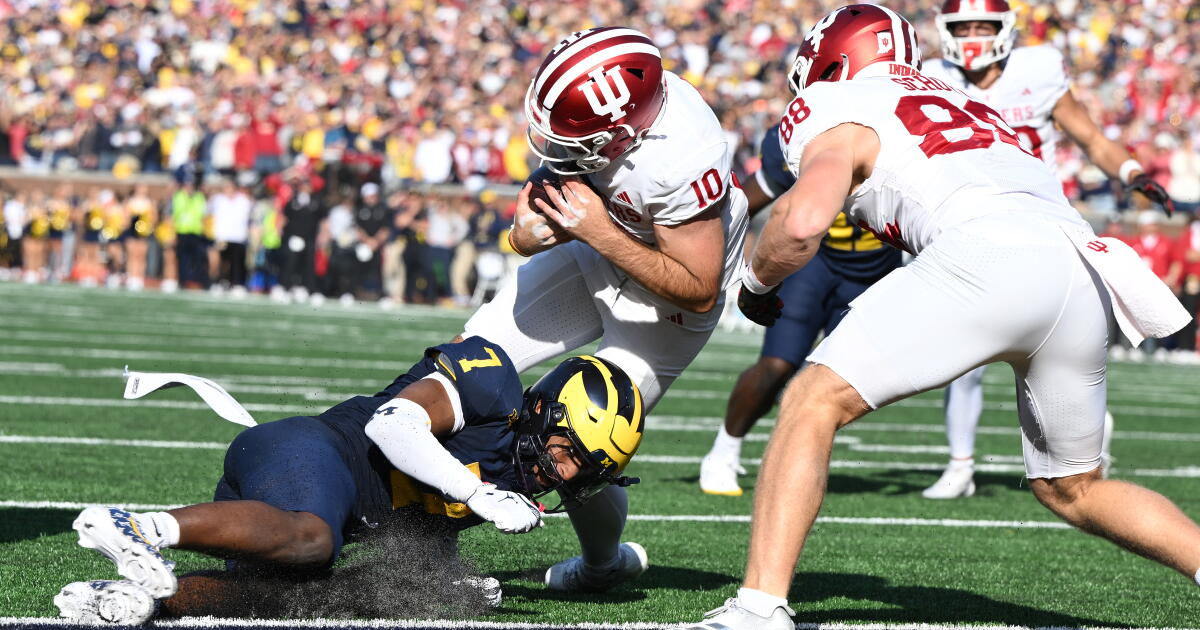
College football: No. 6 Indiana avoids upset; No. 8 Texas Tech falls
Josh Hoover had a four-yard touchdown run in overtime and No. 6 Indiana then kept Michigan out of the end zone in a 13-6 win on Saturday in Ann Arbor.
The defending national champion Hoosiers (7-1, 4-1 Big Ten) avoided losing two in a row for the first time in three years with coach Curt Cignetti — and won at the Big House for the first time since 1967.
The Wolverines (4-3, 1-3) started quarterback Tommy Carr and sat Bryce Underwood, but the freshman didn’t fare as well as he did last week coming off the bench in a win over Penn State.
Carr lost a fumble on an ill-advised pitch in the first quarter and had a pass intercepted in the second half. He took sacks in the second and third quarters that led to missed field goals, including a 32-yard kick after advancing to the Indiana one-yard line.
Michigan reached the Hoosiers three in the final minute of regulation when Carr was sacked for a fourth time, leading to a 26-yard field goal as time expired.
at Cincinnati 37, No. 8 Texas Tech 24: Cole Tabb had a career-high 173 rushing yards and a touchdown while JC French IV threw for a career-high four touchdown passes in the Bearcats’ stunning upset.
It was the Bearcats first win over a top-10 team at home since Nov. 18, 2006, when they defeated No. 7 Rutgers 30-11. Cincinnati won at ninth-ranked Notre Dame in 2021.
The Red Raiders (6-1, 3-1) failed go 7-0 for the first time since 2013 and were plagued by mistakes all afternoon.
at No. 1 Miami 52, Pittsburgh 23: Malachi Toney had a school-record 16 catches and Dariah Mensah threw for 387 yards and four touchdowns in the Hurricanes’ first game as the nation’s top-ranked team in nearly 24 years.
Toney finished with 194 receiving yards and three touchdown catches, while Javian Mallory rushed for two scores and Mark Fletcher Jr. moved into the No. 2 spot on Miami’s all-time list with the 33rd rushing TD of his career.
Miami native Blue Hicks had five catches for 149 yards and a touchdown for Pitt (5-3, 2-3), which dropped its third consecutive game.
No. 10 Louisiana State 38, at Auburn 17: Sam Leavitt accounted for four touchdowns, including two throws to speedster Jackson Harris, and the visitors ended an eight-game, road-losing streak in Southeastern Conference play.
Leavitt completed 32 of 45 passes for a career-high 387 yards, ran for 54 more and played turnover-free football for the second consecutive week.
LSU (6-2, 4-2 SEC) scored on five of six possessions in the first half to take a commanding 31-10 lead into halftime. Harris caught nine passes for 178 yards, scoring on a 10-yard strike and turning a 12-yard crossing route into a 70-yard sprint.
Auburn (4-3, 2-3) seemed to have a letdown a week after stunning then-No. 1 Georgia on the road.
at No. 23 Southern Methodist 59, California 20: Kevin Jennings threw three touchdowns to break the Mustangs’ career record while Kendrick Raphael ran for 104 yards while accounting for three scores, two on fourth-down plays, in the rout.
SMU (6-1, 4-1 ACC) trailed at halftime before scoring touchdowns on their first six drives after the break, when it gained 306 of its 492 total yards. Jennings, already SMU’s career leader for passing yards (9,766) and completions (781), surpassed the 72 scoring passes by Tanner Mordecai from 2021-22.
Freshman running back Christian Rhodes had touchdown runs of five and three yards in SMU’s scoring surge in the second half, while Cal (3-5, 2-3) opened with three consecutive three-and-outs.
at No. 24 Northwestern 42, Rutgers 14: Aidan Chiles threw three touchdowns for the third time this season and rushed for two others to lead the Wildcats to a fourth straight victory.
Caleb Komolafe rushed for 150 yards and a TD, including a 56-yard dash. Griffin Wilde, who finished with 133 receiving yards, Alex Honig and Drew Wagner caught passes for scores as Northwestern (6-1, 3-1 Big Ten) raced to a 28-3 lead late in the first half.
Antwan Raymond rushed for 150 yards on 18 carries and the lone Rutgers (2-5, 1-3 Big Ten) touchdown, a 46-yard run late in the third. The score was set up by the first interception thrown this season by Chiles, who finished with 219 passing yards and 83 rushing.