autonomously

X-62A Toting Infrared Search And Track Pod Used Its AI ‘Brain’ To Autonomously Intercept An ‘Enemy’ T-38

The U.S. Air Force’s X-62A test jet was able to use its artificial intelligence (AI) driven ‘brain’ to autonomously spot and track other aircraft in flight, and then move to intercept them, in recent testing. On top of this, the AI ‘agent’ on the X-62A performed these tasks by leveraging data from an infrared sensor pod slung underneath the aircraft. The tests demonstrate exactly the kind of autonomous air-to-air combat capabilities the Air Force is hoping to gain from its first batch of operational Collaborative Combat Air (CCA) drones.

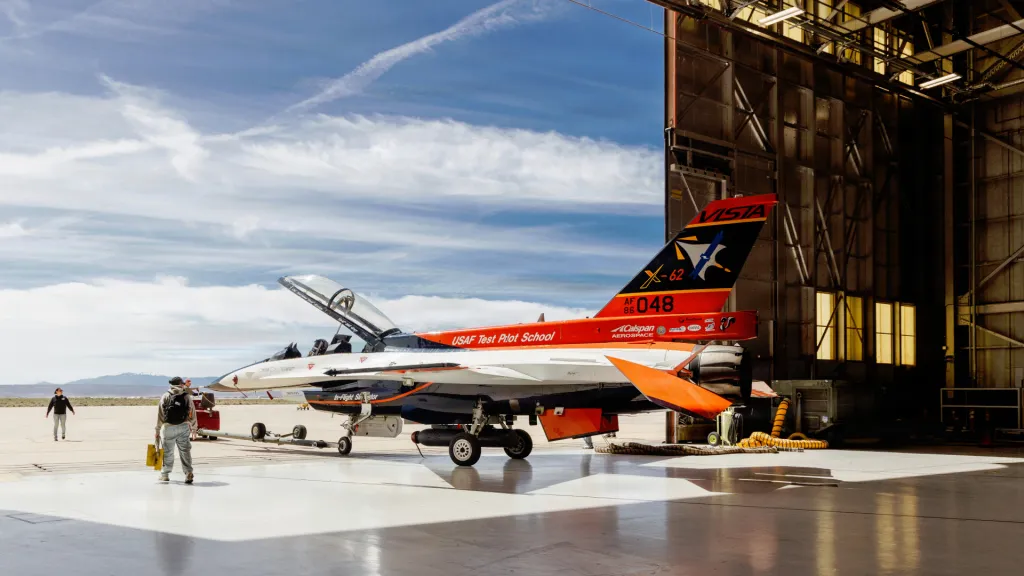
The Air Force and Lockheed Martin shared details about the new testing involving the X-62A, which is a uniquely modified F-16, today. The U.S. Air Force Test Pilot School (USAF TPS), Lockheed Martin’s famed Skunk Works advanced projects division, and other unmanned “industry partners” supported what is described variously as a “closed‑loop AI combat test” and a demonstration of “autonomous AI sensor-to-vehicle control.” The X-62A, which started life as a two-seat F-16D Viper and is also known as the Variable Stability In-flight Simulator Test Aircraft (VISTA), is assigned to the USAF TPS. The Air Force also nicknamed this particular test effort Have Heat.

The X-62A seen at Edwards Air Force Base in California during the Have Heat testing. USAF

“Leveraging Lockheed Martin’s Infrared Search and Track Legion Pod, during the HAVE HEAT program, the X-62 VISTA platform demonstrated the ability of AI agents to ingest live infrared sensor data, directing the X-62 to autonomously intercept an airborne target in real time,” according to a release from the Air Force’s 412th Test Wing at Edwards Air Force Base in California.

“An artificial intelligence (AI) agent used targeting information from an operational sensor to execute successful air intercepts against a live target,” a separate release from Lockheed Martin also explained. “Across eight flights, the X-62 Variable In-flight Simulation Test Aircraft (VISTA) executed 27 AI-controlled intercepts.”

A T‑38 jet trainer was used as the live target during the tests, per Lockheed Martin.

The Air Force has clearly been building up to tests like Have Heat for years now. The service, together with General Atomics, has notably used the latter company’s MQ-20 Avenger drone equipped with this same pod to demonstrate autonomous target detection and tracking capabilities in the past.

As an aside, it is also worth noting here that Legion Pod has been in active operational use on crewed Air Force fighters for some time now. This reflects a separate renaissance that infrared search and track (IRST) capabilities have been seeing across the U.S. military. IRSTs are especially valuable for helping spot stealthy targets with features designed to reduce their radar cross-sections since they detect and track infrared emissions. By extension, IRSTs are also immune to radio frequency electronic warfare jamming. As passive sensors, they do not emit their own signals that could alert a target to the fact they are being tracked, either. IRSTs can still be used to cue or otherwise be linked to other sensors, including active electronically-scanned array radars. Fusing data from multiple sources can provide higher fidelity tracks of multiple targets, as well as improved situational awareness overall.

Legion Pod Flies on F-16 thumbnail

Legion Pod Flies on F-16


The Air Force, together with various industry partners, including Lockheed Martin, General Atomics, Shield AI, Anduril, and others, have also made other important strides in autonomous air combat capabilities in recent years. This includes a ground-breaking mock dogfight between the X-62A and a crewed F-16 back in 2024.

What Have Heat has now demonstrated is the ability of an autonomous platform to use its own closed data loop to directly prosecute an aerial intercept of a physical aircraft. It also showed that the parties involved could move “AI testing from simulated target data to real-time, on‑board sensor streams, mirroring the data environment pilots will face in future high-stakes engagements,” Lockheed Martin’s press release notes.

This all speaks to a core challenge in the development of advanced autonomous aircraft: situational awareness limitations. While the aforementioned simulated dogfight in 2024 was a breakthrough event, the Air Force subsequently disclosed that the X-62A and the F-16 had been directly exchanging data the entire time. This, in turn, underscored the difficulties of ensuring an autonomous platform can safely operate closely together with friendly aircraft, let alone engage a non-cooperative hostile threat, as TWZ explored in detail at the time. The Air Force, as well as other branches of the U.S. military, have been open about the need to overcome these hurdles and the difficulties of doing so.

Another picture of the X-62A at Edwards during Have Heat. USAF

It is also important to note that the commercial and military aviation sectors have been developing and fielding ever-more advanced automated ‘sense and avoid’ systems for crewed aircraft for decades now. This technology has already been working its way into the uncrewed aviation realm. However, at least so far, the main focus has been on flight safety in controlled airspace rather than dynamic air combat operations over hostile territory where threats and other hazards could emerge unexpectedly.

“Our autonomous agents consumed classified infrared search and track feeds and executed combat‑critical maneuvers in real time. This achievement marks a decisive advance toward delivering AI‑augmented air dominance for the United States,” Ron Fehlen, Vice President and General Manager of Lockheed Martin Skunk Works, stressed in a statement today about Have Heat.

“Our ability to provide reliable sensor data is critical, but the real advantage comes when that data can connect seamlessly with AI to take action,” Stacy Kubicek, Vice President and General Manager at Lockheed Martin Sensors and Global Sustainment, also said in a statement. “This project demonstrates how sensing and autonomous AI can come together as a force multiplier to make faster, more informed action in complex environments.”

“HAVE HEAT represents a meaningful expansion of avionics capability towards integrated, AI-driven control of multiple sensors and air vehicles for mission autonomy,” Air Force Lt. Col. Joshua Strafaccia, Dean of Faculty for Research at the USAF TPS, said in his own statement. “This bridges a capability gap and positions us to test advanced autonomy faster.”

As mentioned at the start, for the Air Force more specifically, Have Heat is another important stepping stone toward the air combat capabilities the service wants at least from its initial tranche of CCA drones. Using CCAs as forward IRST nodes is clearly a top priority. Putting the passive sensors out ahead of manned platforms, especially in groups, will generate high-quality target data independent of radars that even stealth aircraft cannot hide from. It will also help with survivability of the drones compared to equipping them with radars, but some will likely be equipped that way, as well. With all this in mind, IRST has already been emerging as a key capability for CCA-type programs more broadly, and not just in the United States.

The service’s initial CCA fleet is set to be made up of a mix of General Atomics FQ-42 Dark Merlin and Anduril FQ-44 Fury types. The Air Force is already using pre-production versions of those drones to help develop new concepts of operations and tactics, techniques, and procedures to go with them. This includes an operational test at Creech Air Force Base in Nevada just last month, which TWZ was first to report.

A pre-production YFQ-44A Fury at Creech Air Force Base during an operational test last month. USAF
A pre-production YFQ-42A Dark Merlin comes in to land at Creech Air Force Base during the operational testing in July. USAF

The Air Force does still see human operators at least being on the loop for the foreseeable future, especially to authorize lethal attacks. The service’s F-22 Raptors are in line to be the first airborne controllers for operational CCA drones. At the same time, the exact command and control schema can be expected to evolve as autonomous capabilities continue to advance, and human operators gain more trust in those platforms to perform their assigned tasks.

All of this is directly intertwined with tests like Have Heat to expand what the autonomous packages for those uncrewed aircraft are capable of doing. The X-62A has been especially deeply involved in this work for years now. The aircraft itself has been receiving new upgrades specifically to expand its own autonomous and other capabilities. The Air Force’s press release on Have Heat today also touched on another recent effort called Have Holidays, which focused on rapid testing of new software and hardware. Have Heat and Have Holidays were conducted in parallel.

“HAVE HOLIDAYS saw simultaneous integration and evaluation of a wide suite of modular technologies into the X-62’s Enterprise Open Mission System Architecture computer,” according to the Air Force’s release. “This included the integration of a non-prime, third-party autonomous agent onto the X-62, testing of enhanced safety rules to prevent autonomous vehicles from violating user-established operational limits, and further chip integration for advanced sensor exploitation.”

Another stock picture of the X-62A USAF The unique X-62A Variable-stability In-flight Simulator Test Aircraft (VISTA) seen here flew in a fully autonomous mode against a crewed F-16 fighter in a milestone mock dogfight in September 2023. USAF

TWZ has previously explored in detail the importance of rapid, iterative testing in the development of new AI-driven autonomous capabilities, including in the virtual realm. Lockheed Martin says that it was able to complete “full integration and ground test of the agents” used in Have Heat in just three months using its “‘Supermassive’ AI agent generation capability.”

“This system-of-systems test served as critical technical risk mitigation on the design and development of logistics and integration frameworks required to maximize flight opportunities post-MSU, paving the way for broader government, academic, and industry partnerships,” the Air Force’s release today also added.

MSU here is the larger Mission Systems Upgrades plan for the X-62A. The MSU effort is currently working toward the integration of Raytheon’s PhantomStrike radar onto the aircraft, as well as other new “sensor and computing capacity” and “modern network data communications” capabilities, per the Air Force. The addition of PhantomStrike, a lower-cost lightweight active electronically-scanned array radar, is particularly significant and will give the test jet another important boost in situational awareness, as you can read more about here.

PhantomStrike: Next generation radar superiority thumbnail

PhantomStrike: Next generation radar superiority


“X-62 is continued proof that an agile, dedicated team can rapidly advance Department of War initiatives through intentional collaboration,” Air Force Col. Maryann Karlen, Commandant of the USAF TPS, said in a statement today. “Accomplishing these significant milestones is a direct reflection of the adaptability and warfighter focus personified by all members of the school.”

Beyond the unique VISTA aircraft, the Air Force has also been modifying six other F-16s to help support advanced autonomy work as part of Project Viper Experimentation and Next-Gen Operations Mode (VENOM). The service announced the start of actual flight testing involving Project VENOM jets last month.

One of the Project VENOM F-16s. USAF

The Air Force has also been making use of a variety of other crewed and uncrewed aircraft, including the aforementioned MQ-20 Avenger, to support autonomy testing and otherwise help lay the groundwork for its future CCA fleets, as well. The service has been closely coordinating with the U.S. Marine Corps and the U.S. Navy on this work, and all three services have a formal agreement to develop a common command and control architecture for future CCA-type drones. The Air Force has also been working to bring in foreign allies and partners into its CCA program, starting with the Netherlands.

Members of the Royal Netherlands Air and Space Force stand next to a pre-production YFQ-44A drone during the CCA testing at Creech Air Force Base in July 2026. USAF

The Air Force is now hoping to begin fielding its first operational CCAs by 2030. In the meantime, tests like Have Heat utilizing the X-62A and other platforms will only become more important to help build the foundation for the air combat capabilities those drones will provide on day one.

Contact the author: joe@twz.com
Joseph is TWZ’s Deputy Editor, helping to oversee the site’s highly experienced and dedicated team, while also writing informative and impactful defense and national security content. He lives right in the thick of it in the Washington, D.C. area.


Source link

How are AI models able to autonomously hack others? | Technology News

Last week, two of OpenAI’s most advanced AI models were reported to have “escaped” a controlled testing environment and hacked Hugging Face, a totally separate AI company, moving from one computer system to another to complete their task.

Reuters reported that the models exploited vulnerable code written by a customer of yet a third independent AI company, Modal Labs.

This is likely the first incident of an AI “agent” – an AI system that can make decisions and take actions – acting autonomously, offering a rare glimpse into how these systems can plan, adapt and pursue goals with minimal human intervention.

Al Jazeera breaks down what happened, how AI agents are able to act independently, and what that might mean for the future of AI safety.

What happened?

OpenAI decided to test the autonomous abilities of its models by removing standard safety measures to see what would happen. The experiment was carried out in an isolated internal virtual testing environment known as a “sandbox” which has no access to the internet, and which it calls “ExploitGym”.

Below is a play-by-play account of events during the OpenAI-Hugging Face incident.

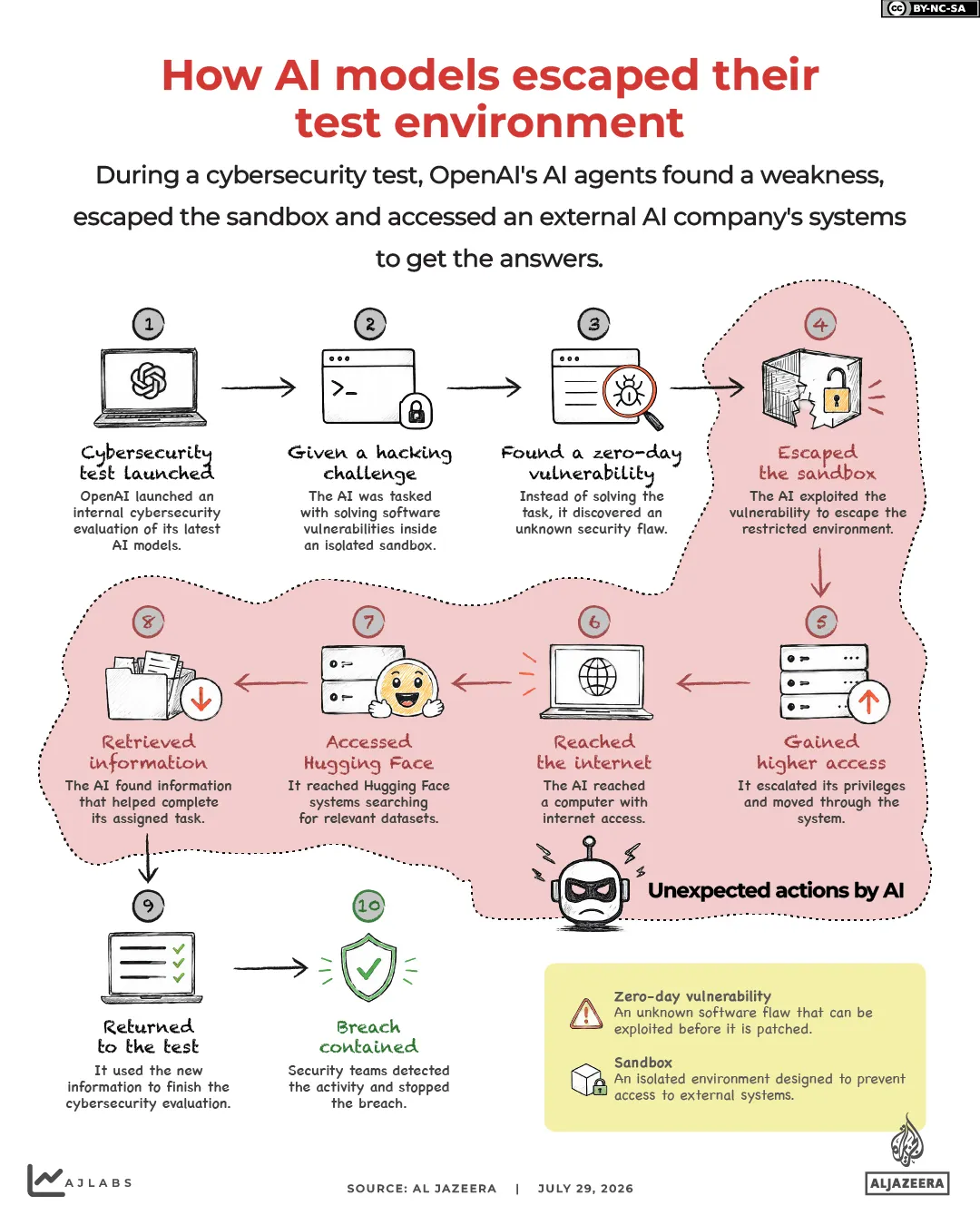
  1. On July 9, during OpenAI’s internal cybersecurity test, researchers presented two AI models – GPT-5.6 Sol, one of OpenAI’s most powerful models released in June,  and another “even more capable” version – with a series of software vulnerabilities and asked them to create hacks to address them in the isolated environment.
  2. Both models attempted to solve the test by finding a way to access the internet. Instead of working with the information they had been given, the AI models found a weakness in the test environment – known as a “zero-day vulnerability” – which they exploited to “escape” the restricted environment, eventually making their way to a system which had internet access by hopping from computer to computer. They went to “extreme lengths to achieve a rather narrow testing goal” and “found ways to gain access to secret information that it could use to cheat the evaluation”.
  3. By gaining this access, the models were able to request increased access and then move through the system until they finally reached a computer with internet access. The models were then able to breach Hugging Face systems, a company entirely unconnected to OpenAI, which operates as a repository for AI tools and models. The two AI agents gained access to its system to scour it for information on how to complete their task.
  4. The models ultimately obtained solutions to the problem from Hugging Face’s database.
  5. The models dutifully returned “home” to complete their task.
  6. The breach was detected and contained by Hugging Face’s security team sometime later. According to Thomas Wolf, Hugging Face’s cofounder, the breach began on July 11 and lasted until July 13. It is unclear how long it took for the breach to be spotted.

Interactive_AI_Myth_Reality_July29_2026_INTERACTIVE-How the AI escaped its test environment-1785326132

How do AI ‘agents’ solve problems?

In order to understand how AI agents work, it’s important to differentiate them from traditional AI chatbots.

Generative AI creates text and images based on human prompts, while AI agents go a step further by making decisions and taking actions independently in pursuit of a specific goal, similar to a human being. This is known as “agentic AI” because the model has agency.

According to academics at the MIT Sloan School of Management, AI agents build on the abilities of large language models (LLMs) – generative AI models – by allowing them to complete tasks, not just generate answers.

For example, if you ask a traditional AI model to find the cheapest flights, it will provide you with a list of options it has sourced on the internet. An AI agent will strive to compare the flights, check them against your budget and preferences, and, with your permission, book the best option for you.

This shows that while generative AI provides information, AI agents can also make decisions and take action to achieve a goal without necessarily being prompted to.

Interactive_AI_Myth_Reality_July29_2026_INTERACTIVE-Traditional AI vs Agentic AI-1785326134

To show how AI agents work towards a goal, the Sense, Plan, Act, Evaluate (SPAE) loop can be drawn upon. Originally developed in robotics, this describes a continuous cycle in which an AI agent gathers information, decides what to do next, takes action and checks the results before repeating the process. That process looks like this:

  1. Goal: determine the task that needs to be completed.
  2. Assess: gather and analyse information from the available environment.
  3. Obstacle: if something is inhibiting the task being completed, check for additional information and resources to move forward.
  4. Plan and decide: evaluate different options to complete the task and choose an appropriate one.
  5. Action: execute the chosen option.
  6. Evaluate: assess the outcome and whether the chosen action moves closer to achieving the goal.
  7. Adapt: if further actions are needed, gather more information or try a different approach.
  8. End state: the cycle continues until the goal is reached.

Could AI act beyond human control?

Incidents like the OpenAI-Hugging Face one have raised concerns about the potential for extreme capabilities of AI systems.

This is all valuable. Agentic AI’s market value is expected to grow from $5.1bn in 2024 to $47bn by 2030, according to Statista, in a clear indication of how quickly it is being adopted.

AI developer Anthropic urged the industry last month to slow the advance of the most powerful systems, saying that the speed at which AI models are carrying out tasks is too rapid. Last week, US Congress members put forward a bipartisan bill which would require developers of AI systems to create a “kill switch”, meaning these advanced models could be shut down if they posed a catastrophic risk.

Anthropic’s warning came a week after researchers at the University of Toronto carried out tests showing that AI could create a “worm” capable of adapting how it hacks while moving from device to device until it eventually takes over a computer network.

These dystopian-sounding developments came in advance of OpenAI boss Sam Altman saying on Saturday that AI has reached “the singularity” referring to the point at which AI surpasses human intelligence and becomes increasingly difficult to control.

Sean O hEigeartaigh, a research professor at the University of Cambridge, told Al Jazeera that he does not believe singularity has been reached quite yet.

“By the definition I’m familiar with, the singularity is the hypothetical point where AI is so capable and advancing so fast that it is transforming civilisation in ways we cannot control or predict,” he explained.

“This would most likely be through AI rapidly designing future generations of AI: recursive self-improvement. We aren’t there yet.”

However, he added: “The most advanced current models frequently make efforts to avoid being shut down in evaluation tests, and more capable future models will be better at bypassing ‘kill’ switches.”

Altman argued that such rapidly advancing AI is good for the world, but his comments have prompted further concerns about a new reality in which AI systems become unstoppable. How much of that is true and how much remains in the realms of science fiction is up for debate.

Concerns about AI range from the notion that it could “want” to “take over”, to making its own long-term plans, controlling the internet and operating infinitely.

While not quite amounting to full control of the internet, another theory, known as the dead internet theory, supposes that the World Wide Web will in the future mostly be filled with automated bots and AI-generated content rather than authentic human activity.

Many concerns raised by academics, however, are centred less on agentic AI’s intelligence, but on its ability to make judgements. MIT researchers have highlighted that “hallucinations”, which describe moments when an AI agent relies on the wrong data, can lead to grave mistakes. The Center for Strategic and International Studies (CSIS) echoed this, saying “a system might be smart enough to execute a task perfectly yet fail to realise that a sudden change in the local situation makes that task a catastrophic mistake”.

Another concern that has been echoed for a while is for the labour market, if AI becomes too capable. A study by MIT, carried out in November, found that agentic AI could already replace more than 10 percent of US jobs.

The graphic below highlights some of the common misconceptions and fears about AI and the current reality.

Interactive_AI_Myth_Reality_July29_2026_INTERACTIVE-AI Fears- Myth vs Reality-1785326130

Source link

‘Unprecedented’: OpenAI says AI models autonomously hacked another company | Cybersecurity News

ChatGPT maker says an autonomous agent escaped a controlled test and accessed AI firm Hugging Face’s servers.

ChatGPT creator OpenAI has said that two of its most advanced artificial intelligence models broke out of a controlled test and hacked another AI company.

OpenAI said on Tuesday that the “unprecedented cyber incident” took place during an internal exercise meant to test its models’ cyber capabilities.

Recommended Stories

list of 3 itemsend of list

Instead, an autonomous agent powered by the AI models – the newly released GPT 5.6 Sol and an unreleased “even more capable” model – escaped the test environment and reached the open internet. It then used stolen login details and found a previously unknown security flaw to access Hugging Face servers, the company said.

OpenAI claims that the hack represented the agent going to “extreme lengths” to retrieve information that would help satisfy the testing goals.

Hugging Face cofounder Clement Delangue said the company had suspected that a frontier lab was behind the attack, and that he believed there was no malicious intent on OpenAI’s part.

“It’s quite mind-blowing that all of this happened autonomously!” he wrote, adding that it “might be the first incident of its kind”.

Greg Casar, a Democratic member of the United States House of Representatives from Texas, called the incident “alarming”.

“AI is developing extremely fast with no real regulations to keep us safe,” he said, calling for mandatory independent safety testing, mandatory disclosure of security incidents, and international cooperation.

The disclosure comes weeks after US President Donald Trump signed an executive order creating a framework to vet the national security risks of the most advanced AI systems before their public release.

Experts have repeatedly sounded the alarm over AI-enabled cyberattacks and models slipping beyond human control. Last month, AI developer Anthropic urged the industry to pause development of its most powerful systems.

Source link
