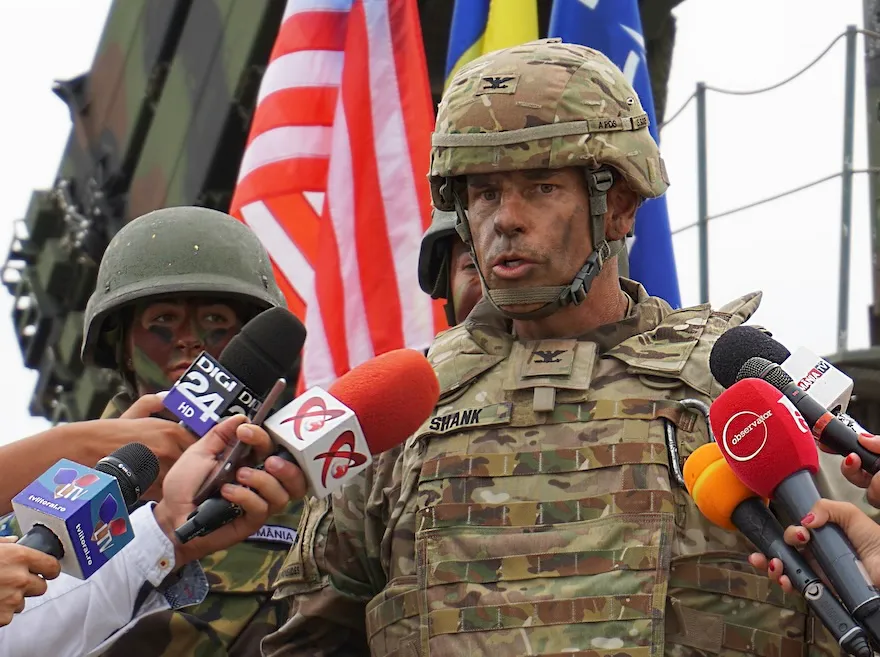
Retired Patriot Battalion Commander On The Challenges Of Defeating Iran’s Barrages
When it comes to understanding air and missile defense, especially in the Middle East, David Shank has few peers. The retired Army colonel served as Commandant of the Air Defense Artillery School at Fort Sill, Oklahoma and as the 10th Army Air Missile Defense Commander in Europe, back when Israel was defended by U.S. European Command. He also commanded a Patriot battery that deployed to Qatar, Bahrain and Jordan.
In an exclusive, hour-long, wide-ranging interview on Sunday, Shank offered some unique insights into the challenges faced by the U.S. and its partners in the region after four weeks of defending against Iranian missile and drone barrages. He is now a consultant for Orion 360 Consulting, his family-owned company which works with prime contractors on counter missile and drone capabilities.
Some of these questions and answers have been edited for clarity.

Q: Are you surprised with how many drones and ballistic missiles are getting through U.S. and allied defenses in the region?
A: I am not surprised based on Iranian overmatch with regards to the vast numbers of ballistic missiles, cruise missiles, long range rockets and unmanned aerial vehicles (UAVs). The only surprise to me were the attacks on Gulf nations’ population centers and the reported 1,500-plus [missiles and drones fired at] the UAE.
There’s no system that’s 100% guaranteed. As a former U.S. Army air defender, we’ve planned, we’ve studied, we’ve exercised against an Iranian threat, where we clearly understood that they possessed thousands of long range ballistic missiles, long range rockets, cruise missiles. And then, of course, in the last 10-plus years, the use of unmanned aerial systems. It’s not just the Iranians, but their proxies also, which are across the region from Iraq to Hezbollah and Lebanon to Hamas that we’ve seen recently, down to Yemen and the Houthis.
Q: There have also been a lot of drone attacks in Iraq from Iranian proxies there.
A: Yes, they’ve targeted some U.S. footprints in Iraq and across the region. And on that note, across the Middle East, we’ve had U.S. and coalition forces forward deployed for decades. They didn’t just show up there last week or two months ago. We’ve been occupying some of the same terrain for decades. And so this goes back to one of your initial questions of, why do we think Iran is able to penetrate the U.S. and Israeli and other coalition defenses. It is because 1.) they’re known targets for the Iranians, and 2.) because of the vast number of missiles and now drones and long range rockets they possess along with their proxies.
Q: What is your observation of how these systems and personnel are performing?
A: Well, you know, the American soldiers are the very best. And as a former air defender, yeah, I’m a little biased. I think they’re performing extremely well. From an Israeli perspective – and I’ve spent many, many days and weeks on the ground in Israel during my time as the 10th Army Air Missile Defense Commander from 2017 to 2019 while stationed in Europe. U.S. European Command at that time had the responsibility for the defense of Israel, and so I’ve made a number of trips in and out of Israel during that two-plus-year period. I’ve walked the ground. We exercised. We deployed Patriot capabilities. We deployed [Terminal High Altitude Area Defense] THAAD capabilities during that time frame, primarily as an exercise, but it was a rehearsal for what’s taking place today.
So while some of the war plans have changed and been adjusted, as we do over time, the outcome remains the same. That’s U.S. forces standing shoulder to shoulder with the Israelis in the State of Israel on ground. As for the rest of the region, we’ve had Patriot battalions and THAAD batteries rotating in and out for probably going back to the mid-to-late 2000s. I was a Patriot battalion commander in 2013. I deployed with my battalion to Qatar, Bahrain, and then was tasked to put Patriot capability in Jordan at the time, because of what the Assad regime was doing to the civilian population – those chlorine gas bombs. That was under the Obama administration. So this has been ongoing for decades.

Q: What makes you say these systems and personnel are performing well?
A: The Army has rehearsed this. We’ve exercised these requirements for decades. The Israelis fight every day against proxies who consistently lob or launch long-range rockets or some type of device, either from the north or from the south, or even by the Houthis. It’s been a constant. So it’s easily, if not every day, at least once a week. And Israel has been enduring this for decades.
And so we are a trained force. We’re a capable force. The forensics continues, battle-tracking continues, the number of interceptors launched, the number of hits to kill, what that battle damage looks like. And then, of course, when, when a ballistic missile or cruise missile or even a drone is able to penetrate the defenses, at least from an American perspective, we roll up our sleeves and we determine, ‘Okay, why did that happen’?
When a ballistic missile or cruise missile or even a drone is able to penetrate the defenses, we conduct these very detailed and sometimes challenging after-action reviews to do our very best to ensure that that doesn’t happen again.
Q: Speaking of which, Israeli media outlets are reporting that a THAAD system failed to intercept ballistic missiles that attacked the southern Israeli cities of Arad and Dimona, the site of Israel’s unacknowledged nuclear weapons program. These claims are unverified, with suggestions that it could have been an Israeli David’s Sling system that missed, but what would the U.S. after-action investigation into a potential THAAD failure look like?
A: The investigators will try to determine whether it was a system malfunction. It starts with the network. It starts with the communications piece, both voice and data. All part of this integrated network. It starts with sensing. There are sensing radars for long range specifically, and how they’re interconnected on this network. And then, of course, passing those tracks to an effector. And then there’s the human in the loop, the decision maker. There’s a decision maker that ultimately directs a subordinate echelon to engage a specific target. So the investigation will look into all these aspects. It could be human error, or it could be a technical glitch. And they’ll determine that.

Q: What makes drones like the Shahed-136 so hard to target and successfully engage?
A: Radar cross section. Let’s look at one radar versus one Shahed-136. If you’re not looking for that size and that speed of a target, you’re not going to see it. And so you’ve heard the cliche, there’s no silver bullet, right? And this drives the importance of a layered defense, and that layered defense includes radars. So very elementary nonetheless, but it’s radar cross section.

Q: What’s being done to calibrate sensors to be able to pick up these Shaheds? And is it working?
A: I think we’ve had a great deal of success against some of these Group-3 drones, specifically the Shahed-136s. From a technical standpoint, the industry is continuing to work and make adjustments to their sensors, especially those that are programs of record, but also sensing capabilities that are non-programs of record to the Department of War and U.S. forces. So yes is the answer. And again, it goes back to layering.
And one other point worth mentioning – you can probably tie this into some of the other comments I made. From a U.S. air defense perspective, and really, probably any coalition or friendly force, we’re not defending dirt. If a ballistic missile is going to land somewhere in the desert – if it’s uninhabited – it’s not an area that we need to be concerned with defending. We’re going to let it impact. And so sometimes people get lost in those types of impacts.
Now turn around, and we talked a little bit earlier about Dimona, right? Whether the Israelis have nuclear capability or not, when you know if a ballistic missile is targeting a population center – or, let’s say, an air base, a logistics center, or maybe even oil or naturl gas fields – those are deemed critical assets and would have some type of defensive capability to prevent any type of strike against those assets. Hope that helps.
Q: What Iranian ballistic missile technology have you seen during this conflict that is concerning in terms of Iran’s ability to penetrate even the best defense?
A: Well, I think that [attempted] strike against Diego Garcia got everyone’s attention because of the range. Reports were that there were two ballistic missiles, one broke up in flight. I think [the other missile reached a distance of] 3,800 kilometers [about 2,400 miles], and our expectation was that they had a ballistic missile they could travel 2,000 kilometers [about 1,240 miles]. Maybe they decreased the size of the warhead in order to travel further. I’m not an engineer. I own a set of post hole diggers, and that’s my PhD, by the way.
We’ve known for decades that Iranians have possessed thousands of ballistic missiles, long-range rockets and cruise missiles. And in the last 10 to 15 years, the evolution of drones has changed the character of war. It’s clearly evident that Russians are assisting the Iranians, not just with missile technology, but now with drone technology. And so the Russians have a lot of lessons learned. Ukrainians have a lot of lessons learned unless you’ve had your head in the sand. The Ukrainians are also assisting in the region to provide not just awareness but expertise in both offensive and defensive actions, using drones and defeating drones.

Q: The U.S. and allies are expending a large amount of interceptors, batting down a variety of missiles and drones. How concerned are you about America’s magazine depth of these critical defensive weapons?
A: Very, very concerned. Clearly, I recognize the efforts, at least in the last several months, of increasing production, for example, of the Patriot interceptor. And we haven’t talked about the cost curve, but Patriot PAC-3 interceptors are not cheap. You know, $3 million, $4 million, $5 million each. That THAAD interceptor, I’ve heard numbers anywhere between $8 million and $12 million per and that’s just from a U.S. perspective. So not cheap at all, especially when you’re engaging potentially a $200,000 target. So you can recognize the cost curve very quickly.
And these munitions are limited, hence, the aggressive movement towards effectors that have an unlimited magazine, or a very deep magazine, such as directed energy. Are we moving fast enough to get to directed energy? Maybe, maybe not. There are some use cases and the one in El Paso was not so well coordinated. In fact, it wasn’t coordinated at all, in my opinion. And it showed a very concerning disconnect between departments here in the U.S. But, the US Navy possesses some directed energy capability.

Q: From what you’re seeing on this conflict, do you think the proper planning was in place in terms of magazine depth of defensive weapons?
A: My experience is the number of interceptors were always factored into the war plans, and so recognizing that based on the number of whether it’s Patriot or THAAD or both interceptors on hand, clearly, we would war game. We would rehearse. We would recognize, okay, through modeling and simulation, certain Patriot locations would go what we call Winchester (out of ammo in military parlance). You’re out of ammunition by a specific day in a conflict. That drives the importance of air power and nowadays, cyber strikes, and even the potential for ground warfare. All of that is factored in. I’m sure additional munitions, potentially from other combatant commands around the globe, were moved to the region to prepare for what’s transpiring now.

Q: In addition to interceptors, the U.S. has shipped a lot of air defense systems from Europe and the Pacific to the Middle East. How concerning is that for other regions, specifically Pacific? If a fight broke out in the Pacific tonight, do we have enough systems and munitions there to defend us assets?
A: It’s a really good question. And so hence the importance of our allies and partners possessing their own capability, because it alleviates some of the stresses on the U.S. force and other nations for that matter. And so to answer your question, if a second conflict were to take place today in another part of the world, there’d be some challenges, but there’d also be some reliance on our allies and partners. They provide their capability and become part of whether it’s a coalition or multilateral bilateral agreement, but it would definitely require additional capability from other nations.

Q: Pacific allies have expressed concerns about U.S. air defense assets heading to the CENTCOM region. How much does that concern you?
A: The State Department is heavily engaged when it comes to having those difficult conversations with some of our allies and partners and explaining why, for example, we need to move a Patriot from the Pacific to the Middle East. I’m sure they’re receiving push back. Because there is a concern, whether it’s PRC, or whether it’s the DPRK, there’s always that concern [about being properly equipped].
Q: You mentioned moving air defense assets. What does it take to move a Patriot battery, which can have up to eight trailer-mounted launchers, as well as an AN/MPQ-65 multifunction phased array radar and other fire control, communications, and support equipment, operators and maintenance personnel?

A: It’s very taxing on the airlift, the C-17s and C-5s. One Patriot battery would take eight to 10 C-17s, it’s a lot. And that was just for an initial deployment. So potentially not the full complement of launching stations. These are very large trucks, very large pieces of equipment. You ship the interceptors in a different airframe, because of the munitions aspect. So there’s some synchronization involved as you think through this. If you put a Patriot battery on the ground, and the radar comes in last, it’s no good. You’ve got to synchronize the flow.
Q: How many flights would it take for a whole battalion, which includes a headquarters element, along with between three and five firing batteries?
A: I’d say about 70 to 75 aircraft. This is why the Army Prepositioned Stocks (APS) stored at a number of locations around the world are so important.
Q: Based on the information at hand, it appears that Iran has been able to destroy one U.S. AN/TPY-2 radar in Jordan and damage the massive American-made AN/FPS-132 phased array radar in Qatar. Reportedly, Iran has hit 12 US and allied radar and SATCOM terminals since the start of the war. How difficult are they to replace and how do their losses affect the overall situational awareness, command and control, reaction time and the overall ability to identify and destroy threats?
A: It’s no different than what we do to an adversary. We conduct some type of air campaign. First thing we want to do is we want to blind, right? We want to take out their communications. We want to take out their air defenses radars so our aircraft can get deep into a country, and strike strategic-level targets initially. The Iranians are doing the same.
If they can take out our sensing capability, or how we see air threats thousands of kilometers away, that’s one of their targets. A high payoff target for the Iranians is to destroy a THAAD radar like the AN/TPY-2 you mentioned. The AN/FPS-132 that you mentioned. If they can destroy these types of long range sensors, that benefits the adversary.
Patriot radars are a target. They emit a signal, and so it drives the importance that they’re not easy to move. It drives the importance of emissions control. When you turn on a radar, when you turn it off, how long is it operating for? Again, you’re not just going to pick up a Patriot, but this is very difficult for some – even American leaders – to understand. You don’t just move a Patriot battery on a dime. I mean, it’s not a tank. And so I know during my career, it was challenging to explain that to senior leaders who were not air defenders.

Q: How difficult are these radars to replace how are these losses affecting the overall situational awareness, command and control, reaction time and ability to identify and destroy threats?
A: Well, you only have so many radars. There are no radars just sitting around in a motor pool, not being used, except at Fort Sill, Oklahoma, where they do the training. That’s the first point. So they’re limited in number. If and when a radar is destroyed, it goes back to that integrated network where there’s potential, depending on proximity and range, that one Patriot battery could actually sense for another Patriot battery. For example, if a radar is destroyed or non-mission capable, say, a technical issue, depending on range, one radar could sense for another battery.
Same at the battalion level. If you have loss of capability there’s capability where one battalion could provide sensing for another battalion’s launchers. And again, it’s all about being on the network as well – an integrated network of sensors. Coupled with what you’ve probably written and talked to people about – launch-on-remote, engage-on-remote – we have done a lot of that testing and experimentation within the last 10 years. So that is supporting the loss of sensors.

Q: Is there anything we can do to improve defending these systems?
A: Get more systems. We’ve learned so many lessons with what’s going on in Ukraine when it comes to a drone war. There’s persistent surveillance, 24/7. Now you can expect to have eyes on your location if you’re a Ukrainian soldier. Now bring that to the Middle East. You know Ukrainians are producing thousands of drones and counter system capabilities a month and now we’re seeing how that’s impacting the Middle East and the requirements for us and partner nations.
So that’s what we need. We need more capability. There’s always someone that says we need more Patriot. We need more THAAD, we need more Aegis, we need more SM-6s. We need more defensive counter air airframes. I do work in and out of the Middle East. And when you talk to those service members and their leadership, their greatest concerns are Group 3 drones, and we’re seeing it play out in real time.
Q: Do you see higher headquarters pushing to get more defenses for the air defense systems?
A: Yes. Just last week, was the activation of the first divisional counter UAS battery in the First Armored division. That’s been a long time coming of having U.S. Army divisions possessing a counter UAS battery. Doesn’t sound like a lot, but that’s in addition to the ongoing activations of short-range air defense battalions across U.S. Army divisions.
Activation are taking place with capability, with trained soldiers, and you don’t have to look very far back in 2004-2005 timeframe, when decisions were made by senior leaders at the time based on the [Counter Insurgency] fight to inactivate short-range air defense battalions. Well, now we’re bringing them back. So the challenge is that generational gap. It’s a crash course on short-range air defense operations. How do you integrate with maneuver forces? How you defend maneuver forces, both in the offense and in the defense? And again, I’m just speaking from an Army perspective.
Contact the author: howard@thewarzone.com