Fire survivors call for audits of Edison’s wildfire prevention spending
Survivors of the devastating Eaton fire called on state lawmakers on Wednesday to pass a bill requiring audits of spending by Southern California Edison and the state’s two other big for-profit electric companies on wildfire prevention.
The survivors pointed to an investigation by The Times that found that Edison had not spent hundreds of millions of dollars that it told regulators before the fire was needed to keep its transmission system safe. Edison had begun charging customers for the costs.
“Californians funded the wildfire prevention,” Joy Chen, executive director of Every Fire Survivor’s Network, told members of the Assembly Utilities and Energy Commission on Wednesday. ”And we survivors paid the price when that work was not done.”
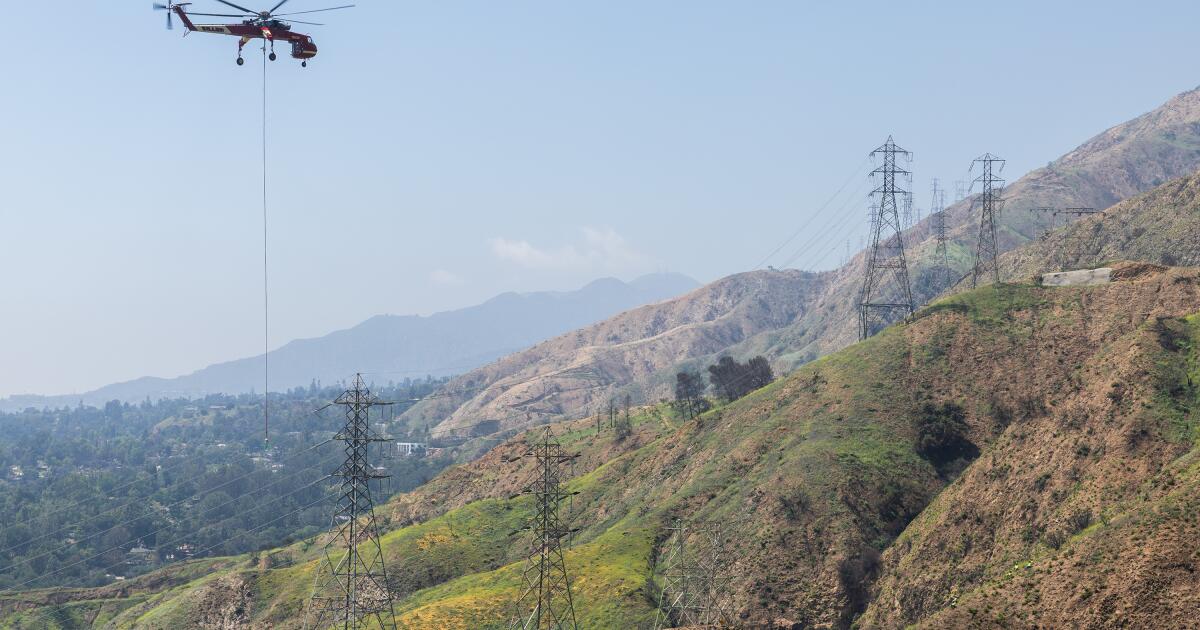
While the government’s investigation into the fire has not yet been released, Edison has said it believes that a century-old transmission line, which had not carried power since 1971, may have briefly re-energized on the night of Jan. 7, 2025, to ignite the fire. The inferno killed 19 people and destroyed thousands of homes and other structures in Altadena.
Chen’s wildfire survivors group and Consumer Watchdog sponsored the bill, known as Assembly Bill 1744. It would require the wildfire safety spending by Edison, Pacific Gas & Electric and San Diego Gas & Electric to be audited by an independent accounting firm.
The state Public Utilities Commission would have to consider the audits’ findings before agreeing to raise customer rates to cover even more wildfire spending.
“Had Edison known it would be accountable for those funds, that wildfire may not have started,” Jamie Court of Consumer Watchdog told the committee, referring to the Eaton fire.
All three utilities said at the hearing they opposed the bill.
A lobbyist for San Diego Gas & Electric said he believed the audits were unnecessary because the commission was already reviewing the spending.
“We think it creates a duplicative process,” he said.
At the committee hearing, Edison’s lobbyist did not say why the company was opposed to the bill.
The company has previously said that safety is its top priority and that it does not believe maintenance on its transmission lines suffered before the Eaton fire.
Also voicing support for the bill at the hearing were survivors of other deadly wildfires in the state, including the 2018 Camp fire, which killed 85 people and destroyed much of the town of Paradise. Investigators found that the fire was ignited when equipment failed on a decades-old PG&E transmission line.
The bill’s author, Assemblywoman Tasha Boerner, an Encinitas Democrat, pointed to how independent audits of the three companies’ wildfire spending from 2019 to 2020 found that $2.5 billion could not be accounted for.
Those were the last independent audits of the three companies’ wildfire spending.
Despite the findings, the commission did not require the companies to return any of the questioned amounts to electric customers. Instead, the commission agreed the companies could spend billions of dollars more, Boerner said.
“This is frankly unacceptable,” she said.
Asked for a response to those audits, the lobbyist from San Diego Gas & Electric told the committee he wasn’t familiar with the findings.
California electric rates are the nation’s second highest after Hawaii.
In 2024, wildfire expenses amounted to 17% to 27% of the costs the three companies charge to consumers, according to a legislative analysis of Boerner’s bill. The average residential customer pays $250 to $490 a year for that spending.